
Which of the following is an accurate statement?
A) In vacuum, ultraviolet photons travel faster than infrared photons.
B) Photons can have positive or negative charge.
C) Infrared photons have enough energy to readily break bonds in a nucleic acid
molecule like DNA.
D) An ultraviolet photon has more energy than does an infrared photon.
How many decibels correspond to a sound intensity of 7.0 x 10⁻⁷ W/m2?
A) 70
B) 58
C) 69
D) 75
E) 63
A string of linear density 1.5 g/m is under a tension of 20. N. What should its length be
if its fundamental resonance frequency is 220. Hz?
A) 0.26 m

B) 1.1 m
C) 0.96 m
D) 43. cm
E) 2.1 m
An image is 4.0 cm behind a concave mirror with focal length 5.0 cm. Where is the
object?
A) 2.2 cm in front of the mirror
B) 2.2 cm behind the mirror
C) 9.0 cm in front of the mirror
D) 1.0 cm behind the mirror
E) 20 cm behind the mirror
In the fissioning of uranium, the typical amount of energy released per nucleon is
A) 0.025 eV.
B) 100 MeV

C) 0.9 MeV.
D) 200 MeV.
E) 10 MeV
A galvanometer with a coil resistance of 40.0 Ω deflects full scale for a current of 2.0
mA. What series resistance should be used with this galvanometer in order to construct
a voltmeter that deflects full scale for 50 V?
A) 25 kΩ
B) 27 kΩ
C) 29 kΩ
D) 31 kΩ
E) 35 kΩ
FIGURE 9-2
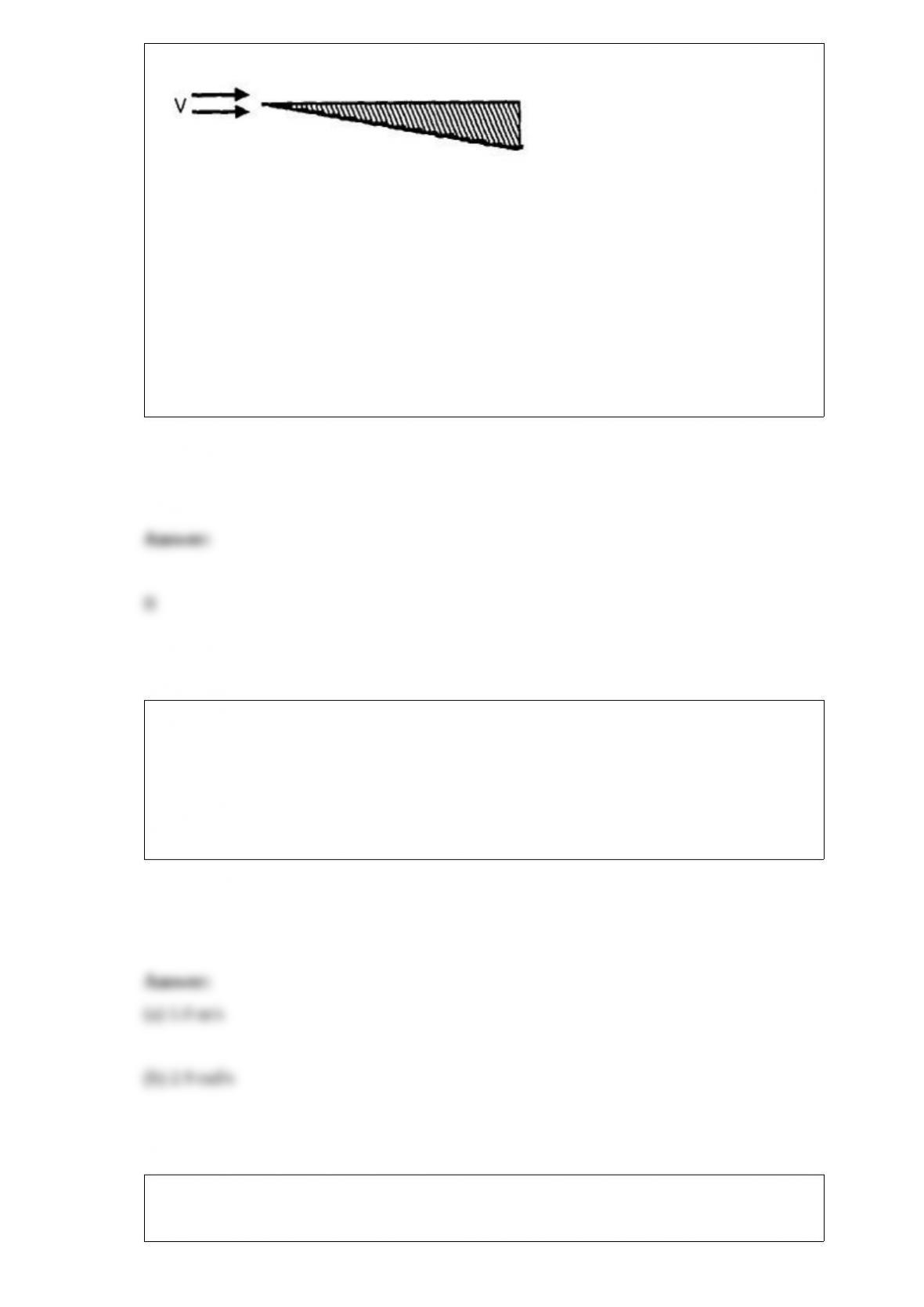
Air is forced to flow over an object whose cross-section is shown in Fig. 9-2. The speed
of the air flowing close to the top surface is ________ the speed of the air flowing close
to the bottom surface.
A) equal to
B) less than
C) greater than
A wheel of diameter 0.70 m rolls without slipping. A point at the top of the wheel
moves with a tangential speed 2.0 m/s.
(a) At what speed is the axis of the wheel moving?
(b) What is the angular speed of the wheel?
FIGURE 4-3

Two identical masses are attached by a light string that passes over a small pulley, as
shown in Fig. 4-3. The table and the pulley are frictionless. The masses are moving
A) with an acceleration less than g.
B) at constant speed.
C) with an acceleration greater than g.
D) with an acceleration equal to g.
A photon is a particle that
A) has zero electric charge.
B) has zero electric field associated with it.
C) cannot travel in a vacuum.
D) has a velocity in a vacuum that varies with the photon frequency.

Consider a thrown ball which has reached its highest point in flight. The magnitude of
the acceleration
A) is less than it will be a short instant later.
B) is zero.
C) reverses direction.
D) is g.
E) is 2 g. ∗
Which of the following best describes the process in which energy is released in a
conventional nuclear reactor?
A) The radiation given off by a naturally radioactive substance, uranium, is collected
and used to make steam.
B) Uranium is reacted with oxygen in a combustion process that releases large amounts
of radioactivity and heat.
C) Deuterium and tritium are joined together to form helium.
D) Uranium, when bombarded by neutrons, splits into fragments and releases two or
three neutrons, and these neutrons in turn strike more uranium nuclei that split, thereby
setting off a chain reaction that releases energy.
E) A uranium nucleus is energized to an excited state by neutron irradiation, and it then
decays by emitting beta rays and gamma rays that heat water and create steam.

The absolute potential at the center of a square is 3. V when a charge of +Q is located at
one of the square’s corners. What is the absolute potential at the square’s center when a
second charge of -Q is placed at one of the remaining corners?
A) zero
B) 6 V
C) 12 V
D) -6 V
E) -12 V
The potential applied to a 20. Ω resistor is 60. cos (33. t) volts. What is the:
(a) frequency?
(b) average power?
If a person’s eyeball is too long from front to back, the person is likely to suffer from
A) spherical aberration.

B) nearsightedness.
C) farsightedness.
D) astigmatism.
E) chromatic aberration.
Given the following four speeds (in m/s) 16.0, 22.0, 36.0, and 38.0:
(a) what is the average speed?
(b) what is the rms speed?
Consider a series circuit in which the capacitive reactance equals the inductive
reactance. What is the phase angle between current and voltage?
A) +180.
B) +90.
C) -180.
D) -90.

E) 0.
A metal airplane flies horizontally at 200. m/s where the Earth’s magnetic field
is vertical and is 45.0 μT. If the wingspan is 25.0 meters:
(a) what emf is induced across the wings?
(b) what wingspan would produce 1.0 volt emf?
(c) The plane reverses direction. Does the polarity of the wingtip emf change, i.e., if the
left wing was positive, does it now become negative?
Concrete is sold by the cubic yard. What is the mass, in kilograms, of one cubic yard of
concrete that is five times as dense as water? (1 m = 1.094 yd, and 1 m3 of water has a
mass of 1,000 kg.)
A) 764 kg
B) 6546 kg
C) 2420 kg

D) 8733 kg
E) 3819 kg
Consider two cylinders of gas identical in all respects except that one contains O2 and
the other He. Both hold the same volume of gas at STP and are closed by a movable
piston at one end. Both gases are now compressed adiabatically to one-third their
original volume. Which gas will show the greater temperature increase?
A) the O2
B) the He
C) neither; both will show the same increase
D) impossible to tell from the information given
A string fixed at both ends is vibrating in its 8th harmonic.
(a) How many nodes are on the string?
(b) The 8th harmonic wavelength is what fraction of the string length?
(c) If the 8th harmonic frequency is 976. Hz, what is the frequency of the 2nd overtone?
Consider a classroom 10.0 m long by 6.0 m wide by 4.0 m high at “room temperature”
20.C and 1.0 atmosphere.
(a) How many moles of gas are contained in the room?
(b) Assuming an average molecular weight of 28, what is the mass of the room air?
Vector is 5.5 cm long and points along the x axis. Vector is 7.5 cm long and
points at +30 above the negative x axis.
(a) Determine the x and y components of Vector .
(b) Determine the x and y components of Vector .
(c) Determine the sum of these two vectors in terms of components.
(d) Determine the sum of these two vectors in terms of magnitude and direction.

A car hits another and the two bumpers lock together during the collision. Is this an
elastic or inelastic collision?
A) elastic
B) inelastic
C) insufficient information (It could be either.)
The following four forces act on a 4.00 kg object:
F1 = 300 N east
F2 = 700 N north
F3 = 500 N west
F4 = 600 N south
What is the acceleration of the object?
A) 224 N in a direction 63.4 north of west
B) 300 N in a direction 63.4 north of west
C) 300 N in a direction 26.6 north of west
D) 224 N in a direction 26.6 north of west
E) 2100 N in a direction 26.6 north of west

A train traveling at 50. km/h approaches another train moving toward the first at 90.
km/h. If they are 35. km apart (on a straight track) how long does it take before they
meet?
A) 15. min
B) 55. min
C) 30. min
D) 45. min
E) 25. min
When resistors are connected in series
A) the same power is dissipated in each one.
B) the potential difference across each is the same.
C) the current flowing in each is the same.
D) the total effective resistance is reduced.

The mass of 1H is 1.007825 u and the mass of 1n is 1.008665 u. The mass of 12C is
12.000000 u, of 13N is 13.005739 u, and of 14N is 14.003074 u. What is the binding
energy of the last proton in 13N?
A) 2.5 MeV
B) 1.9 MeV
C) 9.8 MeV
D) 10.6 MeV
E) 3.8 MeV
All of the following are base units of the SI system except the
A) kilogram.
B) kelvin.
C) meter.
D) volt.
E) candela

Consider a current moving from left to right through a resistor. Which end of the
resistor is at higher potential?
A) left
B) right
C) indeterminate, depends if current is charging a battery or discharging a battery
At the first maxima on either side of the central bright spot in a double-slit experiment,
light from each opening arrives
A) in phase.
B) 90 out of phase.
C) 180 out of phase.
D) 45 out of phase.
E) -45 out of phase.

If sunlight of color B is scattered through an angle 16 times greater than sunlight of
color A, then the wavelength of color B is
A) twice that of color A.
B) 1/2 that of color A.
C) 16 times that of color A.
D) 1/16 that of color A.
E) 1/4 that of color A.
How long does it take a wheel that is rotating at 33.3 rpm to speed up to 78.0 rpm if it
has an angular acceleration of 2.15 rad/s2?
A) 20.8 s
B) 4.75 s
C) 10.4 s
D) 2.18 s
E) 5.20 s
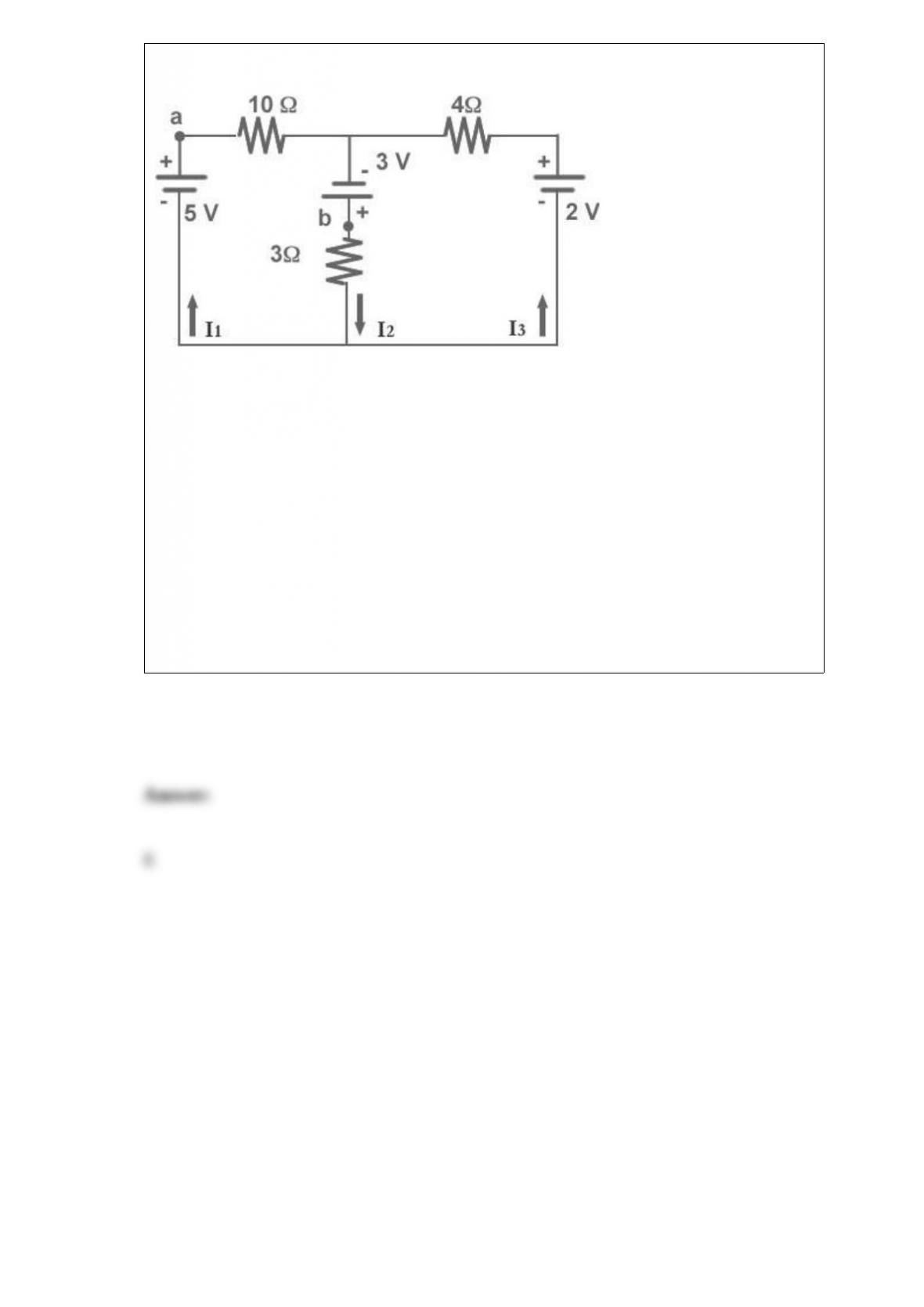
FIGURE 18-19
In Fig. 18-19 the currents I1 and I2 are equal to 0.13 A and 2.22 A respectively. What is
the potential difference Va – Vb?
A) 0
B) 5.0 V
C) -3 V
D) 2.4 V
E) -1.7 V