
The Sun
A) rotates in the same direction as the planets revolve.
B) rotates in the opposite direction as the planets revolve.
C) does not rotate relative to the planets.
D) takes longer to rotate than for the planets to revolve.
Answer:
Using 1000 J of work, a toy elevator is raised from the ground floor to the second floor
in 20 s. How much power does the elevator use?
A) 20 W
B) 50 W
C) 100 W
D) 1000 W
E) 20,000 W
Answer:
When Peter tosses an egg against a sagging sheet, the egg doesn’t break due to
A) reduced impulse.

B) reduced momentum.
C) both of these
D) neither of these
Answer:
A substance most commonly emits heat energy by the process of
A) conduction.
B) convection.
C) radiation.
D) none of the above
Answer:
When current reverses direction in a wire, the surrounding magnetic field
A) also reverses direction.
B) becomes momentarily stronger.
C) contracts.
D) expands.

Answer:
Which relative dating principle states that in an undeformed sequence of sedimentary
rocks, each layer is older than the one above and younger than the one below?
A) original horizontality
B) superposition
C) cross-cutting
D) inclusion
Answer:
The oldest known elements in the periodic table are the ones with
A) the lowest atomic numbers.
B) the highest atomic numbers.
C) odd looking atomic symbols.
D) atomic symbols that match their modern names.
Answer:

A 2-kg mass weighs 20 N and is held 4 m above the ground. Its potential energy relative
to the ground is
A) 8 J.
B) 20 J.
C) 60 J.
D) 80 J.
E) none of the above
Answer:
The crustal surface and the uppermost part of the mantle is called the
A) asthenosphere.
B) lithosphere.
C) mohorovicic.
D) centrosphere.
Answer:
Balance these equations.
________ (g) + ________ (g) → ________ N (g)

A) 2, 2, 3
B) 2, 2, 5
C) 3, 3, 2
D) 3, 1, 2
Answer:
An object is pulled with three forces: one at 20 N to the right, another at 40 N to the
right, and the third at 30 N to the left. The net force is
A) 60 N to the right.
B) 60 N to the left.
C) 30 N to the left.
D) none of the above
Answer:
Radiometric dating is based on
A) decay of uranium-238 to lead-206.
B) sequence of rocks and the relative position of one layer to another.
C) proportions of radioactive isotopes and their decay products.

D) the half-life of radioactive atoms.
Answer:
Why is the surface area of a gecko’s foot so extensive?
A) A gecko, like all amphibians, needs extensive surface area under foot for stability on
land as well as mobility in water.
B) A gecko’s foot acts like a large dipole and thus allows for ion-dipole interaction in
water.
C) The greater the surface area the greater the number of induced dipole-induced dipole
forces of attraction that can occur between the gecko’s foot and the surface.
D) The extensive surface area, once charged by the gecko’s body, allows for the
dipole-dipole attraction of every contact surface.
Answer:
The high concentration of iridium at the Cretaceous Tertiary boundary is most likely
attributed to
A) a worldwide rise in sea level.
B) meteorite bombardment.
C) an out flux of iridium from Earth’s interior.
D) none of the above

Answer:
When comparing geologic time to a calendar year, the time of the dinosaurs is in the
A) middle of October.
B) first half of December.
C) second half of December.
D) first half of February.
Answer:
The first minerals to crystallize from a cooling magma have a
A) high melting point and a low silica content.
B) low melting point and a high silica content.
C) high melting point and a high silica content.
D) low melting point and a low silica content.
Answer:

The pink color of the chromosphere arises from the emission of light from
A) hydrogen atoms.
B) helium atoms.
C) carbon atoms.
D) beryllium atoms.
Answer:
A certain radioactive element has a half-life of one hour. If you start with a 1-g sample
of the element at noon, how much of this same element will be left at 3:00 PM?
A) 0.5 gram
B) 0.25 gram
C) 0.125 gram
D) 0.0625 gram
Answer:
Asteroids orbit the
A) Sun.

B) Earth.
C) Moon.
D) all of these
E) none of these
Answer:
A boulder is dropped onto mud and plows into it a certain distance. If it hits with three
times as much speed, the distance it plows into the mud will likely be
A) the same distance.
B) twice as deep.
C) three times as deep.
D) more than three times as deep.
Answer:
Lobsters live on the bottom of the ocean. Compared with the density of seawater, the
density of a lobster is
A) greater.
B) the same.
C) less.

Answer:
Glacial striations on the continental landmasses provide evidence
A) that Hawaii was once joined to Alaska.
B) of the direction of Pleistocene ice flow.
C) that the Cenozoic was a very cool time.
D) that Baja California was once joined to Mexico.
Answer:
Which of the following statements about chain reactions is true?
A) The key requirement for a chain reaction is that more neutrons are produced than are
absorbed.
B) Three or more neutrons must be released to sustain a chain reaction.
C) Only uranium isotopes are capable of supporting a chain reaction.
D) It is not possible to stop or control a chain reaction once it has been started.
E) A chain reaction will only take place when a critical mass of material has been
assembled.

Answer:
What is the difference between a compound and a mixture?
A) They both consist of atoms from different elements.
B) The way in which their atoms are bonded together.
C) One is a solid and the other is a liquid.
D) The components of a mixture are not chemically bonded together.
Answer:
Volcanoes do not form at which type of convergent plate boundary?
A) oceanicoceanic boundaries
B) oceanicconvergent boundaries
C) continentalcontinental convergent boundaries
Answer:
Some singers are able to shatter a crystal chandelier with their voice, which illustrates

A) an echo.
B) sound refraction.
C) beats.
D) resonance.
E) interference.
Answer:
To minimize heat loss it is best that a teapot be
A) black.
B) silver.
C) depends on size, not color
Answer:
If three samples have the half-lives listed below, which is the most radioactive?
A) a sample with a half-life of 20 minutes
B) a sample with a half-life of 20 hours
C) a sample with a half-life of 20 years
D) a sample with a half-life of 20 million years

E) none of the above
Answer:
A 1-kg chunk of putty moving at 1 m/s collides and sticks to a 5-kg bowling ball
initially at rest. The bowling ball and putty move with a momentum of
A) 0 kg∙m/s.
B) 1 kg∙m/s.
C) 2 kg∙m/s.
D) 5 kg∙m/s.
E) more than 5 kg∙m/s.
Answer:
The amino acid lysine is shown below. What functional group must be removed in
order to produce cadaverine (1,5-pentanediamine)?
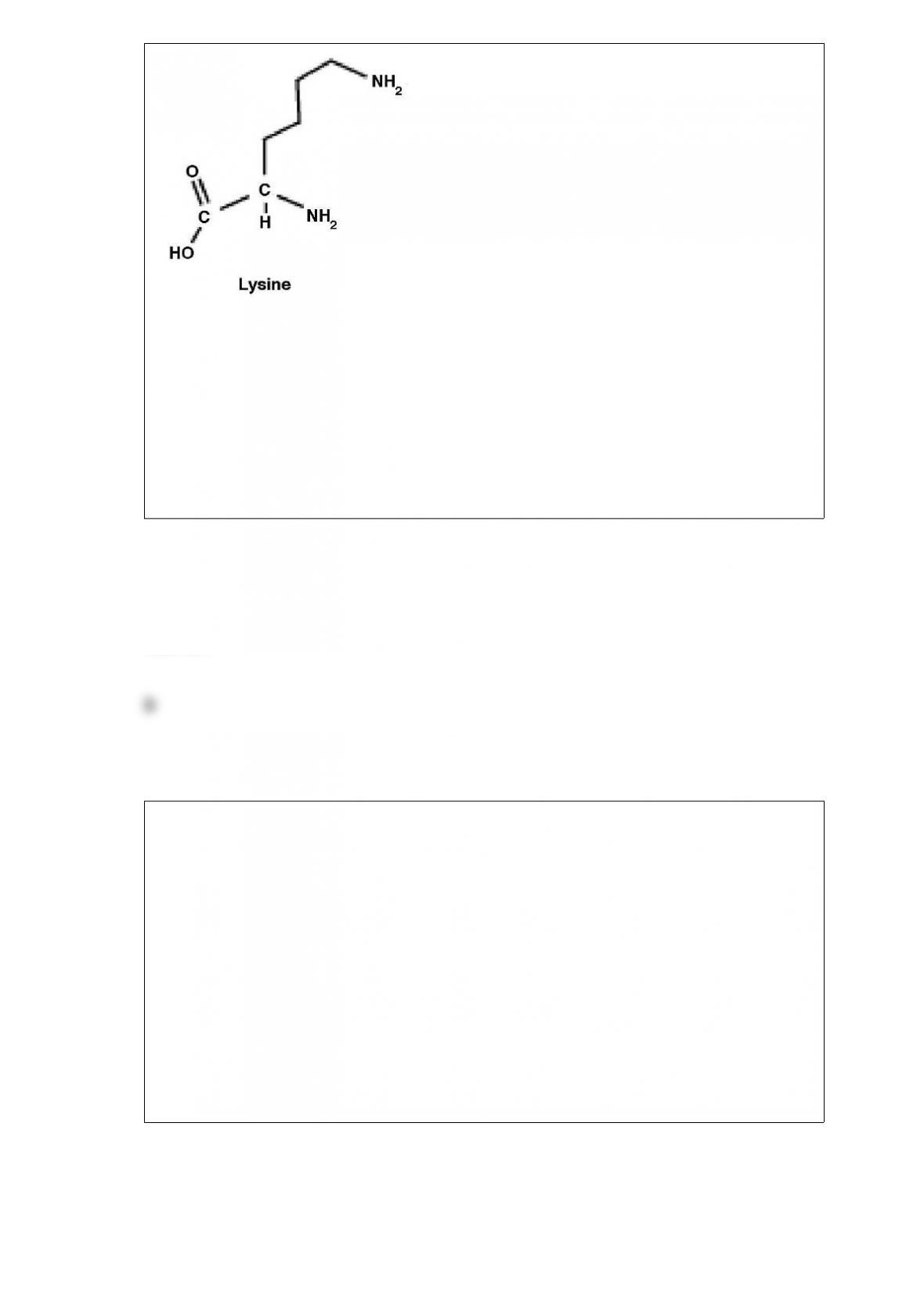
A) One amino group must be removed and replaced with a hydrogen.
B) The carboxyl group must be removed and replaced with a hydrogen.
C) The hydrogen (shown) must be removed and replaced with an amino (NH2) group.
D) Lysine is 1, 5-pentanediamine. Nothing has to be removed.
Answer:
Since some of the compounds that are destroying ozone are found in nature normally,
how is it possible to tell that the reactive molecules destroying the ozone are due to our
actions?
A) They are accompanied by compounds that are only man-made.
B) The compounds only increased in the past few years.
C) The isotope distribution is unique to man-made elements.
D) The chemical composition is different than natural compounds.
E) all of the above
Answer:

Metamorphic foliation is
A) the same as sedimentary layering.
B) the prominent orientation of recrystallized minerals.
C) caused by the interaction with chemical fluids.
D) a layered appearance caused by mineral growth perpendicular to direction of
pressure.
Answer:
A car traveling at 100 km/h strikes an unfortunate bug that splatters on the windshield.
The force of impact is greater on the
A) bug.
B) car.
C) same for both
Answer:
An amino acid is an organic molecule that contains both an amine group and a carboxyl
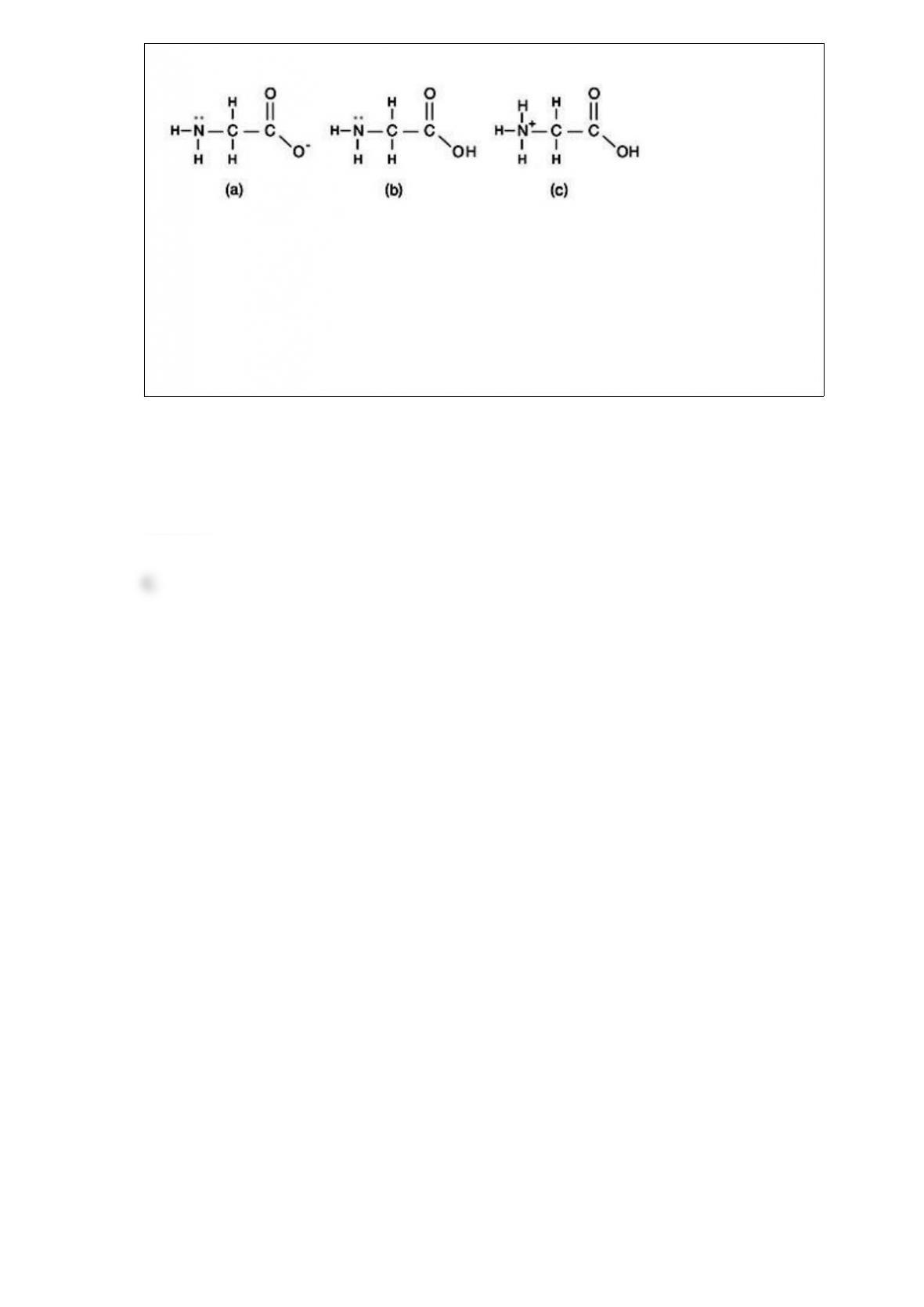
group. At an acidic pH, which structure is most likely:
A) structure (a)
B) structure (b)
C) structure (c)
D) All three structures are equally possible.
Answer: