
If the Sun collapsed to a black hole, Earth would
A) be sucked into the black hole.
B) follow a straight-line path into space.
C) continue in its present orbit.
Interference is a property of
A) water waves.
B) sound waves.
C) light waves.
D) all of the above
E) none of the above
Which requires the most amount of work by the brakes of a car?
A) slowing down from 100 km/h to 70 km/h
B) slowing down from 70 km/h to a stop
C) equal amounts for both

The index of refraction for crown glass, common in eyeglasses, is 1.52. The index of
refraction of a particular plastic lens is 1.76. Light bends more in the
A) crown glass.
B) plastic lens.
C) same speed in each.
D) need more information
Which produces a greater tidal effect in your body, the Moon or a 1-kg melon held at
arm’s length above your head?
A) the Moon
B) the melon
C) both about equally

An object’s weight is properly expressed in units of
A) meters.
B) kilograms.
C) newtons.
D) cubic centimeters.
A bullet and a proton have the same momentum. Which has the longer wavelength?
A) the bullet
B) the proton
C) both the same
A very massive object A and a less massive object B move toward each other under the
influence of gravity. Which force, if either, is greater?
A) the force on A
B) the force on B

C) both forces are the same.
According to Kepler, the orbital period of a planet is directly proportional to the
A) planet’s average distance from the Sun.
B) square of the planet’s average distance from the Sun.
C) cube of the planet’s average distance from the Sun.
Two life preservers have identical volumes, one filled with Styrofoam and the other
filled with sand. When the two life preservers are worn by swimmers, one swimmer
floats with part of the preserver above water, and the other swimmer sinks. In this case
the buoyant force is greater on the life preserver filled with
A) Styrofoam.
B) sand.
C) same for both

If a pizza absorbs more energy than it emits, its temperature
A) decreases.
B) is unaffected.
C) increases.
D) none of the above
A shock wave is produced when a wave source moves
A) nearly as fast as the waves it produces.
B) as fast as the waves it produces.
C) faster than the waves it produces.
D) none of the above
The direction of the force exerted on a moving charge in a magnetic field is

A) in the direction of the motion.
B) opposite its motion.
C) at right angles to the direction of the motion.
Which of these atoms has the greatest number of electrons?
A) helium
B) carbon
C) iron
D) gold
E) uranium
A 10-kg brick and a 1-kg apple are dropped in a vacuum. The force of gravity on the
brick is
A) the same as the force on the apple.
B) 10 times more than the force on the apple.
C) one-tenth as much as on the apple.

D) zero.
Two projectiles are fired from ground level at equal speeds but different angles. One is
fired at an angle of 30 and the other at 60. Neglecting air resistance, the projectile to hit
the ground first will be the one fired at
A) 30.
B) 60.
C) both hit at the same time
Which makes central use of the binary system?
A) phonograph records
B) DVDs
C) both of these
D) neither of these

Which of these lamps employs semi-conductor technology?
A) incandescent lamp
B) fluorescent lamp
C) CFL
D) LED
A yellow candle flame reflects from opposite surfaces of a piece of red glass.
A) both images are yellow
B) one image is yellow and the other red
C) both images are red
D) both images are reddish yellow
Flatten a spherical meatball into a hamburger and you increase its

A) surface area.
B) volume.
C) both of these
D) none of these
A ball is thrown upwards and returns to the same location. Compared with its initial
speed its speed when it returns is about
A) half as much.
B) the same.
C) twice as much.
D) four times as much.
The period of an Earth satellite depends on the satellite’s
A) mass.
B) weight on Earth.
C) radial distance from Earth.

D) all of the above
E) none of the above
While a rock thrown upward at 50 degrees to the horizontal rises, neglecting air drag,
its vertical component of velocity
A) increases.
B) remains unchanged.
C) decreases.
A heavy truck and a small car rolling down a hill at the same speed are forced to stop in
the same amount of time. Compared with the force that stops the car, the force needed
to stop the truck is
A) greater.
B) smaller.
C) the same.

For lunar tides to occur in the human body
A) most of the body would have to be in the liquid state.
B) Earth’s gravitation would have to be incredibly small.
C) parts of the body would have to be appreciably closer to the Moon than other parts.
D) none of the above
A less intense sonic boom at ground level can occur if the aircraft
A) is smaller.
B) flies higher.
C) is more streamlined.
D) all of the above
E) none of the above

Two 2-m/s pool balls roll toward each other and collide. Suppose after bouncing apart
each moves at 4 m/s. This collision violates the conservation of
A) momentum.
B) energy.
C) both momentum and energy.
D) none of the above
Which of the following statements is true?
A) an atom is the smallest particle known to exist
B) there are only about 100 different kinds of atoms that combine to form all substances
C) there are thousands of different kinds of atoms that account for a wide variety of
substances
D) a large atom can be photographed with the aid of an ordinary microscope
E) none of the above
According to special relativity, tomorrow’s travelers can travel
A) only forward in time.

B) backward in time.
C) both forward and backward in time.
The reason a life jacket helps keep you afloat is
A) the jacket makes you weigh less.
B) the jacket has the same density as an average human.
C) the jacket repels water.
D) if you sink, the jacket sinks.
E) the density of both you and the jacket together is less than your density alone.
Some alpha particles pass through gold foil with very little deflection mainly because
the
A) electric field is zero inside the foil.
B) atoms of gold are mostly empty space.
C) net charge of the gold atoms is zero.
D) all of the above

E) none of the above
Once an alpha particle is outside the nucleus it is
A) free to wander about the surrounding material.
B) quickly bound to a neighboring nucleus.
C) electrostatically repelled.
D) radioactive.
When you rapidly stir raw eggs with an eggbeater, the temperature of the eggs
A) increases.
B) decreases.
C) remain unchanged.
D) none of the above

How many octaves exist between 100 hertz and 1600 hertz?
A) 4
B) 5
C) 6
D) 7
E) 8
Figure A-1
Refer to the figure above. Assuming that all transitions between levels are possible, how
many spectral lines will this atom exhibit?
1) 1
2) 2
3) 3

4) 4
5) 5
The spectral line of highest frequency will result from an electron transition from n = 3
to
6) n = 2.
7) n = 1.
8) either, if the levels are equidistant.
An elephant and a feather fall through the air. The force of air resistance is
1) greater on the feather
2) greater on the elephant
3) the same on each
because
4) the feather weighs less.
5) the elephant encounters more air because of his greater size and speed.
6) each is under the influence of gravitational force alone.
If the sky were ordinarily yellow-orange instead of blue, then sunsets would appear
1) orange,
2) green,
3) blue,
4) black,
which has to do with
5) the polarization of sunlight.
6) yellow-orange and sky blue being complementary colors.
7) the refraction of sunlight through the thicker atmosphere.
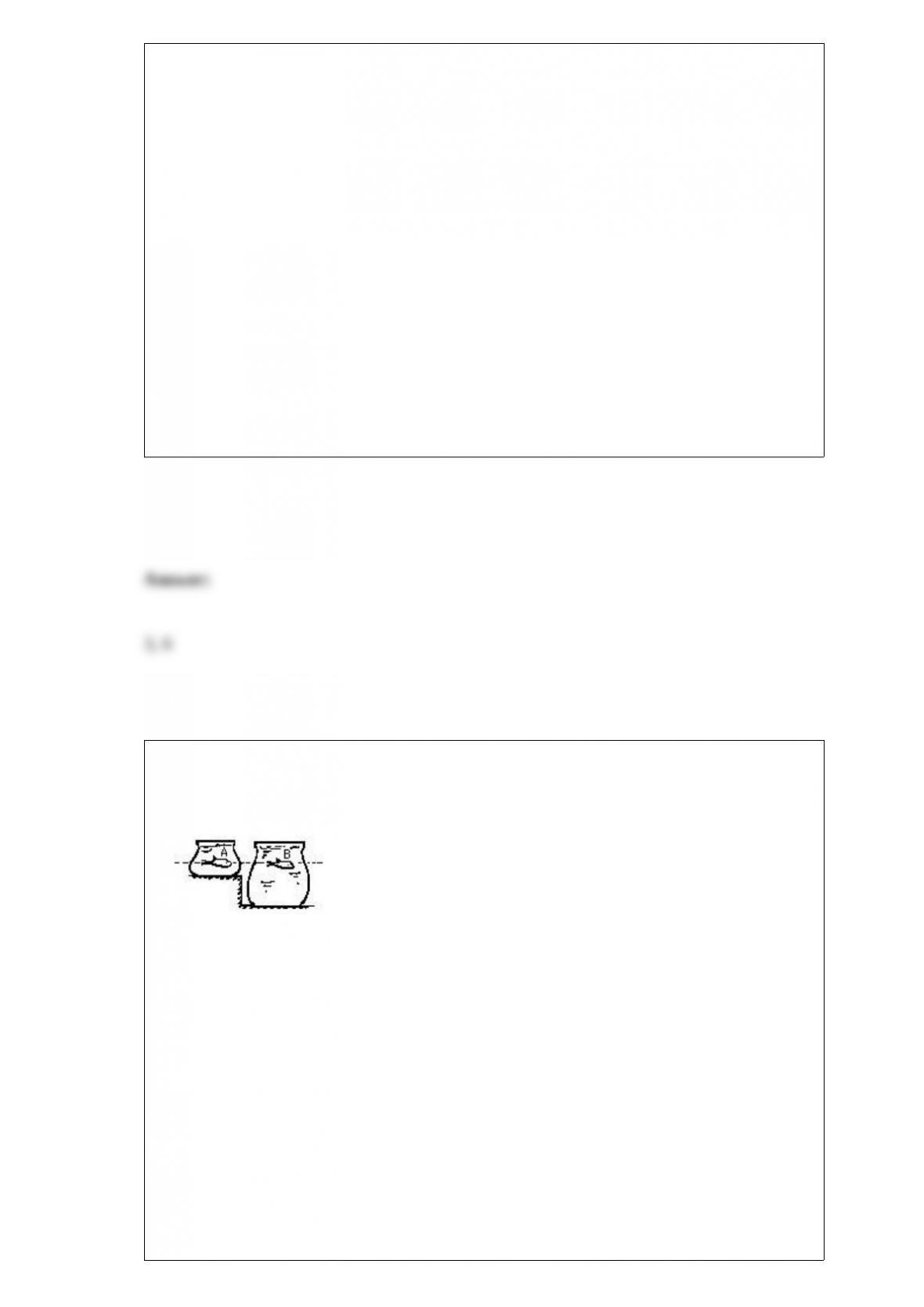
Figure M-2
Two vases of different shapes each contain a goldfish. In the position shown, the fish
that will feel the greatest pressure is
1) A
2) B
3) both experience the same
because
4) the weight of water is greater in vase B.

5) fish A is nearer to the bottom of the vase.
6) both fish are at the same depth.
Compared to a ship floating in salt water, a ship floating in fresh water displaces
1) a greater weight of water,
2) a lesser weight of water,
3) the same weight of water,
and it also displaces
4) a greater volume of water.
5) a lesser volume of water.
6) the same volume of water.
Which of the following contracts the most when temperature is decreased?
1) iron
2) ice water
3) helium
4) All contract the same.
Which of the following contracts the most when temperature is increased?
5) iron
6) ice water
7) helium
8)All contract the same.
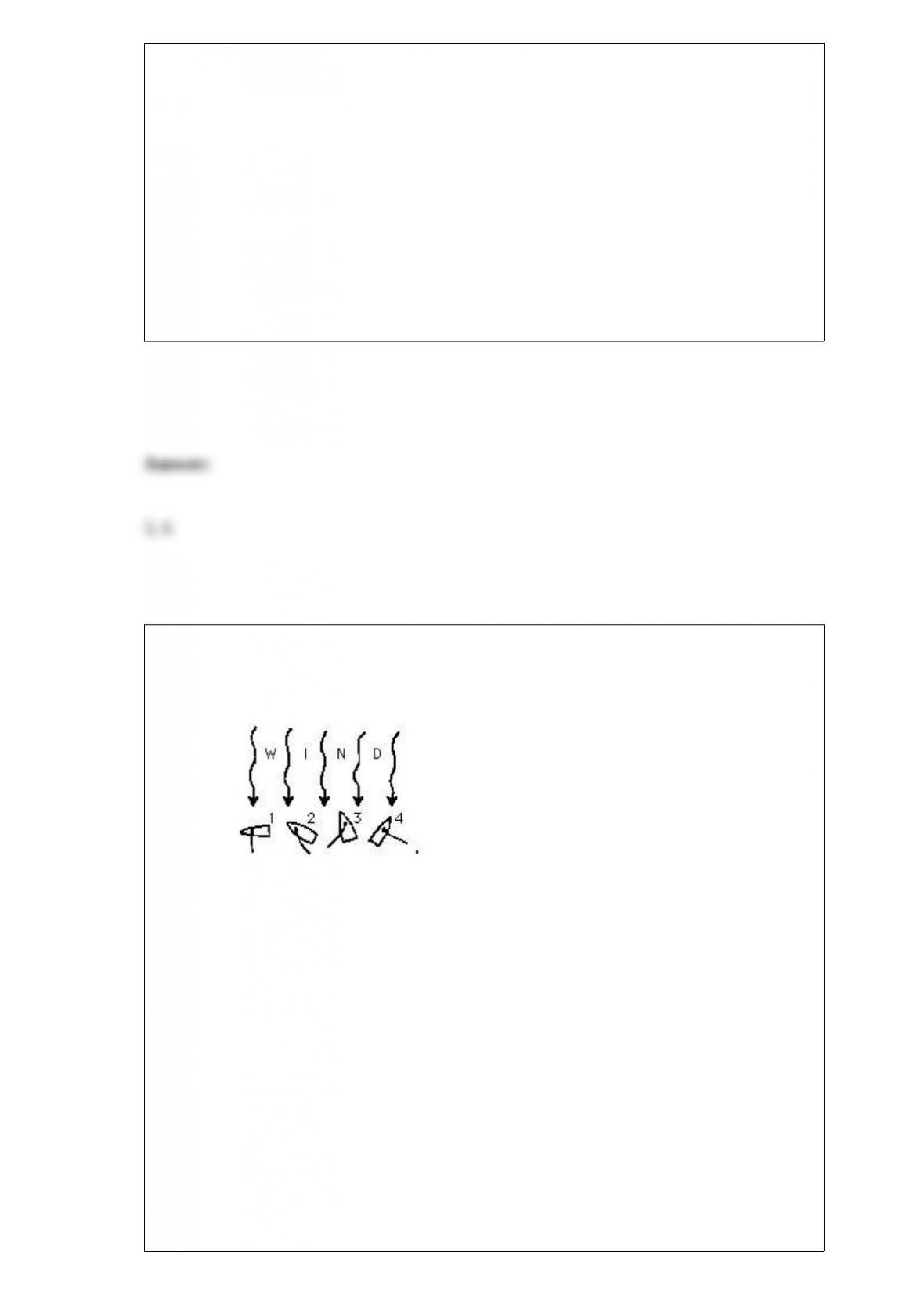
Figure V-6
The boat that will sail fastest in the intended direction is
1) 1,
2) 2,
3) 3,
4) 4,
and the boat that responds least to the wind is
5) 1.
6) 2.

7) 3.
8) 4.
A rifle is fired straight downward from a high-altitude balloon. If the bullet leaves the
barrel at 100 m/s, then its speed one second later (neglecting air resistance) will be
about
1) 10 m/s
2) 100 m/s
3) 105 m/s
4) 110 m/s
and its distance below will be about
5) 5 m.
6) 100 m.
7) 105 m.
8) 110 m.
9) 120 m.

Figure M-4
A certain force is required to keep a block of wood 1 m beneath the surface of water.
The force required to keep it 2 m deep is
1) zero.
2) the same.
3) twice as much.
4) four times as much.
This is because
6) pressure increases with increased depth.
7) it displaces the same weight of water at any depth.
8) wood floats.
9) surface tension is not present beneath the surface.
Consider a sample of water at 6oC. If the temperature is slightly increased, the volume
of water
1) increases.
2) decreases.
3) remains unchanged.

Suppose the water is cooled instead to 3oC. Then further cooling of it will cause its
volume to
4) increase.
5) decrease.
6) remain unchanged.
When two lamps are connected in series to a battery, the electrical resistance that the
battery senses is
1) more than the resistance of either lamp,
2) less than the resistance of either lamp,
And when the same two lamps are connected in parallel to a battery, the electrical
resistance that the battery senses is
3) more than the resistance of either lamp.
4) less than the resistance of either lamp.
5) none of these
A baseball is thrown straight upward. At the very top of its trajectory its instantaneous
velocity is zero and its acceleration is

1) zero.
2) 10 m/s2.
3) between zero and 10 m/s2.
4) none of these.
We can better understand this by noting that when it is at its highest point
5) there momentarily is no motion.
6) its rate of change of motion is still 10 m/s2.
7) although its velocity is not changing, its direction is.
If an object is thrown downward from a tall cliff, its acceleration while falling (in the
absence of air resistance) will be
1) less than 10 m/s2.
2) 10 m/s2.
3) greater than 10 m/s2.
This is evident from the fact that
4) gravitational force depends upon the state of motion of an object.
5) each successive second the speed of the object increases by an additional 10 m/s.
6) the object was not simply dropped but thrown, therefore having an initial
acceleration of fall greater than zero.
The electrons that make up the current in an electric circuit move by
1) interacting with the electric field established in the circuit.
2) bumping into one another in such as way as to send pulses over long distances.
The drift speed of individual electrons making up the current is
3) very low, about a snail’s pace.
4) about the speed of sound.
5) about the speed of light.
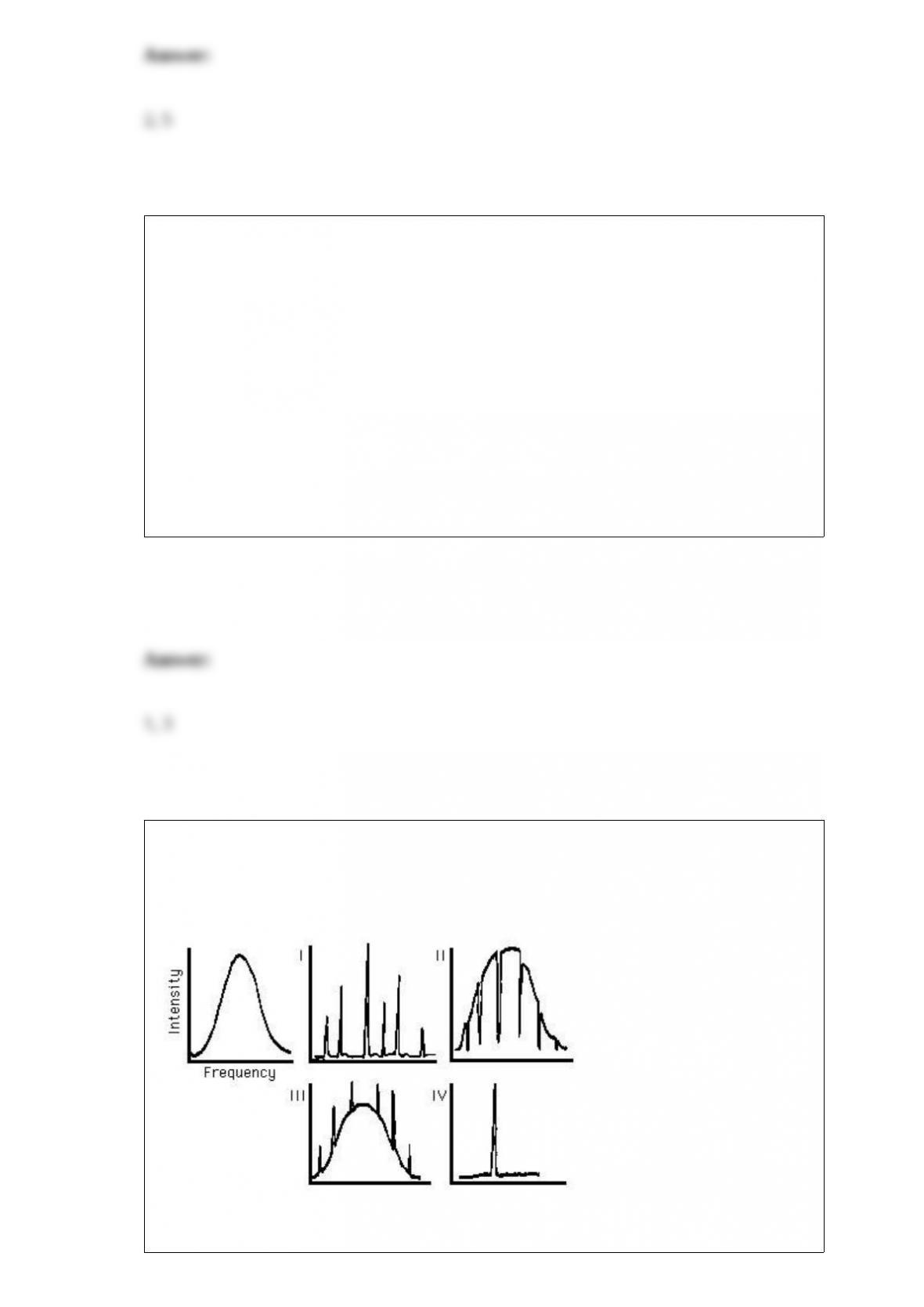
Figure L-3
The radiation curve is a plot of light intensity versus frequency for an incandescent

source such as a glowing lamp filament. If the source of light were excited atoms in the
gaseous phase, the radiation curve would look like
1) I.
2) II.
3) III.
4) IV.
The plot shown in IV is of
5) monochromatic light.
6) a very bright source.
7) light that has passed through a thin slit.