
A beam of light emerges from water into air at an angle bent
A) towards the normal
B) away from the normal.
C) in a direction parallel to the normal.
D) in a direction perpendicular to the normal.
E) not at all.
Answer:
Metals are useful for the structural support of buildings because they
A) do not conduct heat well.
B) are shiny.
C) conduct electricity.
D) are strong but can be bent.
E) c and d
Answer:
Why is it significantly less costly to purify fresh water through reverse osmosis than to
purify salt water through reverse osmosis?

A) The osmotic pressure exerted by fresh water is less.
B) The osmotic pressure exerted by fresh water is greater.
C) For non-coastal regions, the salt water needs to be transported many miles from the
oceans.
D) The expense of reverse osmosis is not dependent upon the salt concentration in the
water.
Answer:
As a stream flows downslope, if stream discharge doubles and the cross-sectional area
of the channel also doubles, what happens to the average stream speed?
A) Average stream speed stays the same.
B) Average stream speed decreases.
C) Average stream speed increases.
D) Not enough information is given.
Answer:
To say that electric charge is conserved is to say that electric charge
A) occurs in an infinite variety of quantities.
B) is a whole-number multiple of the charge of one electron.

C) will interact with neighboring electric charges.
D) can neither be created nor destroyed.
Answer:
Which of the following elements will most likely form an ion with a -2 charge?
A) Na
B) S
C) Ne
D) Mg
E) Cl
Answer:
Carbon-carbon single bonds can rotate while carbon-carbon double bonds cannot rotate.
How many different structures are shown below.
A) 1
B) 2
C) 3

D) 4
Answer:
When Eddie Electron experiences an electrical shock, the source of electrons
composing the shock is
A) the ground beneath Eddie’s feet.
B) Eddie’s body.
C) the power plant.
D) whatever electric device being handled.
E) electric field in the air.
Answer:
A car by itself is capable of a certain maximum acceleration. When it tows a
twice-as-massive car, its maximum acceleration is
A) one-half.
B) one-third.
C) one-fourth.
D) the same.
E) none of these
Answer:
You and your friend journey to the mountain foothills to get closer to nature and escape
such things as radioactivity. While bathing in the warmth of a natural hot spring she
wonders aloud how the spring gets its heat. What do you tell her? You tell her that the
hot water is the result of
A) industrial thermal pollution.
B) radioactivity.
C) chemical reactions involving the atomic nucleus.
D) nuclear fission.
Answer:
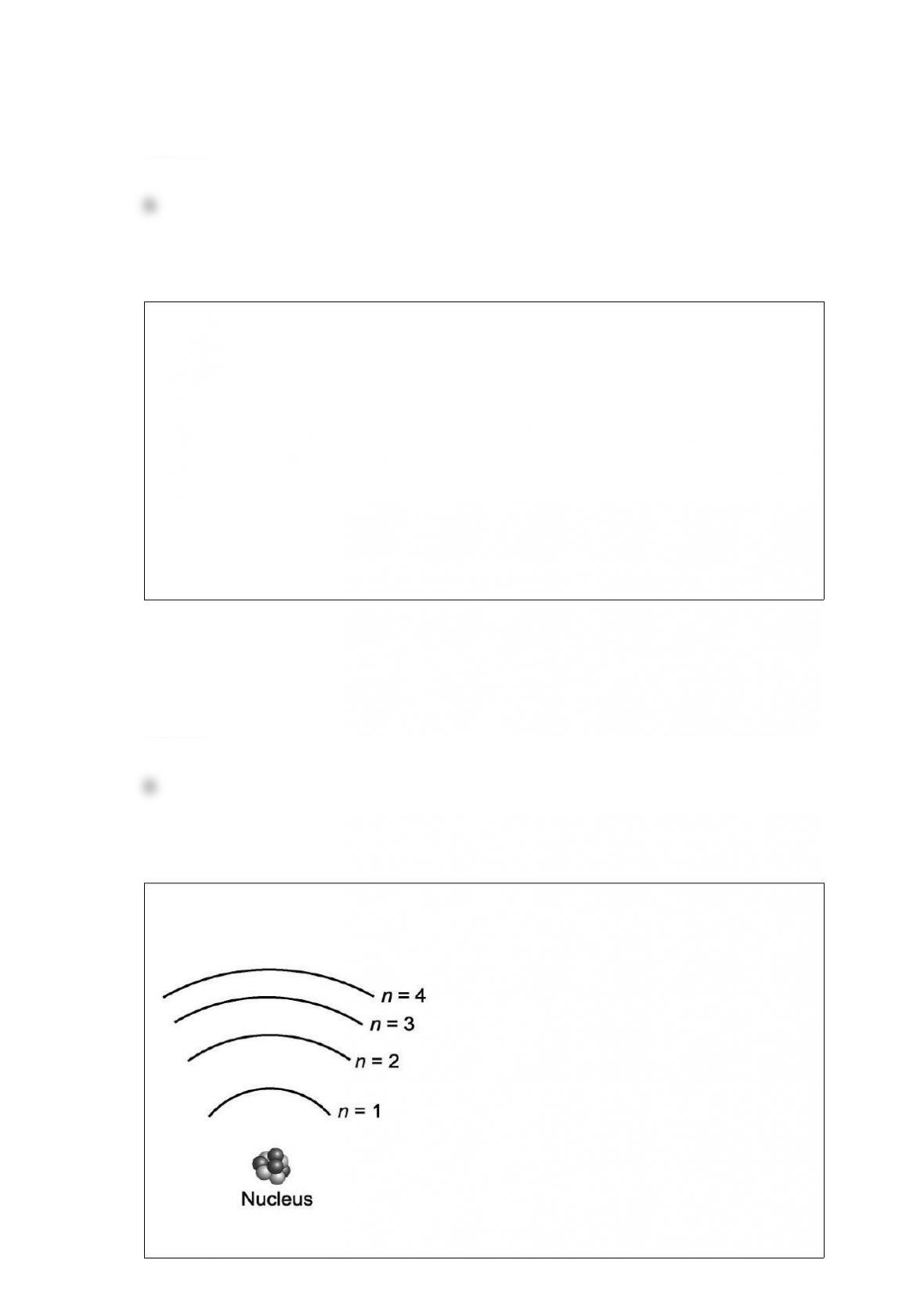
Suppose that a certain atom possesses only four distinct energy levels. Assuming that all
transitions between levels are possible, how many spectral lines will this atom exhibit?

A) three
B) four
C) six
D) unlimited
Answer:
Between mass and weight, the more fundamental quantity is
A) mass.
B) weight.
C) both the same.
D) none of the above
Answer:
If nitrogen, , were pumped into your lungs at high pressure, what would happen to its
solubility in your blood stream?
A) The greater the pressure, the greater the solubility.
B) The greater the pressure, the lower the solubility.
C) You cannot change solubility of a substance by changing the pressure.

D) Nitrogen is not soluble in your blood.
Answer:
In a folded sequence of rocks we find older rocks at the axis of the fold and younger
rocks away from the fold axis. The fold is
A) called a syncline.
B) called an anticline.
C) plunging.
D) tilted.
Answer:
To say there is no such thing as only one force means
A) there must also be an oppositely directed force.
B) other forces, perhaps not evident, are there.
C) gibberish.
Answer:

What happens when you use a monomer with more than two functional groups?
A) The polymer cannot be remelted.
B) The polymer does not form.
C) The polymer has a lower molecular weight.
D) The polymer is softer and more flexible.
Answer:
What beat frequency is produced by 240-Hz and a 246-Hz tuning forks?
A) 6 Hz
B) 12 Hz
C) 240 Hz
D) 245 Hz
E) none of the above
Answer:

A common electromagnet consists of a
A) bar magnet that carries an electric current.
B) current-carrying wire coil.
C) current-carrying coil with a piece of iron inside.
Answer:
A wave barrier is produced in water when the speed of an object
A) matches the speed of waves in water.
B) exceeds the speed of waves in water.
C) is less than the speed of waves in water.
D) none of the above
Answer:
The capacity a material has for transmitting fluids is known as its
A) porosity.
B) permeability.
C) competence.
D) impermeability.

Answer:
The stars Procyon and Betelgeuse both appear equally bright to Earthbound viewers.
Yet Betelgeuse emits 5000 times more light than Procyon. Why do they appear to be
equally bright?
A) because Betelgeuse is much farther than Procyon
B) because Betelgeuse is undergoing fission, not fusion
C) because Betelgeuse lies in the same plane of Earth’s orbit
D) because Procyon is superhot
Answer:
Does a shell have to contain electrons in order to exist?
A) A shell is a form of energy that requires electrons in order to exist.
B) A shell is just a region of space which may or may not contain electrons.
C) A shell is just a conceptual model, hence, it doesn’t really exist with or without the
electron.
D) Two of the above are reasonable answers.
Answer:

Convergent boundaries are regions of
A) great mountain building.
B) plate subduction.
C) plate collision.
D) plate collision, subduction, and mountain building.
Answer:
As a bowling ball that rolls off the edge of a table falls, its horizontal component of
motion
A) decreases.
B) remains constant.
C) increases.
Answer:
Human activities that warm the Earth’s atmosphere are caused by energy

A) production.
B) consumption.
C) both of these
D) none of the above
Answer:
How does fractional distillation work?
A) It takes advantage of the different boiling points of molecules to separate them.
B) It takes advantage of the different weight of molecules to separate them.
C) It uses the fraction of carbon in the isomers to separate the molecules.
D) It takes advantage of the different melting points to separate molecules.
E) none of the above
Answer:
What is the approximate mass of a carbon atom in atomic mass units (amu)? How about
a carbon dioxide molecule?
A) A carbon atom has a mass of about 12 amu. Carbon dioxide would then have a mass
of 28 amu.
B) A carbon atom has a mass of about 6 amu. Carbon dioxide would then have a mass

of 32 amu.
C) A carbon atom has a mass of about 12 amu. Carbon dioxide would then have a mass
of 44 amu.
D) A carbon atom has a mass of about 6 amu. Carbon dioxide would then have a mass
of 22 amu.
Answer:
When you scuff electrons from a carpet onto your shoes, you become
A) negatively charged.
B) positively charged.
C) polarized.
D) ionized.
E) neutralized.
Answer:
A player hits a ball with a bat. If one part of the interaction is the bat against the ball,
the other part is the
A) air resistance on the ball.
B) weight of the ball.

C) ball against the bat.
D) grip of the player’s hand against the ball.
E) none of the above
Answer:
Factors that increase ocean salinity are
A) runoff from streams and rivers.
B) formation of sea ice.
C) precipitation.
D) glacial melting.
Answer:
The amount of current in an incandescent bulb rated 75W-120V is about
A) 0.4 A.
B) 0.6 A.
C) 1.2 A.
D) more than 1.2 A.

Answer:
When light from the air enters a raindrop, the light
A) slows down.
B) remains at speed c.
C) speeds up.
D) none of the above
Answer:
The molecules in a room-temperature glass of water jostle around at
A) various speeds.
B) much the same speed.
C) constant speeds.
Answer: