1) Par value has a direct relationship to the market value of the common stock.
2) A company that has average inventory of $500 and cost of goods sold of $2,000
would have an inventory turnover ratio of 0.25.
3) An example of a bank error that causes the companys balance and banks balance of
cash to differ is the purchase of supplies with a check.
4) If total assets of a company equal $12,000 and total stockholders equity equals
$4,000, then total liabilities equal $8,000.
5) Notes receivable are similar to accounts receivable but are more formal credit
arrangements evidenced by a written debt instrument, or note.
6) We record a gain if we sell an asset for less than book value.
7) Angel investors are investors that focus on companies at or near bankruptcy.
8) A low current ratio indicates that a company has sufficient current assets to pay
current liabilities as they become due.
9) If a company reports revenues of $17,000 and expenses of $12,000, then net income
equals $5,000.
10) Serial bonds require payment of the full principal amount of the bond at a single
maturity date.
11) A lease is a contractual arrangement by which the lessor provides the lessee the
right to use an asset for a specified period of time.
12) What does it mean to revalue a long-term asset? How do U.S. GAAP and IFRS
differ regarding revaluation of long-term assets?

13) California Designs is diversifying its investment portfolio by making a small
investment (less than 5%) in the common stock of Oregon Outfitters. California
Designs engages in the following transactions relating to its investment:
January 1Purchases 1,000 shares of Oregon Outfitters common stock for $20 per share.
The investment is properly classified as an available-for-sale security.
July 12Sells 300 shares of Oregon Outfitters stock for $18 per share.
September 30Receives a cash dividend of $1 per share.
December 31Adjusts the investment to fair value. The fair value of Oregon Outfitters
stock is now $15 per share.
1> Record each of these transactions, including the December 31 adjustment to fair
value.
2> Calculate the balance of the Investments account on December 31 .
14) Stealth Fitness Center issues 7%, 15-year bonds with a face amount of $200,000.
The market interest rate for bonds of similar risk and maturity is 6%. Interest is paid
semiannually. At what price will the bonds be issued?
15) Discuss the differences between the allowance method and the direct write-off
method for recording uncollectible accounts. Which of the two is acceptable under
financial accounting rules?
16) A company has the following transactions during March:
March 3 Purchases inventory on account for $3,500, terms 2/10, n/30.
March 5 Pays freight costs of $200 on inventory purchased on March 3 .
March 6 Returns inventory with a cost of $500.
March 12 Pays the full amount due on March 3 purchase.
March 29 Sells all inventory purchased on March 3 (less those returned on March 6) for
$5,000 on account.
Record all transactions, including the month-end adjustment to cost of goods sold,
assuming the company uses a periodic inventory system and has no beginning
inventory.
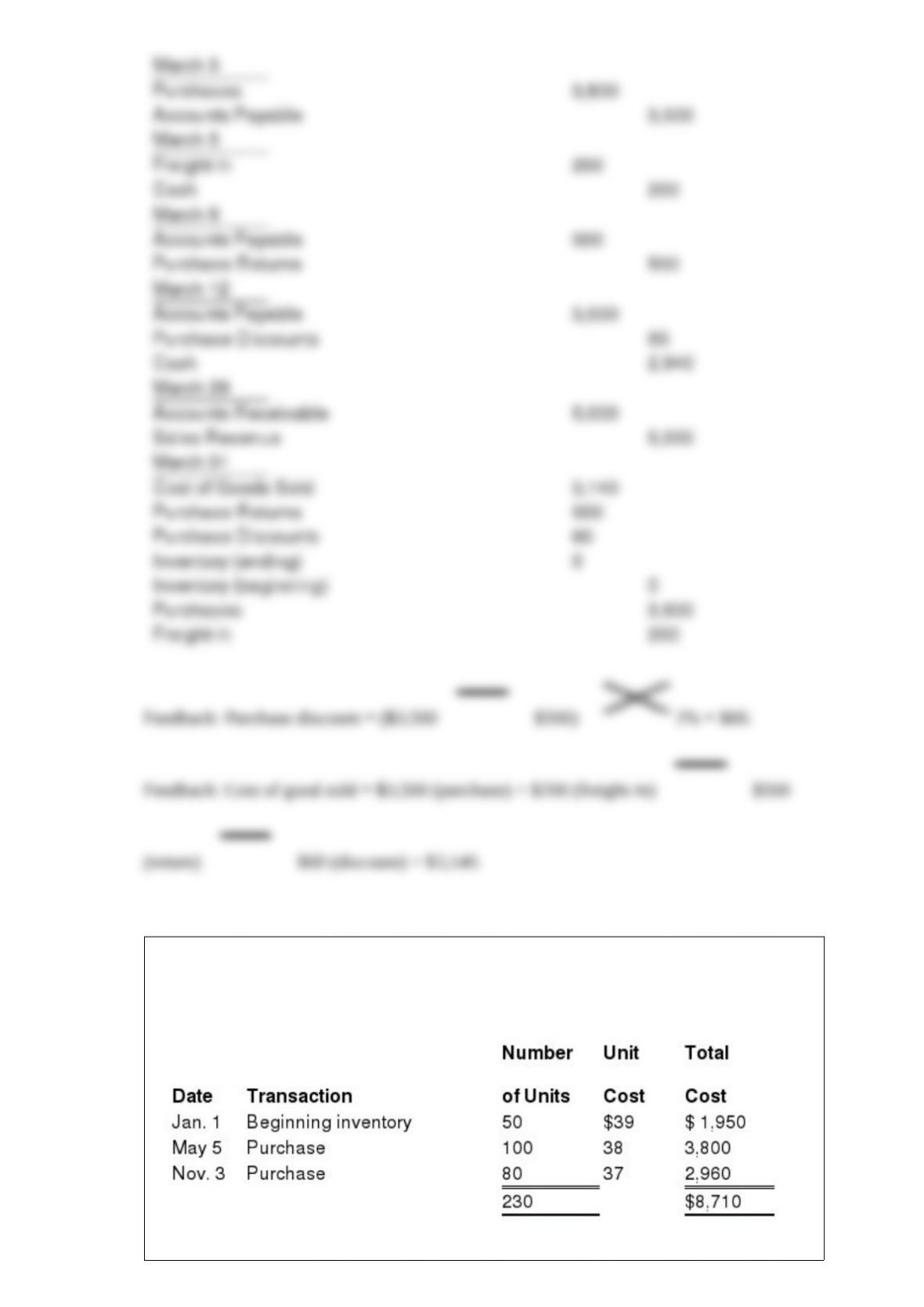
17) During 2015, a company sells 200 units of inventory for $50 each. The company
has the following inventory purchase transactions for 2015:
Actual sales by the company include its entire beginning inventory, 80 units of
inventory from the May 5 purchase, and 70 units from the November 3 purchase.
Calculate cost of goods sold and ending inventory for 2015 assuming the company uses
specific identification.
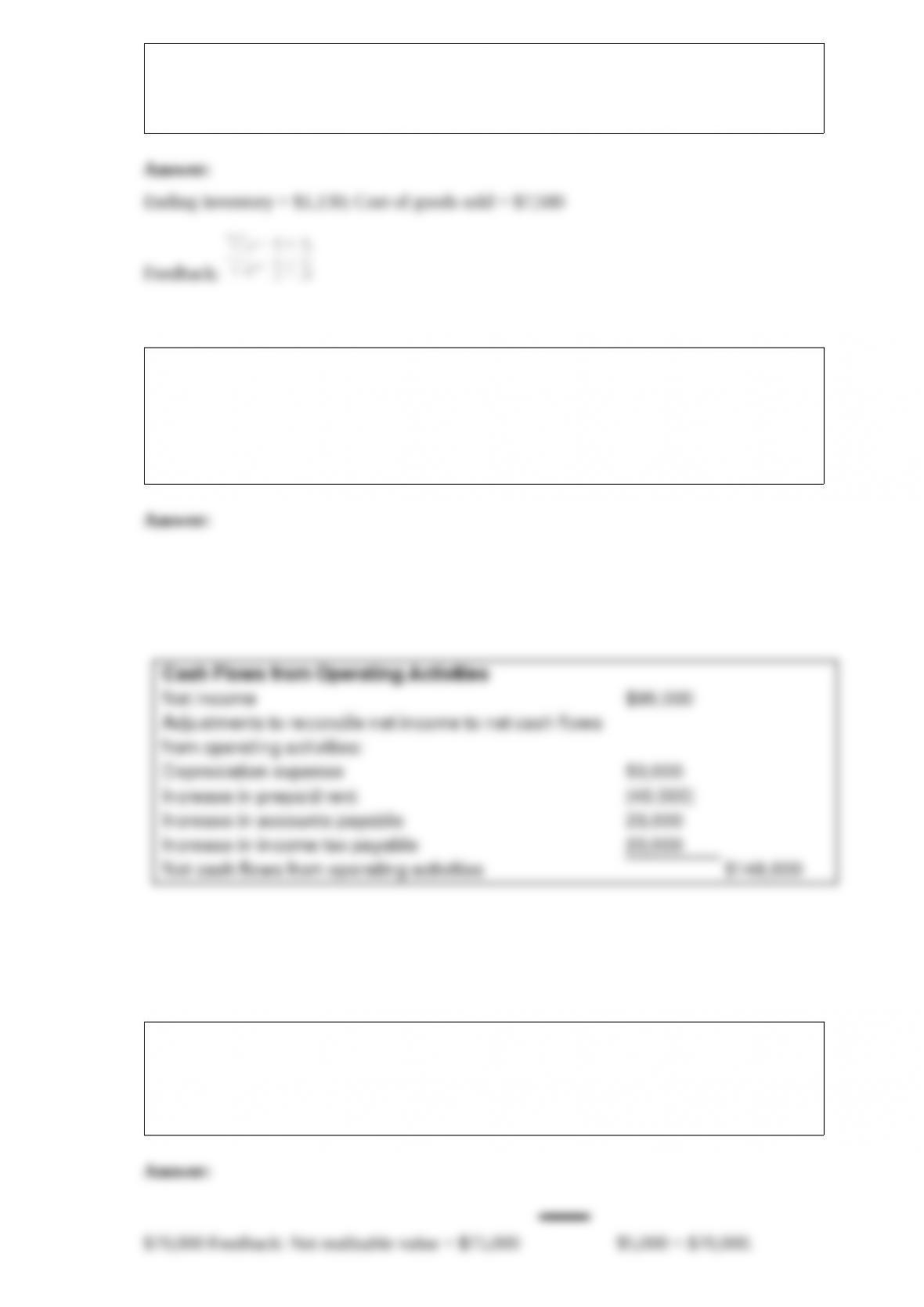
18) Electronic Wonders reports net income of $95,000. The accounting records reveal
Depreciation Expense of $50,000 as well as increases in Prepaid Rent, Accounts
Payable, and Income Tax Payable of $40,000, $23,000, and $20,000, respectively.
Prepare the operating activities section of Electronic Wonders’ statement of cash flows
using the indirect method.
19) A company has the following balances on December 31, 2015, after year-end
adjustments: Accounts Receivable = $75,000; Service Revenue = $400,000; Allowance
for Uncollectible Accounts = $5,000; Cash = $20,000. Calculate the net realizable value
of accounts receivable.