1) The numbers in the body of the simplex tableau can be thought of as substitution
rates.
2) In the assignment problem, the costs for a dummy row will be equal to the lowest
cost of the column for each respective cell in that row.
3) In regression, a dependent variable is sometimes called a predictor variable.
4) With CPM, we are able to calculate the probability of finishing the project within a
specified time.
5) A 0-1 programming representation could be used to assign sections of a course to
specific classrooms.
6) Queuing theory had its beginning in the research work of Albert Einstein.
7) One of the assumptions of LP is ‘simultaneity.”
8) Deterministic inventory models require the use of simulation.

9) The probability of selecting any random number in a two digit table is 1/100.
10) The difference in decision making under risk and decision making under
uncertainty is that under risk, we think we know the probabilities of the states of nature,
while under uncertainty we do not know the probabilities of the states of nature.
11) One purpose of regression is to understand the relationship between variables.
12) The decision making criterion of realism only applies to maximizing expected
payoff.
13) In linear programs with many variables, even though we cannot graph the feasible
region, the optimal solution will still lie at a “corner point.”
14) If conditions require that all decision variables must have an integer solution, then
the class of problem described is an integer programming problem.
15) Summing the error values in a regression model is misleading because negative
errors cancel out positive errors.

16) A healthcare executive is using regression to predict total revenues. She is deciding
whether or not to include both patient length of stay and insurance type in her model.
Her first regression model only included patient length of stay. The resulting r2 was .83,
with an adjusted r2 of .82 and her level of significance was .003. In the second model,
she included both patient length of stay and insurance type. The r2 was .84 and the
adjusted r2 was .80 for the second model and the level of significance did not change.
Which of the following statements is true?
A) The second model is a better model.
B) The first model is a better model.
C) The r2 increased when additional variables were added because these variables
significantly contribute to the prediction of total revenues.
D) The adjusted r2 always increases when additional variables are added to the model.
E) None of the above statements are true.
17) An artificial source added to a transportation table when total demand is greater
than total supply is called
A) excess source.
B) filler source.
C) dummy source.
D) demand source.
E) supply source.
18) The Monte Carlo simulation was developed by
A) John von Neumann.
B) Eric von Brock.
C) A.K. Erlang.
D) P.K. Poisson.
E) J.D. Monte Carlo.
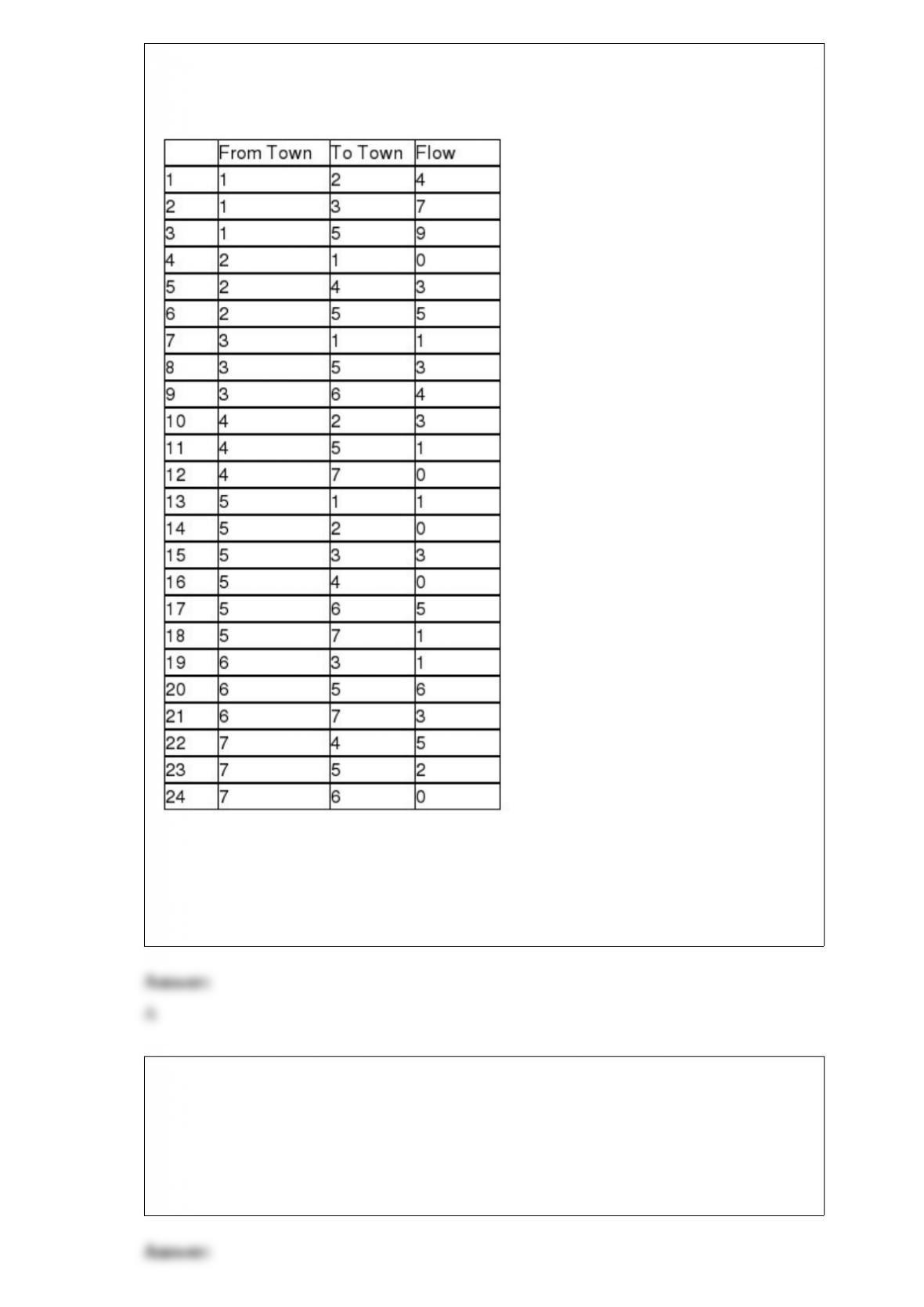
19) Given the following traffic flows, in hundreds of cars per hour, what is the
maximum traffic flow from Town 1 to Town 7?
A) max flow = 4 units
B) max flow = 6 units
C) max flow = 3 units
D) max flow = 9 units
E) None of the above
20) Linear programming is usually used by managers involved in portfolio selection to
A) maximize return on investment.
B) maximize investment limitations.
C) maximize risk.
D) minimize risk.
E) minimize expected return on investment.

21) Robert Weed is considering purchasing life insurance. He must pay a $180 premium
for a $100,000 life insurance policy. If he dies this year, his beneficiary will receive
$100,000. If he does not die this year, the insurance company pays nothing and Robert
must consider paying another premium next year. Based on actuarial tables, there is a
0.001 probability that Robert will die this year. If Robert wishes to maximize his EMV,
he would not buy the policy if the EMV were negative for him. He has determined that
the EMV is, negative for him, but decides to purchase the insurance anyway. Why?
A) He believes that the actual likelihood of his death occurring in the next twelve
months is really much greater than the actuarial estimate.
B) While the EMV is negative, the utility gained from purchasing the insurance is
positive, and high.
C) Mr. Weed is not rational.
D) A or C
E) None of the above
22) What is said to exist when total demand equals total supply in a transportation
problem?
A) an equalized problem
B) an equilibrialized problem
C) a harmonized problem
D) a balanced problem
E) This situation can never occur.
23) Drivers arrive at a toll booth at a rate of 3 per minute during peak traffic periods.
The time between consecutive driver arrivals follows an exponential distribution. What
is the probability that it will take more than 1/3 of a minute between consecutive
drivers?
A) 0.632
B) 0.111
C) 0.368
D) 0.208
E) Not enough information given
24) Bret’s bakery must decide how many loaves of fresh bread to produce in a single
day. Daily demand for fresh bread is normally distributed with a mean of 70 loaves and

standard deviation of 18. If the marginal loss is $2 and the marginal profit is $1, how
much bread should Bret’s bakery produce in a single day?
A) 88
B) 52
C) 63
D) 78
E) 70
25) Which of the following is considered a causal method of forecasting?
A) exponential smoothing
B) moving average
C) Holt’s method
D) Delphi method
E) None of the above
26) The expected time in PERT is
A) greater than the most likely time.
B) equal to the most likely time.
C) less than the most likely time.
D) Any of the above
E) None of the above
27) Table M2-5
The data below is a dynamic programming solution for a shortest route problem.

Using the data in Table M2-5, determine the optimal arc of stage 4.
A) 1 – 2
B) 2 – 4
C) 1 – 3
D) 3 – 4
E) None of the above
28) A large school district is reevaluating its teachers’ salaries. They have decided to use
regression analysis to predict mean teacher salaries at each elementary school. The
researcher uses years of experience to predict salary. The raw data is given in the table
below. The resulting equation was:
Y = 19389.21 + 1330.12X, where Y = salary and X = years of experience
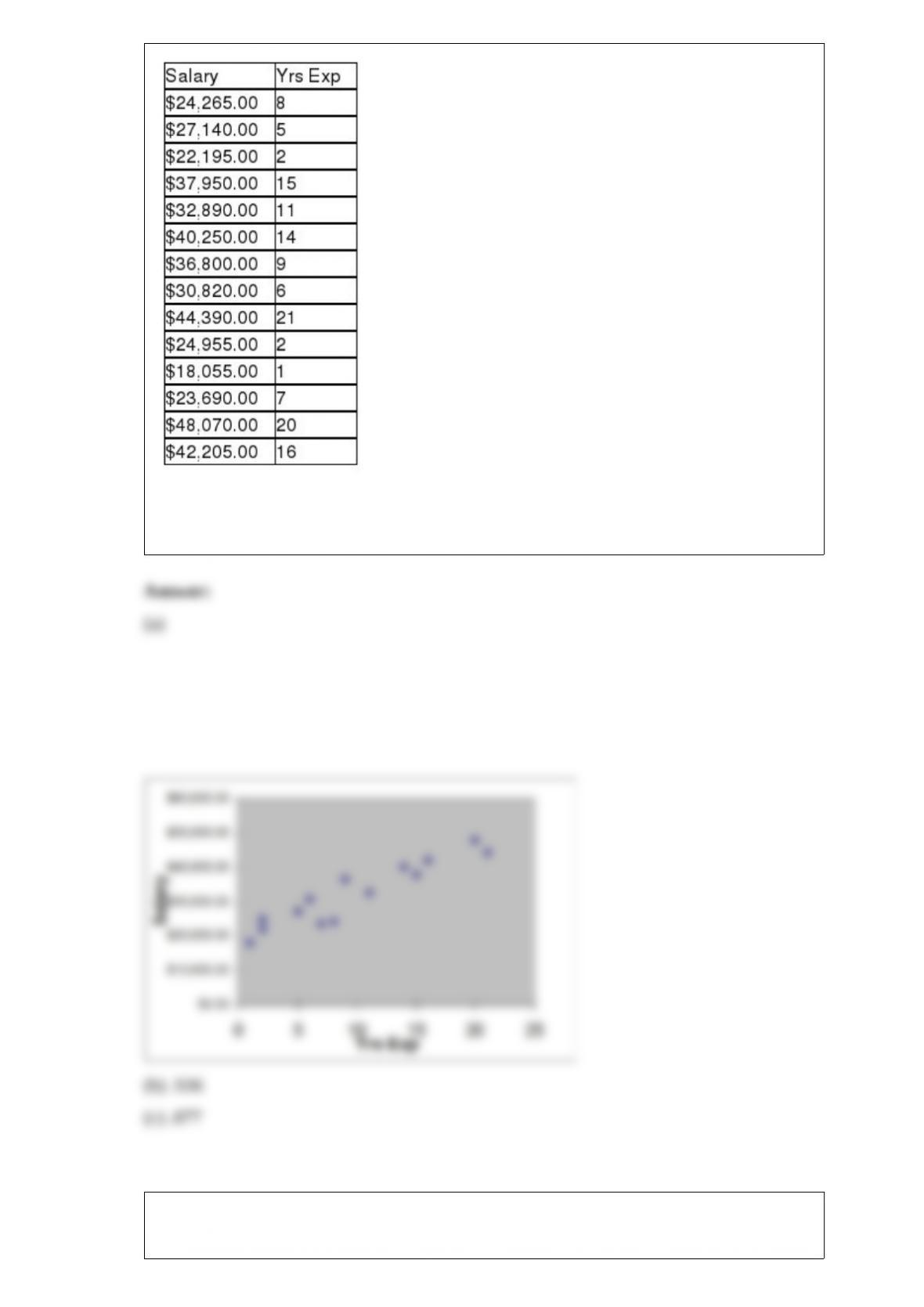
(a) Develop a scatter diagram.
(b) What is the correlation coefficient?
(c) What is the coefficient of determination?
29) The computed EOL will be the same as the computed
A) EMV.

B) unit normal loss.
C) break-even point.
D) EVPI.
E) None of the above
30) The maximal-flow technique would best be used
A) to assign workers to jobs in the cheapest manner.
B) to determine the number of units to ship from each source to each destination.
C) to determine LAN network wiring within a building.
D) to maximize traffic flow on a busy highway.
E) by a trucking company making frequent but repeatable drops.
31) Cars arrive at a local JLUBE franchise at the rate of 1 every 12 minutes. Service
times are exponentially distributed with an average of 15 minutes. Jack Burns, the
JLUBE owner, has decided to open a second work bay, i.e., make the shop into a
two-channel system. Under this new scheme, the total time an average customer spends
in the system will be
A) 37 minutes.
B) 2.1 minutes.
C) 9.6 minutes.
D) 33.3 minutes.
E) 24.6 minutes.
32) Table 12-5
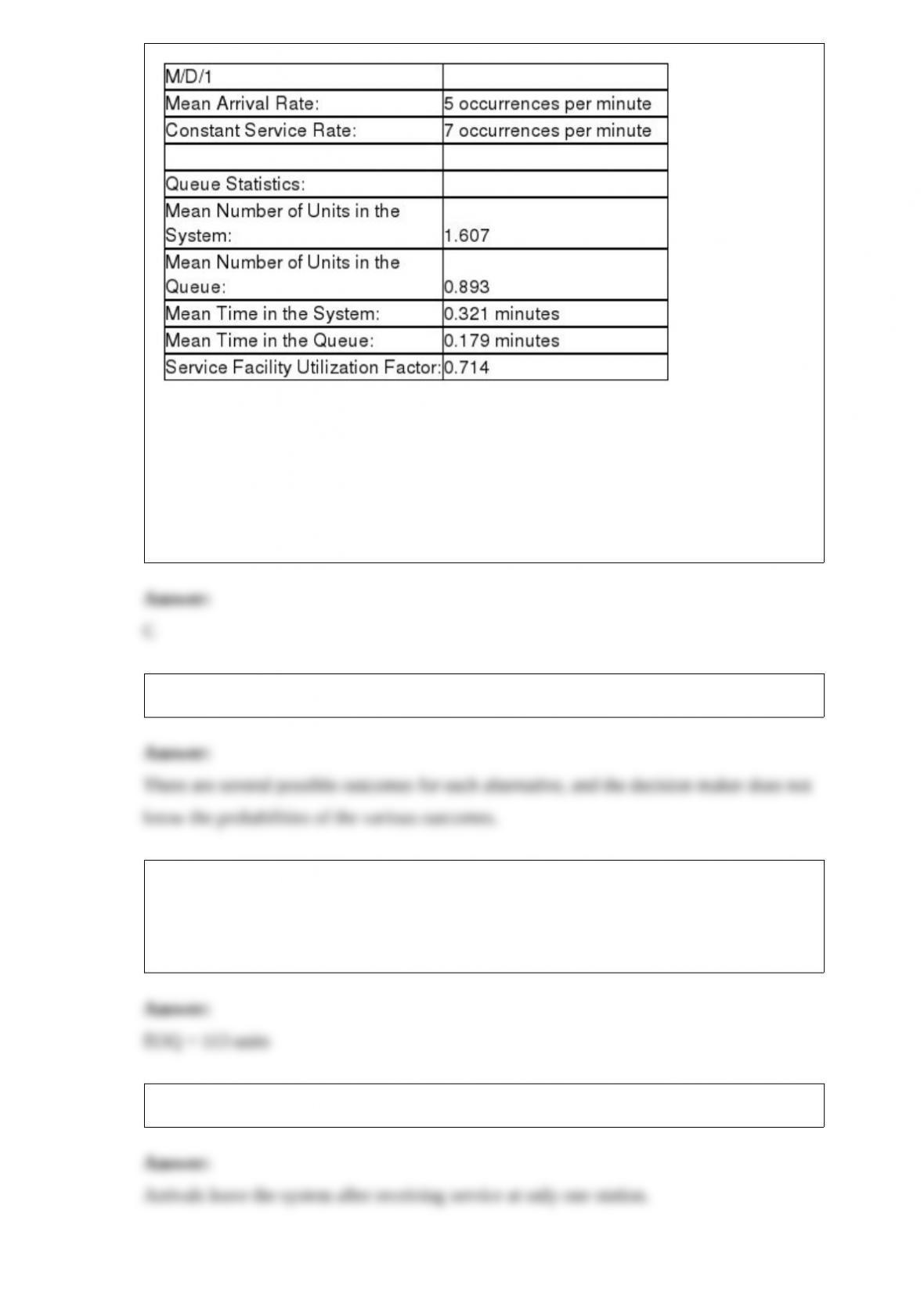
According to the information provided in Table 12-5, which presents the solution for a
queuing problem with a constant service rate, the probability that the server is idle is
A) 0.217.
B) 0.643.
C) 0.286.
D) 0.714.
E) None of the above
33) Briefly describe decision making under uncertainty.
34) ArtOrgan, Ltd. distributes mechanical replacements for human mitral heart valves.
Its artificial valve has a demand of 12,765 units per year and sells for $7,900 per unit.
The cost of ordering is $75 per order and the average carrying cost per unit per year is
$150. Determine the economic order quantity.
35) What is meant by a single-phase system?
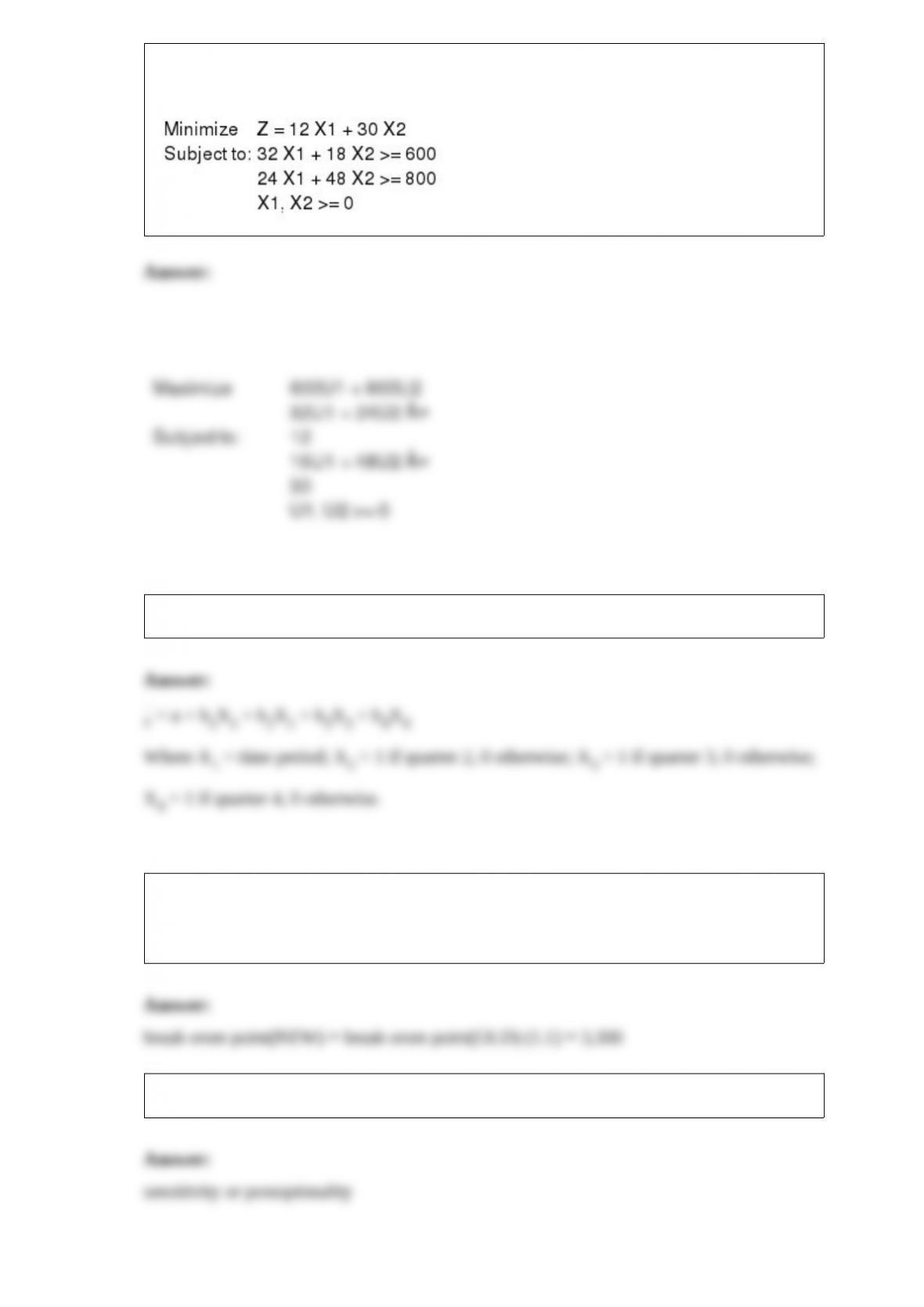
36) Write the dual of the following linear program:
37) What is the basic additive decomposition model (in regression terms)?
38) The break-even point was determined to be 3,000 units/month. Next month begins
an increased lease payment for the production facility. The overall effect will be to
increase the fixed costs by 10%. How will the break-even point be affected?
39) Once we have a solution, we should then perform ________ analysis.
40) What are the three categories of business analytics?
41) One basic assumption of linear programming is proportionality. Explain its need.