1) A transportation problem with intermediate points is called a transshipment problem.
2) A high correlation always implies that one variable is causing a change in the other
variable.
3) Markov analysis is a technique that deals with the probabilities of future occurrences
by analyzing currently known probabilities.
4) The several criteria (maximax, maximin, equally likely, criterion of realism, minimax
regret) used for decision making under uncertainty may lead to the choice of different
alternatives.
5) An increase in holding cost will increase the economic order quantity, holding all
other factors constant.
6) Tony B. is attempting to start a landscaping business. He estimates that to
break-even, he will need about 140 customers. He believes he will lose approximately
$500 per customer for each customer fewer than the 140. At the moment, he believes
that there is an 80% probability that he will be able to secure at least 130 customers and
that there is a 50/50 chance that demand will be greater than 150 customers. He has
several marketing research firms offering (for a price, of course) to conduct a survey
that will provide additional information regarding the probability of demand. How
much should he be willing to spend if he decides to have a survey made?
A) $4,000
B) $3,000
C) $5,000
D) $2,700
E) None of the above
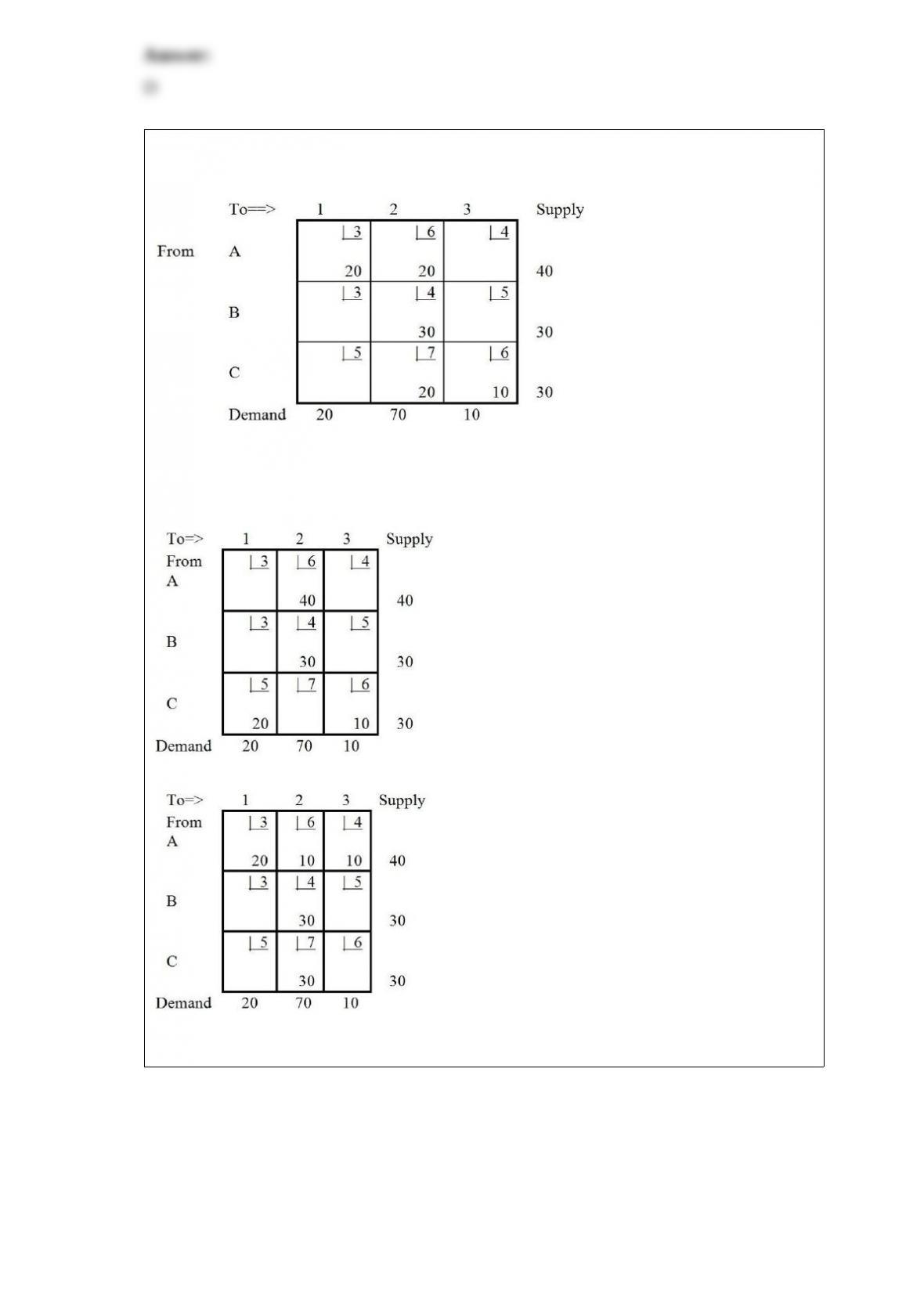
7) Table M8-4
Assuming that Table M8-4 represents the results of an iteration of a transportation
model, the next tableau will be:
A)
B)
C)
D)
E) None of the above
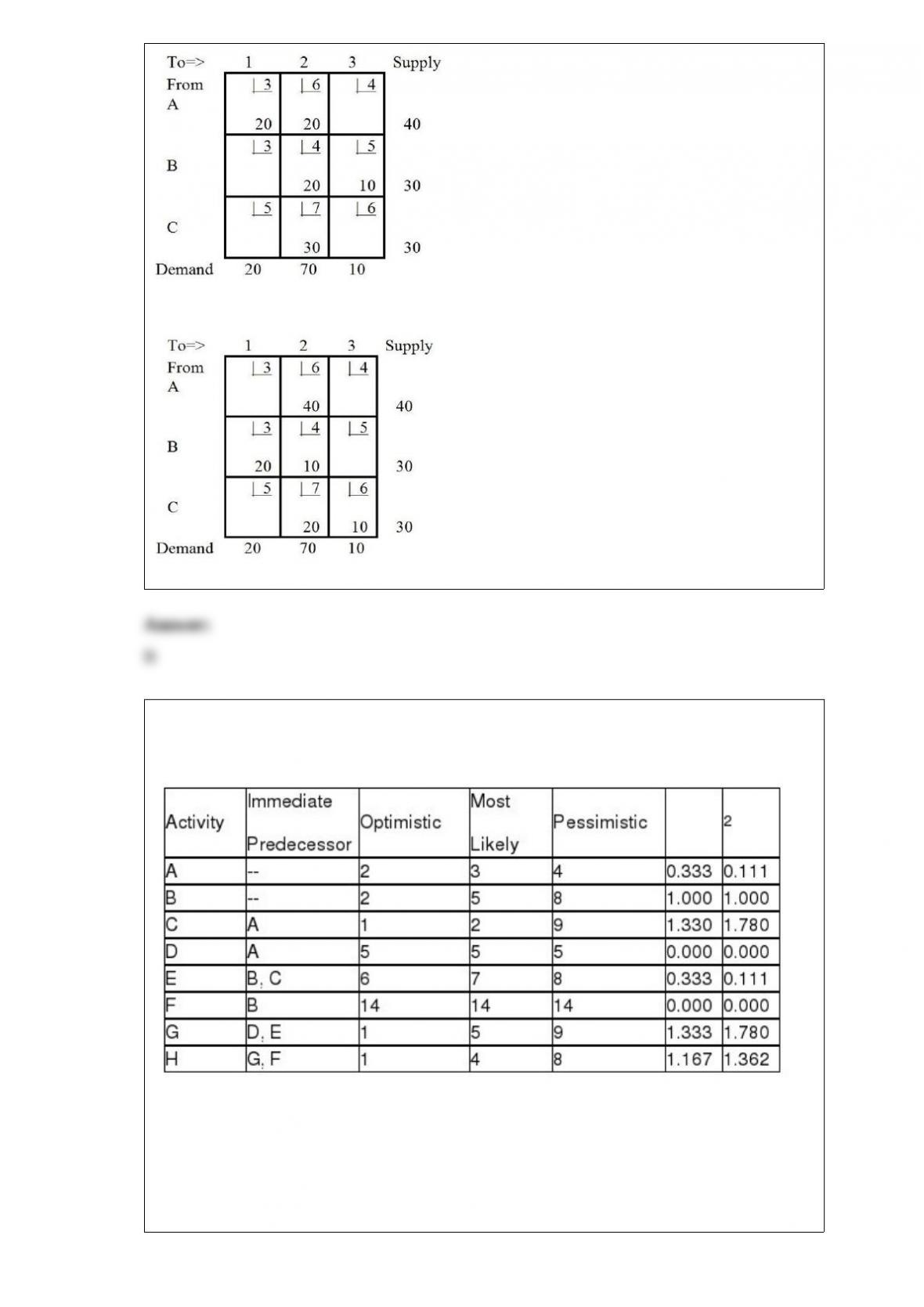
8) Table 11-6
Which activities are part of Table 11-6’s critical path?
A) A-B-E-G-H
B) A-C-E-G-H
C) A-D-G-H
D) B-F-H
E) None of the above
9) Suppose that 10 golfers enter a tournament and that their respective skill levels are
approximately the same. What is the probability that one of the first three golfers that
registered for the tournament will win?
A) 0.100
B) 0.001
C) 0.300
D) 0.299
E) 0.700
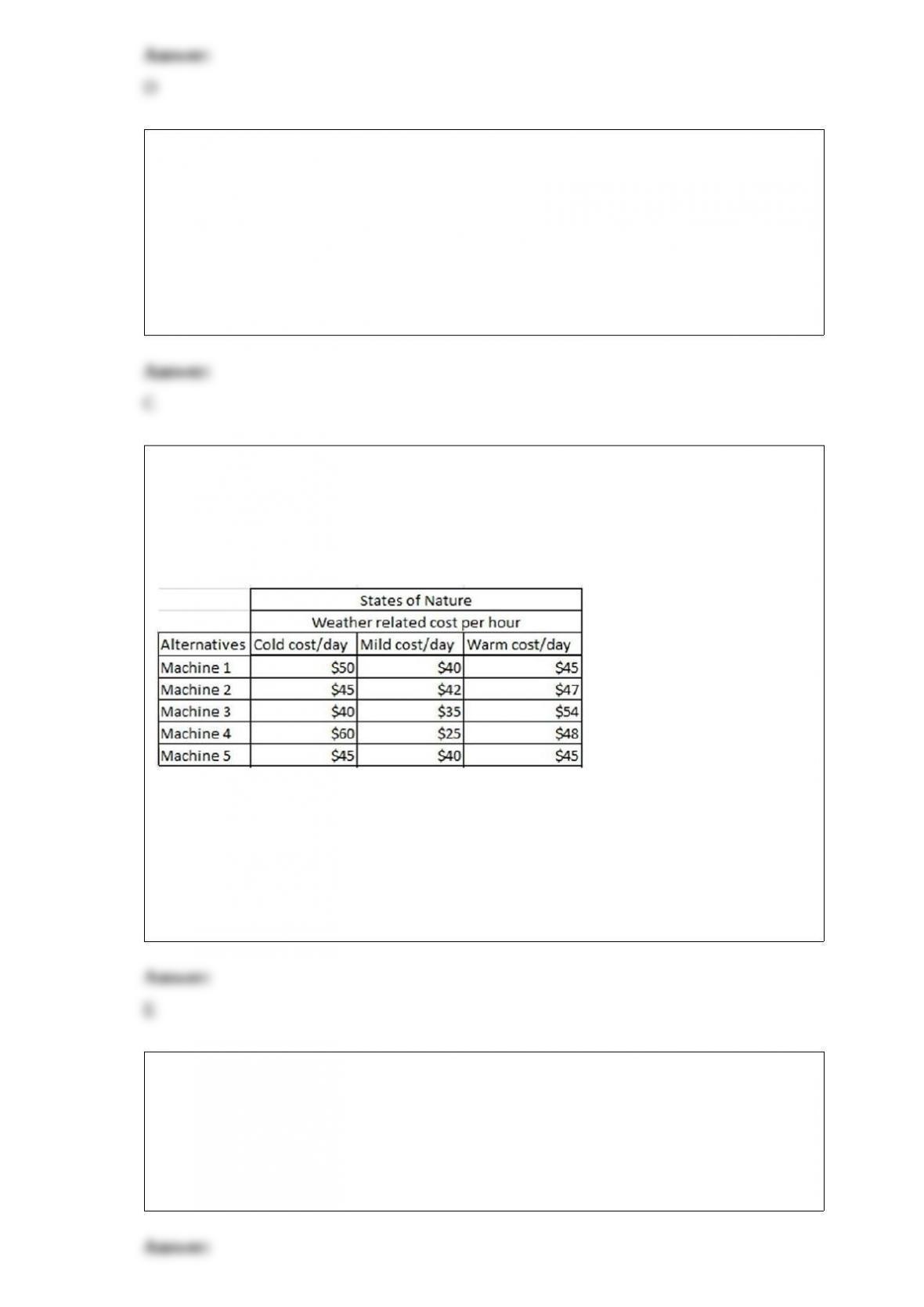
10) A plant manager considers the operational cost per hour of five machine
alternatives. The cost per hour is sensitive to three potential weather conditions: cold,
mild, and warm. The following table represents the operations cost per hour for each
alternative-state of nature combination:
Using the pessimistic criterion, which alternative is best?
A) Machine 1
B) Machine 2
C) Machine 3
D) Machine 4
E) Machine 5
11) Decision trees are particularly useful when
A) perfect information is available.
B) formulating a conditional values table.
C) the opportunity loss table is available.
D) a sequence of decisions must be made.
E) all possible outcomes and alternatives are not known.
12) The use of simulations in competitive situations is called
A) Monte Carlo simulation.
B) systems simulation.
C) operational gaming.
D) virtual reality.
E) None of the above
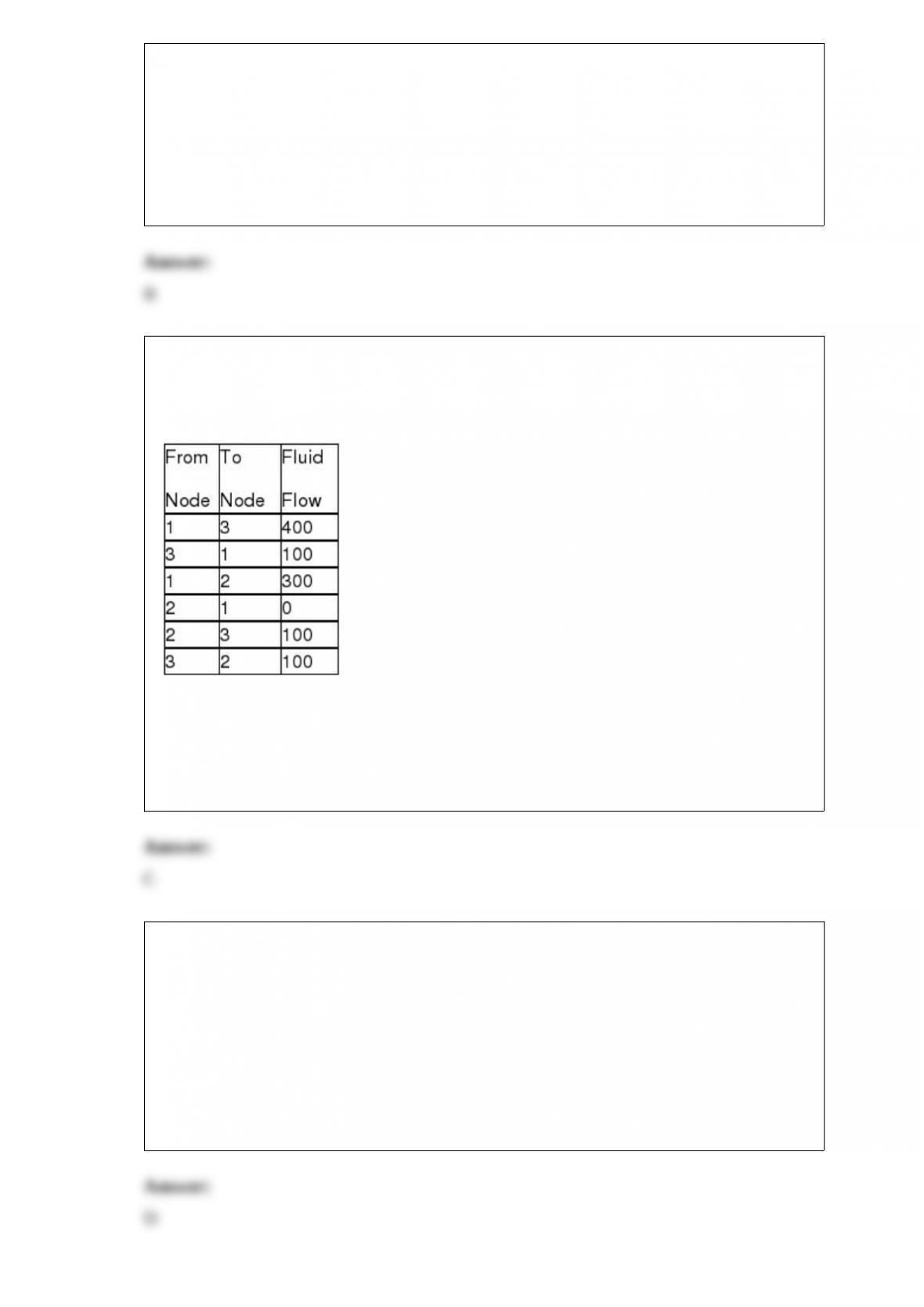
13) Given (Time in weeks):
Determine:
(a) the critical path.
(b) the probability that the project will be completed in 22 weeks.
14) If we wish to develop a stock portfolio wherein we maximize return and minimize
risk, we would have to use
A) pure-integer programming.
B) goal programming.
C) zero-one integer programming.
D) mixed-integer programming.
E) nonlinear programming.
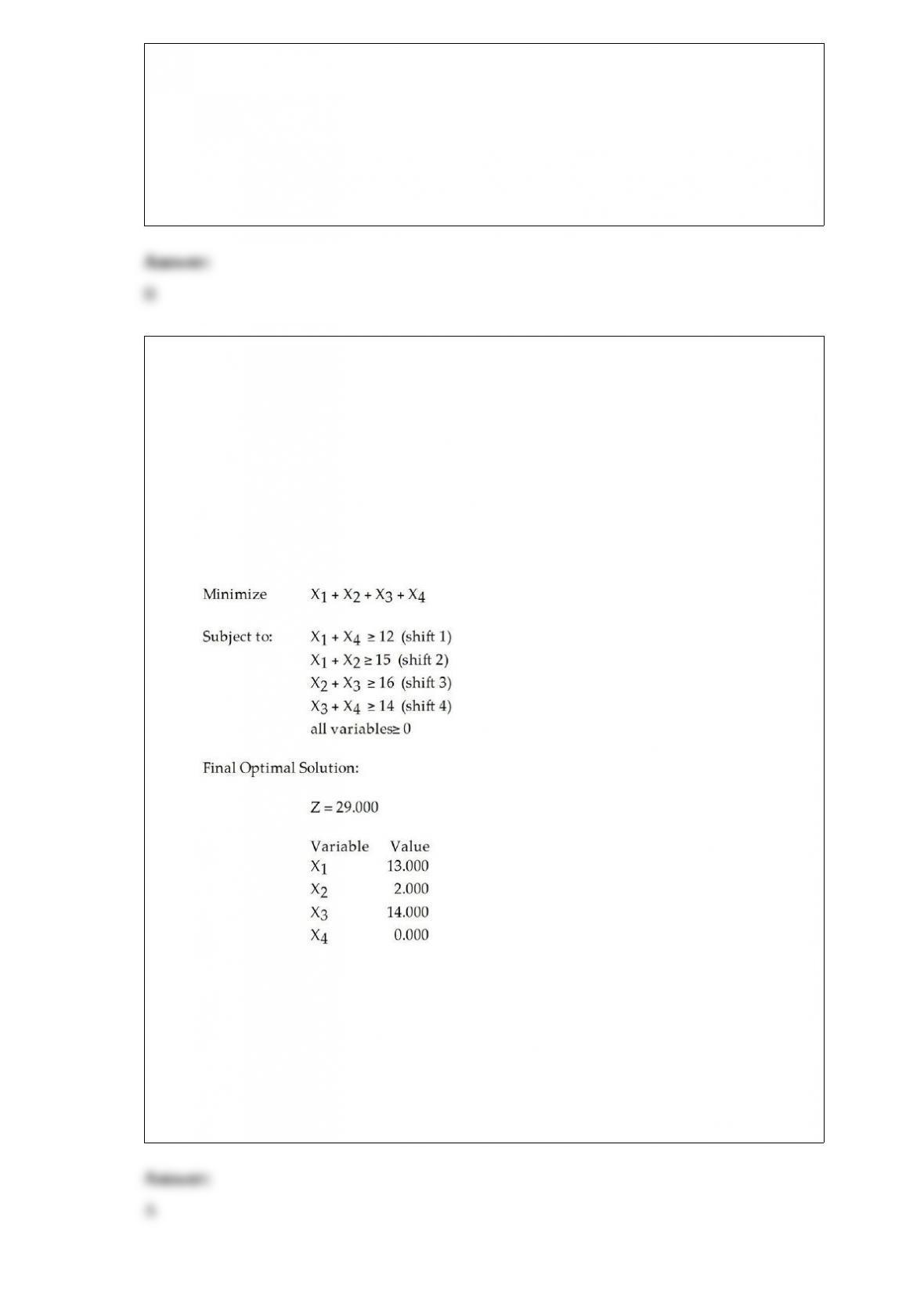
15) Pipeline fluid flows are indicated below. Determine the maximum flow from Node
1 to Node 3.
A) 100
B) 400
C) 500
D) 700
E) None of the above
16) Data for a particular subdivision near downtown Houston indicate that the average
price per square foot for a home is $100 with a standard deviation of $5 (normally
distributed). What is the probability that the average price per square foot for a home is
greater than $90?
A) 0
B) 0.023
C) 0.159
D) 0.977
E) None of the above
17) In constructing a utility curve,
A) a comparison is made of the different amounts of money at different times.
B) the certainty of a certain amount is compared with the willingness to gamble that
amount on a larger amount.
C) one takes the risk out of gambling.
D) inflation plays a critical part in the evaluation.
E) None of the above
18) Table 8-6
The following is a linear programming formulation of a labor planning problem. There
are four overlapping shifts, and management must decide how many employees to
schedule to start work on each shift. The objective is to minimize the total number of
employees required while the constraints stipulate how many employees are required at
each time of day. The variables X1 – X4 represent the number of employees starting
work on each shift (shift 1 through shift 4).
According to Table 8-6, which describes a labor planning problem and its solution, how
many workers would be assigned to shift 2?
A) 2
B) 0
C) 14
D) 15
E) None of the above

19) How are decision tables organized?
A) alternatives down the left, states of nature on top, payoffs inside
B) states of nature down the left, alternatives on top, payoffs inside
C) alternatives down the left, payoffs on top, states of nature inside
D) payoffs down the left, alternatives on top, states of nature inside
E) states of nature down the left, payoffs on top, alternatives inside
20) Cars arrive at a local JLUBE franchise at the rate of 1 every 12 minutes. Service
times are exponentially distributed with an average of 15 minutes. Jack Burns, the
JLUBE owner, has decided to open a second work bay, i.e., make the shop into a
two-channel system. Under this new scheme, the average customer will wait in an
________ line.
A) M/M/1
B) M/M/2
C) M/D/2
D) M/D/1
E) M/G/2
21) An airline company tracks the number of lost bags that occur each day. This is best
monitored by which of the following control charts?
A) x-bar chart
B) R-chart
C) p-chart
D) c-chart
E) None of the above
22) The project described by:
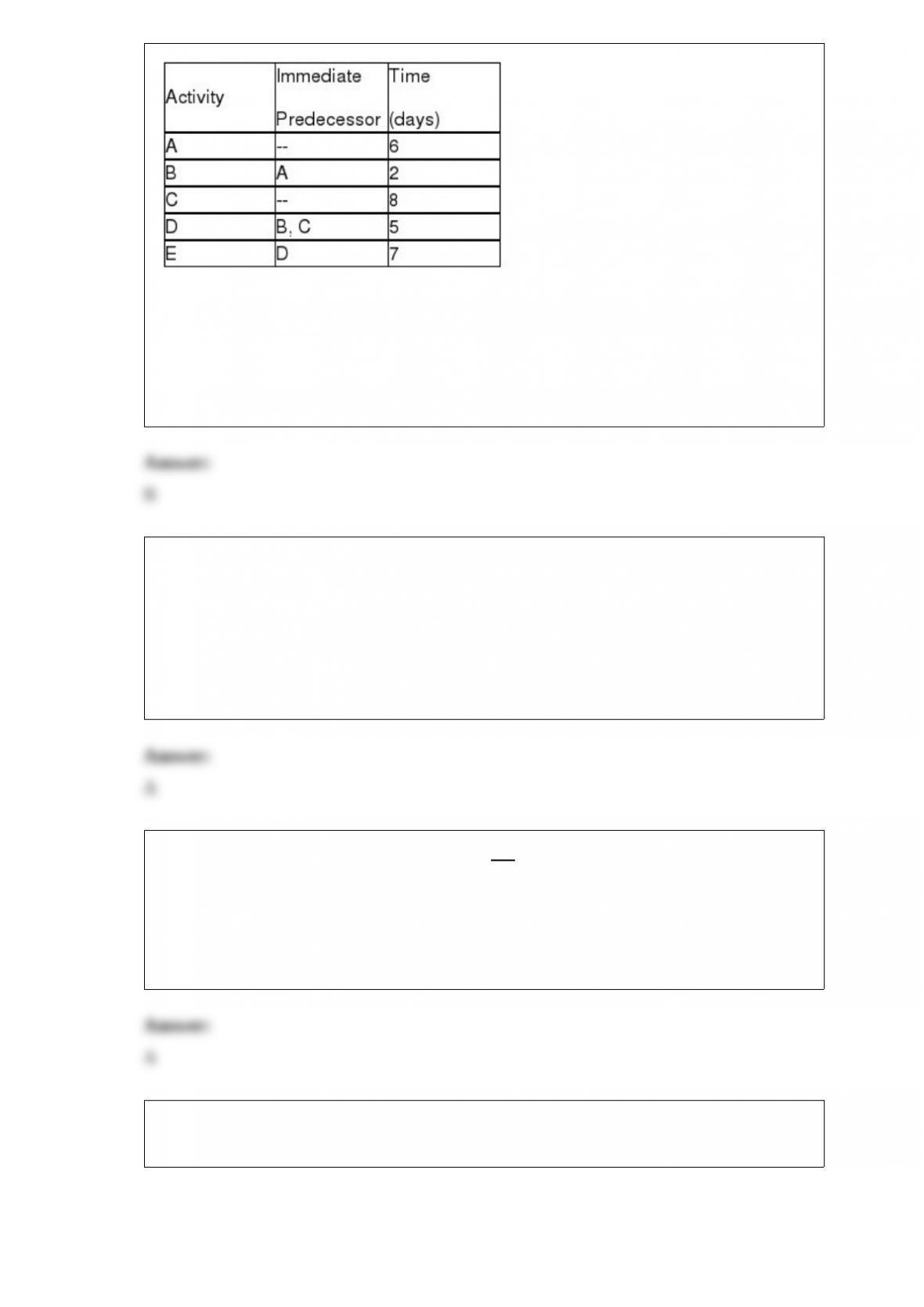
has a critical path of length of
A) 15 days.
B) 20 days.
C) 17 days.
D) 18 days.
E) None of the above
23) A measurable quantity that may vary, or is subject to change, and can be controlled
is known as a(n)
A) decision variable.
B) algorithm.
C) parameter.
D) solution.
E) None of the above
24) Which of the following characteristics is not true for the exponential distribution?
A) It is discrete probability distribution.
B) It is also called the negative exponential distribution.
C) It is used in dealing with queuing problems.
D) It is used to describe the times between customer arrivals.
E) The variance is the square of the expected value.
25) Table M8-7
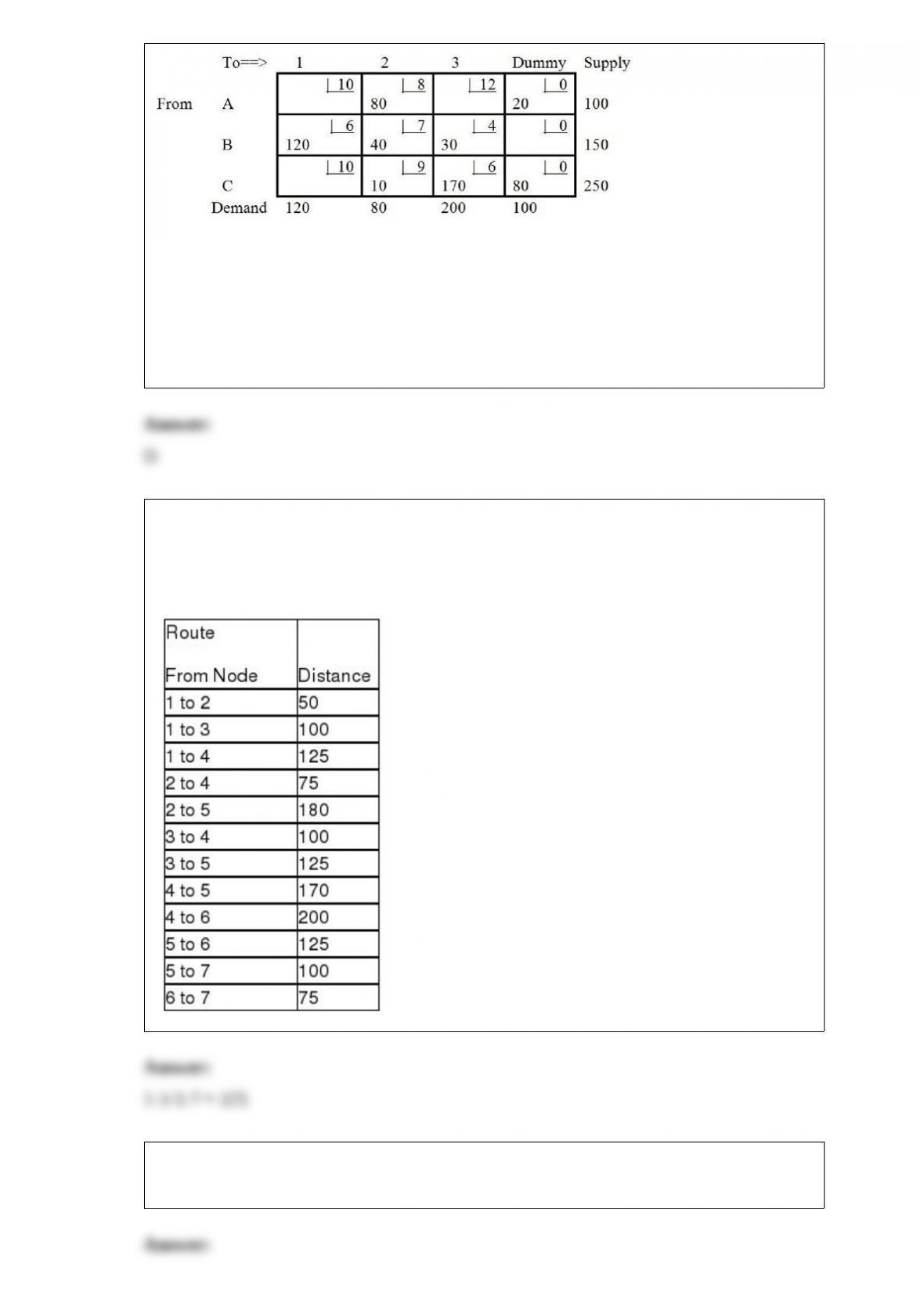
Table M8-7 illustrates a(n)
A) optimal solution.
B) degenerate solution.
C) unbounded solution.
D) infeasible solution.
E) None of the above
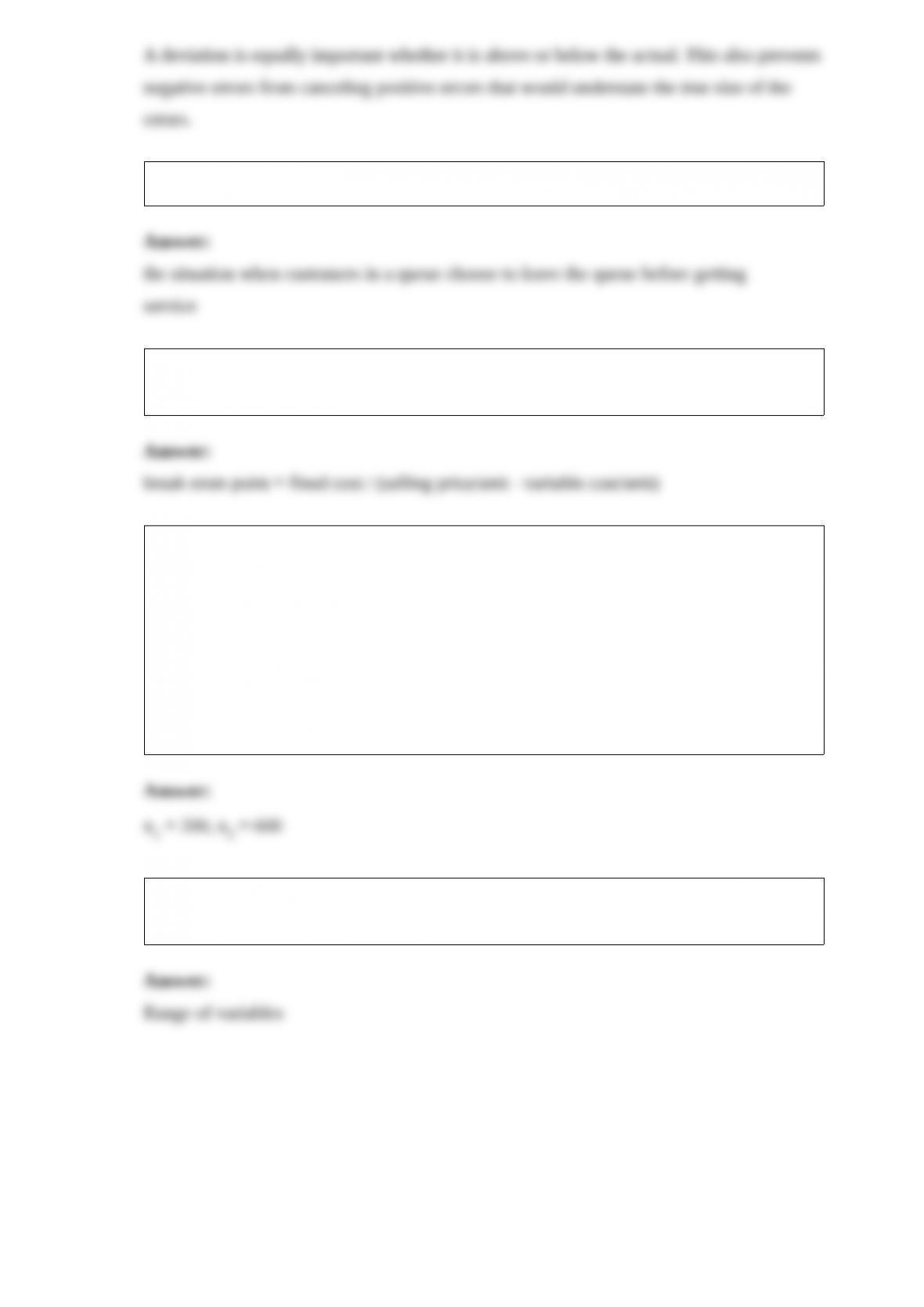
26) A logistics company is determining the shortest route to get to a selected final
destination. The information on possible paths and distances is given below:
27) Explain, briefly, why most forecasting error measures use either the absolute or the
square of the error.
28) With regard to queuing theory, define what is meant by reneging.
29) In terms of fixed costs, variable cost/unit, and the selling price/unit, what is the
break-even point?
30) A bakery produces muffins and doughnuts. Let x1 be the number of doughnuts
produced and x2 be the number of muffins produced. The profit function for the bakery
is expressed by the following equation: profit = 4x1 + 2x2 + 0.3x1
2 + 0.4x2
2. The
bakery has the capacity to produce 800 units of muffins and doughnuts combined and it
takes 30 minutes to produce 100 muffins and 20 minutes to produce 100 doughnuts.
There is a total of 4 hours available for baking time. There must be at least 200 units of
muffins and at least 200 units of doughnuts produced. How many doughnuts and
muffins should the bakery produce in order to maximize profit?
31) Column 1: R-chart
Column 2: Range of variables