
In linear programming, if there are three constraints, each representing a resource that
can be used up, the optimal solution must use up all of each of the three resources.
When developing the standard time for a task, the elements that make up the task must
use the same performance rating factor.
For the greatest chance of success, an organization’s operations management strategy
must support the company’s strategy.
Reduced inventory levels and faster response to market changes are both benefits of
MRP.

One responsibility of a project manager is to make sure that the project meets its quality
goals.
Benchmarking requires the comparison of your firm to other organizations; it is not
appropriate to benchmark by comparing one of your divisions to another of your
divisions.
The multidomestic OM strategy maximizes local responsiveness while achieving a
significant cost advantage.
Simulation models that are based on the generation of random numbers may fail to give
the same solution in repeated use to any particular problem.

An organization’s ability to generate unique advantages over competitors is central to a
successful strategy implementation.
One of the demand options of aggregate planning is to vary the workforce by hiring or
layoffs.
In the analysis of queuing models, the Poisson distribution often describes arrival rates
and service times are often described by the negative exponential distribution.
Self-directed teams tend to be successful in work environments where there is little
employee empowerment.

All of the following are advantages of enterprise resource planning (ERP) except it
A) creates commonality of databases
B) increases communications and collaboration worldwide
C) helps integrate multiple sites and business units
D) requires major changes in the company and its processes to implement
E) can provide a strategic advantage over competitors
Which of the following is not true when explaining why productivity tends to be lower
in the service sector than in the manufacturing sector?
A) Services are typically labor-intensive.
B) Services are often difficult to evaluate for quality.
C) Services are often an intellectual task performed by professionals.
D) Services are difficult to automate.
E) Service operations are typically capital intensive.

Which of the following is not consistent with a pure level strategy?
A) varying the use of subcontracting
B) finding alternative work for employees during low-demand periods
C) using built-up inventory to meet demand requirements
D) varying production levels and/or work force to meet demand requirements
E) All of the above are inconsistent with the pure level strategy.
Flexibility can be achieved with
A) movable equipment
B) inexpensive equipment
C) sophisticated electronic equipment
D) modular equipment
E) all of the above
Learning curves (or experience curves) were first applied to industry by __________
who was studying __________.
A) Frank Lloyd Wright; architecture
B) Frank Gilbreth; worker efficiency

C) T. P. Wright; air frame manufacture
D) Lilian Gilbreth; factory efficiency
E) Frederick W. Taylor; scientific management
Which one of the following technologies is used only for material handling, not actual
production or assembly?
A) robots
B) CNC
C) CAD
D) AGVs
E) FMS
Suppose that the allowance factor for a job is 0.10 and the normal time is 5 hours. What
is the standard time?
A) 5.6 hours
B) 50.0 hours
C) 4.9 hours
D) 5.1 hours

E) 4.5 hours
Which of the following values of alpha would cause exponential smoothing to respond
the most slowly to forecast errors?
A) 0.10
B) 0.20
C) 0.40
D) 0.80
E) cannot be determined
Which of these companies is most apt to have quality standards that are relatively
subjective?
A) Chrysler
B) Dell Computer
C) Sanyo Electronics
D) Harvard University
E) Whirlpool

Scheduling is rather straightforward in product-focused facilities because
A) kanban automates the scheduling of the assembly line
B) demand is reasonably stable, and capacities, set-up times, and run times are
generally known
C) assembly line balancing assures the highest possible production efficiency
D) finite capacity scheduling has made MRP much more realistic
E) All of the above are true.
“Designed to show economy of motion by pointing out waste motion and idle time”
describes
A) a flow diagram
B) an activity chart
C) an operations chart
D) all of the above
E) none of the above

All of the following steps are taken to analyze problems with decision trees except
A) define the problem
B) structure or draw a decision tree
C) assign probabilities to the alternatives
D) estimate payoffs for each possible alternative/state of nature combination
E) solve the problem by computing expected monetary values for each state of nature
node
The reason fast food restaurants often are found in close proximity to each other is
A) they enjoy competition
B) location clustering near high traffic flows
C) low cost
D) availability of skilled labor
E) all of the above
Which of the following combinations of sources and destinations would fill no more
than 25% of cells with quantities to be shipped for the optimal solution?

A) 1 to 1
B) 1 to 4
C) 4 to 1
D) 8 to 2
E) 5 to 16
Which of the following methods best considers intangible costs related to a location
decision?
A) crossover methods
B) locational break-even analysis
C) factor-rating analysis
D) the transportation method
E) the assignment method
A linear programming problem contains a restriction that reads “the quantity of Q must
be no larger than the sum of R, S, and T.” Formulate this as a constraint ready for use in
problem solving software.
A) Q + R + S + T =<4
B) Q >= R + S + T
C) Q – R – S – T =<0

D) Q / (R + S + T) =<0
E) none of the above
Which of the following increase as repairs move from the maintenance department to
the depot service?
A) cost
B) replacement time
C) quality
D) employee ownership
E) A, B, and C
The difference between minimization and maximization problems is that
A) minimization problems cannot be solved with the corner-point method
B) maximization problems often have unbounded regions
C) minimization problems often have unbounded regions
D) minimization problems cannot have shadow prices
E) None of the above are true.
What is the primary concept of total productive maintenance (TPM)? List the other
elements of total productive maintenance.
An operations manager’s staff has compiled the information below for four
manufacturing alternatives (E, F, G, and H) that vary by production technology and the
capacity of the machinery. All choices enable the same level of total production and
have the same lifetime. The four states of nature represent four levels of consumer
acceptance of the firm’s products. Values in the table are net present value of future
profits in millions of dollars. Forecasts indicate that there is a 0.1 probability of
acceptance level 1, 0.2 chance of acceptance level 2, 0.4 chance of acceptance level 3,
and 0.3 change of acceptance level 4.
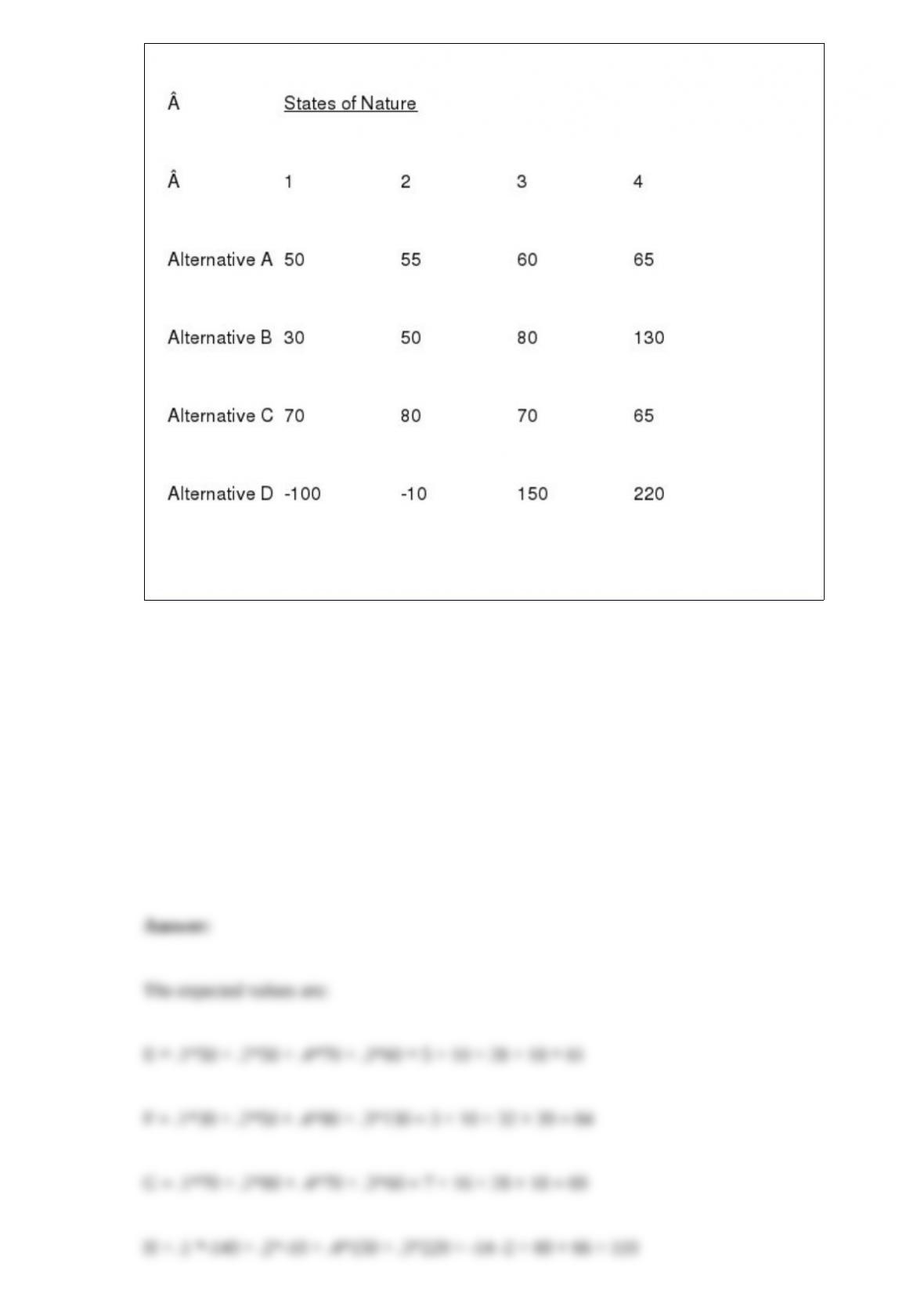
Using the criterion of expected monetary value, which production alternative should be
chosen?
A transportation problem has 6 origins and 12 destinations. How many possible routes
are there for this problem? How many routes will be used in the optimal solution?
A retail store manager is trying to improve and control the rate at which cashiers sign
customers up
for store credit cards. Suppose the manager takes 10 samples, each with 100
observations. P-bar
is found to be .05, and the manager does not want a lower limit below .0064. What
z-value would
this imply, and how confident can he be that the true lower limit is greater than or equal
to .0064?
Repeated sampling of a certain process shows the average of all sample ranges to be 1.0
cm. The sample size has been constant at n = 5. What are the 3-sigma control limits for
this R-chart?
Describe the meaning of EVPI. Provide an example in which EVPI can help a manager.
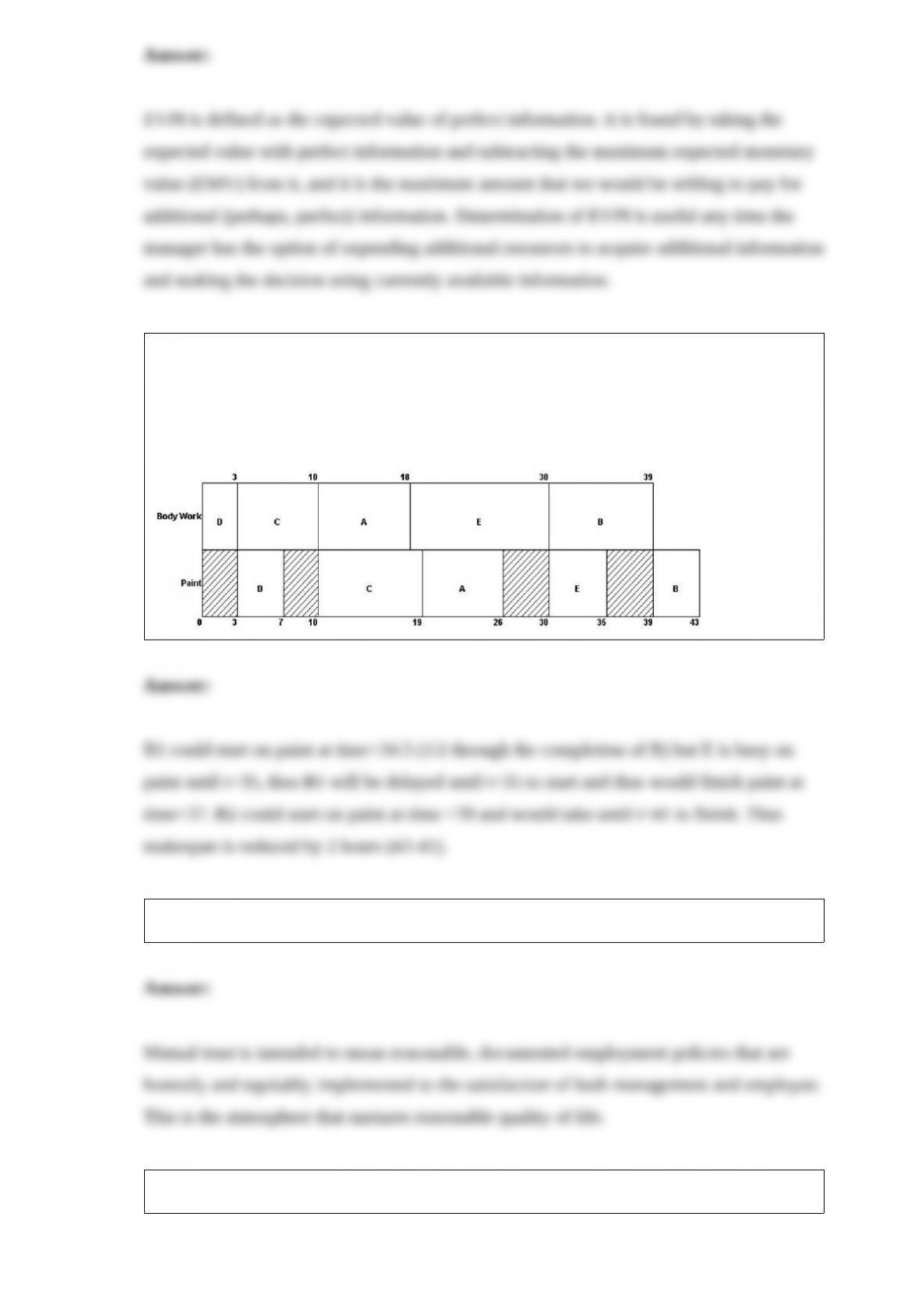
Given the following chart of jobs assigned with Johnson’s rule suppose that all the jobs
(A, B, C, etc) could be evenly divided into two tasks (such as A1 and A2, B1 and B2,
etc). Suppose job B is divided into jobs B1 and B2, each with a body work time of 4.5
hours and a paint time of 2 hours. How much is makespan reduced by this splitting of
B?
What is mutual trust? What is its link to a firm’s human resource strategy?
Identify, in order, the six steps basic to both PERT and CPM.