1) The EOQ model is relatively insensitive to minor violations of the basic assumptions.
2) Cost volume analysis deals only with costs while break-even analysis deals with both
costs and revenues.
3) The decision maker can control states of nature.
4) The Basic Kendall notation is based on arrival time distribution, service time
distribution, and cost characteristics.
5) In a shortest-route problem, the limit on the number of allowable decision variables
from one node to another is the number of possible nodes to which one might yet travel.
6) The error standard deviation is estimated by MSE.
7) A second table (an opportunity loss table) must be computed when applying the
maximin decision criterion.
8) Any linear programming problem can be solved using the graphical solution
procedure.
9) The shortest-route model assumes that one is trying to connect two end points in the
shortest manner possible, rather than attempting to connect all the nodes in the model.
10) Any problem that can be presented in a decision table can also be graphically
portrayed in a decision tree.
11) In a decision problem where we wish to use Bayes’ theorem to calculate posterior
probabilities, we should always begin our analysis with the assumption that all states of
nature are equally likely, and use the sample information to revise these probabilities to
more realistic values.
12) In goal programming, the deviational variables have the same objective function
coefficients as the surplus and slack variables in a normal linear program.
13) A company can decide how many additional labor hours to acquire for a given
week. Subcontractor workers will only work a maximum of 20 hours a week. The
company must produce at least 200 units of product A, 300 units of product B, and 400
units of product C. In 1 hour of work, worker 1 can produce 15 units of product A, 10
units of product B, and 30 units of product C. Worker 2 can produce 5 units of product
A, 20 units of product B, and 35 units of product C. Worker 3 can produce 20 units of
product A, 15 units of product B, and 25 units of product C. Worker 1 demands a salary
of $50/hr, worker 2 demands a salary of $40/hr, and worker 3 demands a salary of
$45/hr. The company must choose how many hours they should contract with each
worker to meet their production requirements and minimize labor cost.
(a) Formulate this as a linear programming problem.
(b) Find the optimal solution.
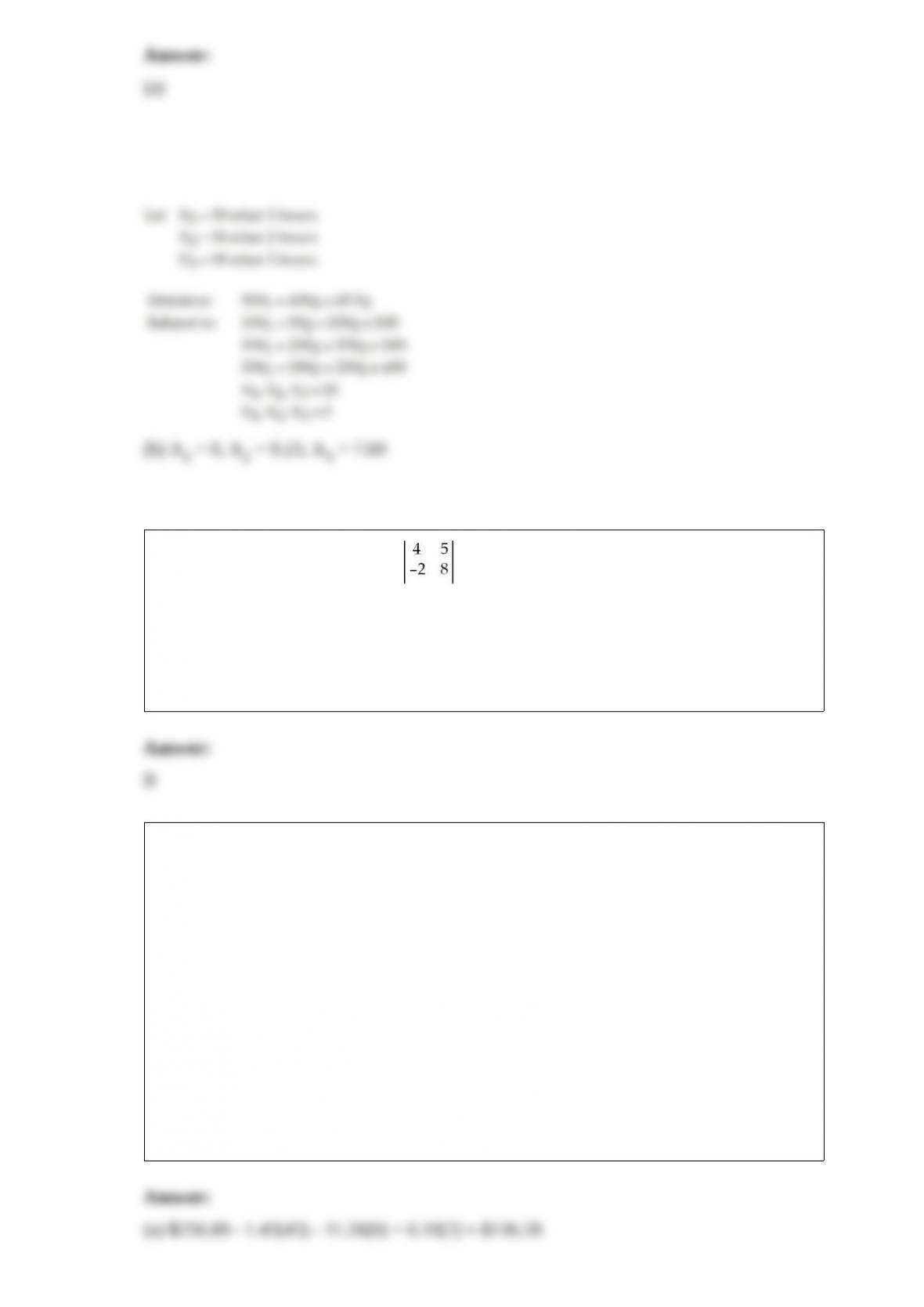
14) The value of the determinant is
A) 30.
B) 42.
C) 16.
D) 20.
E) None of the above
15) An air conditioning and heating repair firm conducted a study to determine if the
average outside temperature, thickness of the insulation, and age of the heating
equipment could be used to predict the electric bill for a home during the winter months
in Houston, Texas. The resulting regression equation was:
Y = 256.89 – 1.45X1 – 11.26X2 + 6.10X3, where Y = monthly cost, X1 = average
temperature, X2 = insulation thickness, and X3 = age of heating equipment
(a) If December has an average temperature of 45 degrees and the heater is 2 years old
with insulation that is 6 inches thick, what is the forecasted monthly electric bill?
(b) If January has an average temperature of 40 degrees and the heating equipment is 12
years old with insulation that is 2 inches thick, what is the forecasted monthly electric
bill?
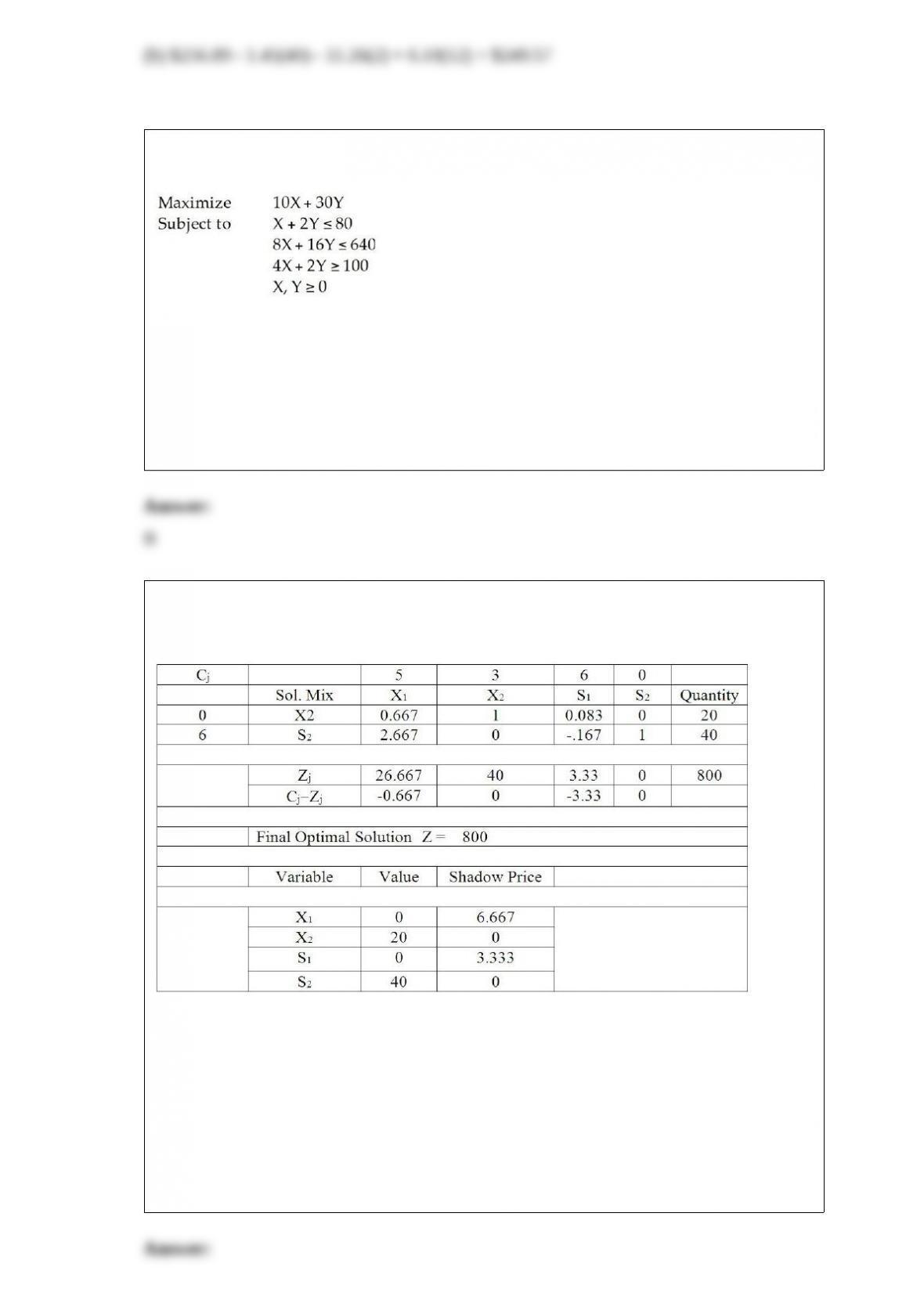
16) Consider the following linear programming problem:
This is a special case of a linear programming problem in which
A) there is no feasible solution.
B) there is a redundant constraint.
C) there are multiple optimal solutions.
D) this cannot be solved graphically.
E) None of the above
17) Table M7-3
According to Table M7-3, which is the final simplex tableau for a problem with two
variables and two constraints, what can be said about the optimal solution and the
constraints?
A) There is slack remaining in the first constraint.
B) There is slack remaining in the second constraint.
C) There is slack remaining in both constraints.
D) There is no slack remaining in either constraint.
E) None of the above
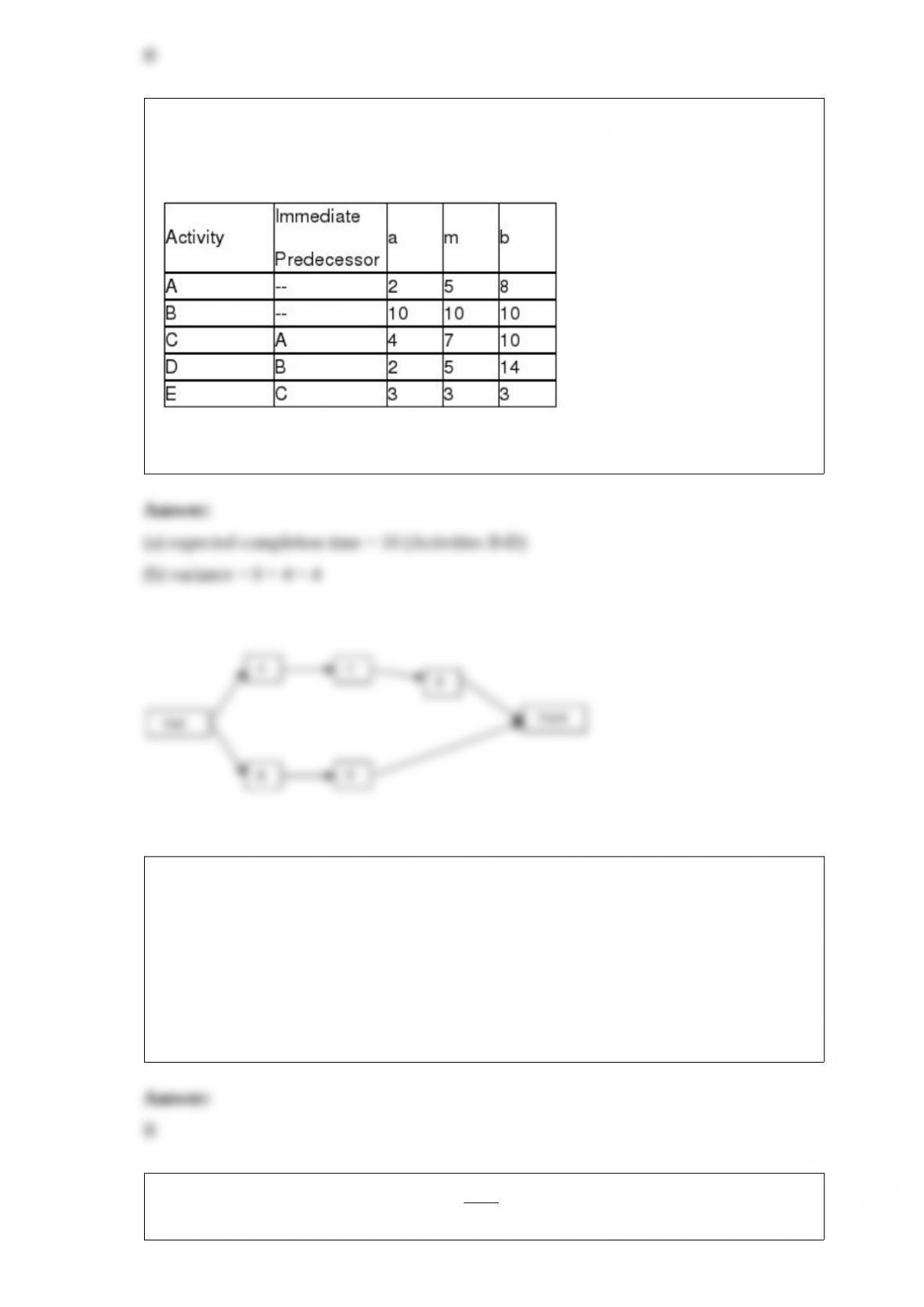
18) A small software development project has five major activities. The times are
estimated and provided in the table below.
(a) What is the expected completion time for this project?
(b) What variance would be used in finding probabilities of finishing by a certain time?
19) The number of phone calls coming into a switchboard in the next five minutes will
either be 0, 1, 2, 3, 4, 5, or 6. The probabilities are the same for each of these (1/7). If X
is the number of calls arriving in a five-minute time period, what is the mean of X?
A) 2
B) 3
C) 4
D) 5
E) None of the above
20) Which of the following statements is false regarding the portfolio selection
problem?
A) The typical objective is to maximize the expected return on investment.
B) The constraints only pertain to risk.
C) Typical applications include banks, mutual funds, investment services, and insurance
companies.
D) The problem typically includes both greater-than-or-equal-to and
less-than-or-equal-to constraints.
E) The problem can also factor in legal requirements.
21) Table 8-3
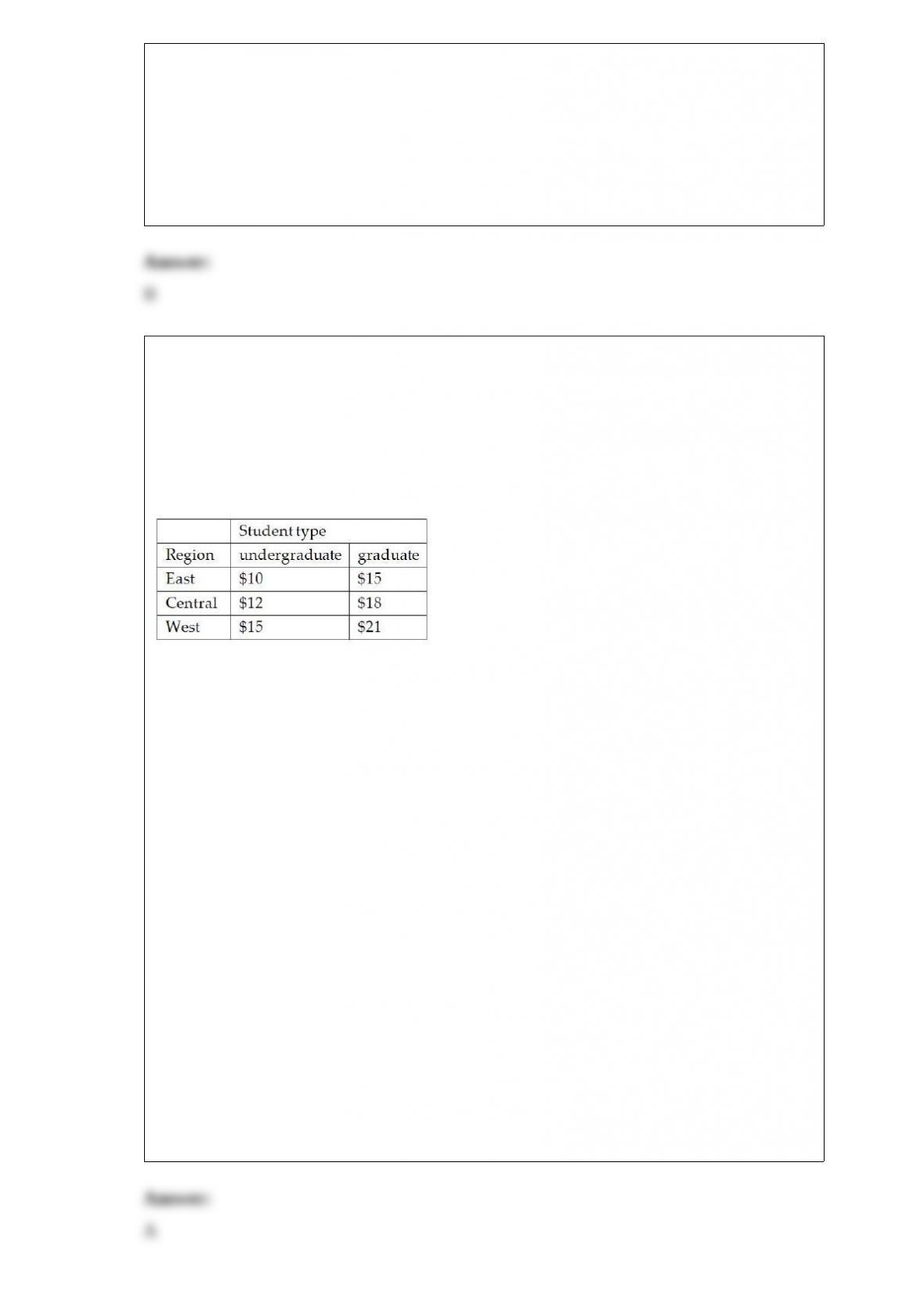
A marketing research firm would like to survey undergraduate and graduate college
students about whether or not they take out student loans for their education. There are
different cost implications for the region of the country where the college is located and
the type of degree. The survey cost table is provided below:
The requirements for the survey are as follows:
1. The survey must have at least 1500 students
2. At least 400 graduate students
3. At least 100 graduate students should be from the West
4. No more than 500 undergraduate students should be from the East
5. At least 75 graduate students should be from the Central region
6. At least 300 students should be from the West
The marketing research firm would like to minimize the cost of the survey while
meeting the requirements. Let X1 = # of undergraduate students from the East region,
X2 = # of graduate students from the East region, X3 = # of undergraduate students
from the Central region, X4 = # of graduate students from the Central region, X5 = # of
undergraduate students from the West region, and X6 = # of graduate students from the
West region.
According to Table 8-3, what is the objective function?
A) Minimize 10X1 + 15X2 + 12X3 + 18X4 + 15X5 + 21X6
B) Maximize 10X1 + 15X2 + 12X3 + 18X4 + 15X5 + 21X6
C) Minimize 10X1 + 12X2 + 15X3 + 15X4 + 18X5 + 21X6
D) Maximize 10X1 + 12X2 + 15X3 + 15X4 + 18X5 + 21X6
E) Minimize 1500X1 + 400X2 + 100X3 + 500X4 + 75X5 + 300X6
22) The selection of specific media from among a wide variety of alternatives is the
type of LP problem known as
A) the product mix problem.
B) the investment banker problem.
C) the Wall Street problem.
D) the portfolio selection problem.
E) None of the above
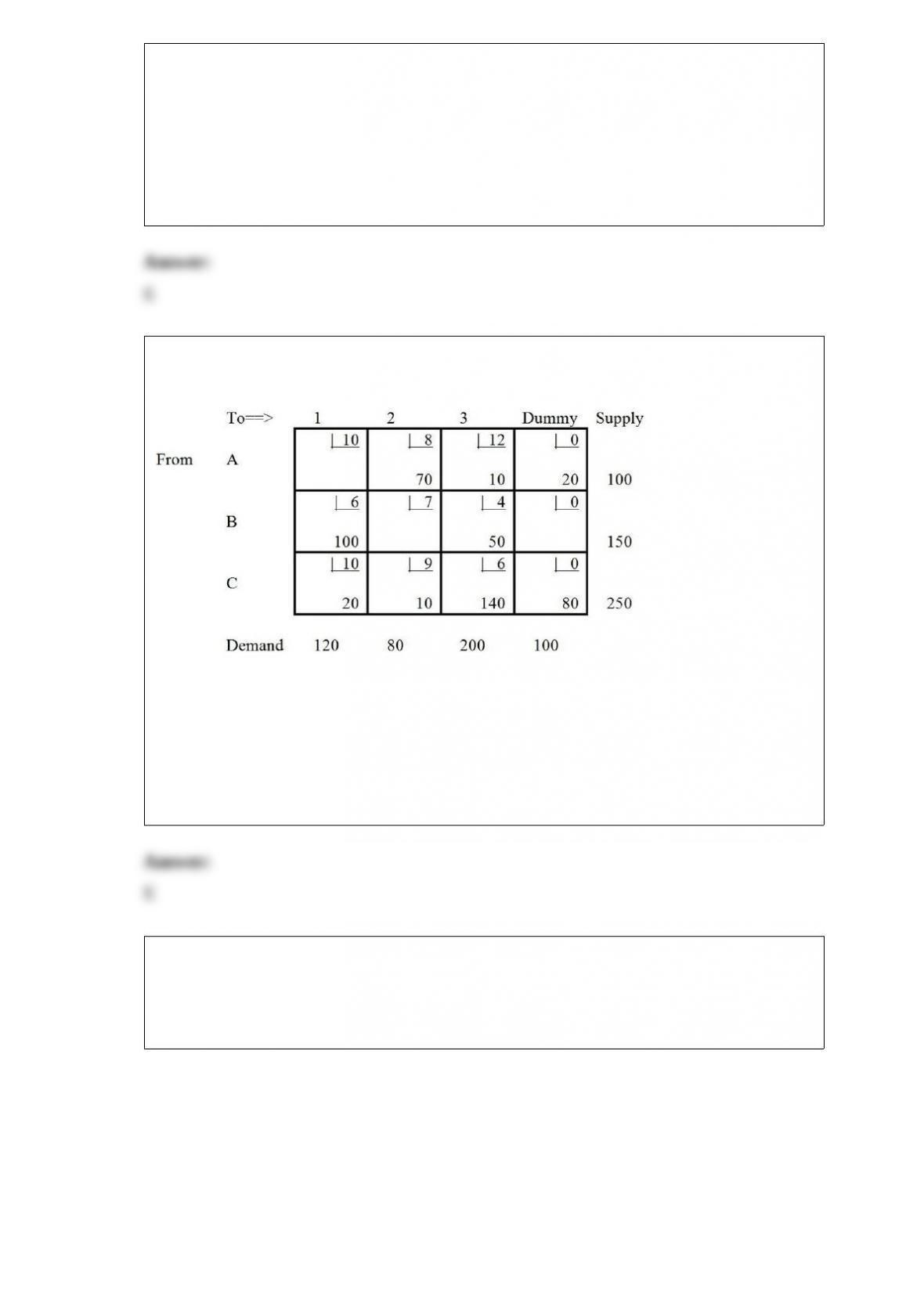
23) Table M8-10
What is wrong with Table M8-10?
A) The solution is infeasible.
B) The solution is degenerate.
C) The solution is unbounded.
D) Nothing is wrong.
E) There are too many filled cells.
24) Table M2-5
The data below is a dynamic programming solution for a shortest route problem.
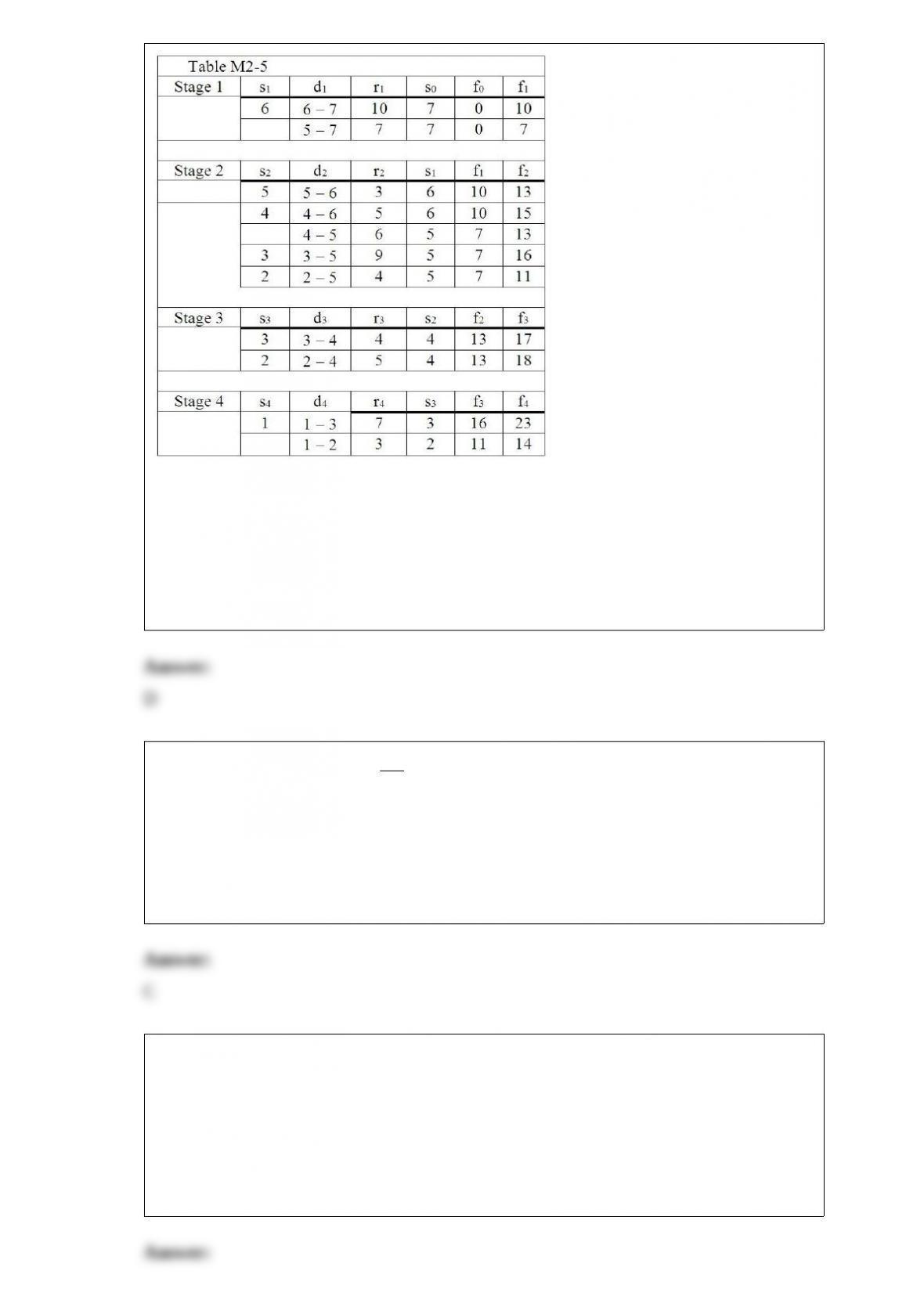
Using the data in Table M2-5, determine the minimum distance from point 1 to point 7.
A) 18
B) 17
C) 23
D) 14
E) None of the above
25) Which of the following is not considered a special situation with the transportation
algorithm?
A) unbalanced transportation problems
B) degeneracy
C) unconstrained transportation problems
D) more than one optimal solution
E) maximization transportation problems
26) A person is using the normal distribution to determine the safety stock for a product.
What z value would be associated with a 90 percent service level?
A) 0.90
B) 1.28
C) 0.53
D) 0.64
E) None of the above
27) What size matrix is yielded when an n x m matrix is multiplied by an m x p matrix?
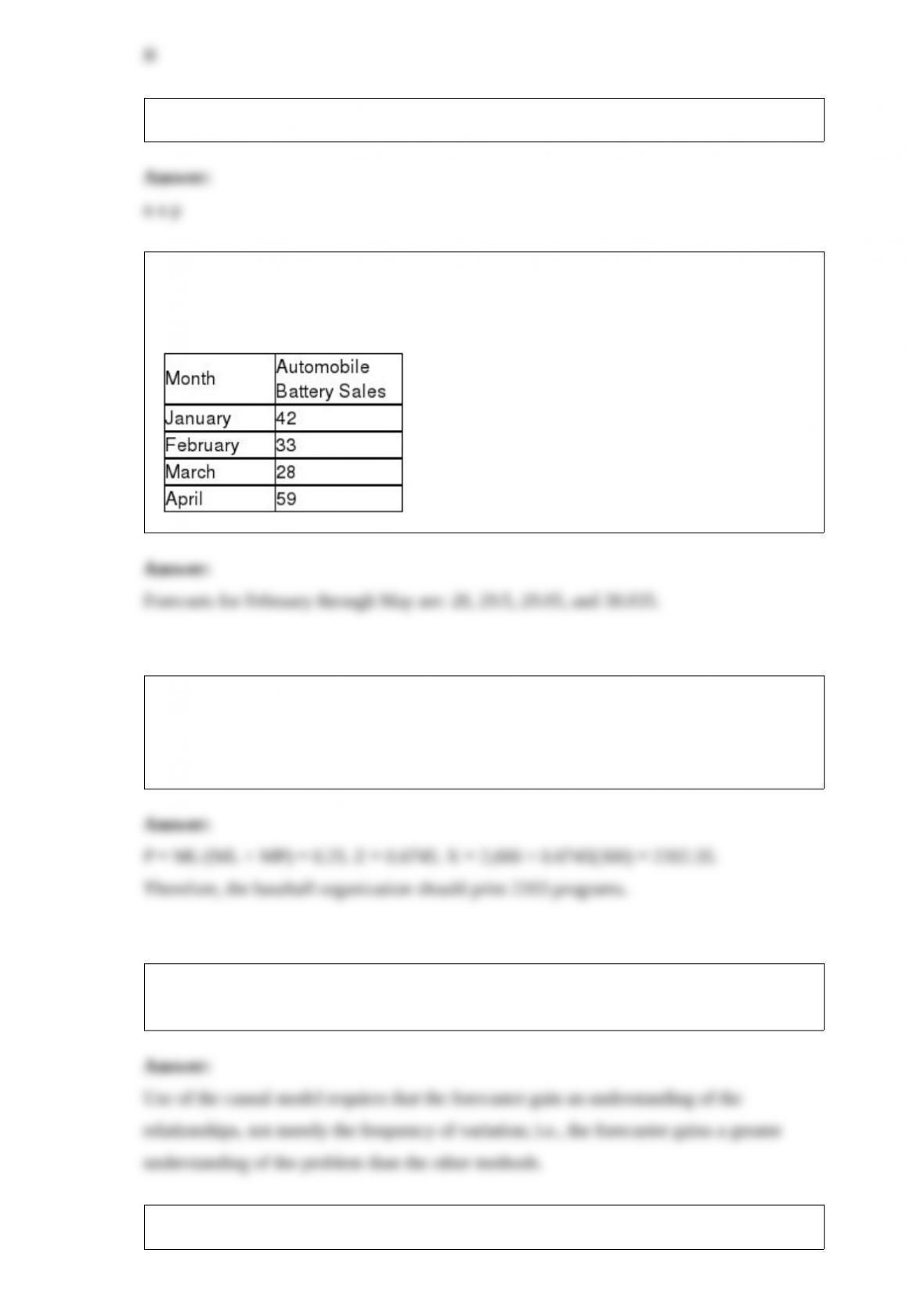
28) Use simple exponential smoothing with α= 0.3 to forecast battery sales for February
through May. Assume that the forecast for January was for 22 batteries.
29) A professional baseball organization chooses to sell game day programs. Demand
for game day programs is normally distributed with a mean of 2,000 and standard
deviation of 300. If the marginal loss is $1 and the marginal profit is $3, how many
programs should the baseball organization print?
30) What is one advantage of using causal models over TIME SERIES or qualitative
models?
31) Determine N(D) for the following D values: 0.01, 0.21, 0.77, and 1.20.

32) What is the difference between the Expected Monetary Value and Expected Value
with Perfect Information?
33) A(n) ________ chart is appropriate to monitor the percent of mortalities due to
heart problems.