1) For a maximization problem, the Zj values in the body of the simplex table represent
the gross profit given up by adding one unit of this variable into the current solution.
2) PERT had its beginnings in a military department of the United States.
3) For the single-period model, if marginal loss increases relative to marginal profit,
then the optimal order quantity will increase.
4) To create the transpose of a given matrix, we simply interchange the rows with the
columns.
5) In the decoupling function, some inventory may be stored between each production
process to act as a buffer.
6) In CPM, crashing an activity that is not on the critical path increases the cost of the
project.
7) The final node or destination in a network is called a(n)
A) arc.
B) branch.
C) source.
D) mouth.
E) sink.
8) Table 8-3
A marketing research firm would like to survey undergraduate and graduate college
students about whether or not they take out student loans for their education. There are
different cost implications for the region of the country where the college is located and
the type of degree. The survey cost table is provided below:
The requirements for the survey are as follows:
1. The survey must have at least 1500 students
2. At least 400 graduate students
3. At least 100 graduate students should be from the West
4. No more than 500 undergraduate students should be from the East
5. At least 75 graduate students should be from the Central region
6. At least 300 students should be from the West
The marketing research firm would like to minimize the cost of the survey while
meeting the requirements. Let X1 = # of undergraduate students from the East region,
X2 = # of graduate students from the East region, X3 = # of undergraduate students
from the Central region, X4 = # of graduate students from the Central region, X5 = # of
undergraduate students from the West region, and X6 = # of graduate students from the
West region.
According to Table 8-3, the constraint that the survey must have at least a total of 1500
students is expressed as
A) X1 + X2 + X3 + X4 + X5 + X6 =< 1500.
B) X1 + X2 + X3 + X4 + X5 + X6 >=1500.
C) 10X1 + 15X2 + 12X3 + 18X4 + 15X5 + 21X6 =< 1500.
D) 10X1 + 15X2 + 12X3 + 18X4 + 15X5 + 21X6 >=1500.
E) X1 + X3 + X5 >=1500.
9) Which of the following is not a potential drawback of an ERP system?
A) Training employees on the use of the new software can be expensive.
B) The software is costly to customize.
C) The software is expensive to buy.
D) The implementation may require a company to change its normal operations.
E) It does not incorporate inventory control decisions.
10) Trying various approaches and picking the one that results in the best decision is
called
A) the trial-and-error method.
B) incomplete enumeration.
C) complete enumeration.
D) algorithmic approximation.
E) sensitivity analysis.
11) Which of the following is not considered a significant inventory cost?
A) cost of production labor
B) purchase cost
C) cost of stockouts
D) cost of carrying an item
E) cost of ordering
12) An alternative approach to project crashing is to use which of the following
techniques?
A) linear programming
B) nonlinear programming
C) Markov analysis
D) queuing theory
E) None of the above
13) Table M7-2
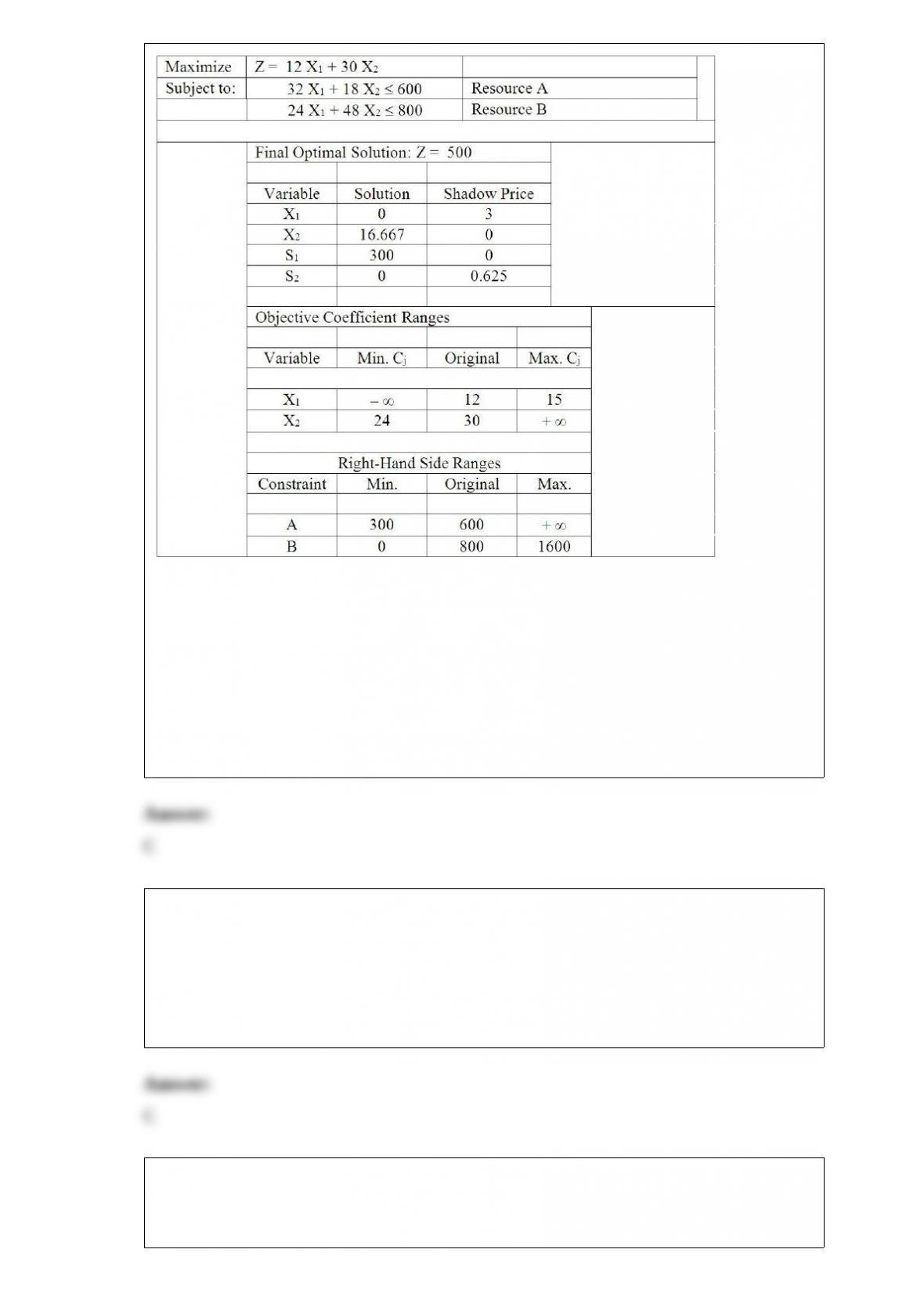
According to Table M7-2, which is a summarized solution output from simplex
analysis, if the amount of resource A were decreased so that there were only 550 units
available instead of 600, what would happen to total profits?
A) They would decrease.
B) They would increase.
C) They would not change.
D) Unable to determine from the given information.
E) None of the above
14) The “point at which to reorder” depends directly on which of the following?
A) EOQ
B) ordering cost
C) lead-time
D) storage costs
E) unit purchasing cost
15) Which of the following statements about scatter diagrams is true?
A) Time is always plotted on the y-axis.
B) It can depict the relationship among three variables simultaneously.
C) It is helpful when forecasting with qualitative data.
D) The variable to be forecasted is placed on the y-axis.
E) It is not a good tool for understanding TIME SERIES data.
16) It is sometimes said that, “Those who gamble the most are the ones who can least
afford to lose.” These people gamble because
A) the EMV is positive.
B) the EMV is negative.
C) the gambler has no family to consider if he/she dies.
D) there is utility other than monetary to consider.
E) None of the above
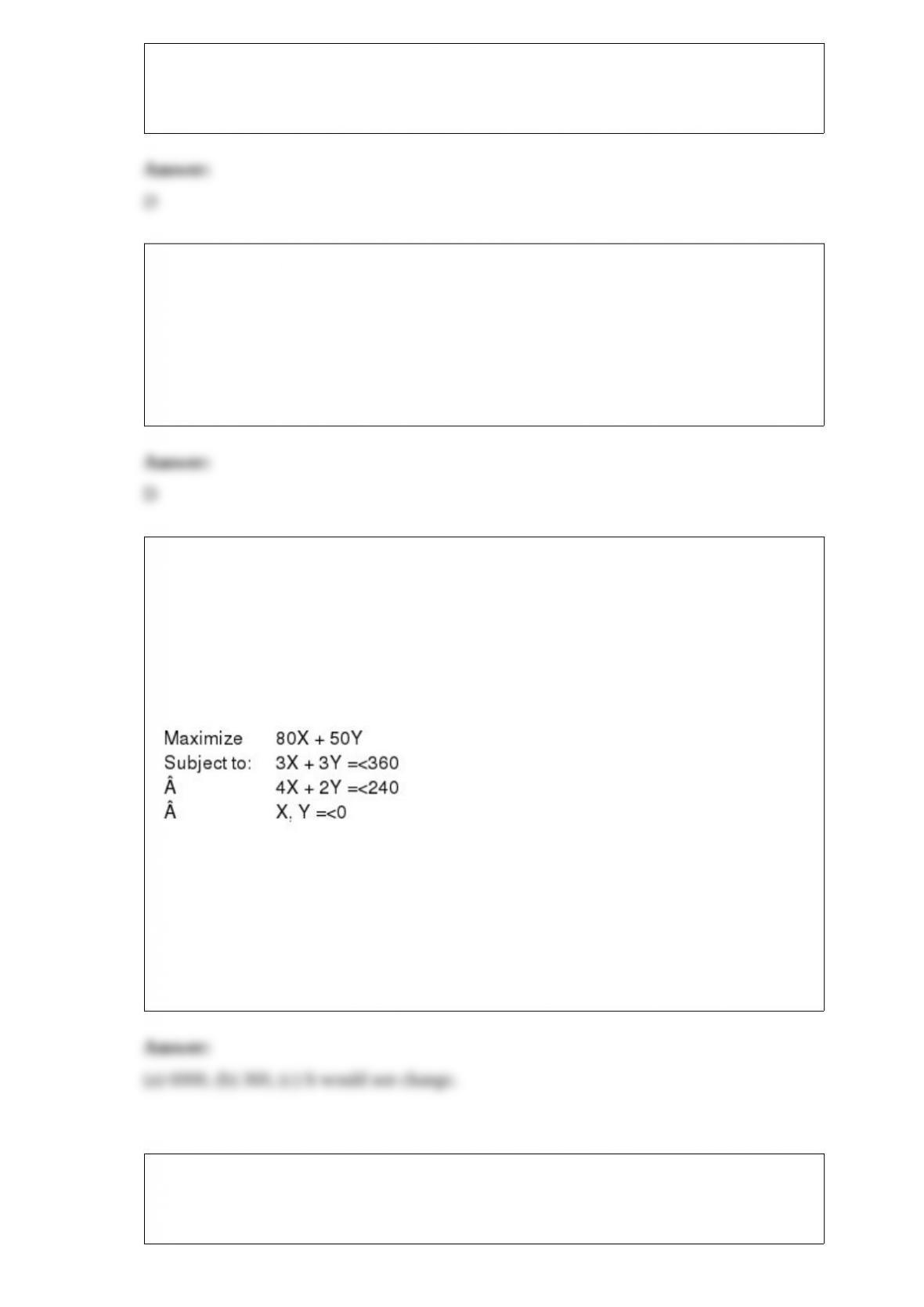
17) Susanna Nanna is the production manager for a furniture manufacturing company.
The company produces tables (X) and chairs (Y). Each table generates a profit of $80
and requires 3 hours of assembly time and 4 hours of finishing time. Each chair
generates $50 of profit and requires 3 hours of assembly time and 2 hours of finishing
time. There are 360 hours of assembly time and 240 hours of finishing time available
each month. The following linear programming problem represents this situation.
The optimal solution is X = 0, and Y = 120.
(a) What would the maximum possible profit be?
(b) How many hours of assembly time would be used to maximize profit?
(c) If a new constraint, 2X + 2Y =<400, were added, what would happen to the
maximum possible profit?
18) The time required to travel downtown at 10 a.m. on Monday morning is known to
be normally distributed with a mean of 40 minutes and a standard deviation of 5
minutes. What is the probability that it will take more than 40 minutes?
A) 0.2500
B) 0.0625
C) 1.000
D) 0.5000
E) None of the above
19) Defects in the finish of new, custom, automobiles usually require the whole body to
be repainted. In one “custom” shop, the percentage of defective finishes has been 2
percent. If a sample size of 10 is taken, what should the 99.7 percent upper control limit
be?
A) 0.1328
B) 0.1085
C) 0.0443
D) 0.1528
E) None of the above
20) R. C. Barker makes purchasing decisions for his company. One product that he buys
costs $50 per unit when the order quantity is less than 500. When the quantity ordered
is 500 or more, the price per unit drops to $48. The ordering cost is $30 per order and
the annual demand is 7,500 units. The holding cost is 10 percent of the purchase cost. If
R. C. orders 500 units each time he places an order, what would the total annual holding
cost be?
A) $450
B) $1,200
C) $1,250
D) $2,400
E) None of the above
21) A company has been receiving complaints about the attitude of some sales clerks.
Over a 10-day period, the total number of complaints was 250. The company wishes to
develop a control chart for the number of complaints. What would the lower control
limit on the number of complaints per day be for a 3 sigma (99.7%) control chart?
A) 20
B) 0
C) 15
D) 10
E) 202.6
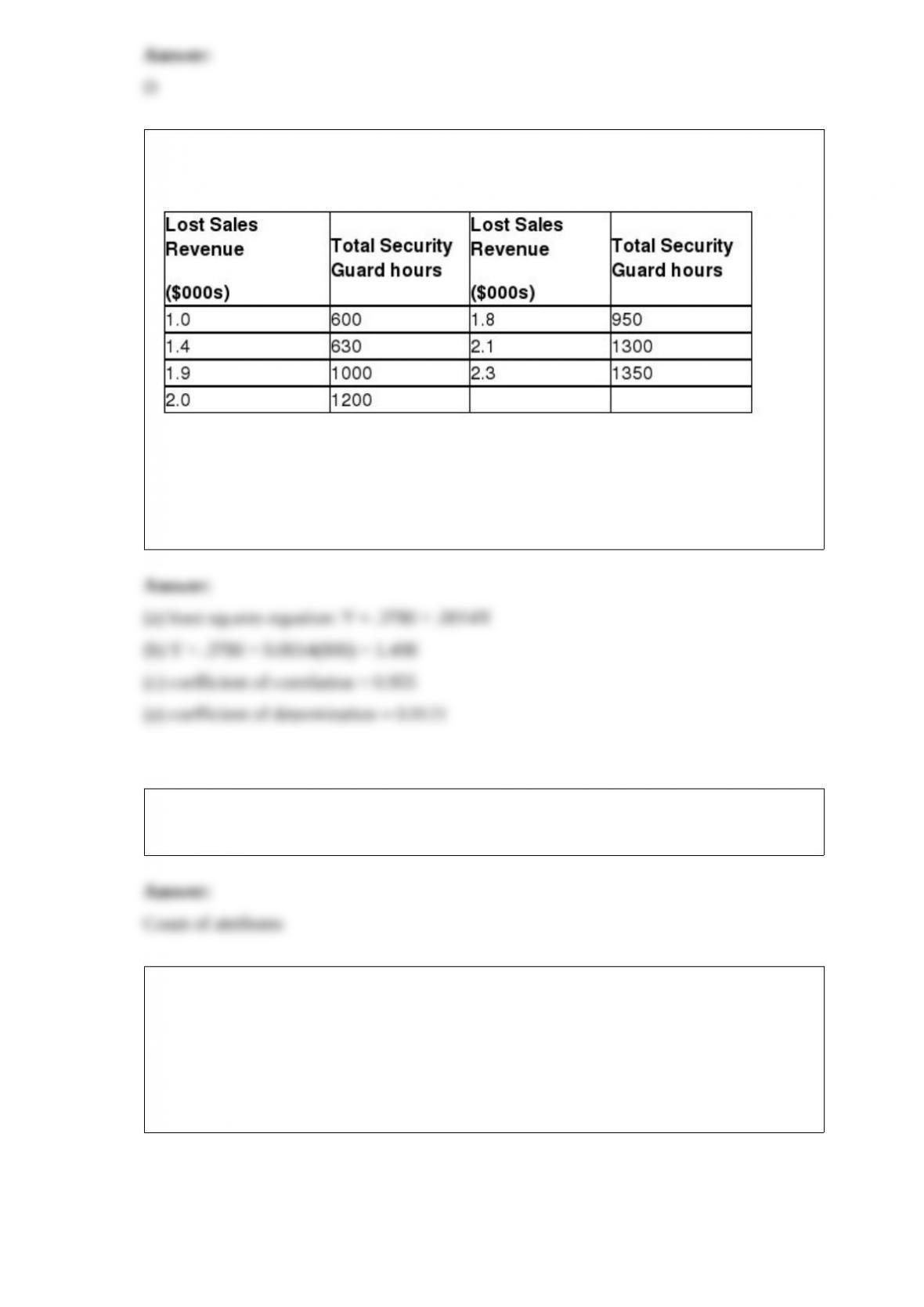
22) A large department store has collected the following monthly data on lost sales
revenue due to theft and the number of security guard hours on duty:
(a) Determine the least squares regression equation.
(b) Using the results of part (a), find the estimated lost sales revenues if the total
number of security guard hours is 800.
(c) Calculate the coefficient of correlation.
(d) Calculate the coefficient of determination.
23) Column 1: c-chart
Column 2: Count of attributes
24) Friendly Manufacturing has three factories (1, 2, and 3) and three warehouses (A,
B, and C). The table below shows the shipping costs between each factory (in dollars)
and warehouse, the factory manufacturing capabilities (in 1000s), and the warehouse
capacities (in 1000s). Write the objective function and the constraint inequalities. Let
X1A = 1000s of units shipped from factory 1 to warehouse A, etc.
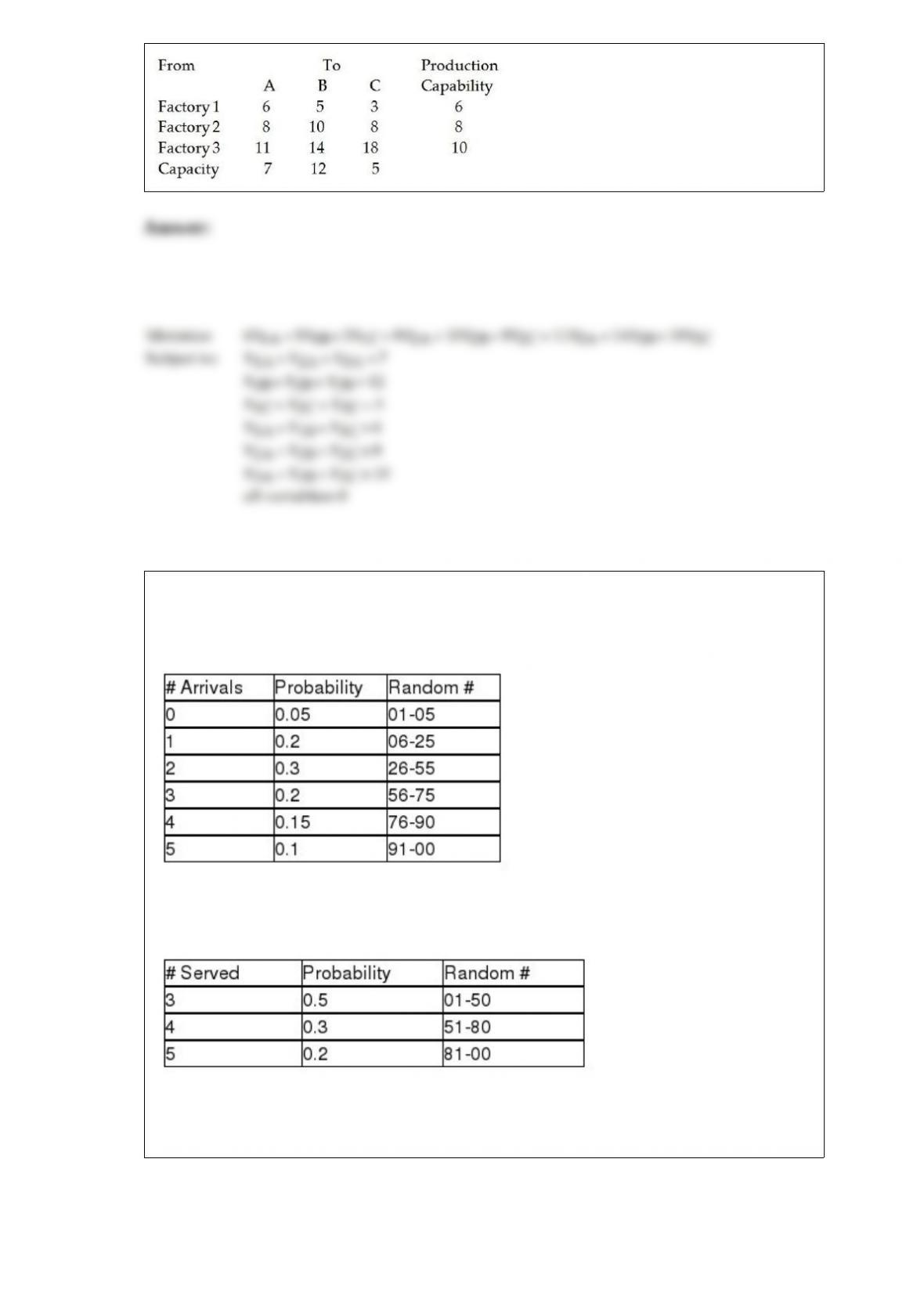
25) A computer help desk receives new daily customer arrivals according to the
following probability distribution:
The number of customers that the help desk has the capability to serve per day is based
on the following probability distribution:
If the number of arrivals exceeds the # served capability, the customers will receive top
priority the next day. The random numbers drawn for a 5-day simulation are as follows:
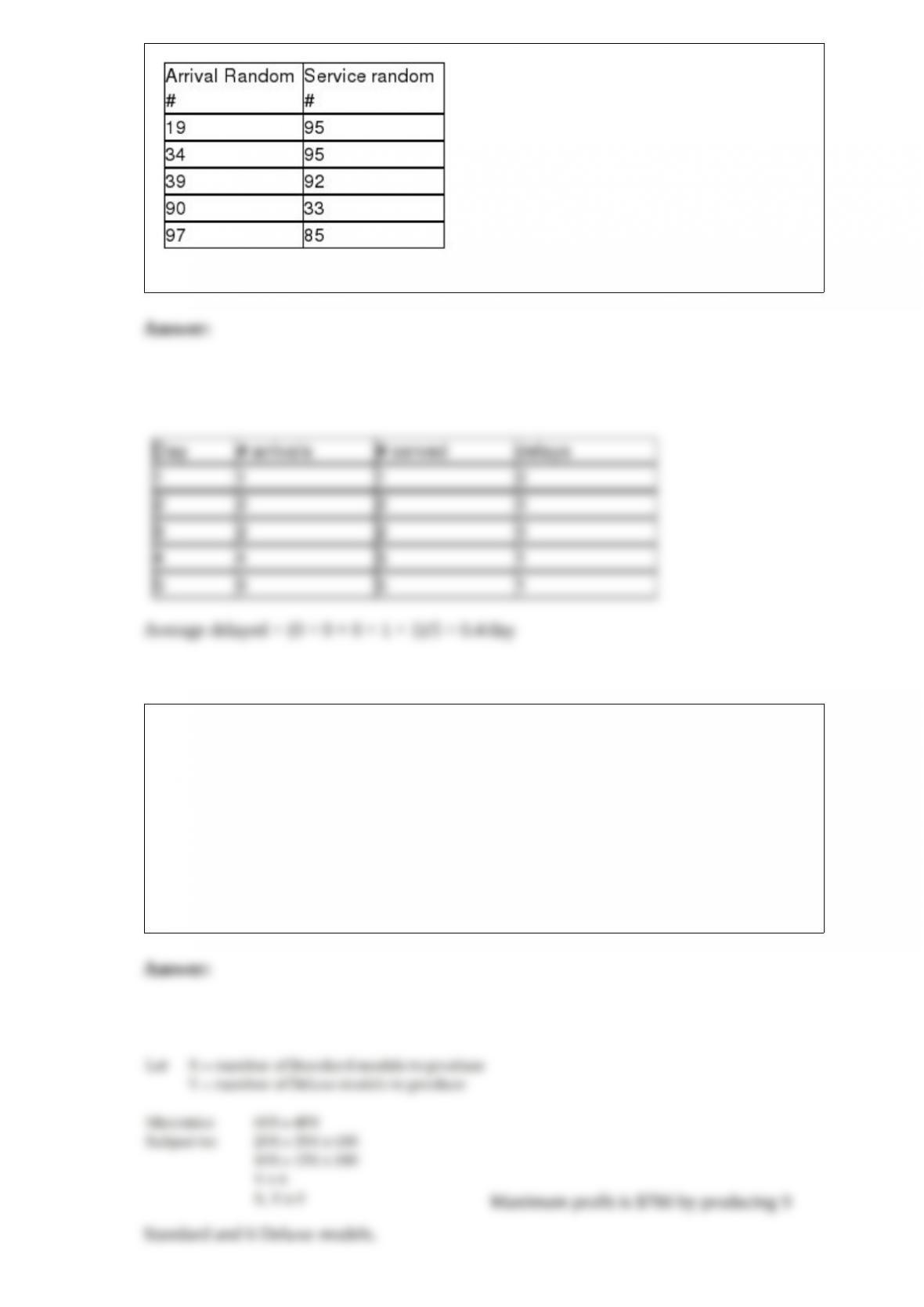
What will the average number of delays be for the 5-day simulation?
26) Billy Penny is trying to determine how many units of two types of lawn mowers to
produce each day. One of these is the Standard model, while the other is the Deluxe
model. The profit per unit on the Standard model is $60, while the profit per unit on the
Deluxe model is $40. The Standard model requires 20 minutes of assembly time, while
the Deluxe model requires 35 minutes of assembly time. The Standard model requires
10 minutes of inspection time, while the Deluxe model requires 15 minutes of
inspection time. The company must fill an order for 6 Deluxe models. There are 450
minutes of assembly time and 180 minutes of inspection time available each day. How
many units of each product should be manufactured to maximize profits?
27) The assignment problem is a special case of the transportation problem. So, then,
why is it not recommended to use the transportation algorithm to solve the assignment
problem?
28) A controllable variable is also called a ________ variable.
29) Explain how degeneracy is recognized when using the simplex algorithm.
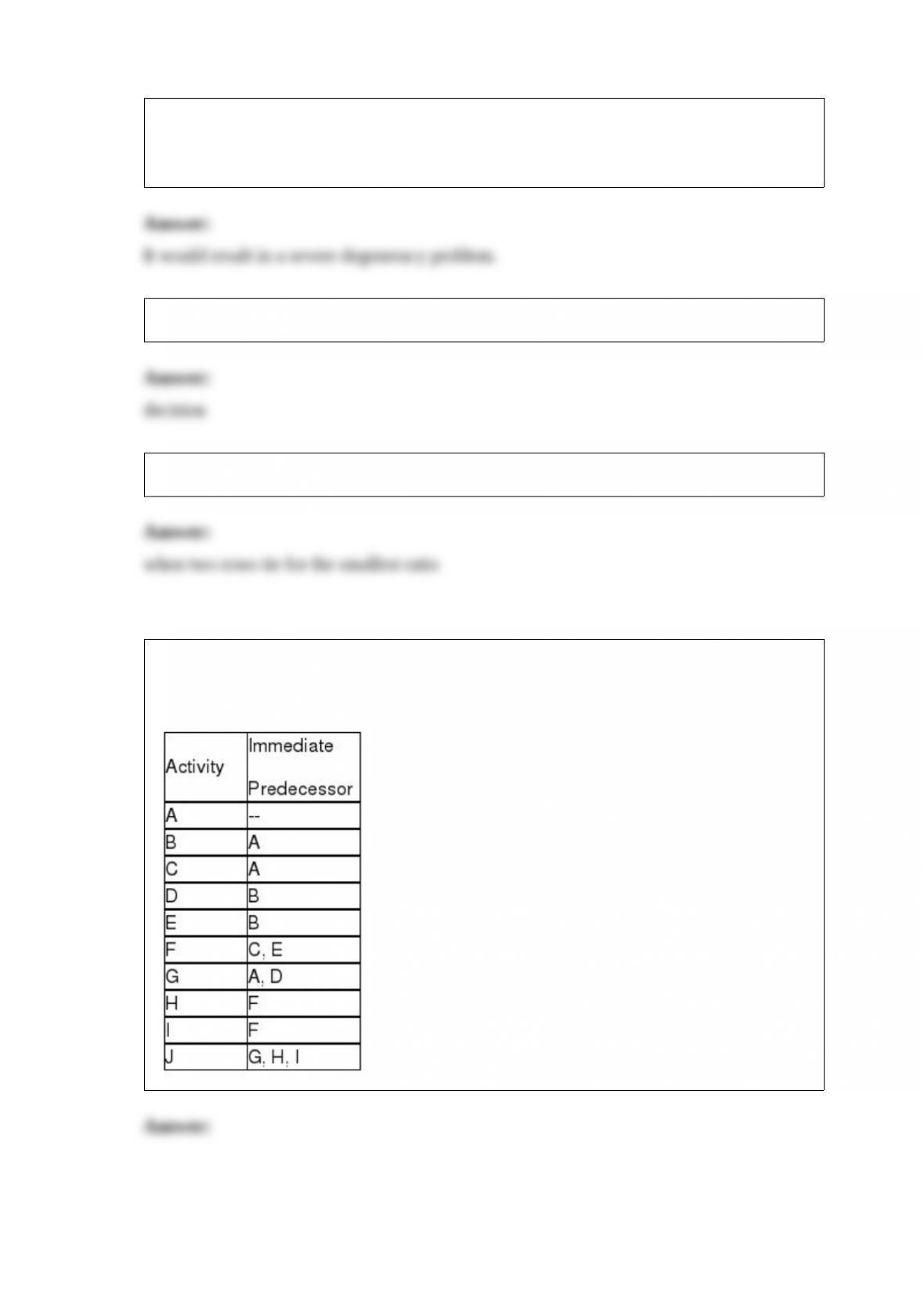
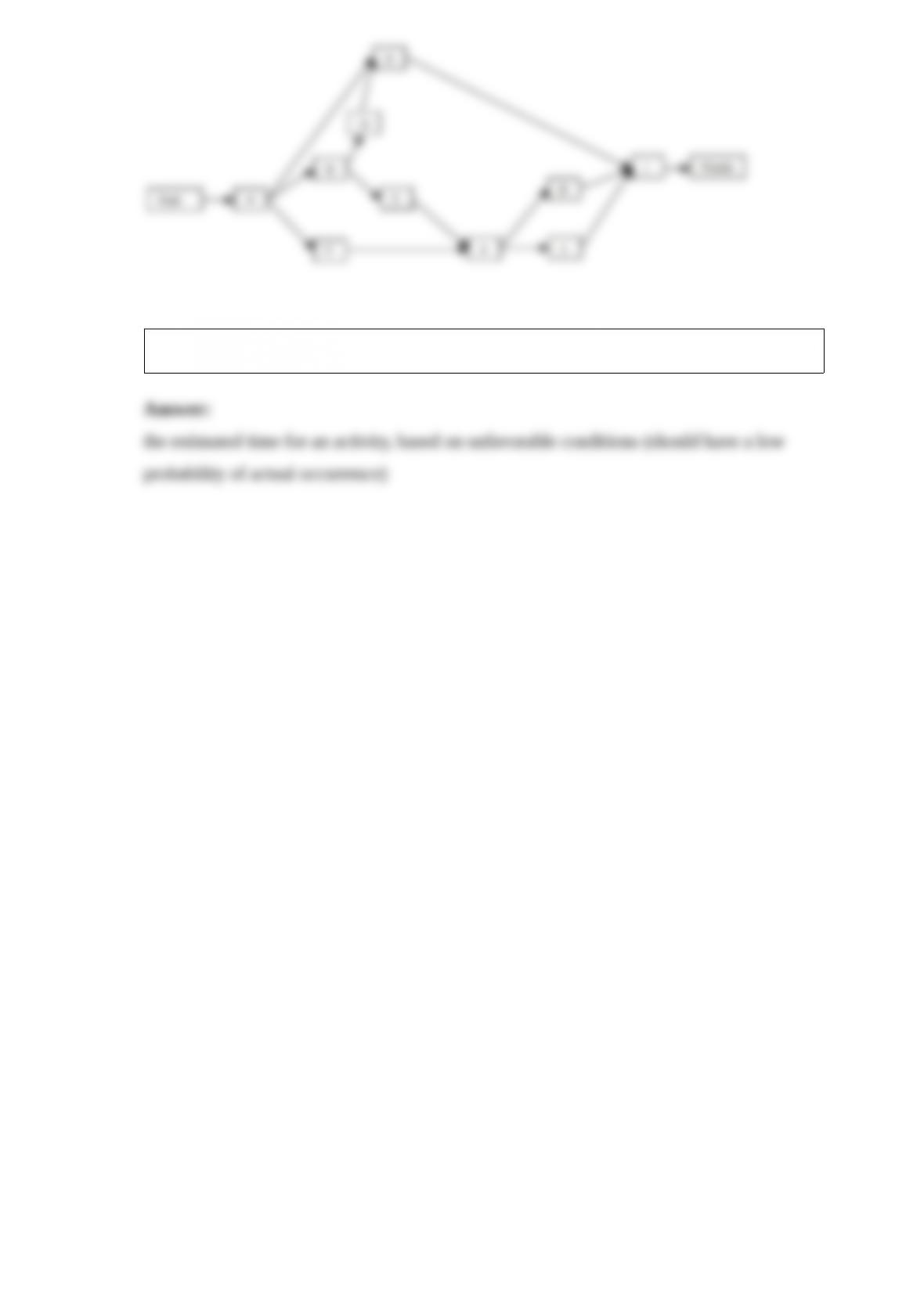
30) Draw the PERT network associated with the following activities.
31) In PERT analysis, how is the pessimistic activity time defined?