Capturing information directly from the source through such systems as point-of-sale,
radio-frequency identification tags, bar-code scanners, and automatic recognition has
had little impact on Operations and Supply Chain Management.
Answer:
A free trade zone operates under different rules and laws than a foreign trade zone.
Answer:
An order winner is a set of criteria that differentiates the products or services of one
firm from another.
Answer:
In a forecasting model using simple moving average the shorter the time span used for
calculating the moving average, the closer the average follows volatile trends.
Answer:
The term “conformance quality” refers to the relative level of performance of a product
as compared to competing products. For instance, certain luxury sedans are said to be of
“higher quality” than some low-priced sub-compact automobiles.
Answer:
Returning involves processes for receiving worn-out, defective, and excess products
back from customers but does not involve support for customers who have problems
with the product.
Answer:
In assembly-line balancing the theoretical minimum number of workstations is found
by a ratio of the sum of all task times divided by the cycle time.
Answer:
One trade-off illustrated by the product-process matrix is between flexibility and cost.
Answer:
SSME is an acronym standing for “Service Sector Management Economics.”
Answer:
Henry Ford used JIT concepts as he streamlined his moving assembly lines to make
automobiles in the early 1900’s.
Answer:
In setting up a Kanban control system you need to determine the number of Kanban
card sets needed. If the expected demand during lead time is 50 per hour, the safety
stock is 20% of the demand during lead time, the container size is 4. If the lead time to
replenish an order is 8 hours, what number of Kanban card sets is needed?
A. 60
B. 80
C. 90
D. 120
E. 150
Answer:
Using the assembly-line balancing procedure, which of the following is the theoretical
minimum number of workstations if the task times for the eight tasks that make up the
job are 7, 4, 7, 8, 9, 4, 3 and 6 minutes, and the cycle time is 8 minutes?
A. 3
B. 5
C. 6
D. 8
E. None of the above
Answer:
You want to determine the lower control line for a “p” chart for quality control
purposes. You take several samples of a size of 50 items in your production process.
From the samples you determine the fraction defective is 0.006 and the standard
deviation is 0.001. If the desired confidence level is 99.7 percent, which of the
following is the resulting LCL value for the line?
A. 0.0
B. 0.002
C. 0.003
D. 0.004
E. None of the above
Answer:
Which of the following is the net requirement using an MRP program if the gross
requirement is 1,250 and the inventory on hand is 50?
A. 1,200
B. 1,300
C. 1,150
D. 2,450
E. None of the above
Answer:
A company wants to forecast demand using the simple moving average. If the company
uses three prior yearly sales values (i.e., year 2011 = 130, year 2012 = 110, and year
2013 =160), which of the following is the simple moving average forecast for year
2014?
A. 100.5
B. 122.5
C. 133.3
D. 135.6
E. 139.3
Answer:
A series of projects that are organized in such a way that each project utilizes people
from different functional areas is using which of the following organizational
structures?
A. Matrix project
B. Integrated Task Force
C. Functional project
D. Pure project
E. Cross-functional flexible team
Answer:
If all you knew about a production system was that total daily output was 400 units and
the total labor necessary to produce the 400 units was 350 hours, what kind of
productivity measure could you use to compute productivity?
A. Partial measure
B. Multifactor measure
C. Total measure
D. Global measure
E. All of the above
Answer:
Which of the following is an example of a finite population in a queuing system?
A. People waiting to place their order at a fast food restaurant
B. The departmental faculty in line at the copy machine.
C. People waiting in line at an ATM.
D. Patients seeking help in a hospital emergency room
E. Taxpayers calling for assistance from the IRS
Answer:
Which of the following industry types have high expected benefits from the application
of MRP?
A. Fabricate-to-stock
B. Fabricate-to-order
C. Assemble-to-stock
D. Continuous process
E. Service and repair parts
Answer:
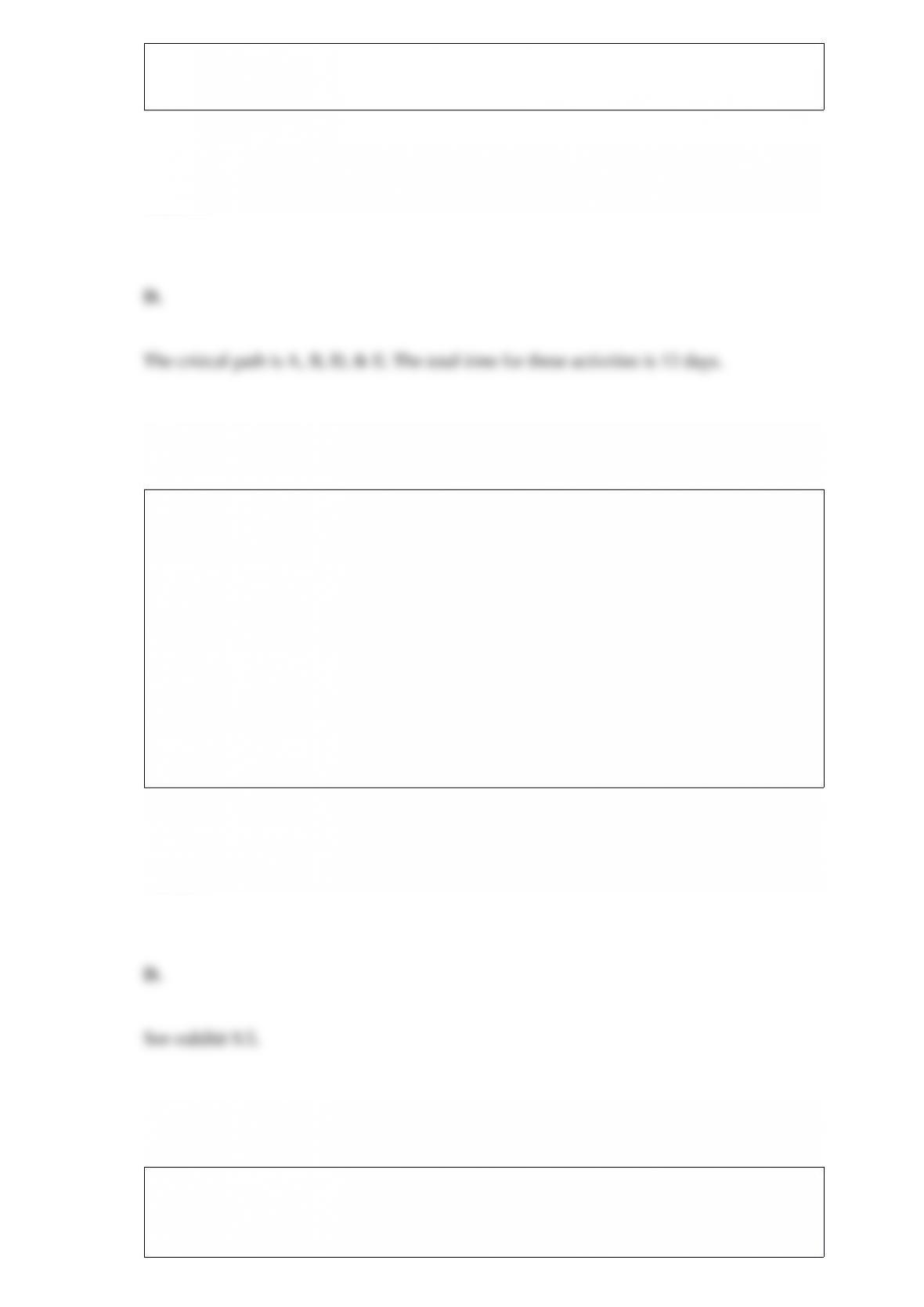
A simple project listing of five activities, their predecessors and their respective time
estimates are presented below:
Using CPM, what is the Latest Finish Time for the last activity in this project (i.e., the
total time to complete the project)?
A. 10 days
B. 7 days
C. 8 days
D. 12 days
E. 9 days
Answer:
Which of the following is considered a primary report in an MRP system?
A. Planning reports
B. Performance reports
C. Exception reports
D. Planned order schedules
E. Cycle counting reports
Answer:
Which of the following is not a step used in determining production capacity
requirements?
A. Forecasting to predict product sales
B. Forecasting raw material usage
C. Projecting availability of labor
D. Calculating equipment and labor needs
E. Projecting equipment availability
Answer:
When developing inventory cost models, which of the following are not included as
costs to place an order?
A. Phone calls
B. Taxes
C. Clerical

D. Calculating quantity to order
E. Postage
Answer:
If it takes a supplier 25 days to deliver an order once it has been placed and the standard
deviation of daily demand is 20, which of the following is the standard deviation of
usage during lead time?
A. 50
B. 100
C. 400
D. 1,000
E. 1,600
Answer:
As a consultant you have been asked to generate a unit demand forecast for a product
for year 2014 using exponential smoothing. The actual demand in year 2013 was 750.
The forecast demand in year 2013 was 960. Using this data and a smoothing constant
alpha of 0.3, which of the following is the resulting year 2014 forecast value?
A. 766
B. 813
C. 897
D. 1,023
E. 1,120
Answer:
Which of the following is a not criterion that influences manufacturing plant or
warehouse facility location decisions?
A. Suppliers
B. Free trade zones
C. Political risk
D. Gross national product
E. Tariffs and customs duties
Answer:
Which of the following are the recommended percentage groupings of the ABC
classifications of the dollar volume of products?
A. A items get 15%, B items get 35%, and C items get 50%
B. A items get 15%, B items get 45%, and C items get 40%
C. A items get 25%, B items get 35%, and C items get 40%
D. A items get 25%, B items get 15%, and C items get 60%
E. A items get 20%, B items get 30%, and C items get 50%
Answer:
There are many applications of poka-yokes in service organizations. Which of the
following is one of the three-T’s used to classify poka-yokes?
A. Talent
B. Teamwork
C. Trust
D. Treatment
E. Time
Answer:
In business forecasting, what is usually considered a long-term time period?
A. Three months or longer
B. Six months or longer
C. One year or longer
D. Two years or longer
E. Ten years or longer

Answer:
Which of the following is a basic type of process structure?
A. Process flow diagram
B. Product matrix
C. Process matrix
D. Workcenter
E. Manual assembly
Answer:
The producer’s risk associated with rejecting a high quality lot is denoted in acceptance
sampling with the Greek letter beta.
Answer:
Which of the following is an assumption of the basic fixed-order quantity inventory
model?
A. Lead times are averaged
B. Ordering costs are variable
C. Price per unit of product is constant
D. Back orders are allowed
E. Stock-out costs are high
Answer:
Which of the following is a criterion that influences manufacturing plant or warehouse
facility location decisions?
A. Proximity to customers
B. Corporate policy
C. Competitor’s locations
D. Competitive advantage
E. Host community politics
Answer:
What is a major industry and university program aiming to apply the latest concepts in
information technology to continue to improve service productivity of
technology-based organizations called?
_____________________________________________
Answer:
In making any decision that affects the size of inventory, what are the four categories of
cost that must be considered?
1> __________________________________________
2> __________________________________________
3> __________________________________________
4> __________________________________________
Answer:
What is that sequence of activities that consume the longest amount of time in a project
network of activities called?
Answer:
You want to determine the control lines for a “p” chart for quality control purposes. If
the total number of defects from all samples is 560, the number of samples is 70, and
the sample size is 80, what would be the standard deviation used in developing the
control lines? ______________________________________
Answer:
What is the name for demand caused by the demand for a higher level item?
__________________________
Answer:
In Hau Lee’s uncertainty framework to classify supply chains, a supply chain that
combines the strengths of a “risk-hedging” and a “responsive” supply chain is called
what? ______________________________________
Answer:
Describe the collaborative planning, forecasting and replenishment (CPFR) technique.
Answer:
You want to develop a three-sigma “R” chart. You know the average range is 5 based on
several samples of size 10. Which of the following is the resulting UCL?
_______________________________________
Answer:
What is the name of a physical inventory-taking technique that focuses only on certain
items and counts more often than once or twice a year?
______________________________________
Answer: