The goal of procurement is
A) to analyze spending across various suppliers and component categories to identify
opportunities for decreasing the total cost.
B) to analyze spending across various suppliers and component categories to identify
opportunities for increasing the total cost.
C) to enable orders to be placed and delivered on schedule at the lowest possible overall
cost.
D) to enable orders to be placed and delivered on schedule regardless of cost.
Marlo Stanfield’s operation also uses large quantities of prepaid cell phones, on average
1500 per week with a standard deviation of 145. The lead time for their own brand of
prepaid cell phones is three weeks and they have a lot size of 350 phones. To ensure
they never run out, they keep a safety stock of 500 phones with Proposition Joe.
What is the expected shortage per cycle under this policy?
A) 1 phone
B) 2.2 phones
C) 4.5 phones
D) 9.8 phones
Which transportation network design option establishes an extra layer between
suppliers and retailers to store inventory and to serve as a transfer location?
A) Direct shipping network
B) Direct shipping with milk runs
C) All shipments via central DC
D) Shipping via DC using milk runs
Gang Aft Agley, a manufacturing company, faces the aggregate planning problem
shown in the table below. Cost of regular production is $5 per unit, the cost of
producing the same unit on overtime is $7.50, the cost of subcontracting is $9 per unit,
and the cost of carrying a unit in inventory from one month to the next is $2.
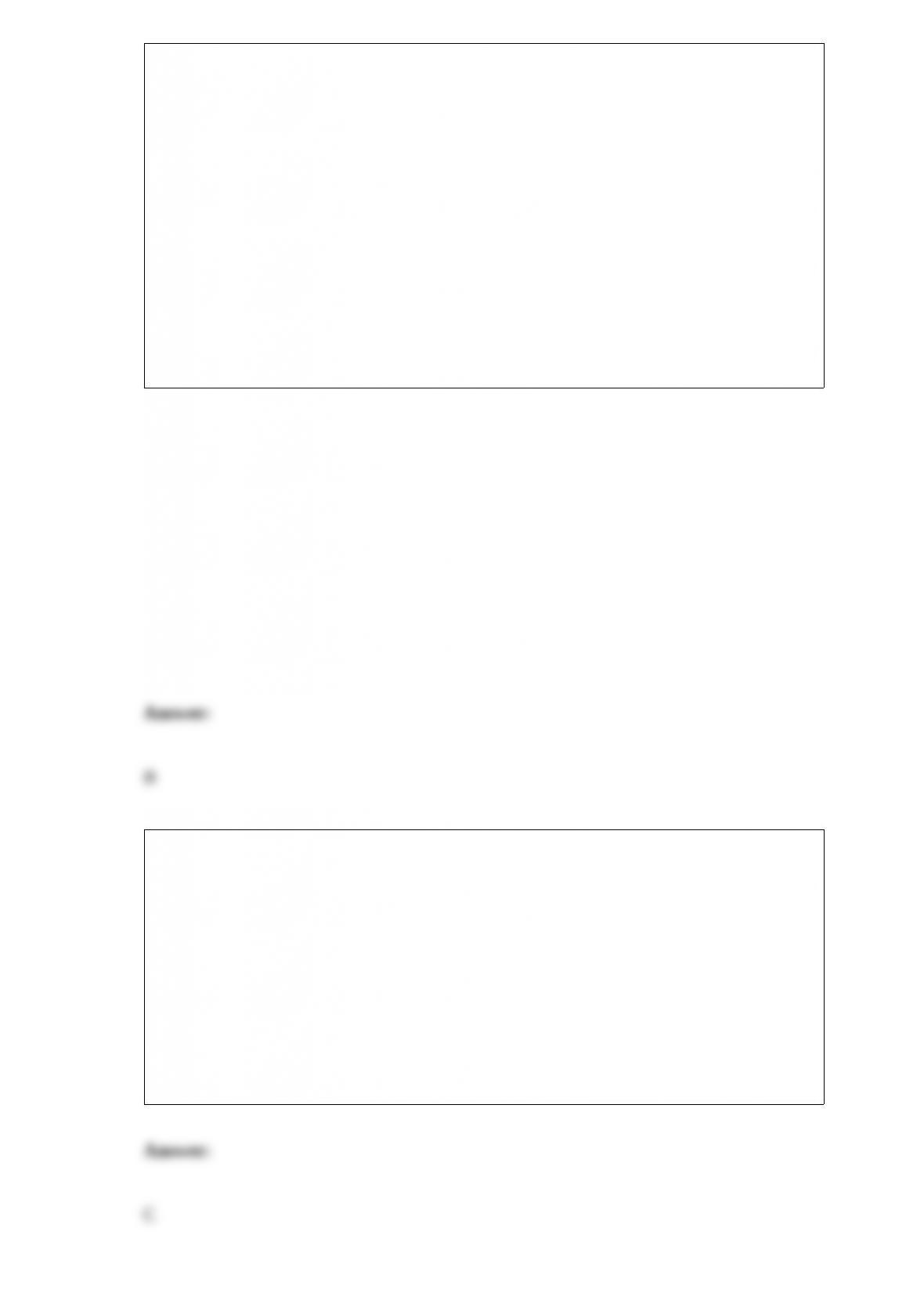
The labor contract at the plant prohibits both overtime and subcontracting output to
exceed 300 units in any five month window. The plant capacity is 600 units per month
produced using two shifts, regardless of the number of days in a month. By policy,
management wants to avoid stockouts.
What is the optimal total cost of the aggregate plan developed to address Scenario 8.1?
A) $16,700
B) $18,950
C) $18,450
D) $16,250
Supply chain network design decisions classified as capacity allocation are concerned
with
A) what processes are performed at each facility.
B) where facilities should be located.
C) how much capacity should be allocated to each facility.
D) what markets each facility should serve and which supply sources should feed each
facility.
________ is a service factor performance characteristic of Manufacturer or Distributor
Storage with Customer Pickup that is lower than other options because of the lack of
home delivery. Experience is very sensitive to capability of pickup location.
A) Response time
B) Product variety
C) Customer experience
D) Time to market
A poor aggregate plan can result in
A) appropriate inventory levels.
B) efficient use of capacity.
C) better sales and lost profits.
D) lost sales and lost profits.
The process by which a firm decides how much to charge customers for its goods and
services is
A) supply chain coordination.
B) forecasting.
C) aggregate planning.
D) pricing.
The taco stand in the atrium of the new College of Business building carried two items,
fish tacos and chicken tacos. The fish tacos sell for $15 and are made out of $5 of
ingredients and the chicken tacos sell for $10 and are made out of $4 of ingredients.
Some days the taco stand owner has only chicken at his disposal, so he makes nothing
but chicken tacos, and some days the opposite is true and he makes only fish tacos.
Thus, he is able to estimate demand for chicken tacos at 2500 per day with a standard
deviation of 600 and the demand for fish tacos at 2000 per day with a standard
deviation of 500. Any fish or chicken tacos that do not sell at the end of the day can be
sold for $1 each as bait. On days when both proteins are available, the taco stand
manager prefers to make a few of each kind. All tacos are made in his home kitchen and
then transported to campus. Due to time constraints and the capacity of his pickup truck
bed, he is limited to beginning each day with only 3000 tacos.
Suppose the taco stand manager could wake up a little earlier and borrow his buddy’s
full size pickup to transport tacos to campus. If time and capacity were not an issue,
how many total tacos should he bring to campus each day?
A) 2500
B) 3000
C) 5041
D) 5500
A decision tree is
A) a graphic device used to evaluate decisions under certainty.
B) a graphic device used to evaluate decisions under uncertainty.
C) a tabular device used to evaluate decisions under certainty.
D) a tabular device used to evaluate decisions under uncertainty.
All costs that do not vary with the size of the order but are incurred each time an order
is placed are referred to as
A) the material cost and are denoted by C.
B) the fixed ordering cost and are denoted by S.
C) the holding cost and are denoted by H.
D) the purchase price and are denoted by P.
The earliest IT supply chain products were
A) aggregate planning modules.
B) cloud-based.
C) SaaS (software as a service).
D) enterprise resource planning modules.
Which of these statements about Dell’s supply chain is best?
A) Dell’s supply chain surplus was largely driven by their negative shipping model.
B) Dell’s initial success was largely driven by the ability to accurately forecast what
customers wanted and supply those models to retail outlets that carried their computers.
C) Dell’s initial success was largely driven by their AssemblyCustomer supply chain
linkage.
D) Dell’s supply chain consists of only two members, Dell and the customer.
The processes involved in the manufacturing cycle include
A) order trigger.
B) production scheduling.
C) order fulfillment.
D) order entry.
In this approach to managing capacity, a firm has flexible production lines whose
production rate can easily be varied.
A) Time flexibility from workforce
B) Use of subcontracting
C) Designing product flexibility into the production processes
D) Use of seasonal workforce
These two companies have also set aggressive targets for their suppliers to improve
overall supply chain sustainability.
A) Walmart and IKEA
B) IBM and 3M
C) Mattel and Hasbro
D) Apple and Starbucks
Demand is forecast for the next five months as 200, 300, 500, 300, 200. The production
planner decides to adopt a chase strategy, so over the next five months they should
produce
A) 200, 300, 500, 300, 200.
B) 500, 400, 300, 200, 100.
C) 100, 200, 300, 400, 500.
D) 300, 300, 300, 300, 300.
A supply chain strategy involves decisions regarding all of the following except
A) inventory.
B) transportation.
C) new product development.
D) operating facilities.
Although faster transportation is more expensive, a firm receives which benefit as a
result of the faster transportation?
A) Fewer rejects
B) Higher profit
C) Lower inventories
D) More warehouses