Because little or no inventory is carried in a service operation, it is easy to separate the
operations management functions from marketing in services.
Answer:
A rate fence is a person who books airline seats at low rates far in advance and sells the
seats at a profit later.
Answer:
An operational goal of total quality management is the careful design of the product or
service.
Answer:
The increasing complexity of modern operations management has made simple
cut-and-try charting and graphical methods formerly used to develop aggregate
operations plans impractical and obsolete.
Answer:
Fixed and variable costs incurred in producing a given product type in a given time
period are relevant aggregate operations planning costs.
Answer:
Cross docking is a practice used in the international shipping industry that facilitates
port utilization.
Answer:
The term “value” refers to the relationship between quality and the price paid by the
consumer.
Answer:
Total, one-hundred percent, inspection can never be cost justified.
Answer:
In a logistics organization vehicle dispatching immediately precedes vehicle loading.
Answer:
Green sourcing is only about finding new environmentally friendly technologies and
increasing the use of recyclable materials.
Answer:
Respect for people is a key to Toyota’s improvement ideas in manufacturing.
Answer:
One of the drivers of the direct-to-store (direct distribution) approach is the decrease in
trucking industry regulation.
Answer:
Cross-docking is an approach used in consolidation warehouses, where large shipments
are broken down into small shipments for local delivery in an area.
Answer:
Which of the following is not an improvement-driven reason to outsource?
A. Improve risk management
B. Increase commitment in a non-core area
C. Shorten cycle time
D. Improve quality and productivity
E. Obtain expertise, skills and technologies that are otherwise not available
Answer:
If annual demand is 50,000 units, the ordering cost is $25 per order and the holding cost
is $5 per unit per year, which of the following is the optimal order quantity using the
fixed-order quantity model?
A. 909
B. 707
C. 634
D. 500
E. 141
Answer:
Which of the following is the net requirement using an MRP program if the gross
requirement is 1,000 and the inventory on hand is 500?
A. 1,000
B. 950
C. 500
D. 400
E. 350
Answer:
Which of the following address elimination of waste under lean production?
A. Info-matic warehouse networks
B. Outsourced housekeeping
C. Quality at the source
D. Backflush
E. Bottom-round management
Answer:
Using the fixed-time period inventory model, and given an average daily demand of
200 units, 4 days between inventory reviews, 5 days for lead time, 120 units of
inventory on hand, a “z” of 1.96, and a standard deviation of demand over the review
and lead time of 3 units, which of the following is the order quantity?
A. About 1,086
B. About 1,686
C. About 1,806
D. About 2,206
E. About 2,686
Answer:
Which of the following should we use an “R” chart to monitor process quality?
A. Weighing trucks at a highway inspection station to determine if they are overloaded
B. Deciding whether an airliner has sufficient fuel for its trip
C. Student grades measured from 1 to 100
D. Determining whether vehicles from a motor pool will run
E. Determining the accuracy of a forecast of ‘snow”
Answer:
You have just been assigned to oversee a series of projects. Functional areas will loan
you personnel for each project and separate project managers will be responsible for
separate projects. These project managers will report to you. Which project
management structure is being used?
A. Pure Project
B. Task force
C. Matrix Project
D. Functional Project
E. PERT
Answer:
You would like to use the fixed-time period inventory model to compute the desired
order quantity for a company. You know that vendor lead time is 10 days and the
number of days between reviews is 15. Which of the following is the standard deviation
of demand over the review and lead time period if the standard deviation of daily
demand is 10?
A. 25
B. 40
C. 50
D. 73
E. 100
Answer:
If the average aggregate inventory value is $1,200,000 and the cost of goods sold is
$600,000, which of the following is weeks of supply?
A. 1,040
B. 606
C. 104
D. 60.6
E. 2.0
Answer:
Which of the following forecasting methods is very dependent on selection of the right
individuals who will judgmentally be used to actually generate the forecast?
A. Time series analysis
B. Simple moving average
C. Weighted moving average
D. Delphi method
E. Panel consensus
Answer:
A product tree can do which of the following?
A. Help to compute component usage
B. Reduce product scrap
C. Reduce labor overtime
D. Reduce regular time labor
E. Locate raw material supplies
Answer:
Which of the following is not listed in the textbook as a component of a lean supply
chain?
A. Lean customers
B. Lean Management
C. Lean logistics
D. Lean warehousing
E. Lean procurement
Answer:
Which of the following is the portion of observations you would expect to see lying
within a plus or minus 3 MAD range?
A. 57.05 percent
B. 88.95 percent
C. 98.36 percent
D. 99.85 percent
E. 100 percent
Answer:
An analytical tool used in six-sigma quality improvement programs is which of the
following?
A. Leadership
B. Continuous improvement
C. Quick response
D. Partnership diagrams
E. Checksheets
Answer:
In the textbook Toyota’s Fujio Cho identified which of the following types of waste to
be eliminated?
A. Underproduction
B. Excess quality
C. Preventive maintenance
D. Product defects
E. Kaizen
Answer:
If it takes a supplier two days to deliver an order once it has been placed and the daily
demand for three days has been 120, 124, and 125, which of the following is the
standard deviation of usage during lead time?
A. About 2.16
B. About 3.06
C. About 4.66
D. About 5.34
E. About 9.30
Answer:
Which of the following should we use an “R” chart to monitor process quality?
A. Grades in a freshman “pass/fail” course
B. Tire pressures in an auto assembly plant
C. Vehicles passing emissions inspection
D. Computer software errors
E. Number of units with missing operations
Answer:
If a vendor has correctly used marginal analysis to select their stock levels for the day
(as in the newsperson problem), and the profit resulting from the last unit being sold
(Cu) is $0.90 and the loss resulting from that unit if it is not sold (Co) is $0.50, which of
the following is the probability of the last unit being sold?
A. Greater than 0.357
B. Greater than 0.400
C. Greater than 0.556
D. Greater than 0.678
E. None of the above
Answer:
The total value of all items held in inventory for the firm valued at cost is which of the
following?
A. Cost of goods to be sold
B. Average aggregate inventory value
C. Weeks supply of goods
D. Inventory turnover
E. None of the above
Answer:
In a workcenter, machine A has a ten minute set-up time per batch and a two minute per
unit run time. Machine B performs the identical function but has a set-up time of thirty
minutes and a one minute run time per unit. The workcenter makes products in batches
ranging from one unit to one hundred units. Assuming capacity is not a limitation on
either machine, on which batches should machine B be used?
A. All batches should be run on machine B
B. Batches of more than 20 units should be run on machine B
C. Batches of fewer than 80 units should be run on machine B
D. Batches with up to 50 units should be run on machine B
E. No batches should be run on machine B
Answer:
You want to determine the control lines for a “p” chart for quality control purposes. If
the total number of defects from all samples is 2,500, the number of samples is 100, and
the sample size is 50, which of the following would be the standard deviation used in
developing the control lines?
A. 0.4900
B. 0.2499
C. 0.1556
D. 0.0707
E. 0.02499
Answer:
Which of the following methods discussed in the text requires generating several
alternative aggregate plans?
A. Trial and error
B. Production smoothing
C. Graphing and charting
D. Aggregate plan simulation
E. Cut and try
Answer:
Which of the following forecasting methods can be used for short-term forecasting?
A. Simple exponential smoothing
B. Delphi technique
C. Market research
D. Hoskins-Hamilton smoothing
E. Serial regression
Answer:
What is the difference between the concepts of design quality and conformance quality?
Answer:
Compare and contrast the factor-rating system and the transportation method of linear
programming as used in facility location decisions.
Answer:
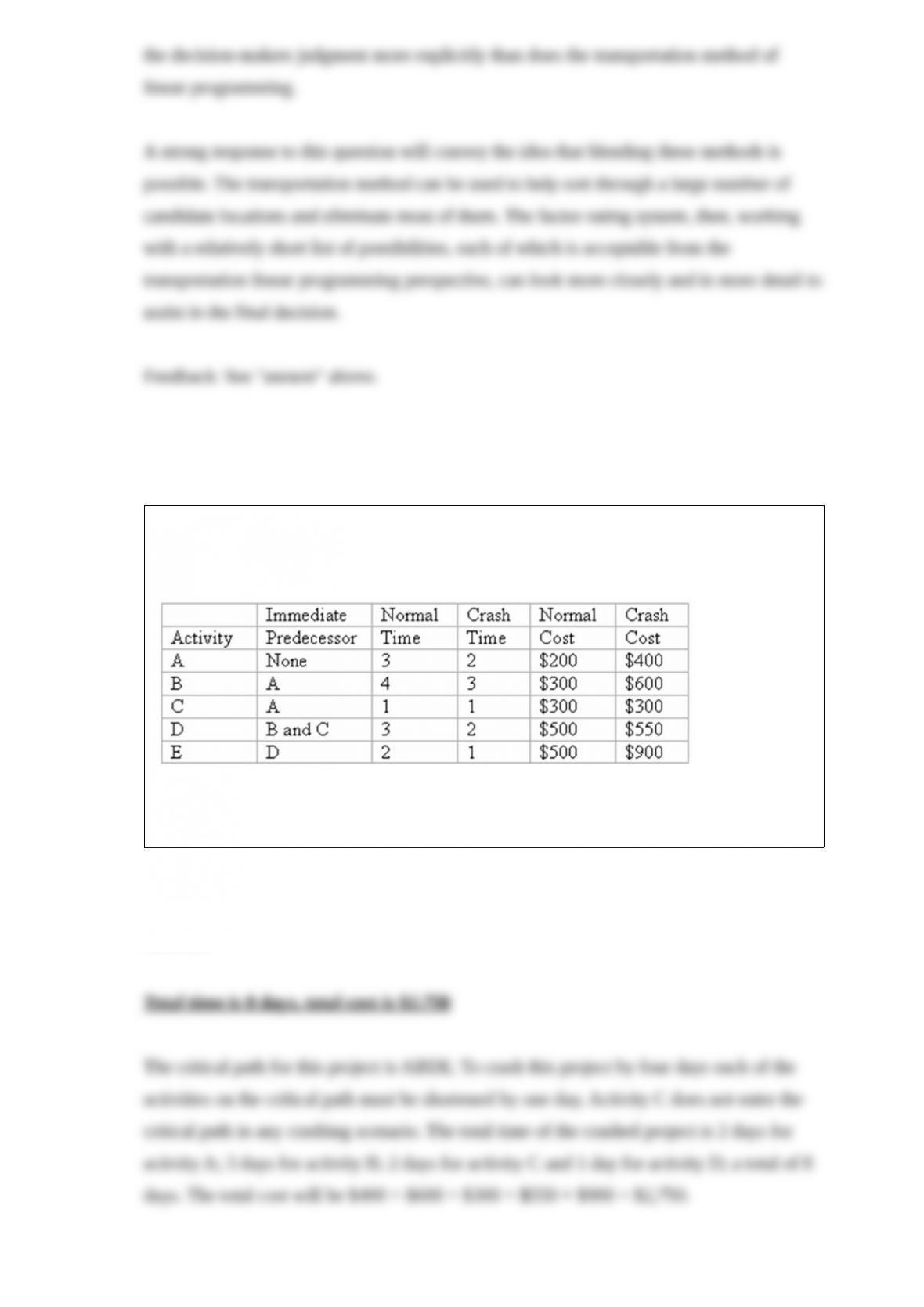
Below are the data for a Time-Cost CPM Scheduling analysis. The time is in days and
the costs include both direct and indirect costs.
If you crash this project to reduce the total time by four days, what is the total time of
the project and total cost? __________________
Answer:
The National Quality Award in the United States is named what?
___________________________________
Answer:
As a facility location consultant, would you advise a client wanting to locate a retail
service facility differently than you would advise a client wanting to locate an on-line
stock trading operation? Explain.
Answer:
What are expenditures related to achieving product or service quality including the
costs of appraisal and prevention of defects called?
______________________________________
Answer: