When a firm’s design capacity is less than the capacity required to meet its demand, it is
said to have a negative capacity cushion.
Answer:
The three main inputs to an MRP system are the bill of materials, the master schedule
and the inventory records file.
Answer:
The aggregate operations plan differs in virtually every aspect in service organizations
as contrasted with manufacturing organizations.
Answer:

Fixed-time period inventory models generate order quantities that vary from time
period to time period, depending on the usage rate.
Answer:
Operations and supply chain processes can be conveniently categorized as planning,
sourcing, making, and delivering.
Answer:
The supply network as can be thought of as a pipeline through which cash, material and
information flows.
Answer:
MRP is a logical, easily understandable approach to the problem of determining the
number of parts, components, and materials needed to produce each end item.
Answer:
While business organizations can seek to achieve the Baldrige National Quality Award,
universities cannot.
Answer:
Retailer behavior when stocking up during promotion periods (where the prices of
goods are reduced) is called backward buying.
Answer:
A time series is defined in the text as chronologically ordered data that may contain one
or more components of demand variation: trend, seasonal, cyclical, autocorrelation, and
random.
Answer:
Variation that is inherent in a production process itself is called assignable variation.
Answer:
MRP stands for Manufacturing Requirements Planning.
Answer:
The optimal stocking decision in inventory management, when using marginal analysis,
occurs at the point where the benefits derived from carrying the next unit are more than
the costs for that unit.
Answer:
The costs associated with reduced inventory results in lower profits.

Answer:
Using the Time-Cost CPM model, the crash time is the shortest possible time allowed
for each activity in the project.
Answer:
The term “electronic commerce” refers to the use of the internet as an essential element
of business activity.
Answer:

In a forecasting model using simple exponential smoothing the data pattern should
remain stationary.
Answer:
The approach that advocates making revolutionary changes as opposed to evolutionary
changes is called “business process reengineering.”
Answer:
The value of the smoothing constant alpha in an exponential smoothing model is
between 0 and 1.
Answer:

DHL and United Parcel Service are transportation companies which are prohibited from
functioning as a third-party logistics company the way Federal Express does.
Answer:
In general, which forecasting time frame compensates most effectively for random
variation and short term changes?
A. Short-term forecasts
B. Quick-time forecasts
C. Long range forecasts
D. Medium term forecasts
E. Rapid change forecasts
Answer:
Which of the following is not an improvement-driven reason for outsourcing?
A. Improve quality and productivity
B. Enhance effectiveness by focusing on what you do best
C. Improve risk management
D. Obtain expertise, skills and technologies not otherwise available
E. Improve credibility and image by associating with superior providers
Answer:
The effect of the lack of synchronization among supply-chain members is referred to as
which of the following?

A. Forward buying
B. Continuous replenishment
C. Bullwhip effect
D. Metcalf’s Law
E. Being out of step
Answer:
Given a prior forecast demand value of 230, a related actual demand value of 250, and a
smoothing constant alpha of 0.1, what is the exponential smoothing forecast value for
the following period?
A. 230
B. 232
C. 238
D. 248
E. 250
Answer:
Which of the following is the portion of observations you would expect to see lying
within a plus or minus 2 MAD range?
A. 57.04
B. 89.04
C. 98.33
D. 99.86
E. 100.00
Answer:
Given a prior forecast demand value of 1,100, a related actual demand value of 1,000,
and a smoothing constant alpha of 0.3, what is the exponential smoothing forecast
value?
A. 1,000
B. 1,030
C. 1,070
D. 1,130
E. 970

Answer:
Which of the following can be used for lot sizing in an MRP system?
A. Low-level coding
B. Time bucket size
C. Least unit cost
D. Inventory record file
E. Peg inventory
Answer:
For which of the following should we use a “p” chart to monitor process quality?

A. Defective electrical switches
B. Errors in the length of a pencil
C. Weight errors in cans of soup
D. Temperature of entrees in a restaurant
E. Letter grades on a final examination
Answer:
Which of the following is the cost of quality classification for costs such as defects that
pass through the system, such as customer warranty replacements, loss of customer or
goodwill, handling complaints, and product repair?
A. Appraisal costs
B. Prevention costs
C. External failure costs
D. Customer return cost
E. Workmanship costs
Answer:

Which of the following is a graphic project report used in project management?
A. Project proposal
B. Approved project plan
C. Humphrey chart
D. Equipment and supplies chart
E. Cost and performance tracking schedule
Answer:
What transportation mode has very high initial investment costs but gives a very low
cost per mile for products that are highly specialized and require no packaging?
A. Highway
B. Rail
C. Water
D. Pipeline
E. Air
Answer:
In the simple exponential smoothing forecasting model you need at least 30
observations to set the smoothing constant alpha.
Answer:
You have been called in as a consultant to set up a Kanban control system. The first

thing you do is to determine the number of Kanban card sets needed. Your research
shows that the expected demand during lead time for a particular component is 1,200
per hour. You estimate the safety stock should be set at 5% of the demand during lead
time. The tote trays used as containers can hold 2 units of stock and the lead time to
replenish an order is 10 hours. Which of the following is the number of Kanban card
sets necessary to support this situation?
A. 5,000
B. 5,500
C. 6,300
D. 6,500
E. 7,000
Answer:
If you are going to develop an “R” chart based on range statistics and you are using a
sample size of 9 for your charting purposes. Which of the following is the lower control
limit D3 factor for the chart?
A. 0.08
B. 0.14
C. 0.18
D. 0.22
E. 0.29
Answer:
Which of the following is not necessary to compute the order quantity using the
fixed-time period model with safety stock?
A. Forecast average daily demand
B. Safety stock
C. Inventory currently on hand
D. Ordering cost
E. Lead time in days
Answer:

Plant A is located at the (X, Y) coordinates of (100, 200) and has a volume of shipping
of 500 units a day. Plant B is located at the (X, Y) coordinates of (150, 400) and has a
volume of shipping of 200 units a day. Using the centroid method, which of the
following is the X coordinate for the new plant location?
A. About 100
B. About 114
C. About 130
D. About 150
E. X coordinate cannot be computed from the data given
Answer:
A company has actual unit demand for three consecutive years of 124, 126, and 135.
The respective forecasts for the same three years are 120, 120, and 130. Which of the
following is the resulting MAD value that can be computed from this data?
A. 1
B. 3
C. 5
D. 15

E. 123
Answer:
Under the lot-for-lot (L4L) lot sizing technique as used in MRP, we would expect which
of the following?
A. A consistent lag of supply behind demand
B. Minimized carrying costs
C. Minimized set-up costs
D. A just in time management philosophy
E. Minimized quality problems
Answer:

If the average aggregate inventory value is $1,200,000 and the cost of goods sold is
$600,000, which of the following is inventory turnover?
A. 60
B. 10.4
C. 2
D. 0.5
E. None of the above
Answer:
In essence, a queuing system includes several major components. Which of the
following is not one of them?
A. Source population

B. Servicing system
C. How the customer exits the system
D. The queue discipline
E. None of the above
Answer:
A company has calculated its running sum of forecast errors to be 500 and its mean
absolute deviation is exactly 35. Which of the following is the company’s tracking
signal?
A. Cannot be calculated based on this information
B. About 14.3
C. More than 35
D. Exactly 35
E. About 0.07
Answer:

Which of the following is not a way that operations and supply processes are
categorized?
A. Planning
B. Return
C. Delivery
D. Selecting
E. Making
Answer:
You have just used the capability index (Cpk) formulas to compute the two values “min
[2, 2.5].” Which of the following is the proper interpretation of these numbers?
A. The TRUE capability index value is 2.5
B. The mean of the production process has shifted to the left of the design limits
C. The mean of the production process has shifted to the right of the design limits
D. The mean has not shifted at all
E. The TRUE capability index value is between 2 and 2.5
Answer:
Which of the following is a dynamic lot-sizing technique that calculates the order
quantity by comparing the carrying cost and the setup (or ordering) costs for various lot
sizes and then selects the lot in which these are most nearly equal?
A. Economic Order Quantity
B. Lot for lot
C. Least total cost
D. Least unit cost
E. ABC analysis
Answer:

You have just determined the actual number of workstations that will be used on an
assembly line to be 8 using the assembly-line balancing procedure. The cycle time of
the line is 10 minutes and the sum of all that tasks required on the line is 60 minutes.
Which of the following is the correct value for the resulting line’s efficiency?
A. 0.500
B. 0.650
C. 0.750
D. 0.850
E. None of the above
Answer:
List five OSCM job titles.
1>___________________
2>___________________
3>___________________
4>___________________
5>___________________
Answer:
What is a total systems approach to managing the flow of information, materials, and
services from raw material suppliers through factories and warehouses to the end
customer called? ________________________________
Answer:
A chance node on a decision tree has four possible outcomes each worth $100,000. The
probabilities of the outcomes occurring are assessed as 10%, 27%, 43% and 20%. What
is the expected value of this chance node? ____________________
Answer:

What does the text mean when it states that rather than to search for the perfect forecast
one should learn to live with inaccurate forecasts?
Answer:
When arrivals occur in a purely random fashion at a service facility, the distribution of
the number of arrivals per unit of time forms which kind of distribution?
___________________
Answer:
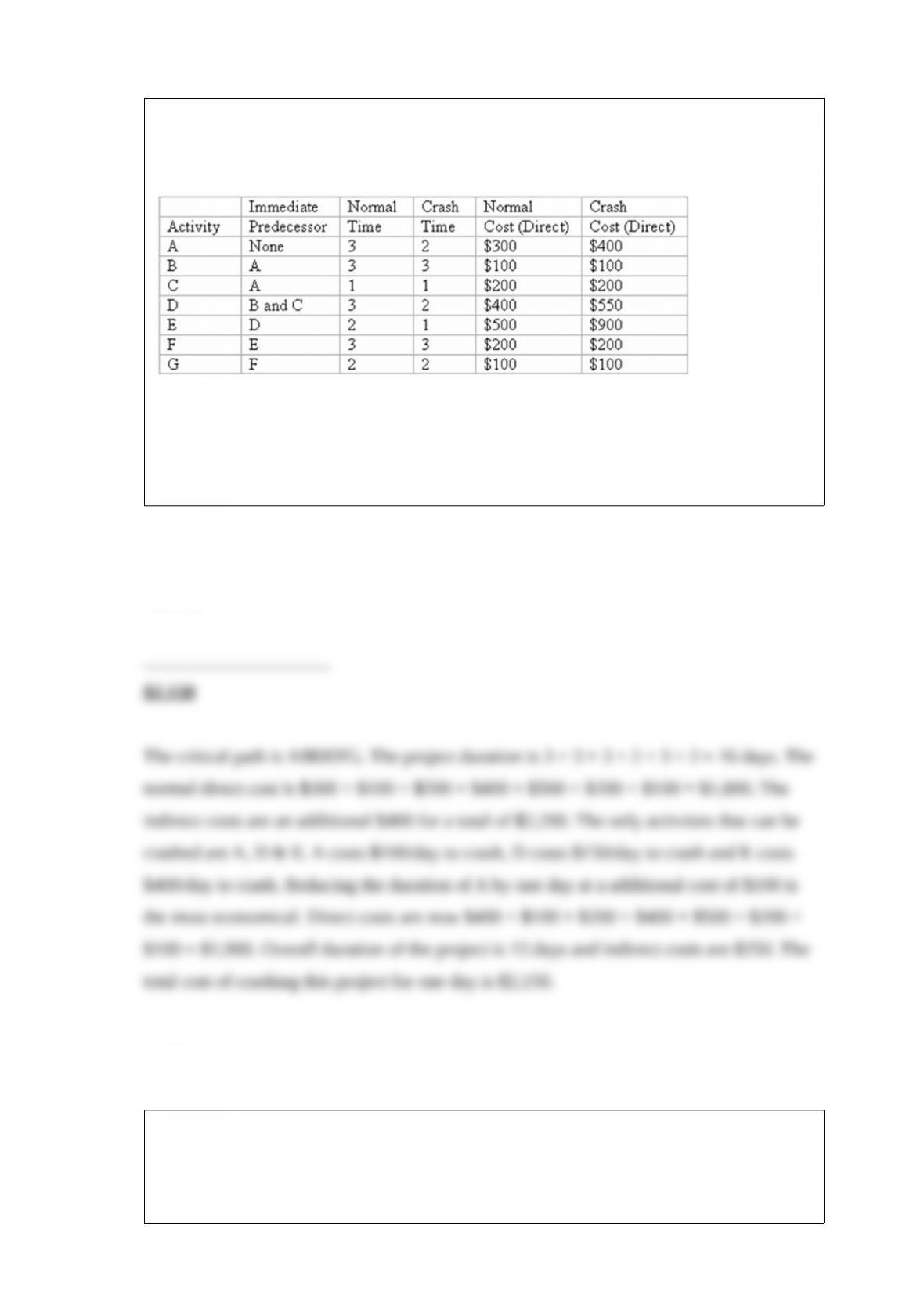
You have collected the data for a Time-Cost CPM Scheduling model analysis. The time
is in days and the project “direct costs” are given below.
The indirect costs for the project are determined on a daily duration basis. If the project
lasts 16 days the total indirect costs are $400, 15 days they will be $250, 14 days they
will be $200, and 13 days they will be $100. If you crash this project by one day what is
the total (i.e., direct and indirect) project cost?
Answer:
An estimate of the cost of an item that includes all the costs related to the procurement
and use of an item, including any related costs in disposing of the item after it is no
longer useful is called what? ______________________.
Answer:
A pipeline through which material and information flows is a conception of a
_______________________.
Answer:
Assuming no safety stock, what is the reorder point (R) given an average daily demand
of 100 units and a lead time of 5 days? __________________________________
Answer:

Distinguish between strategic and tactical forecasts.
Answer: