
In the Celtex case study, Leo Garcia, President of the synthetic chemical division,
regularly fails to sell his products to and through the consumer products division. This
is because:
A. there is a market-based alternative to his products that are cheaper.
B. Celtex has a faulty organizational structure that regularly cheats Garcia.
C. the head of the consumer products division does not understand the difference
between price and value.
D. Garcia produces inferior products.
A new entrant can deter the brand advantage enjoyed by an existing firm by
A. offering their product at a comparatively lower price.
B. getting licenses and patents for their products.
C. offering government certified products.
D. investing in specific assets.
If a company has a cost curve of TC = 300 + 2Q + Q2 and it produces 300 units per day,
then its marginal cost is
A. $1.
B. $600.
C. $602.
D. $2.02.
Third-degree price discrimination results when a firm sells

A. its product to every customer at a different price.
B. its product by volume at a different price.
C. every unit at the same price.
D. its product to different groups at different prices.
Price discrimination requires that different customers have different levels of price
sensitivity and that
A. the cost of production is different for every customer.
B. customers cannot resell the product amongst themselves.
C. demand is homogeneous amongst customers.
D. marginal costs are falling.
Externalities exist when the actions of one agent
A. benefit or hurt another agent who is not part of the exchange relationship.
B. hurt the agent committing the action.
C. benefit the agent committing the action.
D. benefit or hurt another agent who is a part of the exchange relationship.
Setting up outlet malls in rural highways is an example of
A. increased consumer transactions cost.
B. increased producer transactions cost.
C. reduced consumer transactions cost.
D. reduced producer transactions cost.

In a monopolistically competitive market, the advantage that a seller has over
competitors or newcomers is
A. the consumer preference for its brand.
B. the high price elasticity of demand for its product.
C. the high price elasticity of supply for its product.
D. the licenses or patents it has received.
A jury ordered McDonald’s to pay $2.7 million to Stella Liebeck, a drive-through
customer who burned herself with hot coffee after placing the cup between her legs to
remove the top and add cream. She claimed that the coffee was too hot. This tells us
that our legal system can:
A. promote efficiency by making property rights secure.
B. promote efficiency by lowering transaction costs.
C. lower costs by creating incentives to litigate frivolous suits.
D. raise costs by creating incentives to litigate frivolous suits.
It is in the self-interest of individuals to:
A. minimize the total contracting costs in any relationship.
B. maximize the total contracting costs in any relationship.
C. eliminate the total bargaining costs in any relationship.
D. reduce value through formal contracting costs.

Explain how each of the following market forces helps reduce incentive conflicts
between shareholders and management: a) the market for corporate control, b) the
managerial labor market, and c) the product market.
A firm produces 10 widgets that they sell for $15 each. The average variable cost for
the production of 10 widgets is $13/unit. The fixed cost for this firm equals $20. What
is the value of this firm’s profits?
A. – $20
B. – $2
C. 0
D. $20
If a work performance measure is based on both objective and subjective measures, the
objective measure would be:

A. the number of units produced.
B. employee dependability.
C. quality of units produced.
D. employees’ willingness to cooperate with coworkers.
Which of these results from the separation of ownership and management in large
publicly traded corporations?
A. Corporate managers have stronger incentives to rather quickly transfer control of the
firm to less informed management teams.
B. Corporate managers have weaker incentives to transfer control of the firm to less
informed management teams.
C. Corporate managers have stronger incentives to rather quickly transfer control of the
firm to more informed management teams.
D. Corporate managers have weaker incentives to transfer control of the firm to more
informed management teams.
Which of the following is not a cost of specialized task assignment?
A. Foregone complementarities across tasks
B. Functional myopia
C. Comparative advantage of specialization
D. Reduced flexibility

Which of the following is true of standard economic analysis?
A. It characterizes a firm as a black box that transforms inputs to outputs.
B. It focuses on the internal architecture of a firm.
C. It applies basic economic tools to examine the effects of managerial decisions.
D. It characterizes a firm as an organization that generates economic growth.
Tasty Chicken has been buying its animal feed in the open market. It notices that about
10 percent of its purchases are watered down, so that the feed seems to weigh more than
it actually does. To improve quality of its purchases, Tasty Chicken might consider:
A. moving to long-term contracts with specific feed producers.
B. hiring an economist to see if the market is really competitive.
C. lobbying for new laws concerning water levels in feed.
D. going out of the chicken processing business.
Which of these is a drawback of logrolling?
A. Nobody wins in the long run.
B. All other proposals get support only after yours gets support.
C. Your proposal will be supported only after all other proposals get supported.
D. Once you support someone’s proposal, they can turn their back on yours.
Compared to owners, employees receive a large fraction of their incomes from their
employers and are consequently dependent on the fortunes of that company in the
marketplace. From a ‘risk-sharing’ perspective, an employee tends to prefer:

A. a flat salary.
B. output-based incentive pay.
C. year-end based performance pay.
D. commission-based incentive pay.
Bloomberg Business sums up the failure of Enron to
A. September 11, 2001.
B. flawed organizational design.
C. too much debt.
D. risky projects in India and the oil price hikes.
If Tiger Toys faces a demand curve of P = 85 − 0.25Q and a MC = ATC = 20, then the
economic profits would be
A. $130.
B. $6,825.
C. $2,600.
D. $4,225.
The gains from specific training in human capital tend to go to the:
A. employing firm and not the individual.
B. federal government in the form of higher taxes.
C. individual and not the employing firm.
D. parents since they paid for the education in the first place.

As a source of market power, a precommitment contract is an example of a(n)
A. newcomer advantage.
B. incumbent advantage.
C. incumbent reaction.
D. newcomer reaction.
Economist Milton Friedman argued that ethical behavior followed and practiced by
organizations is the same as:
A. cost minimization.
B. wealth maximization.
C. sales minimization.
D. output maximization.
Bio seeds offers free genetically modified seeds (GMS) to farmers in developing
countries the first season. The land accepts only GMS in any other cropping season. So
providing free seeds in the first season is a strategic way to
A. bundle goods.
B. administer a two-part tariff.
C. enforce price discrimination.
D. regulate future demand.

Putting together two goods—shaving cream and razors—to increase value is using the
power of
A. complementary goods.
B. substitute goods.
C. unrelated goods.
D. technologically advanced goods.
Currently
where “s” and “a” refer to steel and aluminum, and Ps and Pa refer to the prices of steel
and aluminum, and MPs and MPa refer to the marginal products of steel and aluminum,
respectively, for a firm. Has the firm come up with the right amounts of steel and
aluminum, or should it reallocate its resources to make the maximum profit?
Refer to Figure 7.2. If Happy Times Theater charges one price to all customers, then the
profit will be:

A. $374.25.
B. $62.50.
C. $562.50.
D. $150.00.
Many people believe that the supply and demand for regulation in an industry often
results in the creation of a powerful coalition group controlling the regulatory body.
That powerful group often comprises of executives from the same industry that is
supposed to be regulated. This is called:
A. capturing.
B. adverse selection.
C. internalization of externalities.
D. free-riding.
Using cost plus pricing, what is the price if ATC = $23.50 and the target rate of return is
17 percent?
A. $28.31
B. $138.24
C. $29.38
D. $46.74

Which of these is a commonly used measure of performance for investment centers?
A. Residual income
B. Total assets
C. Total income
D. Variable cost
Jim Range owns an ice cream store, Best Ice Cream , one of 1,000 franchises across the
country. Jim doesn’t like to work evenings, so he hires Mary Jo Smith to work in the
store in the evening for $6.50 per hour. Mary Jo’s friends come by each evening and she
gives them free cones. Is this an adverse selection problem or an incentive problem?
What is the solution?
In the area of agricultural chemicals, the Environmental Protection Agency requires
detailed labeling on cans of pesticides and herbicides. Generally speaking, the industry
not only doesn’t oppose these labeling requirements, but even supports
government-sponsored education programs on how to use these chemicals. Why?

The text notes that many firms that use animals in production or advertising adopt the
animal treatment standards of the American Society for Prevention of Cruelty to
Animals. Why do companies adopt a professional group’s standard of behavior?
You toss two coins and if heads or tails shows up, then I take $1. If only one heads
shows up, then you give me $1. We play this game many times. Who comes up ahead at
the end of the day?
ALC, Inc., has, in recent years, opened large markets of new customers, experienced
strong competition from substitutes, and survived a nasty national recession. When the
chief economist statistically estimated the company’s product demand using data from
the past five years, she found a statistically significant positive (direct) relationship
between price and quantity. What according to you led to this finding?

In the United States, there are numerous organizations, some sponsored by business and
others that are independent of business, that monitor the behavior, the product quality,
and the service provided by businesses. What role do these organizations have in the
process of promoting ethical behavior?
What is corporate culture?
How is the architecture within firms usually designed?

Explain the effect of self-selection on compensating wage differential.
Suppose that the current market price of VCRs is $300, that the average consumer
disposable income is $30,000, and that the price of DVDs (a substitute for VCRs) is
$500. Under these conditions annual U.S. demand for VCRs is 5 million per year.
Statistical studies have shown that for VCRs the own-price elasticity of demand is –1.3.
The income elasticity of demand for VCRs is 1.7. The cross-price elasticity of demand
for VCRs with respect to DVDs is 0.8. Use this information to predict the annual
number of VCRs sold under the following conditions:
(1) Increasing competition from Asia causes VCR prices to fall to $270 with income
and the price of DVDs remaining unchanged.
(2) Income tax reductions raise average disposable personal income to $31,500 with
prices unchanged.
(3) An inventor in Menlo Park invents a cheaper way to produce DVDs, reducing the
price of a DVD to $400, with the price of VCRs and income unchanged.
(4) All of the events described in parts 1−3 occur simultaneously.

Use the following example to review the basic incentive problem in the owner/
employee conflict. Assume perfect contracting possibilities. Chef Tom Malone is the
key employee for FancyFoods. His utility is defined by
U = I – e2 and his reservation wage is $2,000 per week.
FancyFoods costs = Malone’s wages = $2,000 + e2
FancyFoods benefits = revenue = 300e
Profits = Revenues – Costs
Compute the optimal wage bill for Chef Malone, the revenues for FancyFoods, and the
profits earned by FancyFoods.
The owners of Market Analysts, a business and economics consulting firm, are big
believers in paying benchmark competitive wages. They pay all (non-legally specified)
compensation in wages. If an employee wants a benefit, the company has an insurance
program, but it comes out of the employee’s paycheck. Market Analysts tends to hire
very young workers just out of college. They are energetic and work hard, but after two
years they tend to leave for other firms, taking valuable training with them. If Market
Analysts wants to keep its employees, what changes should it make to the terms of
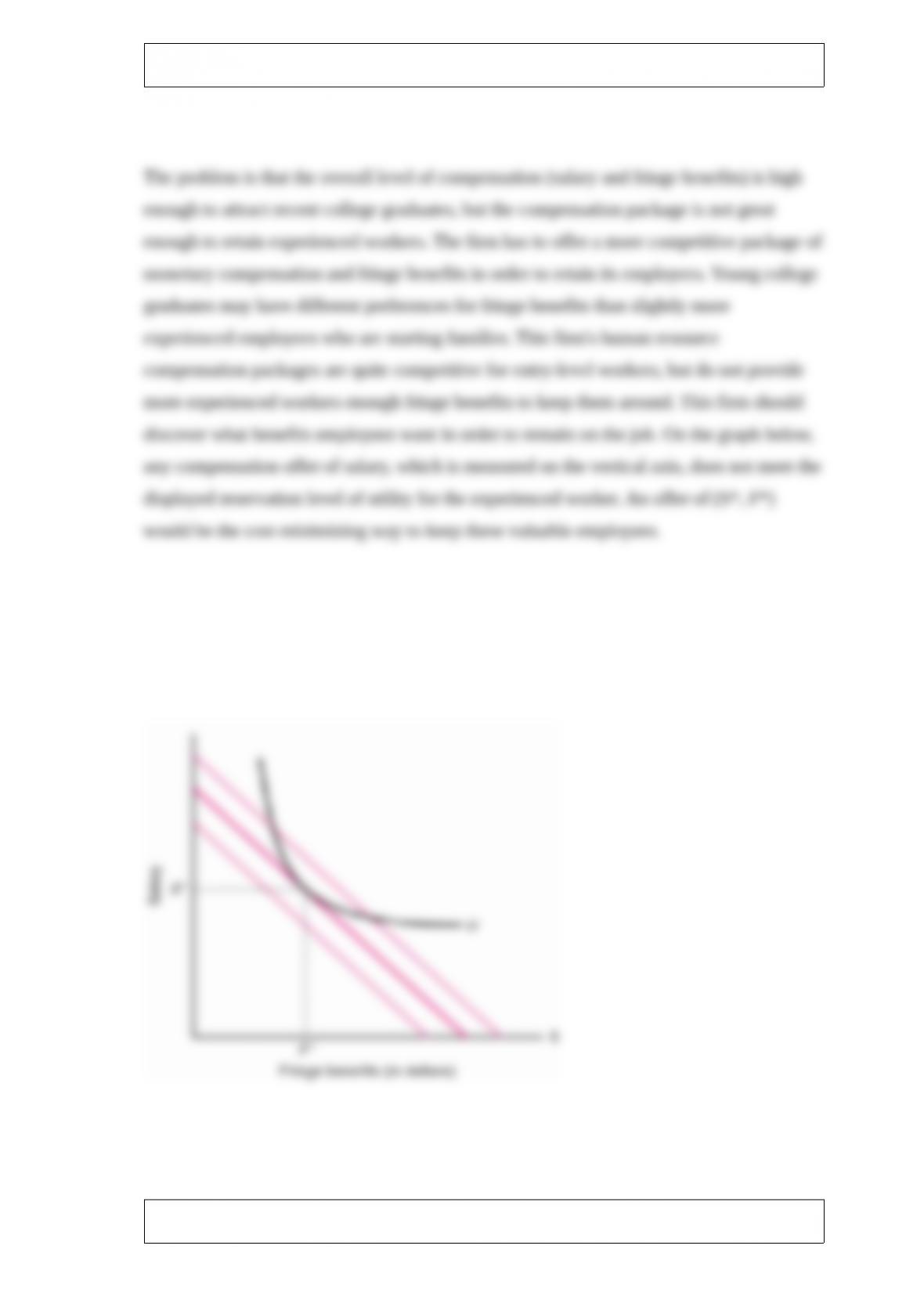
employment offered to new employees?
Always Round Tire tries to base its promotions on seniority (where education and
training requirements are not necessary). The company finds that this system seems to
work most of the time with shop-floor supervisors and team managers. However, the
system breaks down for higher-level positions. Why?
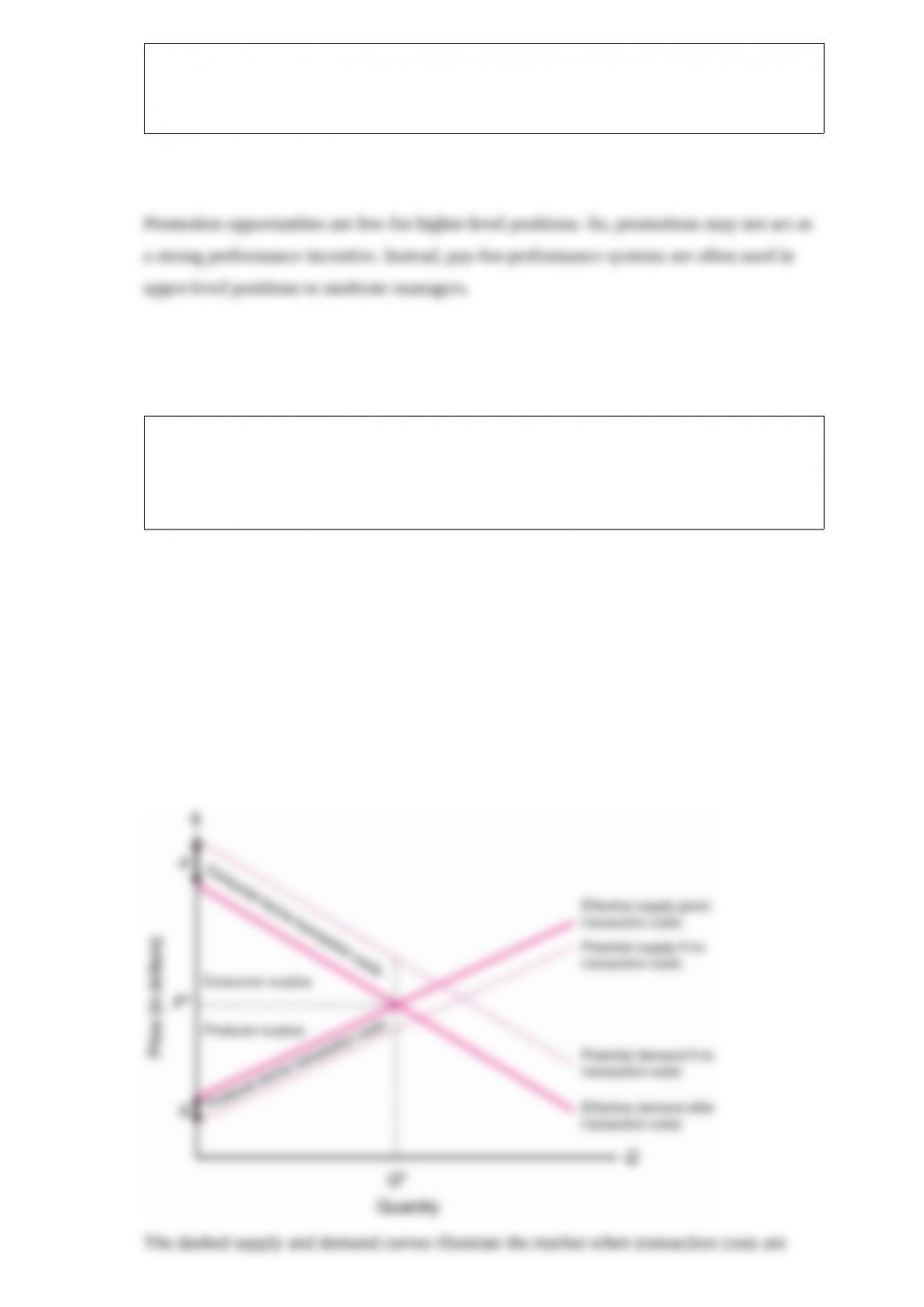
Draw supply and demand curves for a product showing the equilibrium price and
quantity. Illustrate what would happen if all the transaction costs in the market for the
product were reduced. Generally, what is the impact of transaction costs on market
operations?

Currently, the marginal cost equation for a shoe manufacturing company is given by
MC = 10 + 2Q. The market price per pair is $60. How many units should the company
produce?
What do we mean by the U form?
Manifold Manufacturing, a large producer of motorcycle parts, is accused of
monopolizing the market for a particular motorcycle part. Why would its legal defense
team be so interested in a statistical estimate that the price elasticity of demand for its
motorcycle part was 0.62?

Walmart tends to have the best retailing system, the best distribution system, and the
best marketing system of the modern retailers. It also dominates the marketplace for
retail sales to a greater extent than any other retailer. What is the source of Walmart’s
ability to capture value in the marketplace?
How can firms survive in the long run if mandatory retirement is illegal and if firms are
stuck with older workers whose productivity might technically have fallen over time?
The law of demand states the basic price/quantity relationship of consumption
incentives. What does the concept of “price elasticity” add to that knowledge?