Maintaining a stable workforce generally results in the firm paying higher wages than a
firm that follows demand.
Degeneracy in a transportation problem is when no closed path exists for evaluating an
unused cell.
ISO 9000 has evolved from a set of quality assurance standards toward a quality
management system.
Orlando Utilities Commission uses a computerized maintenance management program,
and devotes significant dollar and labor resources to power plant maintenance, because
the costs of unexpected failure are incredibly high.
The quality loss function indicates that costs related to poor quality are low as long as
the product is within acceptable specification limits.
One use of camera-and-computer-based vision systems is to replace humans doing
tedious and error-prone visual inspection activities.
Simulation can use any probability distribution that the user defines.
Errors made within the location decision area may overwhelm efficiencies in other
areas.
In selecting new equipment and technology, decision-makers look for flexibility€the
ability to respond with little penalty in time, cost, or customer value.
A firm’s process strategy is its approach to transforming resources into goods and
services.
Vendor-Managed Inventory is a form of outsourcing.
Technological forecasts address the business cycle by predicting inflation rates, money
supplies, housing starts, and other planning indicators.
A transportation problem has a feasible solution when
A) all of the improvement indices are greater than or equal to zero
B) all demand and supply constraints are satisfied
C) the number of filled cells is one less than the number of rows plus the number of
columns
D) all the squares are used
E) the solution yields the lowest possible cost
Which of the following pioneers was not making a professional impact during the
Scientific Management Era?
A) Frank Gilbreth
B) W. Edwards Deming
C) Henry L. Gantt
D) Lillian Gilbreth
E) Frederick W. Taylor
In the basic queuing model (M/M/1), arrival rates are distributed by
A) continuous probability distributions
B) normal probability distributions
C) negative exponential probability distributions
D) Poisson distributions
E) lognormal distributions
Aggregate planning is capacity planning for
A) the long range
B) the intermediate range
C) the short range
D) typically one to three months
E) typically three or more years
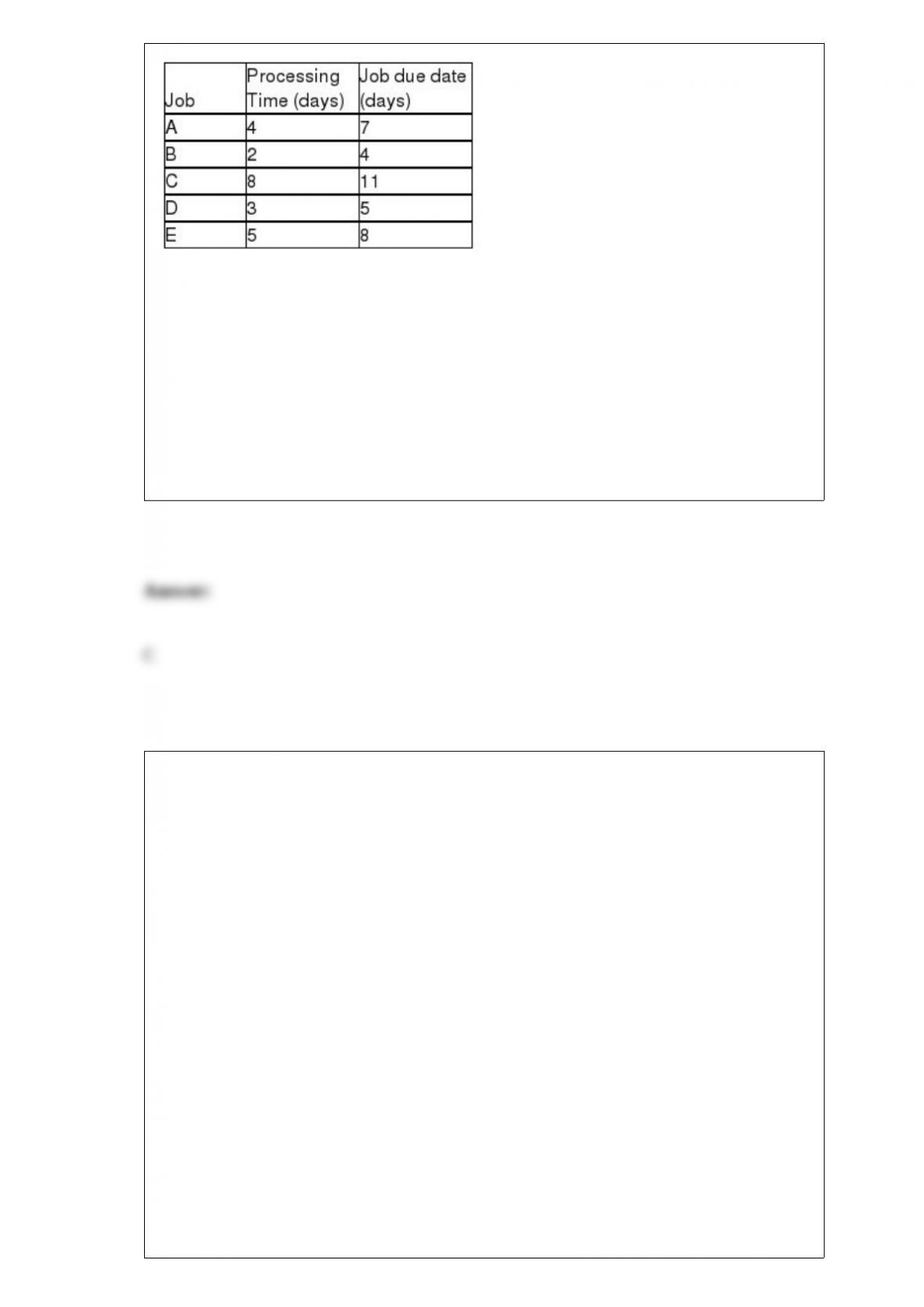
Five jobs are waiting to be processed. Their processing times and due dates are given
below. Using the earliest due date dispatching rule, in which order should the jobs be
processed?
A) C, E, A, D, B
B) A, B, C, D, E
C) B, D, A, E, C
D) C, B, A, E, D
E) none of the above
The property manager of a city government issues chairs, desks, and other office
furniture to city buildings from a centralized distribution center. Like most government
agencies, it operates to minimize its costs of operations. In this distribution center, there
are two types of standard office chairs, Model A and Model B. Model A is considerably
heavier than Model B, and costs $20 per chair to transport to any city building; each
model B costs $14 to transport. The distribution center has on hand 400 chairs€200
each of A and B.
The requirements for shipments to each of the city’s buildings are as follows:
Building 1 needs at least 100 of A
Building 2 needs at least 150 of B.
Building 3 needs at least 100 chairs, but they can be of either type, mixed.
Building 4 needs 40 chairs, but at least as many B as A.
Write out the objective function and the constraints for this problem. (Hint: there are
eight variables€chairs for building 1 cannot be used to satisfy the demands for another
building).
A distribution of lead times in an inventory problem indicates that lead time was 1 day
20 percent of the time, 2 days 30 percent of the time, 3 days 30 percent of the time, and.
4 days 20 percent of the time. This distribution has been prepared for Monte Carlo
analysis. The first four random numbers drawn are 06, 63, 57, and 02. The average lead
time of this simulation is
A) 1.75 days
B) 2 days
C) 3 days
D) 3.5 days
E) none of these
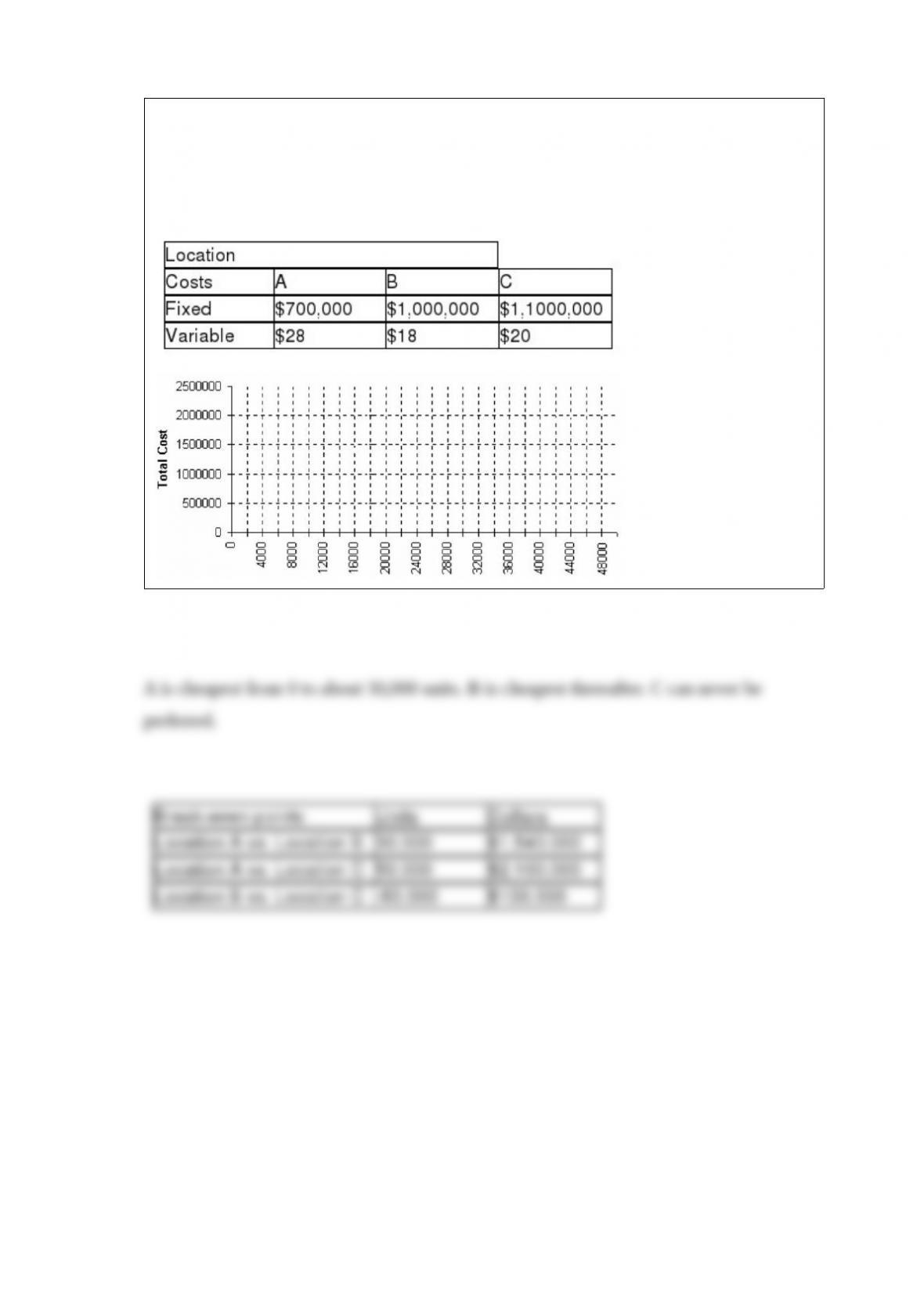
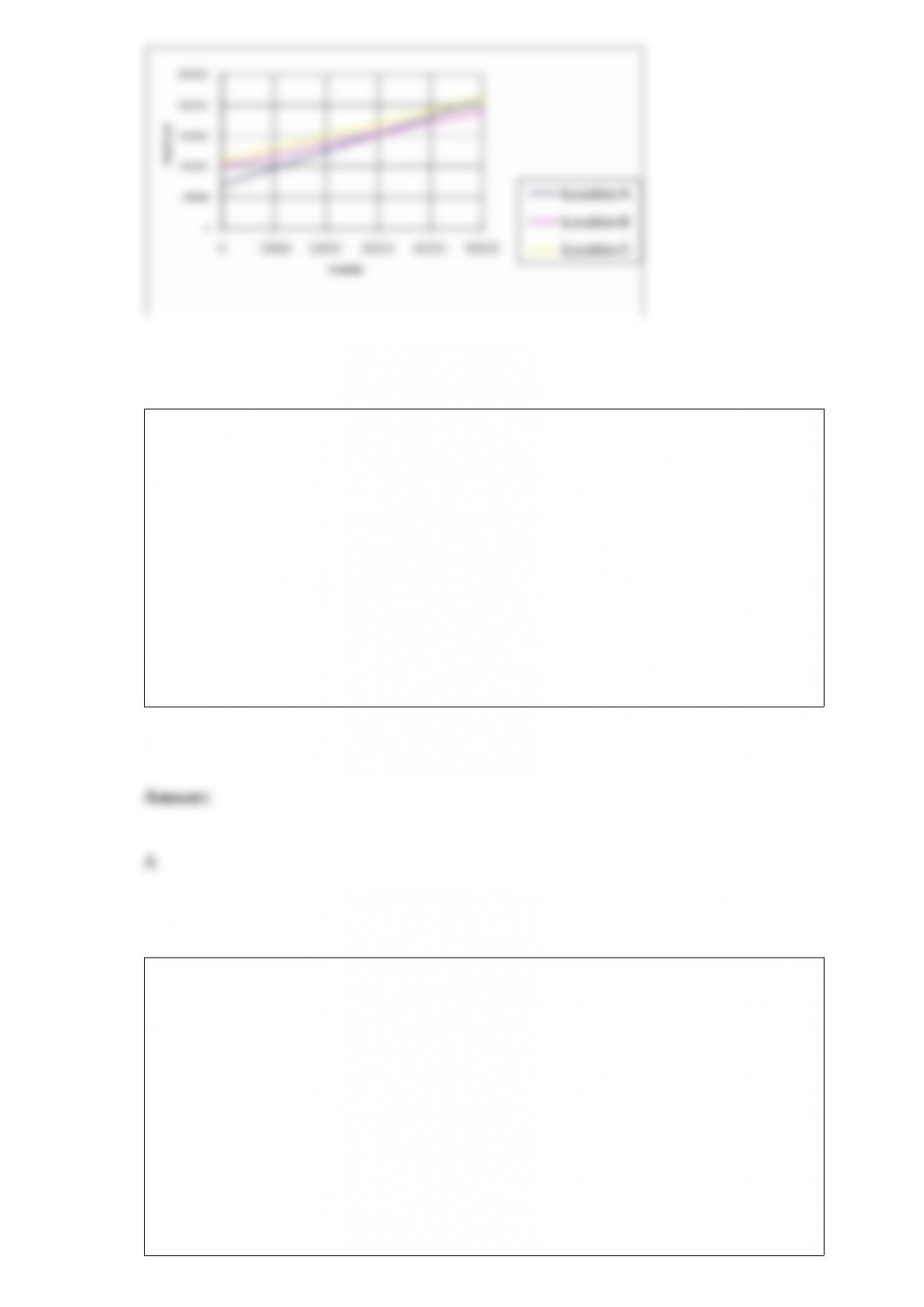
The owner of a millwork shop is considering three alternative locations for a new plant
for building embossed-and-clad steel exterior doors for residences. Fixed and variable
costs follow. Since the plant ships nationwide, revenue is assumed the same regardless
of plant location. Plot the total cost lines in the chart provided below, and identify the
range over which each location is best.
A manufacturing plant uses a computerized scanner to measure the inner diameters of
the belts it produces to ensure they are within the specifications. This is referred to as
A) CAM
B) CAD
C) QFD
D) DFMA
E) STEP
A rice mill in south Louisiana purchases the trucking firm that transports packaged rice
to distributors. This is an example of
A) horizontal integration
B) forward integration
C) backward integration
D) current transformation
E) keiretsu
Which of the following is not needed in order to use the transportation model?
A) the source points and their capacity
B) the fixed costs of source points
C) the destination points and their demand
D) the cost of shipping one unit from each source to each destination
E) All of these are needed.
Break-even is the number of units at which
A) total revenue equals price times quantity
B) total revenue equals total variable cost
C) total revenue equals total fixed cost
D) total profit equals total cost
E) total revenue equals total cost
Stakeholders who are affected by the production and marketing of poor quality products
include
A) stockholders, employees, and customers
B) suppliers and creditors, but not distributors
C) only stockholders, creditors, and owners
D) suppliers and distributors, but not customers
E) only stockholders and organizational executives and managers
Which of the following aggregate planning models is based primarily upon a manager’s
past experience?
A) the linear decision rule
B) simulation
C) the management coefficients model
D) the transportation method
E) graphical methods
Weekly sales of ten-grain bread at the local organic food market are in the table below.
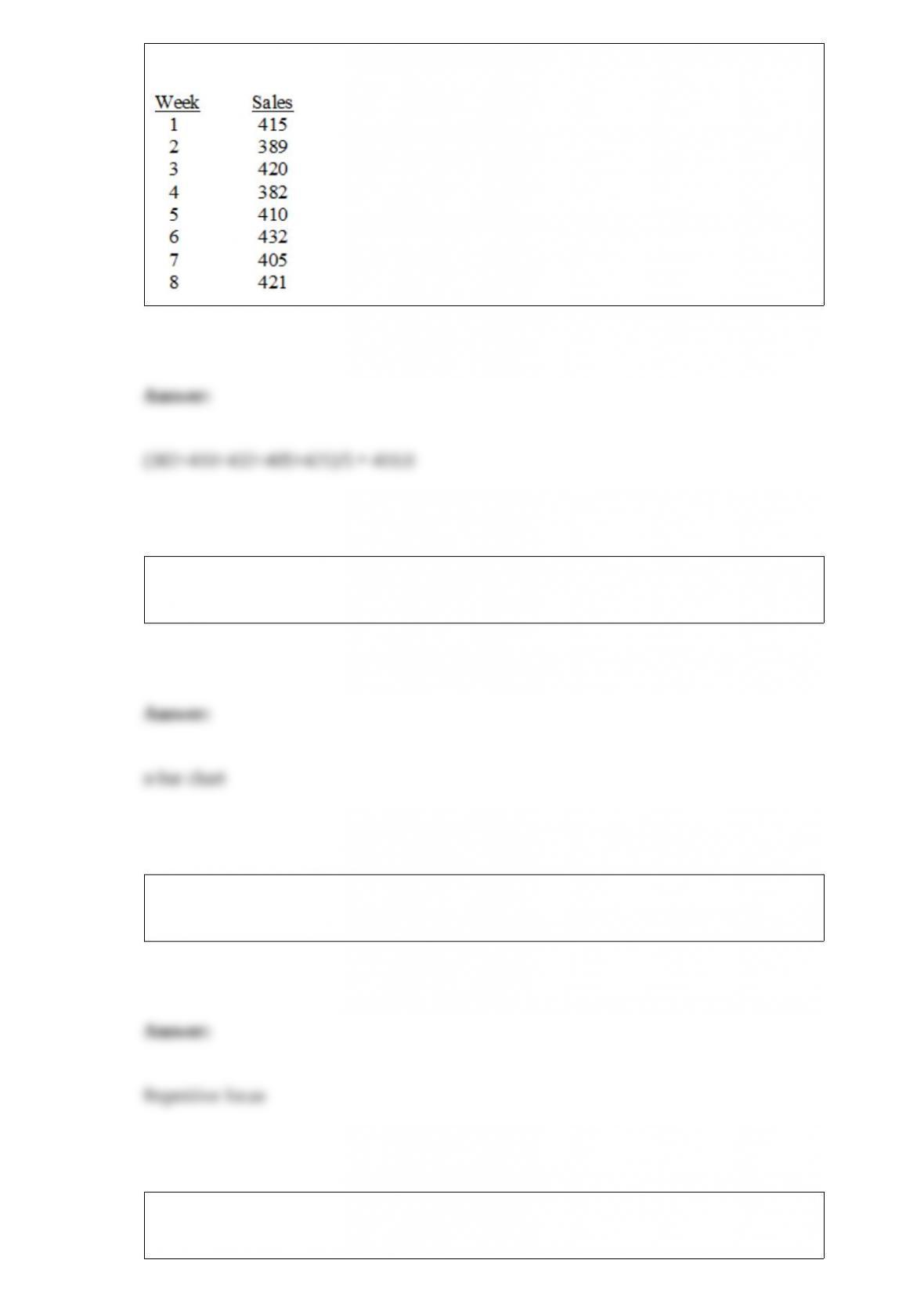
Based on this data, forecast week 9 using a five-week moving average.
The __________ is a quality control chart that indicates when changes occur in the
central tendency of a production process.
__________ is a process strategy that uses a product-oriented production process that
uses modules.
Daily demand is half of daily production. If setup and holding costs are equal,
determine how Q and D are related.
Advantage Milling Devices is preparing to buy a new machine for precision milling of
special metal alloys. This device can earn $300 per hour, and can run 3,000 hours per
year. The machine is expected to be this productive for four years. If the interest rate is
6%, what is the present value? What is the present value if the interest rate is not 6%,
but 9%? Why does present value fall when interest rates rise?
The __________ is how an organization expects to achieve its missions and goals.
Explain the role of regression models (time series and otherwise) in forecasting. That is,
how is trend projection able to forecast? How is regression used for causal forecasting?