
Queue discipline specifies the order in which waiting customers are served.
In 2010, the US surpassed China as the world’s largest manufacturer.
When designing a service, performance specifications are converted into design
specifications, and finally, delivery specifications,
Two approaches to process improvement include continuous and breakthrough.
When probabilities are assigned to states of nature the situation is referred to as
decision-making under uncertainty.
Human resources management provides product demand estimates that are used in
production decisions.
Total quality management represents a set of management principles that focus on
quality improvement in all the functional areas within a company.
Facility layout refers to the arrangement of machines, processes, departments, and other
areas within a facility.
The conventional approach to inventory management is to maintain a level of inventory
that reflects a compromise between inventory cost and customer service.
For a service operation to be in the right place usually means being in a location that is
convenient and easily accessible.
The average inventory can be calculated by dividing the annual demand, D, by 2.
Job rotation often requires cross-training of employees.
Single-source ERP systems are often easier to integrate than systems built using the
best-in-breed approach.
Service design and improvement techniques cannot be applied to societal problems
such as education, healthcare and government services.
Job shop scheduling is also known as shop floor control.
The individual generally credited with the development of lean production is an
American.
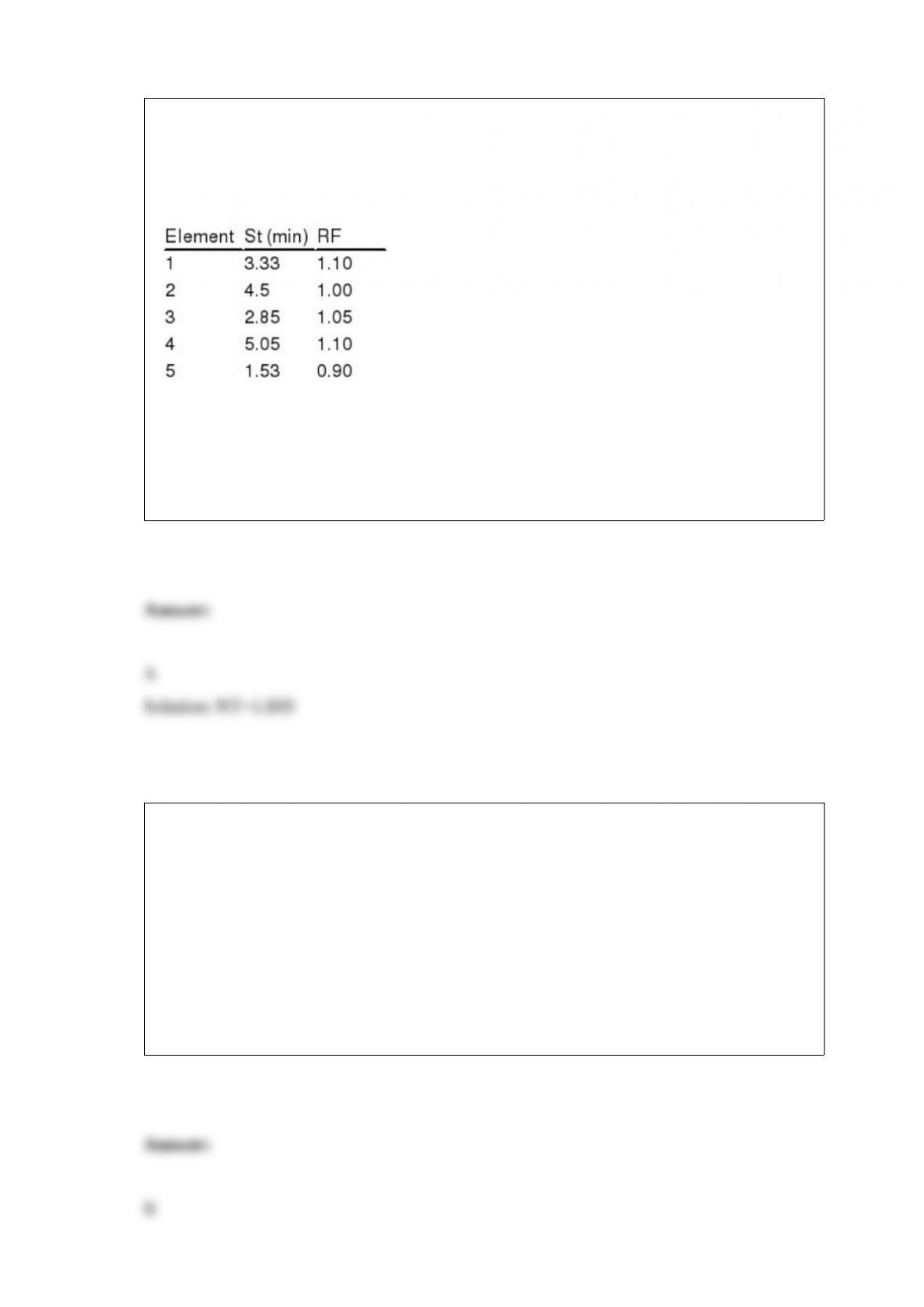
As part of its quality-improvement program a company is conducting a time study for a
particular job. The time study encompassed 10 job cycles, and the results include the
following cumulative times and performance rating factors for each element. An
allowance factor of 16% is assumed.
The normal cycle time for this job would be
a. 1.809 minutes.
b. 2.098 minutes.
c. 1.530 minutes.
d. 2.233 minutes.
The probability that a product will operate properly within an expected timeframe is the
dimension of quality known as
a. durability.
b. reliability.
c. performance.
d. serviceability.

The following information relates to a company’s aggregate production planning
activities:
Beginning Workforce = 50 workers
Production per Employee = 250 units per quarter
Hiring Cost = $1000 per worker
Firing Cost = $1,500 per worker
Inventory Carrying Cost = $15 per unit per quarter
If a level production strategy is used then the total cost of the plan (hiring cost, firing
cost and inventory carrying cost) is
a. $120,000
b. $377,500
c. $675,000
d. $795,000
The following table of probabilistic time estimates (in weeks) and activity predecessors
are provided for a project.
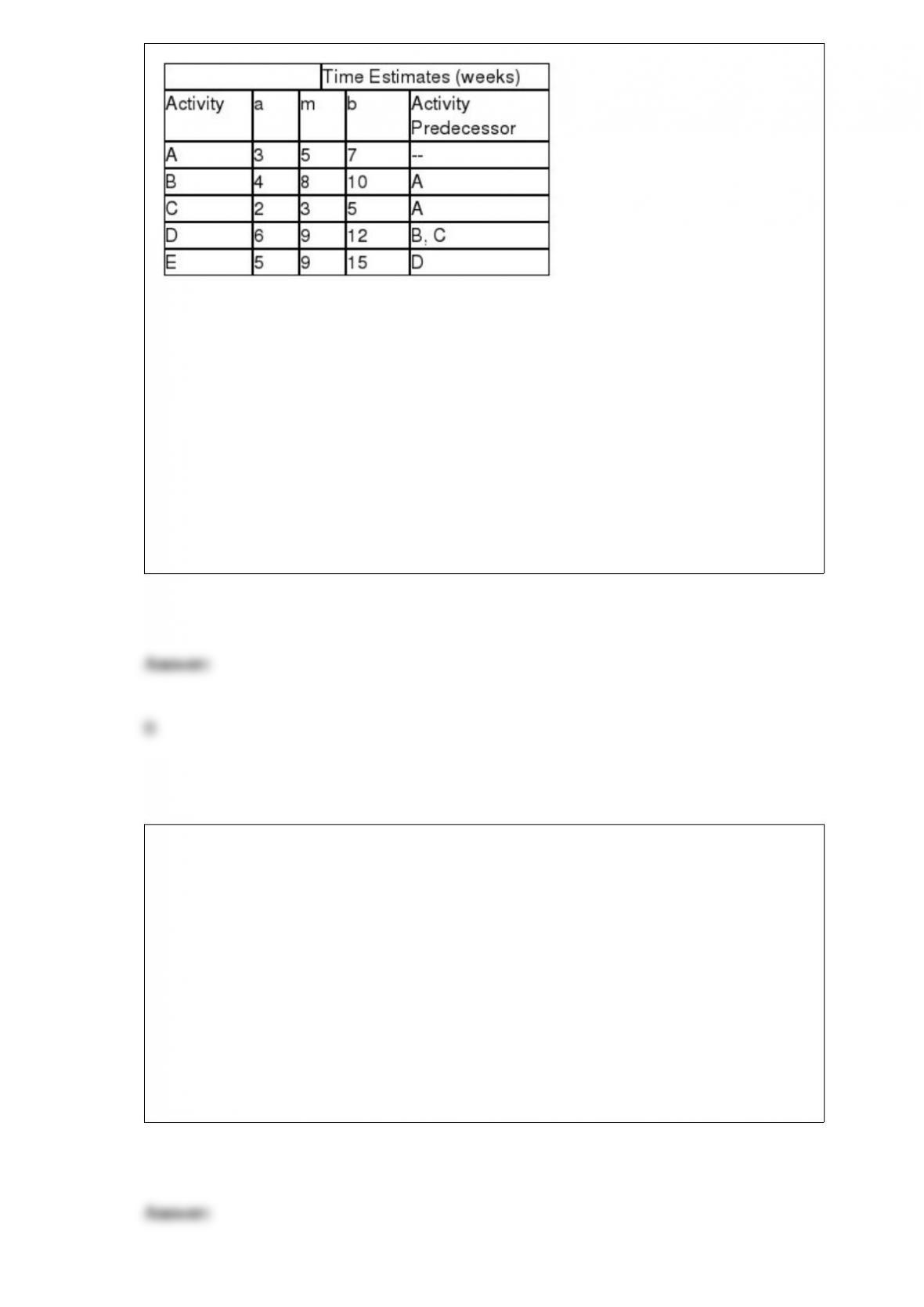
Table ZZ
The variance of the project’s total completion time is
a. 5.472 weeks.
b. 5.222 weeks.
c. 4.872 weeks.
d. 3.752 weeks.
Consider an espresso stand with a single barista. Customers arrive at the stand at the
rate of 28 per hour according to a Poisson distribution. Service times are exponentially
distributed with a service rate of 35 customers per hour. The average time in minutes a
customer spends in the system (i.e., waiting and being served) is
a. 0.114 minute
b. 0.143 minute
c. 6.84 minutes
d. 8.58 minutes
How many observations should be taken to be 90% confident of being within + 2% of
the actual time a machine is busy if it is believed that the machine is in use 70% of the
time?
a. 2,021 observations
b. 1,421 observations
c. 789 observations
d. 365 observations
Easy Tax is a service company that prepares tax returns. An outside auditor has
examined 20 samples each containing one completed tax return. The total number of
defects observed over the 20 samples is 200. The standard deviation for the control
chart is
a. 2.2
b. 3.2
c. 3.9
d. 4.5
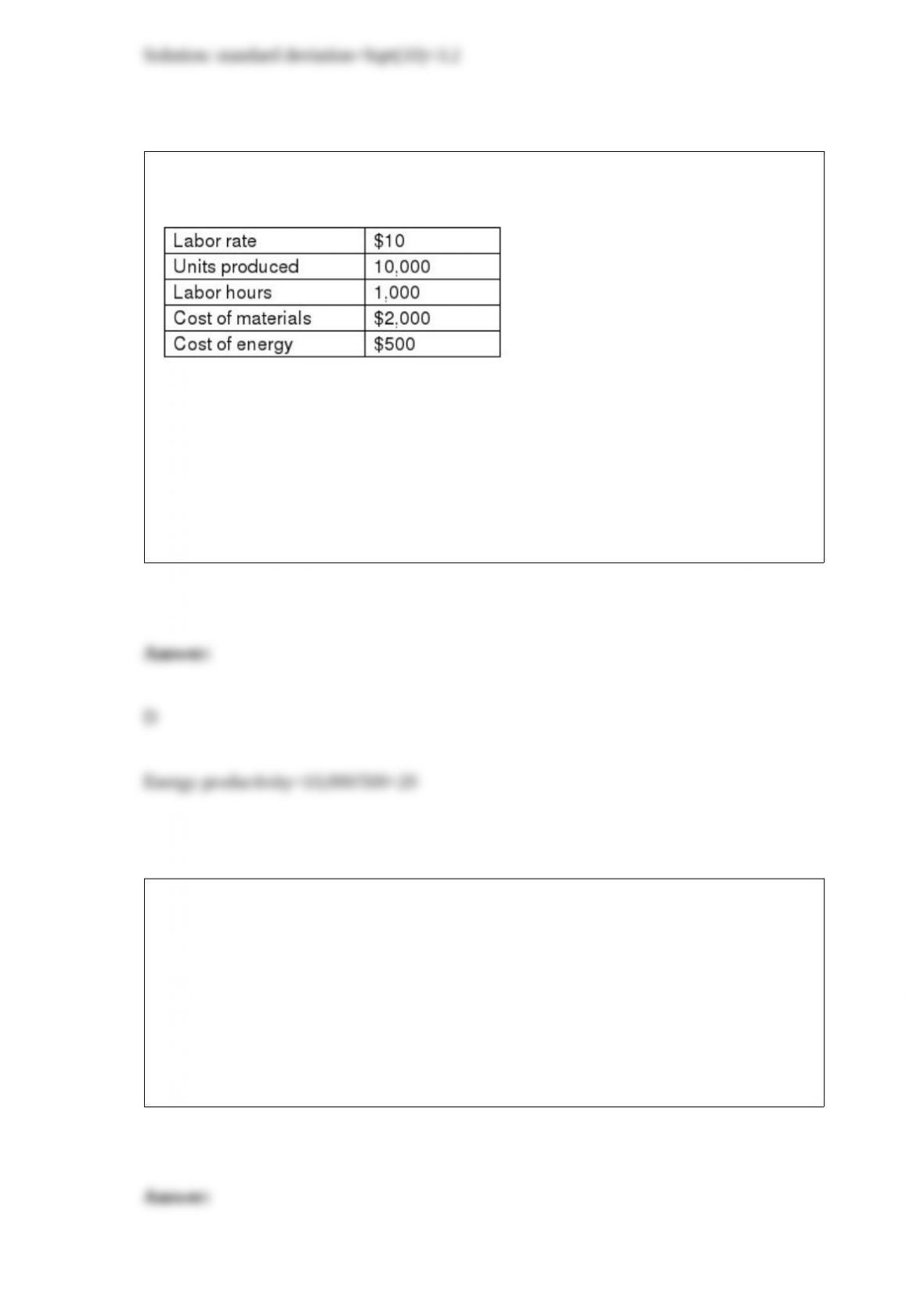
Snacknow, a food service firm, is calculating its monthly productivity report. From the
following data calculate the energy productivity.
a. 0.220
b. 2
c. 10
d. 20
Six Sigma companies report defective parts
a. defective parts per million.
b. defective parts per thousand.
c. defective parts per hundred.
d. no defective parts.do not exist.

A company randomly selects 100 light bulbs every day for 40 days from its production
process. If 600 defective light bulbs are found in the sampled bulbs then the 3-sigma
lower control limit would be
a. 0.0357
b. 0.0429
c. 0.1500
d. 0.1857
The search decision rule (SDR) is an algorithm that
a. solves a set of four quadratic equations.
b. finds the minimum cost for combinations of different workforce levels and
production rates.
c. uses regression analysis to improve the consistency of production planning decisions.
d. requires that a linear cost function be used.
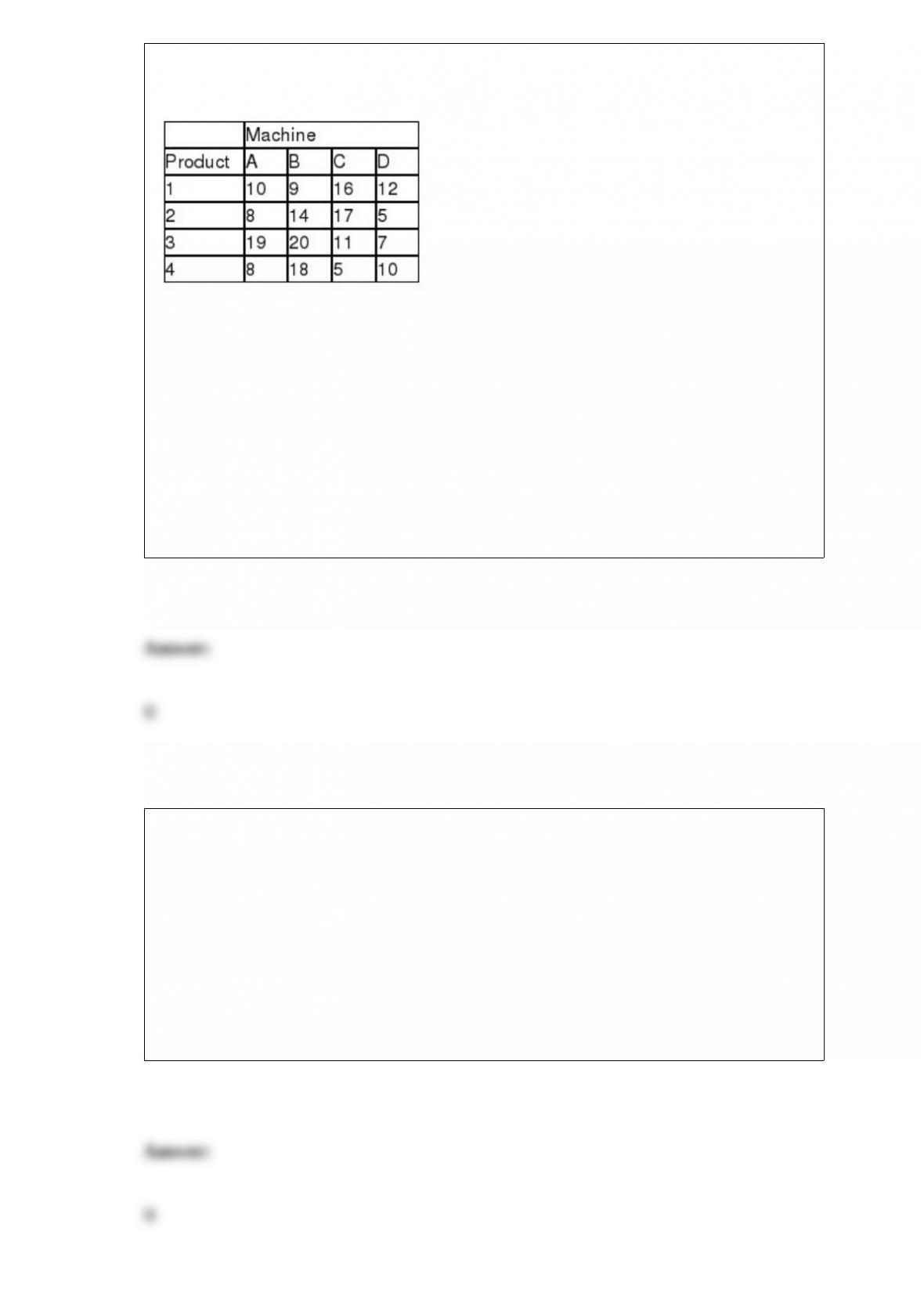
Four products (1, 2, 3, and 4) must be processed on one of four machines (A, B, C, and
D). The times required in minutes for each product on each machine are shown below.
If management assigns products to machines so that the total time to complete all jobs
is minimized, then the time to complete Product 1 is
a. 10 minutes.
b. 9 minutes.
c. 16 minutes.
d. 12 minutes
The estimated variance for an activity with a most likely time (m) equal to 11 days, the
optimistic time (a) equal to 6 days , and the pessimistic time (b) equal to 18 days is
a. 2 days.
b. 4 days.
c. 6 days.
d. 11 days.
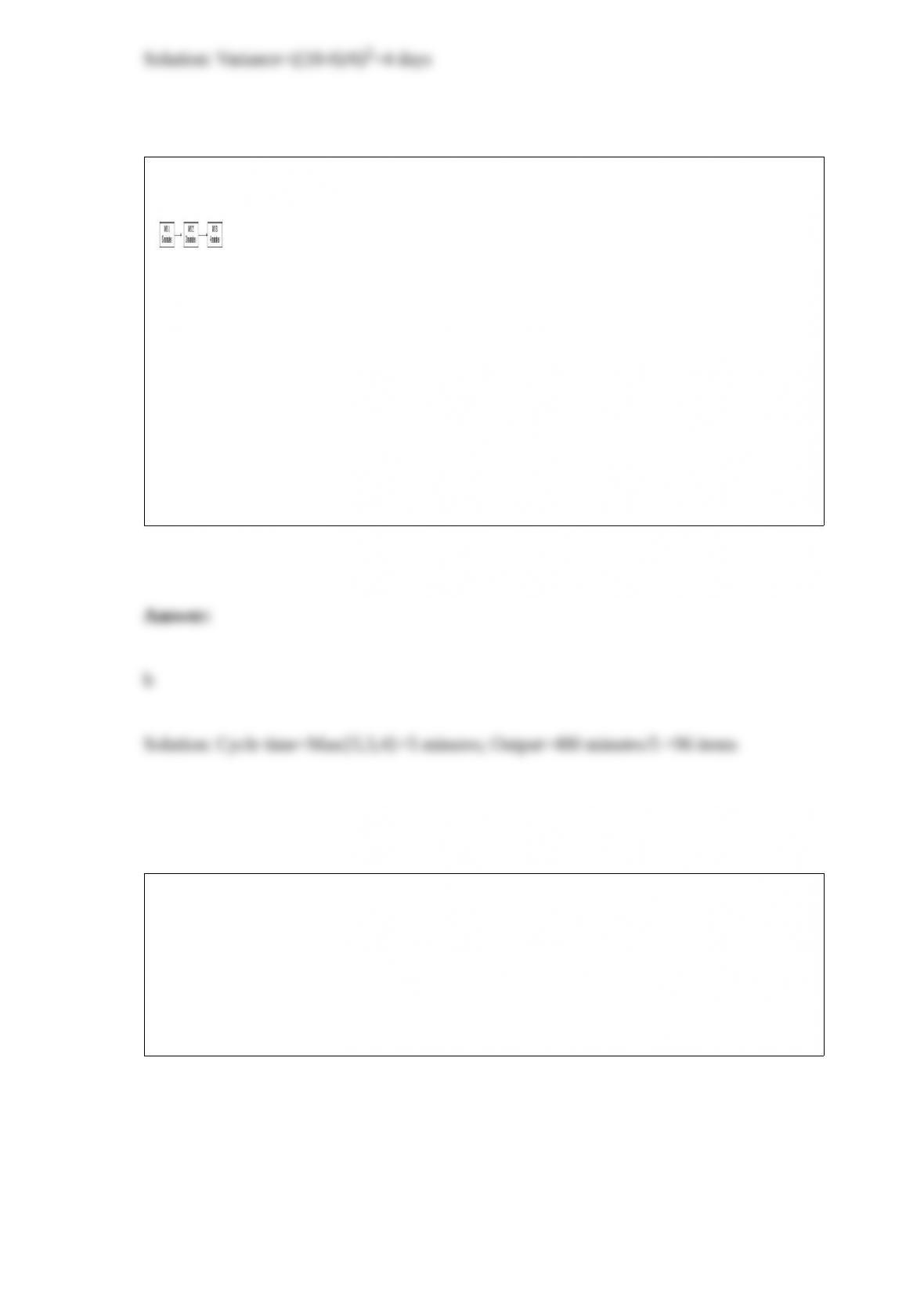
An assembly line consists of three workstations (WS) with each station’s activity time
as shown.
When fully operational the maximum output for this line in 8 hours of production time
would be
a. 40 units
b. 96 units
c. 120 units
d. 160 units
Fairco, a family business, is considering making an investment in its manufacturing
operation. Three decisions are under consideration: (1) a large investment; (2) a
medium investment; and (3) a small investment. The business believes that there are
three possible future outcomes for its product: (1) increasing demand; (2) stable
demand; and (3) decreasing demand. The business believes that the probability for
increasing, stable and decreasing product demand are 0.4, 0.5, and 0.1, respectively.
The following payoff table describes the decision situation.
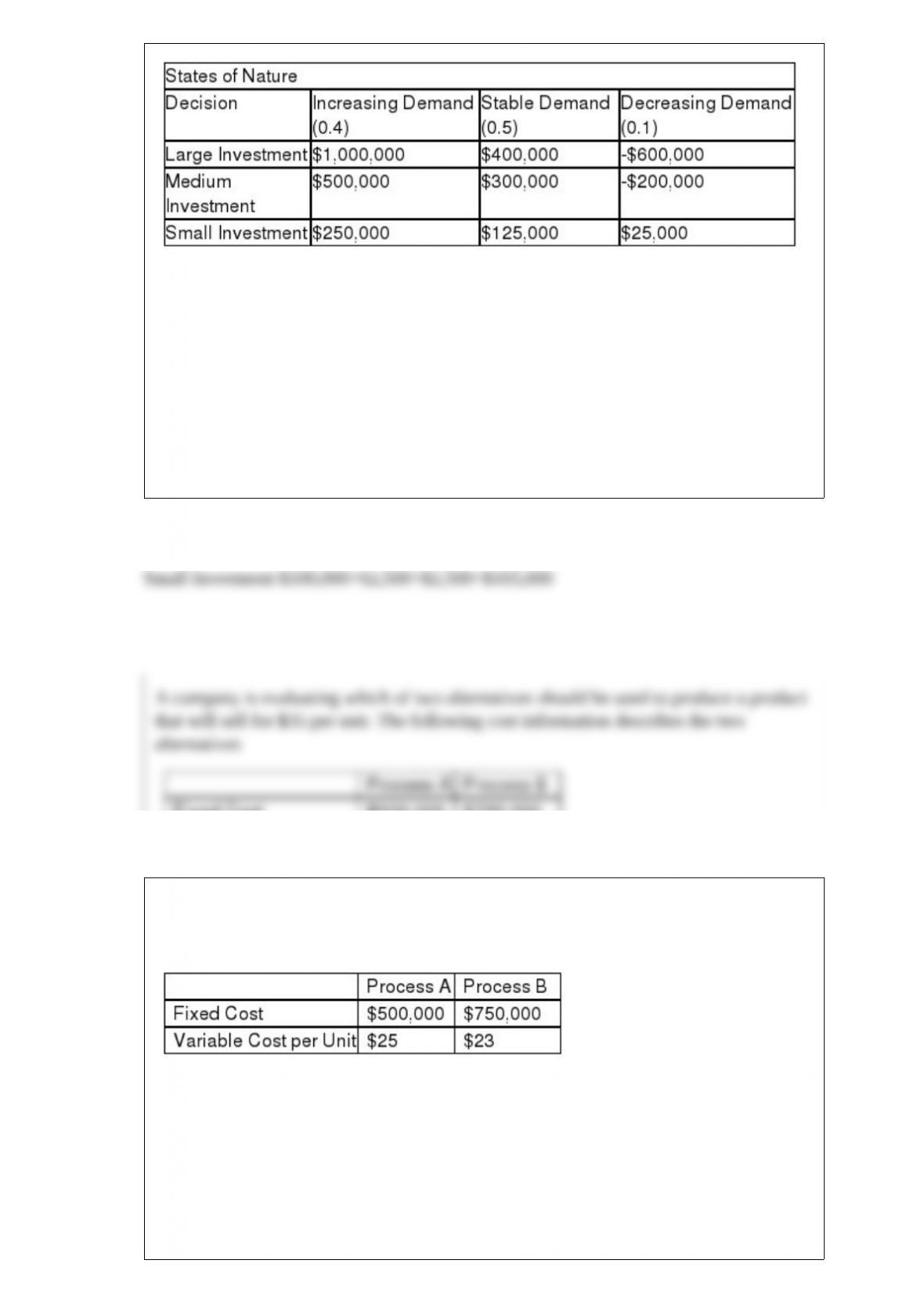
The expected value for the small investment decision is
a. $540,000.
b. $400,000.
c. $330,000.
d. $165,000.
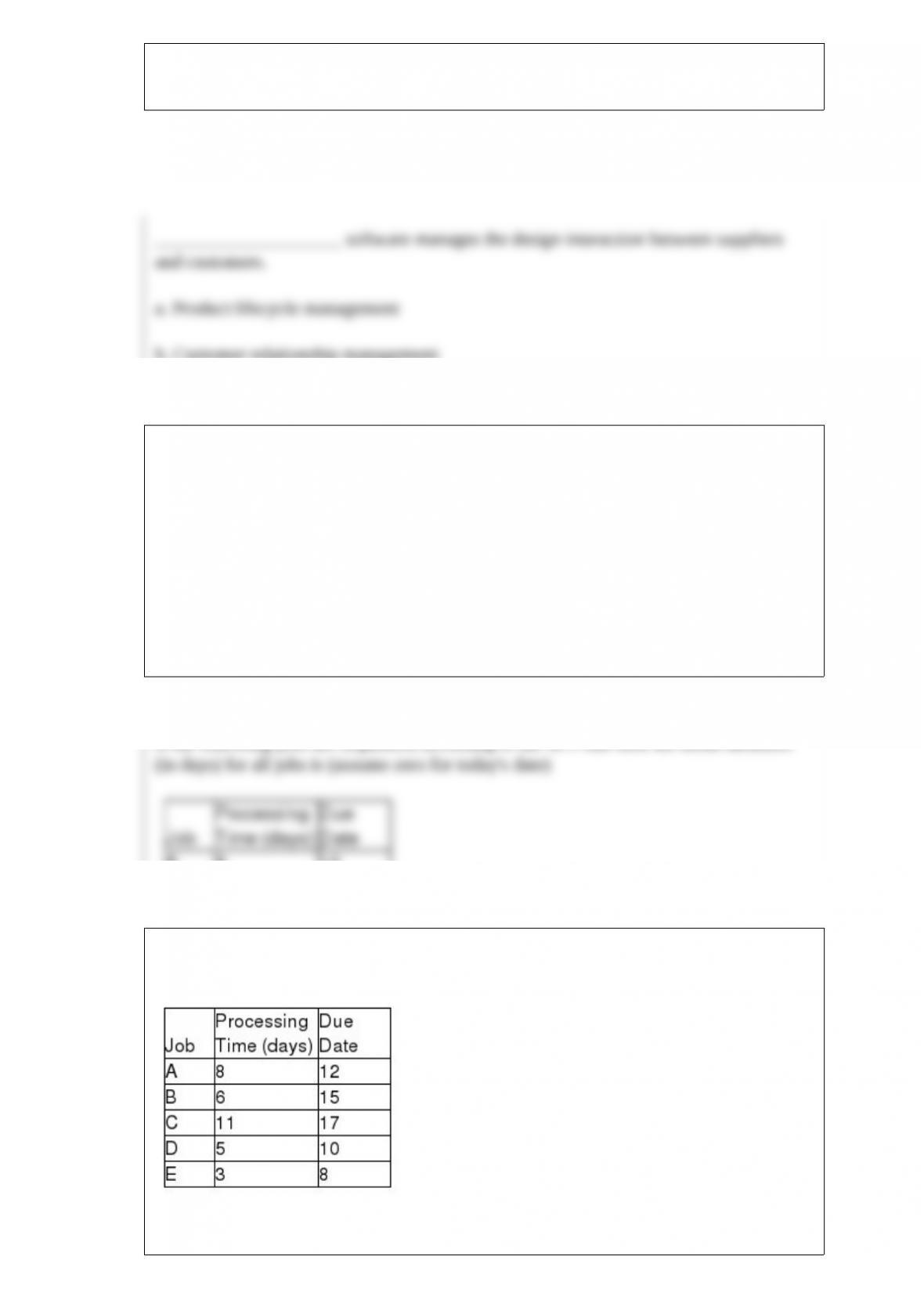
A company is evaluating which of two alternatives should be used to produce a product
that will sell for $35 per unit. The following cost information describes the two
alternatives
If total demand (volume) is 150,000 units, then the company should
a. select Process A with a profit of $1,300,000 to maximize profit
b. select Process B with a profit of $750,000 to maximize profit
c. select Process A with a profit of $1,000,000 to maximize profit
d. select Process B with a profit of $1,050,000 to maximize profit
____________________ software manages the design interaction between suppliers
and customers.
a. Product lifecycle management
b. Customer relationship management
c. Supply chain management
d. ERP
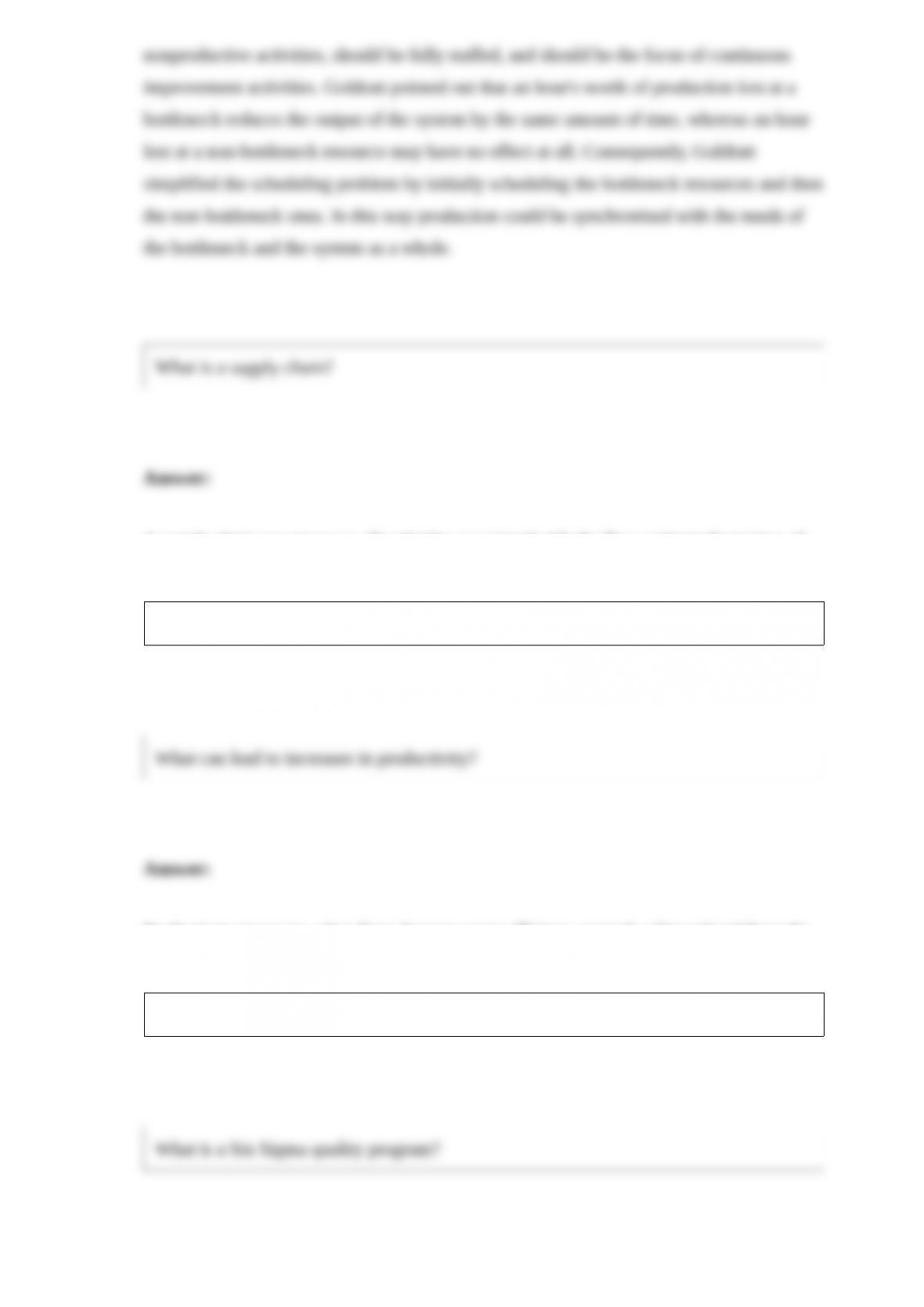
If the following jobs are sequenced according to the SPT rule then the mean tardiness
(in days) for all jobs is (assume zero for today’s date)
a. 16 days.

b. 13 days.
c. 5.2 days.
d. 3.2 days
A multiple sampling plan is also referred to as a
a. double sampling plan.
b. triple sampling plan.
c. sequential sampling plan.
d. None of the answer choices is correct.
Who developed the theory of constraints (TOC) and what is its approach to scheduling?
What is a supply chain?
What can lead to increases in productivity?
What is a Six Sigma quality program?
The ______ is the probability of accepting a lot that has a higher percentage of
defective items than the lot tolerance percent defective.
a. producer’s risk
b. sampling plan
c. consumer’s risk
d. average outgoing quality

Briefly describe the traditional cost relationship in waiting line analysis.
Who are the upstream and downstream supply chain members?