Operations mangers find very few types of linear program models applicable today
because finding an optimal solution is no longer a concern.
Supply chain management focuses on integrating and managing the flow of
manufactured goods, services, and related information.
Kanbans are used to maintain the discipline required of a push production system.
A service package defines the target market and the desired customer experience.
Cellular layouts combine the flexibility of process layouts with the efficiency of product
layouts.
Tolerances reflect the amount of common cause variation allowed in a process.
The service concept also defines how a service differs from other similar products and
how it will compete in the marketplace.
Globalization decreases the need for a well-planned domestic supply chains.
Linear regression relates two variables using a linear model.
Implementing a companywide game plan for allocating resources addresses the
long-standing battle between operations and finance.
The Monte Carlo technique is a type of simulation model.
Because of heightened competition resulting from globalization most companies find
little strategic value in long-range forecasts.
Mixed-modeling sequencing is used at Toyota to create uniform production levels.
The efficiency of a flexible manufacturing system (FMS) comes from reductions in
setup and waiting times.
If the average time to serve a customer is 3 minutes, then the service rate, µ, is
a. 3 per hour.
b. 12 per hour.
c. 16 per hour.
d. 20 per hour.
Which of the following techniques would most likely be used to systematically analyze
product failures?
a. concurrent design
b. quality function deployment
c. failure mode and effects analysis
d. value analysis
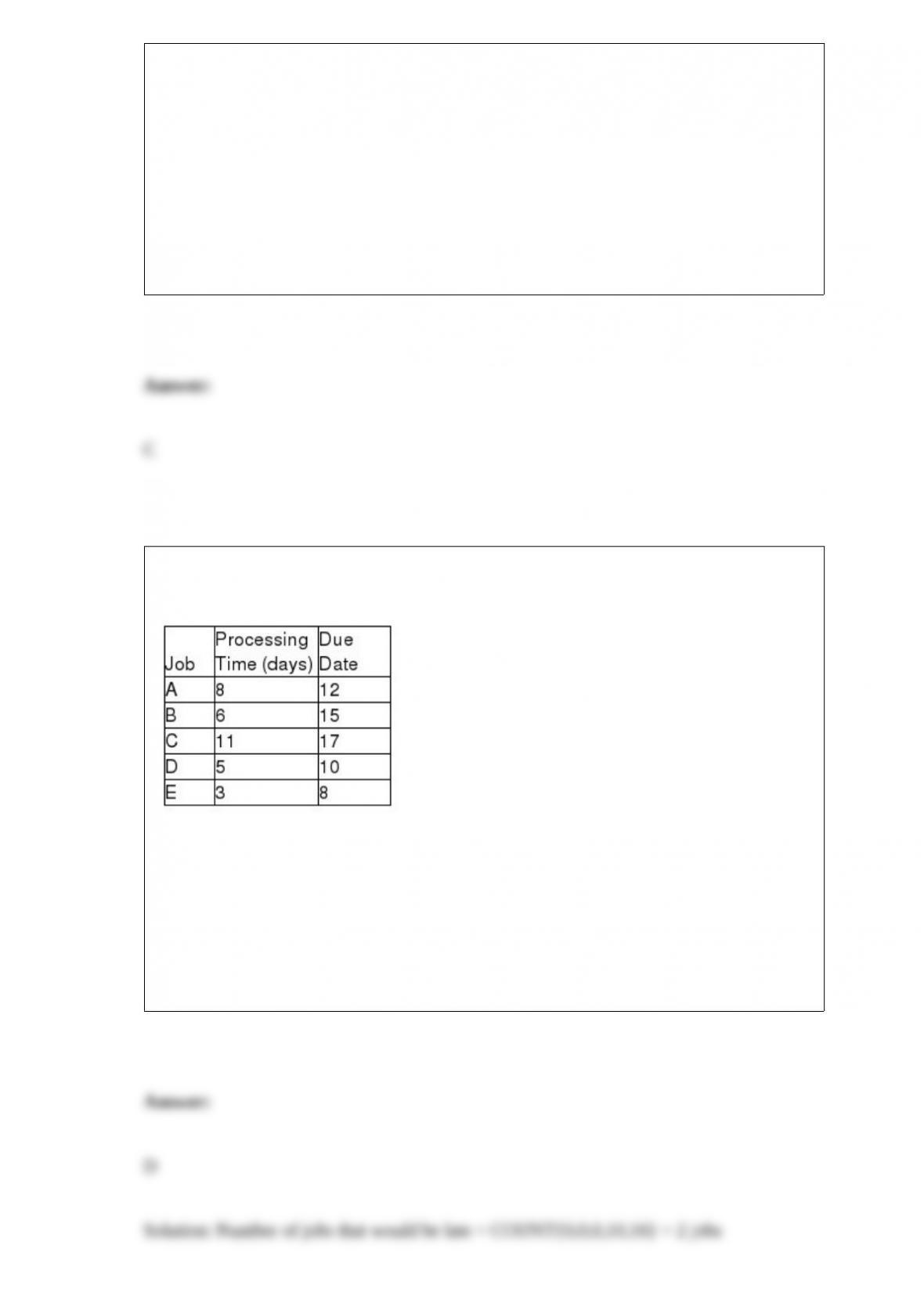
If the following jobs are sequenced according to the SPT rule then the total number of
jobs that would be late is (assume zero for today’s date)
a. 0 jobs.
b. 1 job.
c. 2 jobs.
d. 3 jobs.

A mathematical technique for forecasting that relates the dependent variable to an
independent variable is
a. correlation analysis.
b. exponential smoothing.
c. linear regression.
d. weighted moving average.
All of the following are transformation processes discussed in the text except
a. physiological.
b. locational.
c. exchange.
d. spiritual.
A firm has the following gross requirements for Item F. If ordering costs are $60 per
order and carrying costs are $0.50 per period.
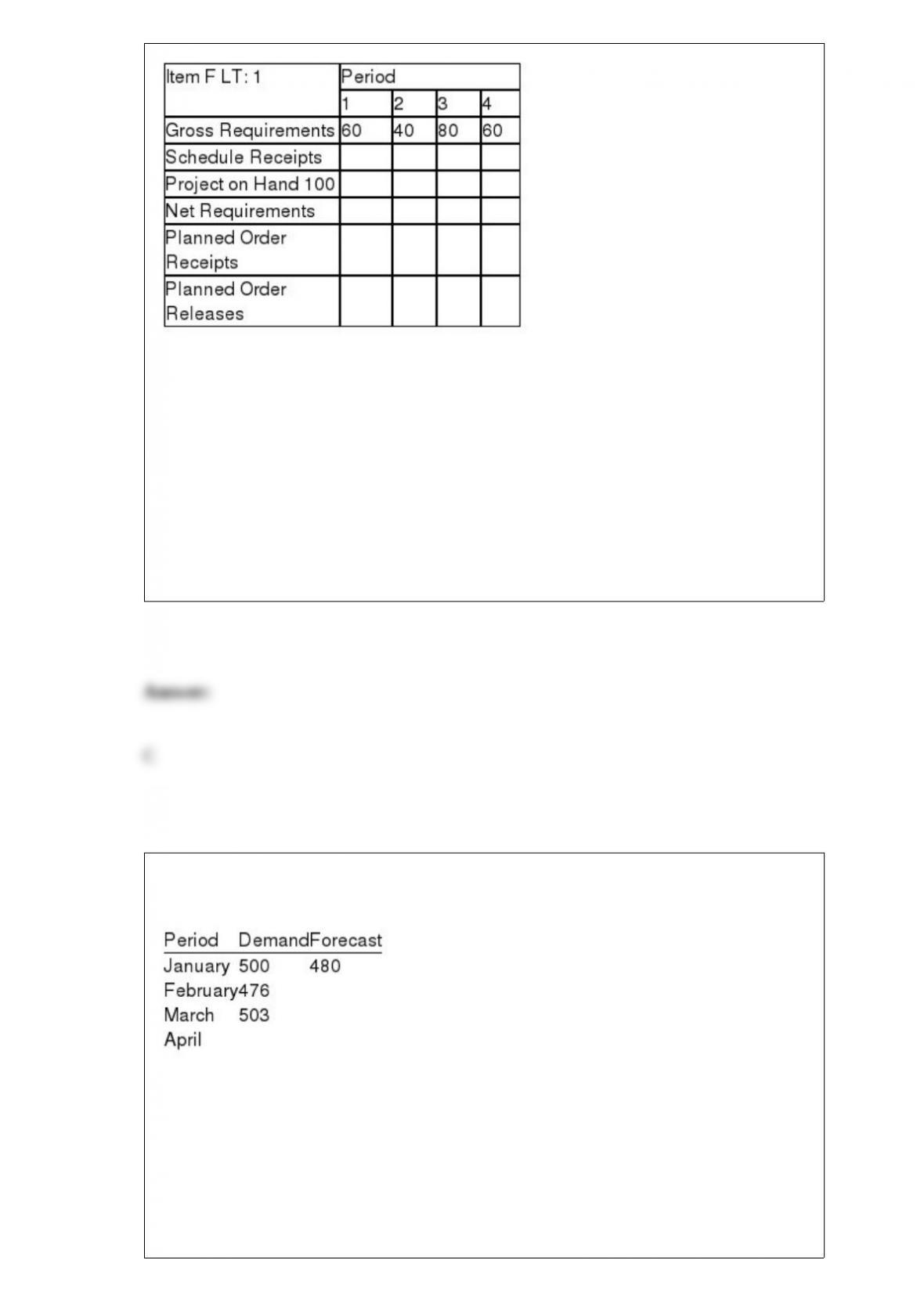
If EOQ lot sizing is used to set the minimum order quantity, then the planned order
releases is
a. 40 in period 1 and 0 in period 3
b. 0 in period 2 and 80 in period 3
c. 120 in period 2 and 120 in period 3
d. 100 in period 2 and 100 in period 3
For the demand values and the January forecast shown in the table below the
exponential smoothing forecast for March using α = 0.30 is
a. 489.
b. 486.
c. 483.
d. 480.

For an activity-on-node (AON) network,
a. arrows represent activities and nodes represent events.
b. nodes represent activities and arrows indicate precedence relationships.
c. arrows represent events and nodes indicate precedence relationships.
d. nodes indicate precedence relationships and arrows indicates the length of the
activity time.
The process of breaking an aggregate plan into more detailed plans is referred to as
a. collaborative planning.
b. hierarchical planning.
c. disaggregation.
d. rough-cut planning.

The process of equalizing the amount of work at each workstation in a product layout is
known as
a. block diagramming.
b. precedence requirements.
c. line balancing.
d. cycle time analysis.
A long-range forecast would normally not be used to
a. design the supply chain.
b. implement strategic programs.
c. determine production schedules.
d. plan new products for changing markets.
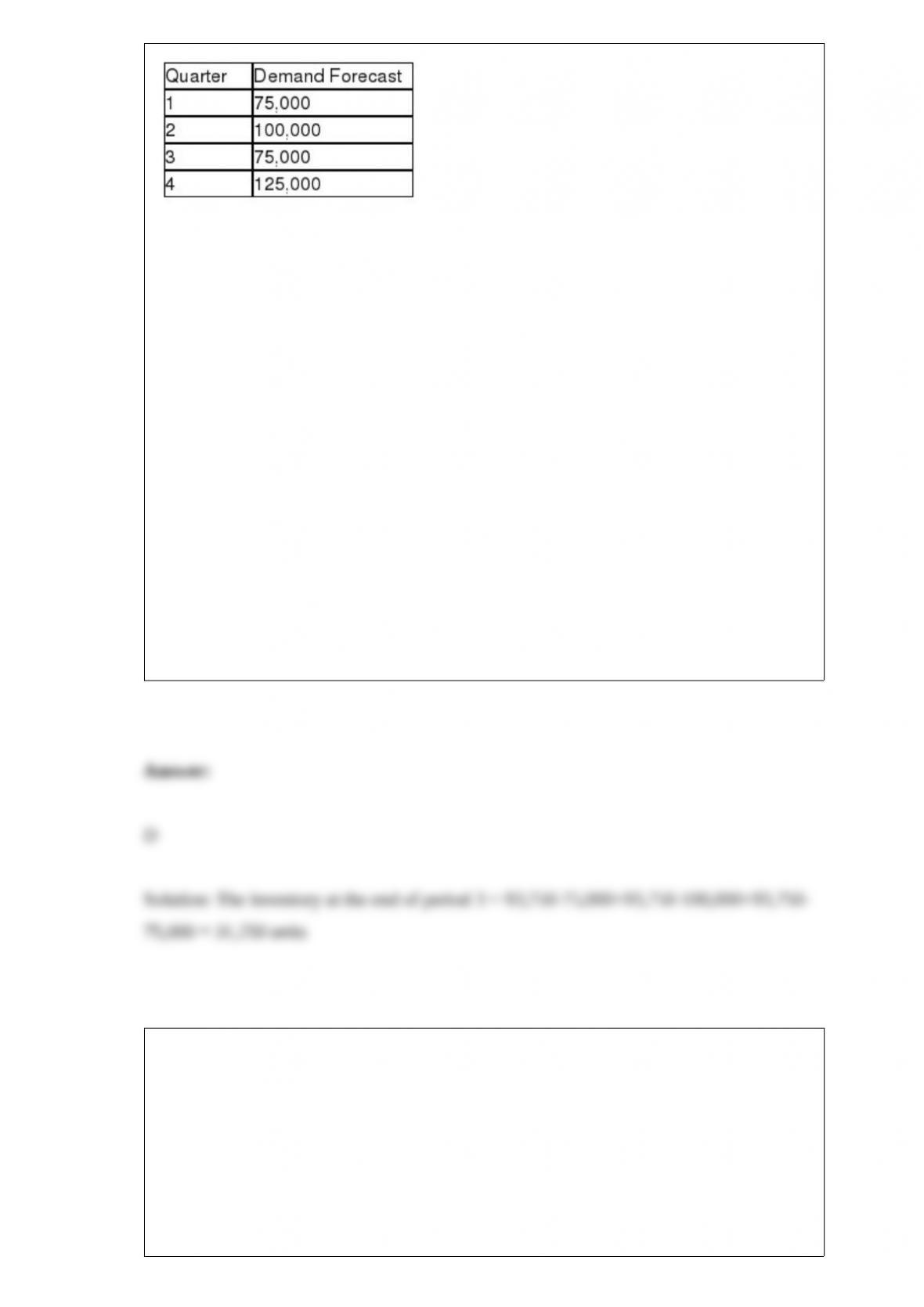
The following information relates to a company’s aggregate production planning
activities:
Beginning Workforce = 35 workers
Production per Employee = 1,250 units per quarter
Hiring Cost = $500 per worker
Firing Cost = $1,000 per worker
Inventory Carrying Cost = $20 per unit per quarter
If a level production strategy is used then the inventory at the end of quarter 3 is
a. 18,750
b. 12,500
c. 25,650
d. 31,250
Pizazz manufactures a 5.0 oz. energy drink of the same name. Because the cans are so
small, consumers are concerned that they are not receiving the full 5 ounces in each
can. A quality engineer at the company is charged with analyzing the filling process and
ensuring accurate readings. On 15 different occasions over the past month, she has
taken a sample of 6 energy drinks off the production line and recorded their weight. If
the sum of the sample means is 80.20 ounces and the sum of the sample ranges is 12.68
ounces, the LCL for an X-bar chart of this process would be
a. 4.50
b. 4.65
c. 4.79
d. 4.94
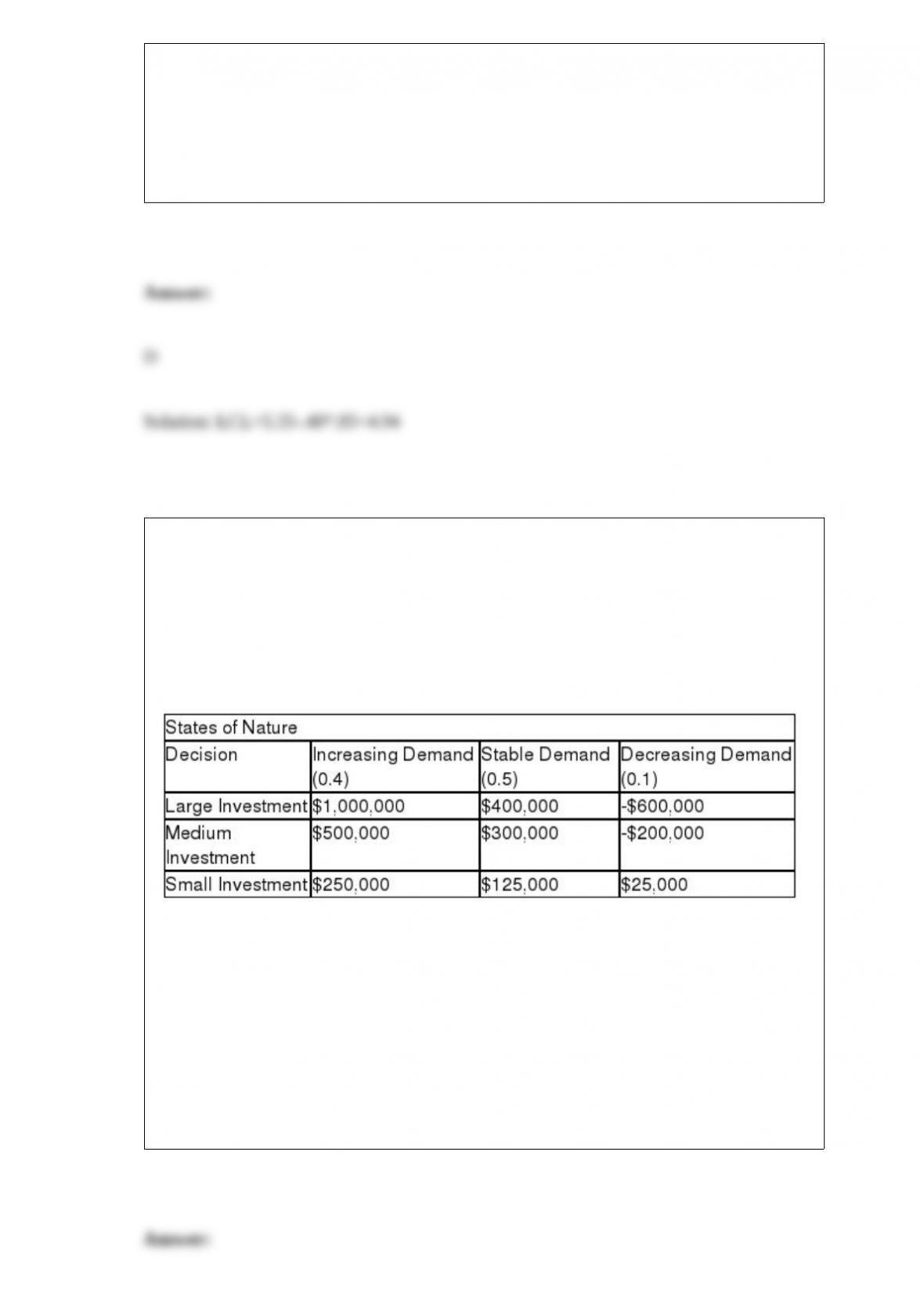
Fairco, a family business, is considering making an investment in its manufacturing
operation. Three decisions are under consideration: (1) a large investment; (2) a
medium investment; and (3) a small investment. The business believes that there are
three possible future outcomes for its product: (1) increasing demand; (2) stable
demand; and (3) decreasing demand. The business believes that the probability for
increasing, stable and decreasing product demand are 0.4, 0.5, and 0.1, respectively.
The following payoff table describes the decision situation.
The expected value for the large investment decision is
a. $700,000.
b. $540,000.
c. $330,000.
d. $165,000.
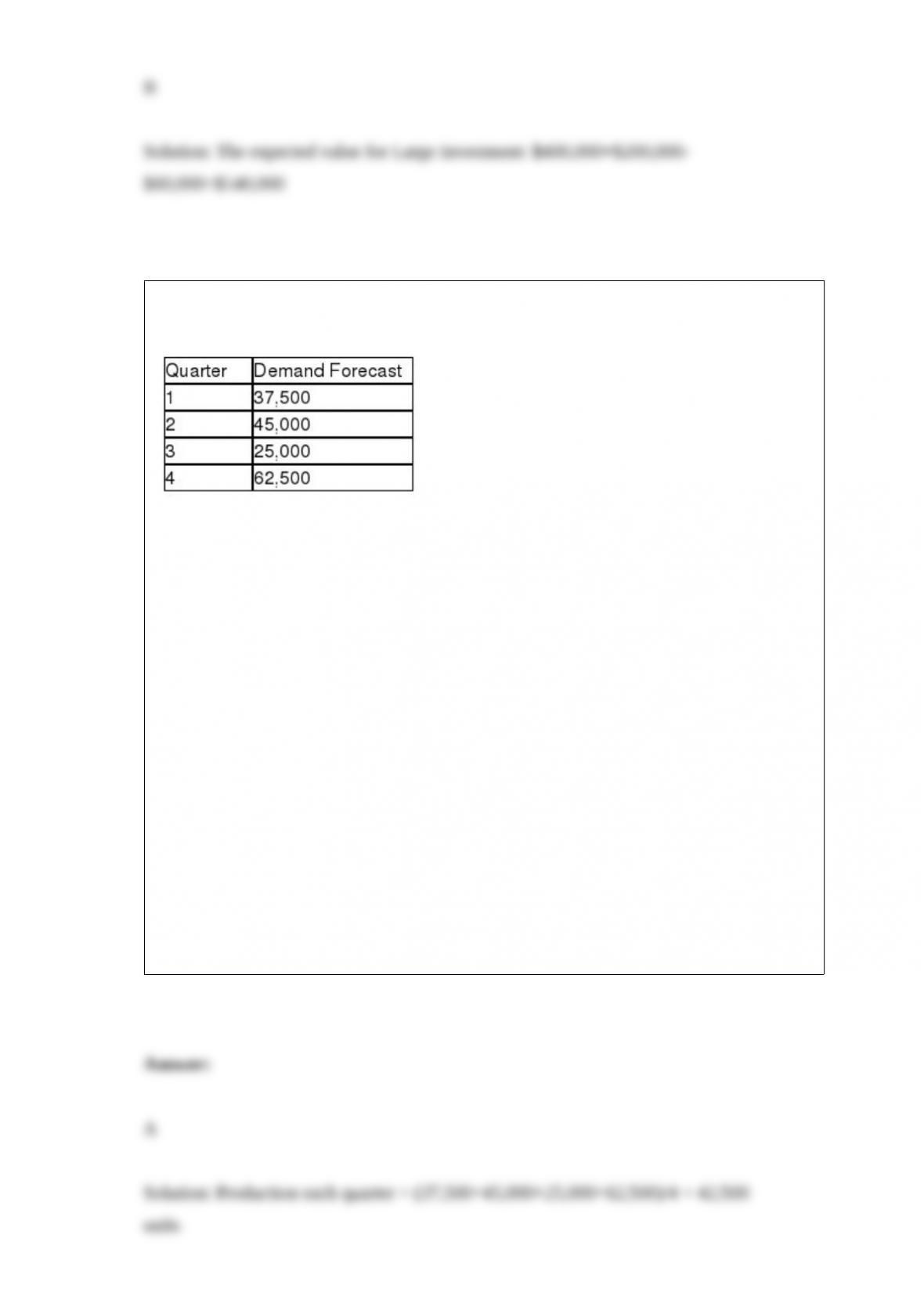
The following information relates to a company’s aggregate production planning
activities:
Beginning Workforce = 125 workers
Production per Employee = 500 units per quarter
Hiring Cost = $750 per worker
Firing Cost = $1,500 per worker
Inventory Carrying Cost = $10 per unit per quarter
If a level production strategy is used the number of units to produce each quarter is
a. 42,500
b. 85,000
c. 62,500
d. 37,500
What is the economic order quantity?
a. 100
b. 115.47
c. 200
d. 500
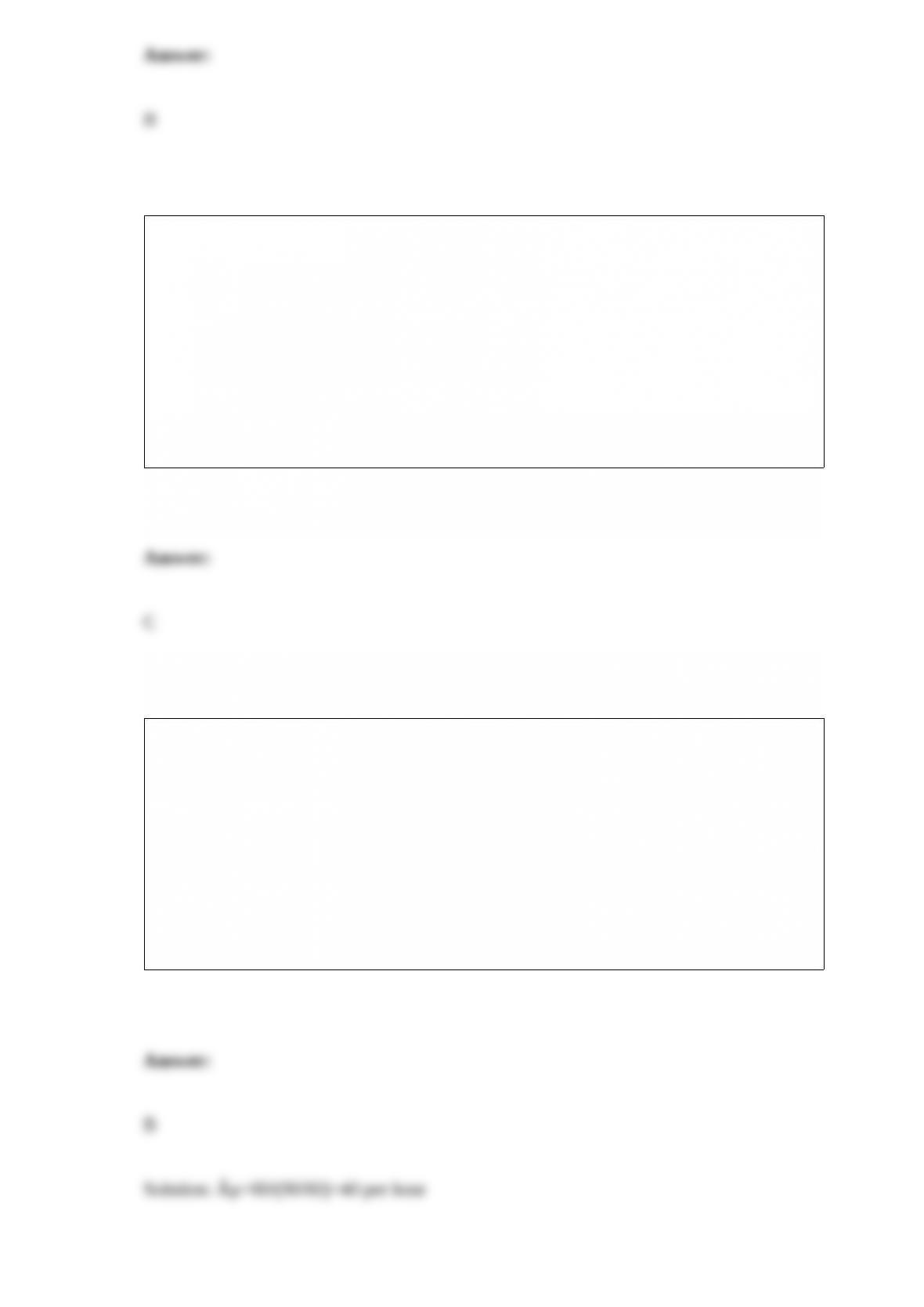
The following table of probabilistic time estimates (in weeks) and activity predecessors
are provided for a project.
Table ZZ
How much slack is associated with activity C?
a. 0 weeks.
b. 4.50 weeks.
c. 12.67 weeks.
d. 31.00 weeks.
Typical performance improvement resulting from a process innovation project ranges
from
a. 5 to 10%.
b. 25 to 50%.
c. 50 to 100%.
d. 100 to 200%.
If, on average, it takes 90 seconds to serve a customer then the hourly service rate, µ,
is
a. 90 per hour.
b. 40 per hour.
c. 30 per hour.
d. 1.5 per hour.

Which of the following is not a benefit of lean production?
a. greater flexibility
b. increased capacity
c. more customers
d. more product variety
The quantity discount model considers
a. purchase price.
b. carrying cost.
c. ordering cost.
d. All of these answer choices are correct.
____________________ is a software system that assists in the creation, modification
and analysis of design.
a. Computer aided design
b. Collaborative product design
c. Computer aided engineering
d. None of these answer choices is correct.
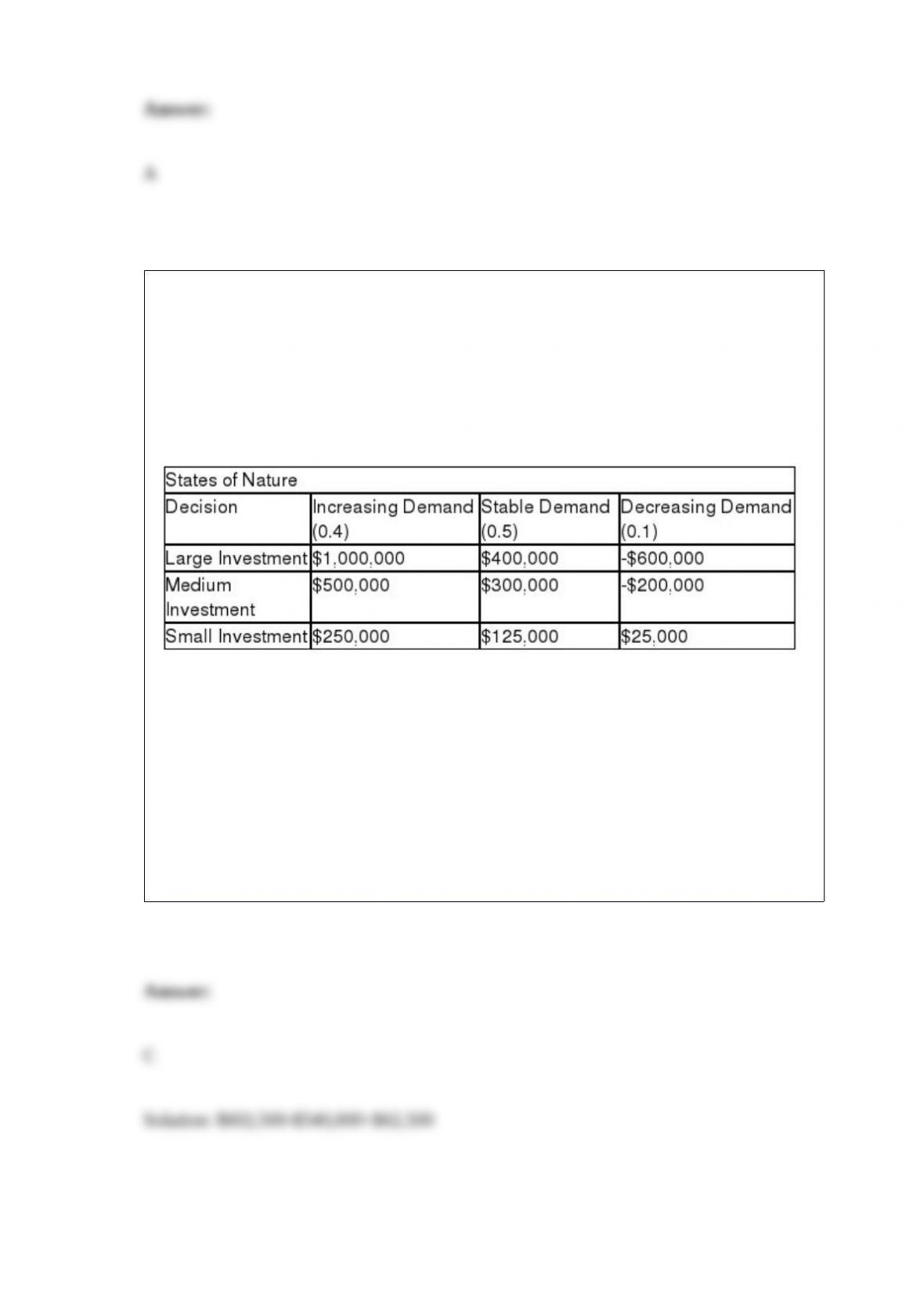
Fairco, a family business is considering making an investment in its manufacturing
operation. Three decisions are under consideration: (1) a large investment; (2) a
medium investment; and (3) a small investment. The business believes that there are
three possible future outcomes for its product: (1) increasing demand; (2) stable
demand; and (3) decreasing demand. The business believes that the probability for
increasing, stable and decreasing product demand are 0.4, 0.5, and 0.1, respectively.
The following payoff table describes the decision situation.
The expected value of perfect information for Fairco is
a. $602,500.
b. $540,000.
c. $62,500.
d. $25,000.