Total productive maintenance combines preventive maintenance with kaizen.
The most common type of forecasting method for long-term strategic planning is based
on quantitative modeling
Dismantling and inspecting a competitor’s product to identify design features that might
be used to improve your own product is known as reverse engineering.
The allowable range of the variation in a part’s design specification is called the
signal-to-noise ratio.
In a job shop environment, the process of prioritizing jobs assigned to a productive
resource is called sequencing.
Johnson’s rule gives an optimal sequence for jobs processed serially through a two step
system.
Subcontracting is a feasible alternative for adjusting capacity provided the supplier can
reliably meet quality and time requirements.
The organization’s overall approach for producing goods and providing services is its
process strategy.
Cloud computing involves on-demand IT services.
An effective design process matches product characteristics with customer
requirements.
An alternative workplace is a combination of nontraditional work locations and
practices that supplement or replace the traditional office.
The fundamental objective of Six Sigma is to focus on improvement by reducing
process variation.
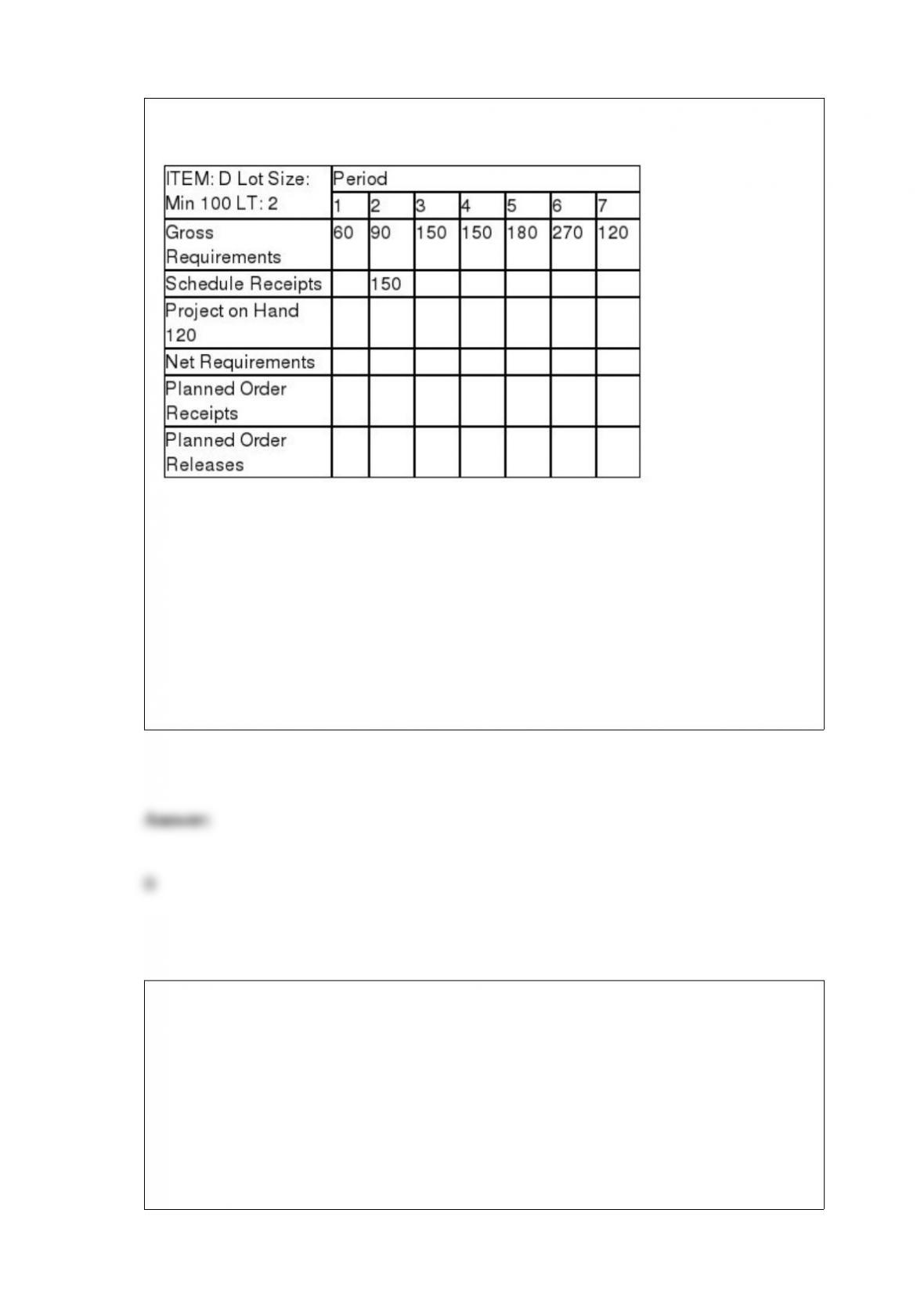
Given the following MRP matrix for Item D:
The planned order release for period 3 is
a. 100.
b. 160.
c. 270.
d. 300.
Which of the following is not associated with the sourcing continuum?
a. Joint venture
b. In-house production
c. Strategic alliance
d. Single contract

A manager of a global supply chain is concerned with all the following except
a. timeliness.
b. quality.
c. social issues.
d. All of these answer choices are correct.
The concept of allocating extra time to a schedule for planning, problem solving, and
maintenance is known as
a. preventative scheduling.
b. preventive maintenance.
c. over capacity maintenance.
d. under capacity scheduling.
_______________ can be subdivided into ________________ that store subsets of

data.
a. Databases, data warehouses
b. Data warehouses, data marts
c. Databases, data marts
d. Data warehouses, databases
Companies that compete on ______________ are able to produce a wide variety of
products in response to customer needs.
a. cost
b. speed
c. flexibility
d. quality
Receiving, handling and shipping costs are examples of
a. shortage costs.
b. carrying costs.
c. ordering costs.
d. None of these answer choices is correct.

What is the inventory ordering cost using the economic order quantity?
a. $200
b. $500
c. $866
d. $1,000
The term aggregate planning reflects the fact that plans are developed for ___________,
rather than _____________.
a. product families, individual products
b. product lines, product families
c. competitor products, product families
d. competitor products, individual products
All of the following are transformation processes discussed in the text except
a. physiological.
b. locational.
c. exchange.
d. spiritual.
Which one of the following is not an example of a hybrid facility layout?
a. Fixed-position
b. Mixed-model
c. Cellular
d. Flexible manufacturing
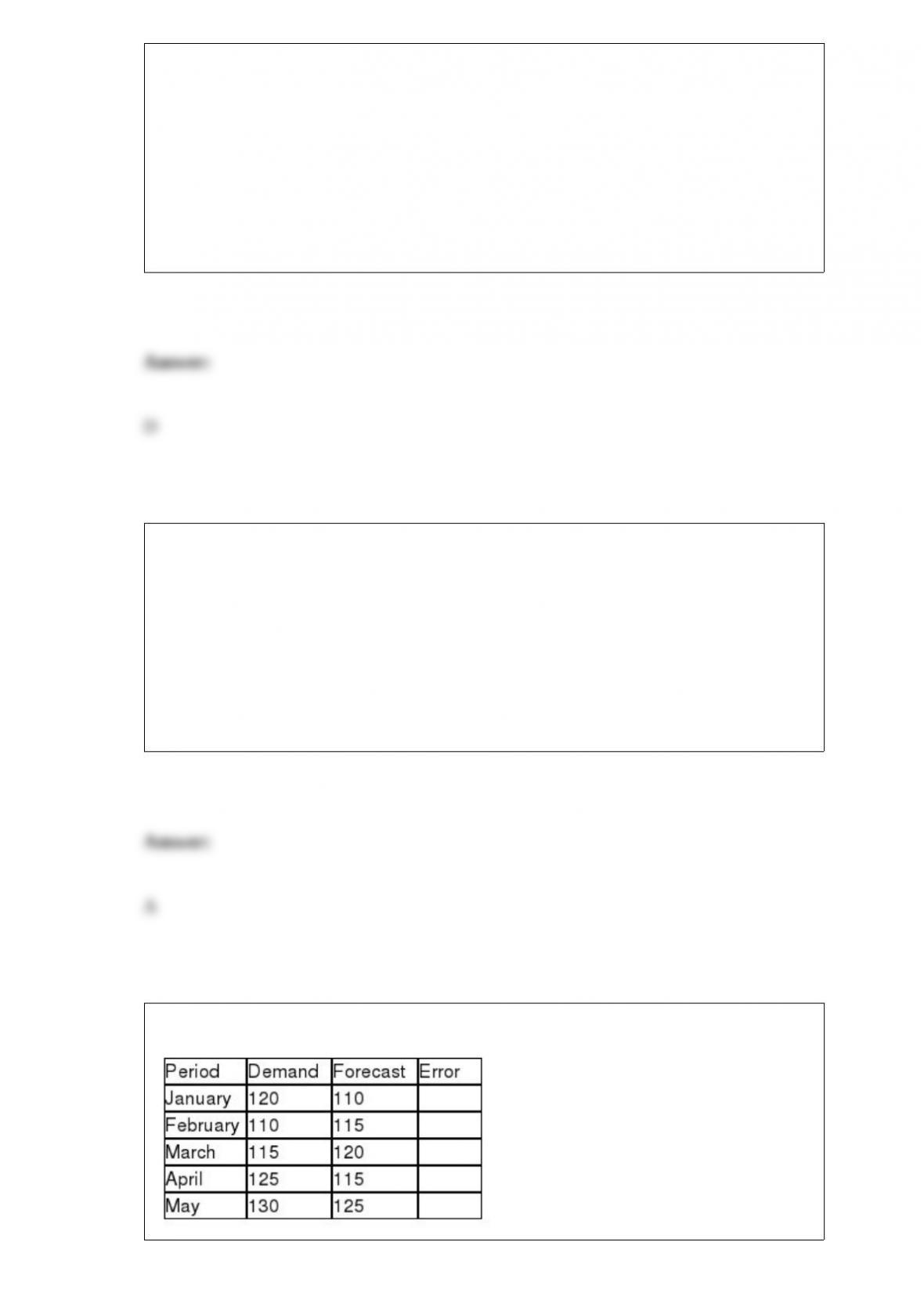
A forecasting model has produced the following forecasts:

At the end of May the tracking signal would be
a. 0.000.
b. 0.667.
c. 1.333.
d. 2.143.
A project consists of the following four activities with activity times in days:
Table YY
The earliest finish (EF) time for activity C is
a. 4 days.
b. 6 days.
c. 10 days.
d. 11 days.

A production process consists of the following four stages with the average percentage
of good quality at each stage as shown.
How many units must the company put into production each day to achieve a daily
yield of 350 good units?
a. approximately 430 units
b. approximately 415 units
c. approximately 468 units
d. approximately 361 units
The ______________ effect is caused in part by distortion in product demand
information caused by inaccurate forecasts.
a. bullwhip
b. regression
c. error
d. None of these answer choices is correct.

________________ is the process of making sure a project progresses to a successful
completion.
a. Project planning
b. Project scheduling
c. Project control
d. None of these answer choices is correct.
A restaurant currently uses 62,500 boxes of napkins each year at a constant daily rate. If
the cost to order napkins is $200.00 per order and the annual carrying cost for one box
of napkins is $1.00, then the economic order quantity for napkins is
a. 62,500 boxes.
b. 10,000 boxes.
c. 5,000 boxes.
d. 2,500 boxes.
Annual demand for a product is 40,000 units. The product is used at a constant rate over
the 365 days the company is open every year. The annual holding cost for the product is
estimated to be $2.50 per unit, and the cost of placing each order is $125.00. If the
company orders according to the economic order quantity (EOQ) formula, then the time
between orders (order cycle time) is
a. 18.25 days.
b. 24.33 days.
c. 36.5 days.
d. 73 days.
Which of the following control charts is used to control the variation within samples?
a. -chart
b. R chart
c. c-chart
d. p-chart
Atlas Inc. produces product A and product B. Each product must go through two
processes. Each A produced requires two hours in process 1 and five hours in process 2.
Each B produced requires six hours in process 1 and three hours in process 2. There are
80 hours of capacity available each week in each process. Each A produced generates
$6.00 in profit for the company. Each B produced generates $9.00 in profit for the
company. The company’s objective function is
a. Maximize Z = $6.00A + $9.00B.
b. Maximize Z = $9.00A + $6.00B.
c. Minimize Z = $6.00A + $9.00B.
d. Minimize Z = $6.00A +$9.00B.
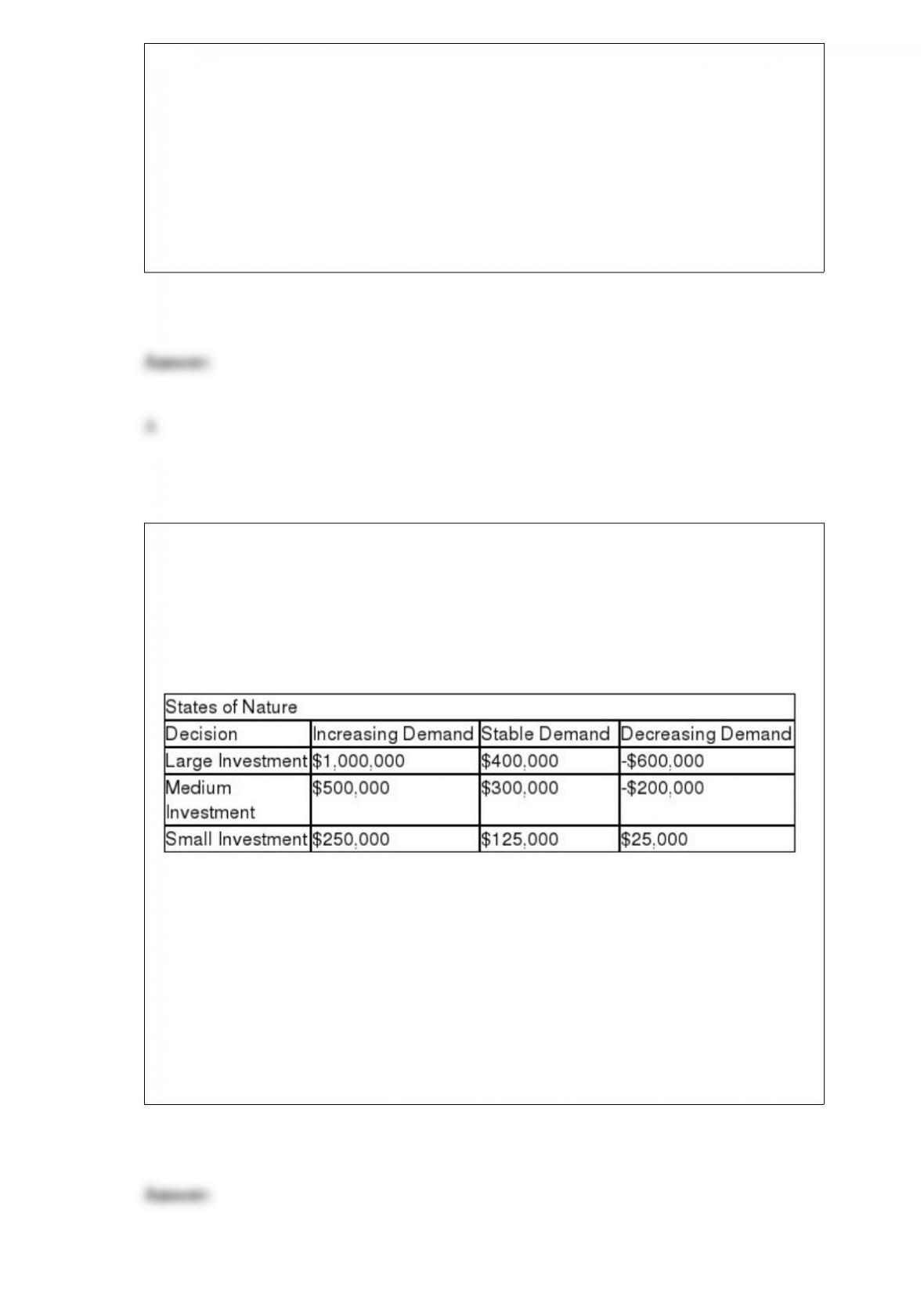
Fairco, a family business, is considering making an investment in its manufacturing
operation. Three decisions are under consideration: (1) a large investment; (2) a
medium investment; and (3) a small investment. The business believes that there are
three possible future outcomes for its product: (1) increasing demand; (2) stable
demand; and (3) decreasing demand. The following payoff table describes the decision
situation.
The best decision for Fairco using the maximin criterion would be to
a. make the large investment.
b. make the medium investment.
c. make the small investment.
d. choose stable demand.
Scientific management involves all the following except
a. breaking down jobs into their simplest elements.
b. eliminating unnecessary motions.
c. hiring only highly trained workers.
d. assigning tasks to workers.
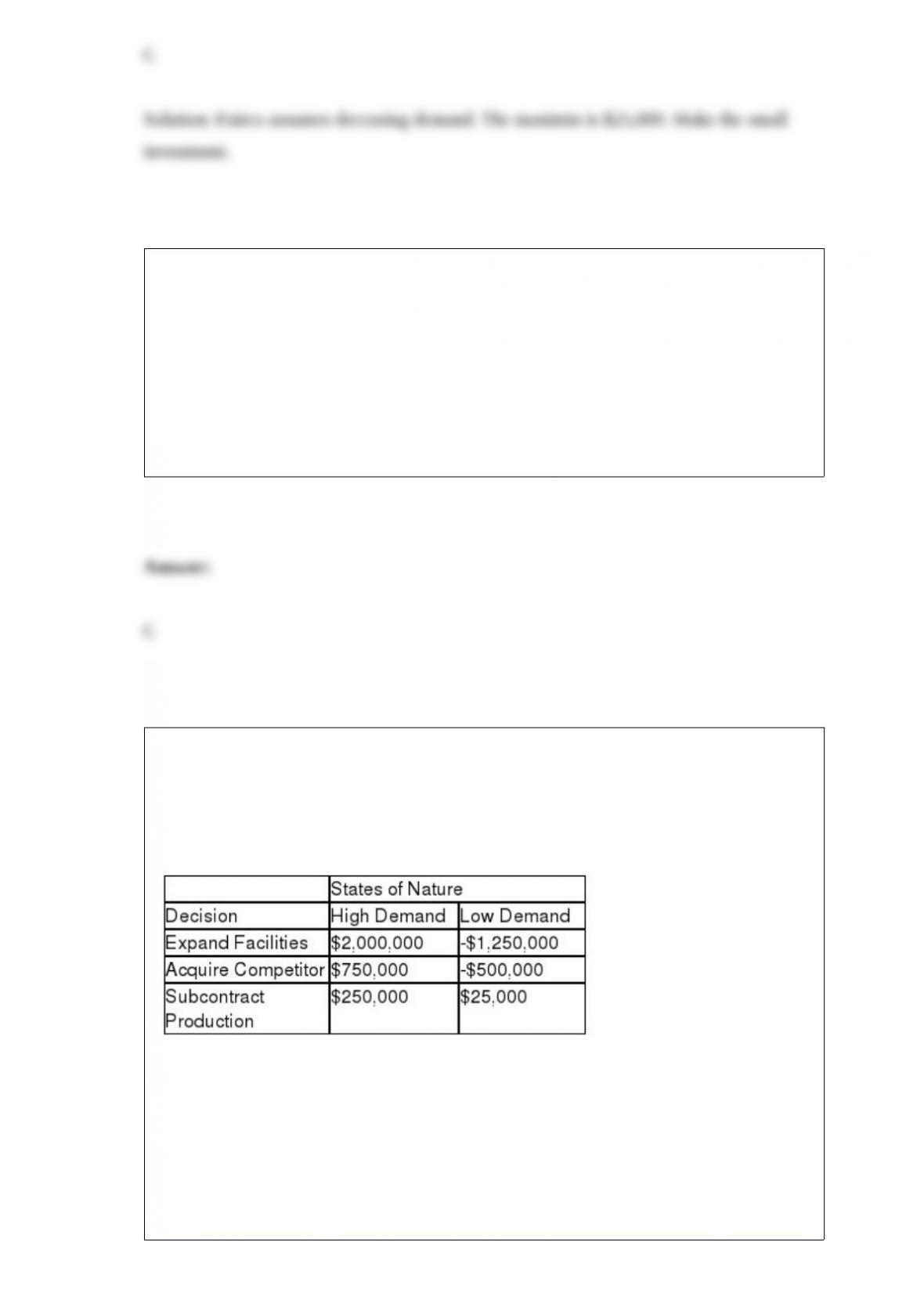
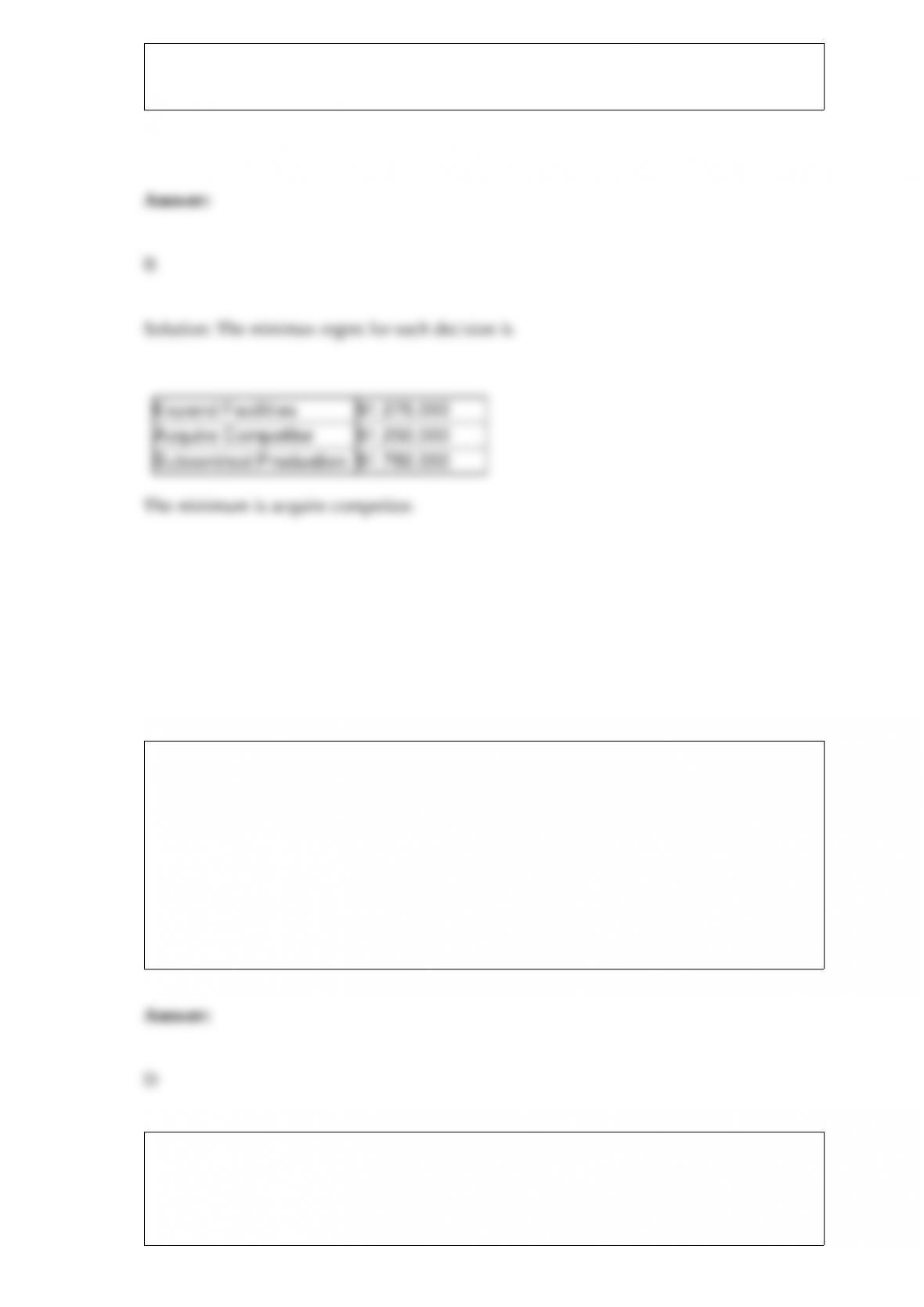
Kallie Inc., a small parts manufacturer, has just engineered a new product for the
automotive industry. In order to produce the part the company can expand existing
facilities, acquire a competitor, or subcontract production. The company believes the
product will either experience high market demand or low market demand. The
following payoff table describes the company’s decision situation.
The best decision for Kallie Inc. using the minimax regret decision criterion is to
a. expand facilities.
b. acquire competitor.
c. subcontract production.
d. select high demand.
An exponential smoothing forecasting technique requires all of the following except
a. the forecast for the current period.
b. the actual demand for the current period.
c. a smoothing constant.
d. large amounts of historical demand data.
Which of the following is not a facility location factor important in selecting a country?
a. Government stability
b. Export and import tariffs
c. Customer service
d. Culture
Briefly discuss the characteristics of an effective design process.
List the 3 categories of the principles of motion study and give 2 rules for each
category.
What is the role of information and information technology in managing the supply
chain?
Briefly describe facility layout and the different objectives involved with facility layout
decision.
List some of the objectives in scheduling.
Modern Inc. manufactures low-cost tables at a processing cost of $80 per table. The
company produces 100 units per day and averages 90% good quality resulting in 10%
defective items. Fifty percent of the defective units are reworked prior to shipment to
Modern’s distribution center. The rework cost is $10 per unit. If the rework cost is
increased to $50 the quality productivity ratio (QPR) is
a. approximately 1.10.
b. approximately 1.15.
c. approximately 1.20.
d. approximately 125.

What are the basic elements of a waiting line? Define each.