What are the advantages of using PERT and CPM?
How many observations would be necessary for a time studies analyst to be 99%
confident that the average time is within .1 minutes of the true value if the average time
is 10.5 minutes and the standard deviation is 3 minutes?
In the context of decision-making, define state of nature.
An approach to sequencing that can handle the situation where jobs must pass through
two or more work centers in a fixed sequence is __________.
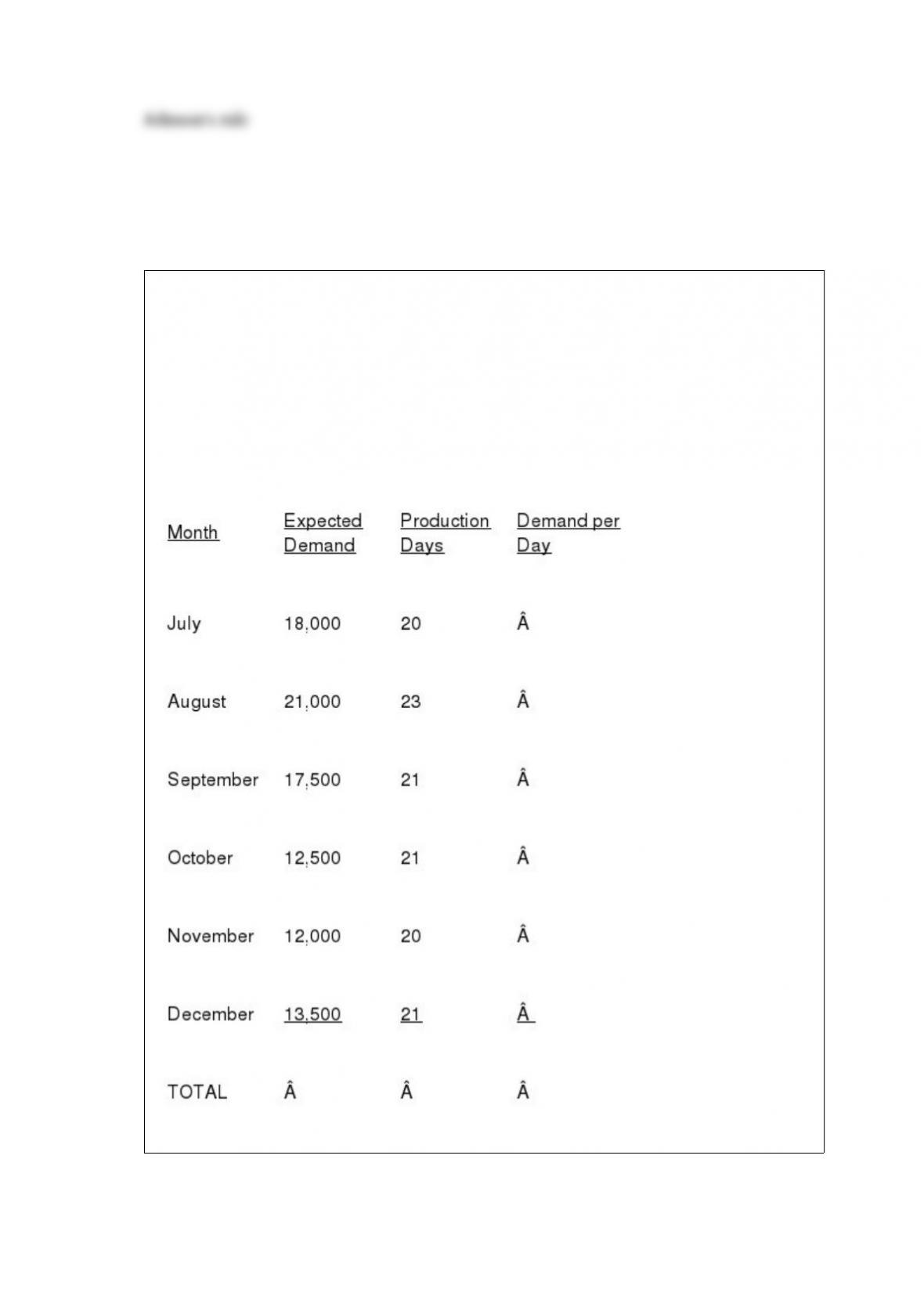
Fairview Industries is preparing its aggregate plan for the second half of the year. The
table below contains monthly demand estimates and working days per month. Complete
the table by computing total demand, demand per day (for each month), and the average
requirement (in units per day) over the six-month planning horizon. Prepare a graph of
forecast demand and level production, by months, for the planning period. Label your
graph carefully.
A management analyst is using exponential smoothing to predict merchandise returns at
an upscale branch of a department store chain. Given an actual number of returns of
154 items in the most recent period completed, a forecast of 172 items for that period,
and a smoothing constant of 0.3, what is the forecast for the next period? How would
the forecast be changed if the smoothing constant were 0.6? Explain the difference in
terms of alpha and responsiveness.
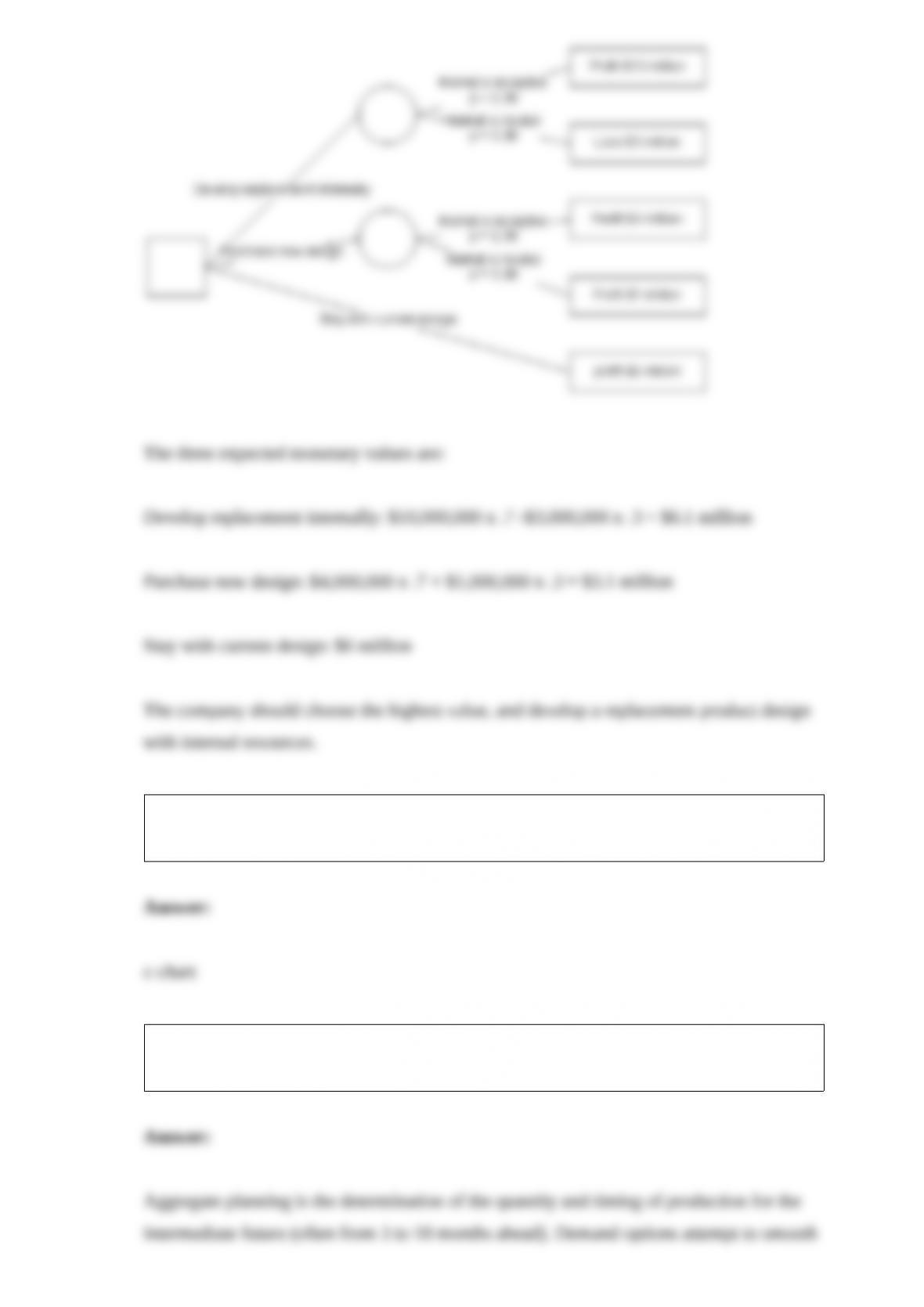
A company manufactures specialty pollution-sensing devices for the offshore oil
industry. One particular device has reached maturity, and the company is considering
whether to replace it with a newer model. Technologies have not changed dramatically,
so the new device would have similar functionality to the existing one, but would be
smaller and lighter in weight. The firm’s three choices are: keep the old model; design a
replacement device with internal resources; and purchase a new design from a firm that
is one of its suppliers. The market for these devices will be either “receptive” or
“neutral” of the replacement model. The financial estimates are as follows: Keeping the
old design will yield a profit of $6 million dollars. Designing the replacement internally
will yield $10 million if the market is “receptive,” but a $3 million loss if the market is
“neutral.” Acquiring the new design from the supplier will profit $4 million under
“receptive,” $1 million under “neutral.” The company feels that the market has a 70
percent chance of being “receptive” and a 30 percent chance of being “neutral.” Draw
the appropriate decision tree. Calculate expected value for all courses of action. What
action yields the highest expected value?
The __________ is a quality control chart used to control the number of defects per unit
of output.
What is the purpose of aggregate planning? Describe some demand and capacity
options for implementing plans.