The aggregate operations planning variable “inventory on hand” refers to the balance of
unused inventory carried over from the previous time period.
Answer:
Attributes are those quality characteristics that are classified as either conforming or not
conforming to specification.
Answer:
An operations and supply chain strategy must be integrated with the organization’s
corporate strategy.
Answer:
“Operations” refers to manufacturing and service processes used to transform resources
employed by a firm into products desired by customers.
Answer:
The job of operations and supply chain strategy is to deliver the most feature-rich,
highest quality product at the lowest price within specified parameters of delivery time
and customization.
Answer:
Operations and supply chain strategy are not important issues to investors who tend to
focus on growth, dividends and earnings per share.
Answer:
Manufacturing firms maintain bill of materials (BOM) files, which are simply a
sequencing of everything that goes into a final product.
Answer:
“Projected available balance” is a term referring to unsold finished goods inventory.
Answer:
A lot-for-lot (L4L) lot sizing technique does not take into account setup costs or
capacity limitations.
Answer:
Lean manufacturing refers to just in time production coupled with total quality control.
Answer:
All managers should understand the basic principles that guide the design of
transformation processes.
Answer:
A kaizen burst is a symbol on a value stream map.
Answer:
Design of Experiments (DOE) refers to work done before production of early model
prototypes of a new product.
Answer:
A supply chain manager is an OSCM job while a purchasing manager is not.
Answer:
The demand on a hospital’s emergency medical services is considered an uncontrollable
arrival pattern of the calling population.
Answer:
Functional products include staples that people buy in a wide range of retail outlets,
such as grocery stores and gas stations.
Answer:
Poka-Yoke is roughly translated from Japanese as “Quality Management.”
Answer:
A decision tree problem does not need probabilities or payoffs to generate a solution.
Answer:
MAD statistics can be used to generate tracking signals.
Answer:
A piece of equipment with twice the capacity of another piece typically costs twice as
much to purchase and to operate.
Answer:
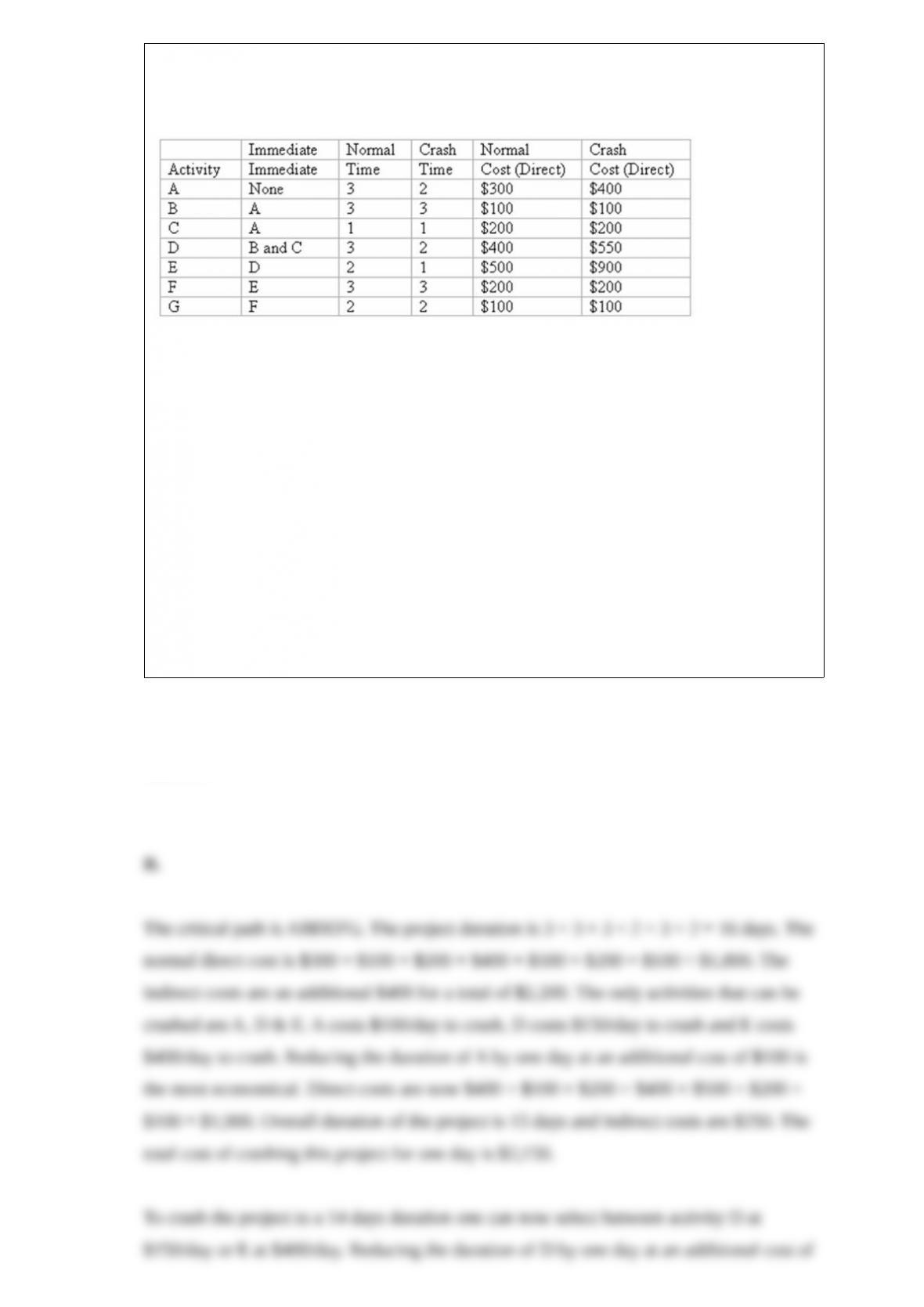
You have collected the data for a Time-Cost CPM Scheduling model analysis. The time
is in days and the project “direct costs” are given below.
The indirect costs for the project are determined on a daily duration basis. If the project
lasts 16 days the total indirect costs are $400, 15 days they will be $250, 14 days they
will be $200, and 13 days they will be $100. At what day do we achieve the lowest total
project cost (i.e., direct plus indirect costs)?
A. 16 days
B. 15 days
C. 14 days
D. 13 days
E. 12 days
Answer:

Which of the following is a dynamic lot-sizing technique that adds ordering and
inventory carrying cost for each trial lot size and divides by the number of units in each
lot size, picking the lot size with the lowest unit cost?
A. Economic order quantity
B. Lot-for-lot
C. Least total cost
D. Least unit cost
E. Inventory item averaging
Answer:

An opportunity flow diagram as part of a six-sigma quality improvement process might
be found in which DMAIC category?
A. Define
B. Measure
C. Analyze
D. Improve
E. Control
Answer:
Which of the following models uses a schematic model of the sequence of steps in a
problem and the conditions and consequences of each step?
A. Probability indexing
B. Johnson’s sequencing rule
C. Decision trees
D. Activity System Maps
E. Decision mapping
Answer:
A company is planning for its financing needs and uses the basic fixed-order quantity
inventory model. Which of the following is the total cost (TC) of the inventory given an
annual demand of 10,000, setup cost of $32, a holding cost per unit per year of $4, an
EOQ of 400 units, and a cost per unit of inventory of $150?
A. $1,501,600
B. $1,498,200
C. $500,687
D. $499,313
E. None of the above
Answer:
In setting up a Kanban control system you need to determine the number of Kanban
card sets needed. If the expected demand during lead time is 25 per hour, the safety
stock is 20% of the demand during lead time, the container size is 5, and the lead time
to replenish an order is 5 hours, what is the number of Kanban card sets needed?

A. 5
B. 20
C. 27
D. 30
E. 34
Answer:
In the service-system design matrix, a face-to-face loose specs service encounter is
expected to have which of the following?
A. Low sales opportunity
B. Low production efficiency
C. High production efficiency
D. Low degree of customer/server contact
E. None of the above
Answer:
One of the “package of features” that make up a service is:
A. Appearance
B. Facilitating goods
C. Packaging
D. Cost
E. Implied use
Answer:
Which of the following forecasting methodologies is considered a qualitative
forecasting technique?
A. Simple moving average
B. Market research
C. Linear regression
D. Exponential smoothing
E. Multiple regression
Answer:
The probability associated with accepting a low quality lot is denoted in acceptance
sampling with the Greek letter alpha.
Answer:
In Hau Lee’s uncertainty framework to classify supply chains, a supply chain for
innovative products with a stable supply process is called which of the following?
A. Efficient
B. Forward looking
C. Agile
D. Risk hedging

E. Responsive
Answer:
Which of the following industry types will not benefit greatly from the application of
MRP?
A. Fabricate-to-order
B. Assemble-to-stock
C. Assemble-to-order
D. Manufacture-to-order
E. None of the above
Answer:
Which of the following is an input to the master production schedule?

A. Prototype products from product development
B. Aggregate component schedule
C. Peg reports
D. Exception reports
E. Forecasts of random demand from customers
Answer:
In conducting aggregate operations planning there are a number of required inputs.
Which of the following are inputs considered external to the firm?
A. Competitor behavior and economic conditions
B. Market demand and inventory levels
C. Subcontractor capacity and current workforce
D. Economic conditions and current physical capacity
E. Raw material availability and inventory levels
Answer:
Which of the following is an organizationally-driven reason for outsourcing?
A. Improve effectiveness by focusing on what the firm does best
B. Turn fixed costs into variable costs
C. Reduce costs through lowered cost structure and increased flexibility
D. Improve risk management
E. Improve credibility and image by associating with superior providers
Answer:
When deciding to add capacity to a factory which of the following need not be
considered?
A. Maintaining system balance
B. The frequency of capacity additions
C. Use of external capacity
D. Immediate product demand
E. Availability of raw materials
Answer:
Which of the following is a perpetual system for inventory management?
A. Fixed-time period
B. Fixed-order quantity
C. P model
D. First-in-first-out
E. The wheel of inventory
Answer:
Having a supply chain that is environmentally responsible is called:
______________________.
Answer:
A diagram showing how a company’s strategy is delivered through a set of tailored
activities is called what? _____________________
Answer:
The triple-bottom-line evaluates the firm against what three criteria?
1> _____________________
2> _____________________
3> _____________________
Answer:
You are developing an “X-bar” chart based on sample means. You know the standard
deviation of the sample means is 4, the desired confidence level is 99 percent, and the
average of the sample means is 20. What is your LCL?
_________________________________________
Answer:
Individuals or organizations that are influenced, either directly or indirectly, by the
actions of the firm are called: _____________________
Answer: