Because value chain and supply chain have similar meanings, they are often used
interchangeably.
Service operations tend to make location decisions more frequently than manufacturing
facilities.
Drugstores are one example of a business using a periodic inventory system because of
their dependence on vendor-managed inventory.
Small-lot production reduces lead time but increases quality problems.
In general, processes should be analyzed for continuous improvement only after a
breakthrough improvement.
The motivation for companies to create alternative workplaces is primarily financial.
The service-process matrix is based on two characteristics: labor intensity and volume.
The tradeoff between the cost of improved service and the cost of making customers
wait provides the basis of waiting line analysis.
The outcome of a decision is referred to as a payoff.
Lean production refers to high-volume production of a standardized product.
General as opposed to specific purpose equipment is typically found in a process
layout.
An order qualifier is the characteristic of a product that wins orders in the marketplace.
Which of the following is not a serious disadvantage of scientific management?
a. workers become bored
b. opportunities to acquire new skills sets is limited
c. workers are required to perform repetitive motions
d. worker output is increased
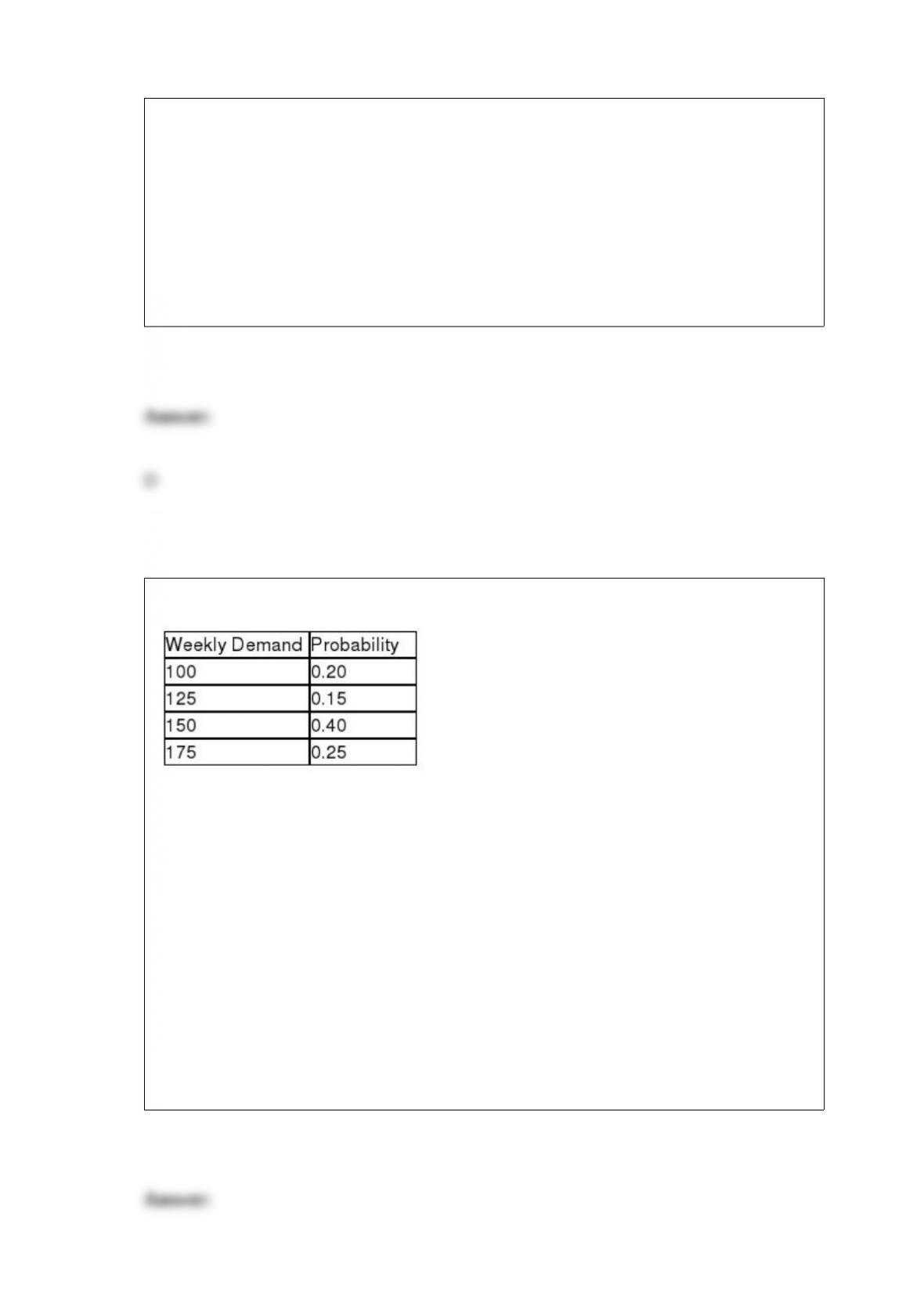
The weekly demand for a company’s product follows the probability distribution below.
Use the following random numbers to simulate the product’s demand for the next five
weeks: 72, 27, 93, 17, 47.
If the first random number interval begins with 0 then the estimated average weekly
demand for the simulated five week period is
a. 137.50.
b. 140.00.
c. 142.50.
d. 152.50.
______________ is a lot sizing technique that orders for multiple demand periods is
referred to as
a. Lot-for-lot (L4L)
b. Periodic order quantity (POQ)
c. Economic order quantity(EOQ)
d. Multiple order quantity (MOQ)
Which of the following can be used to monitor a forecast to see if it is biased high or
low?
a. a tracking signal
b. the mean absolute deviation (MAD)
c. the mean absolute percentage deviation (MAPD)
d. a linear trend line model
Given the following MRP matrix for Item E:
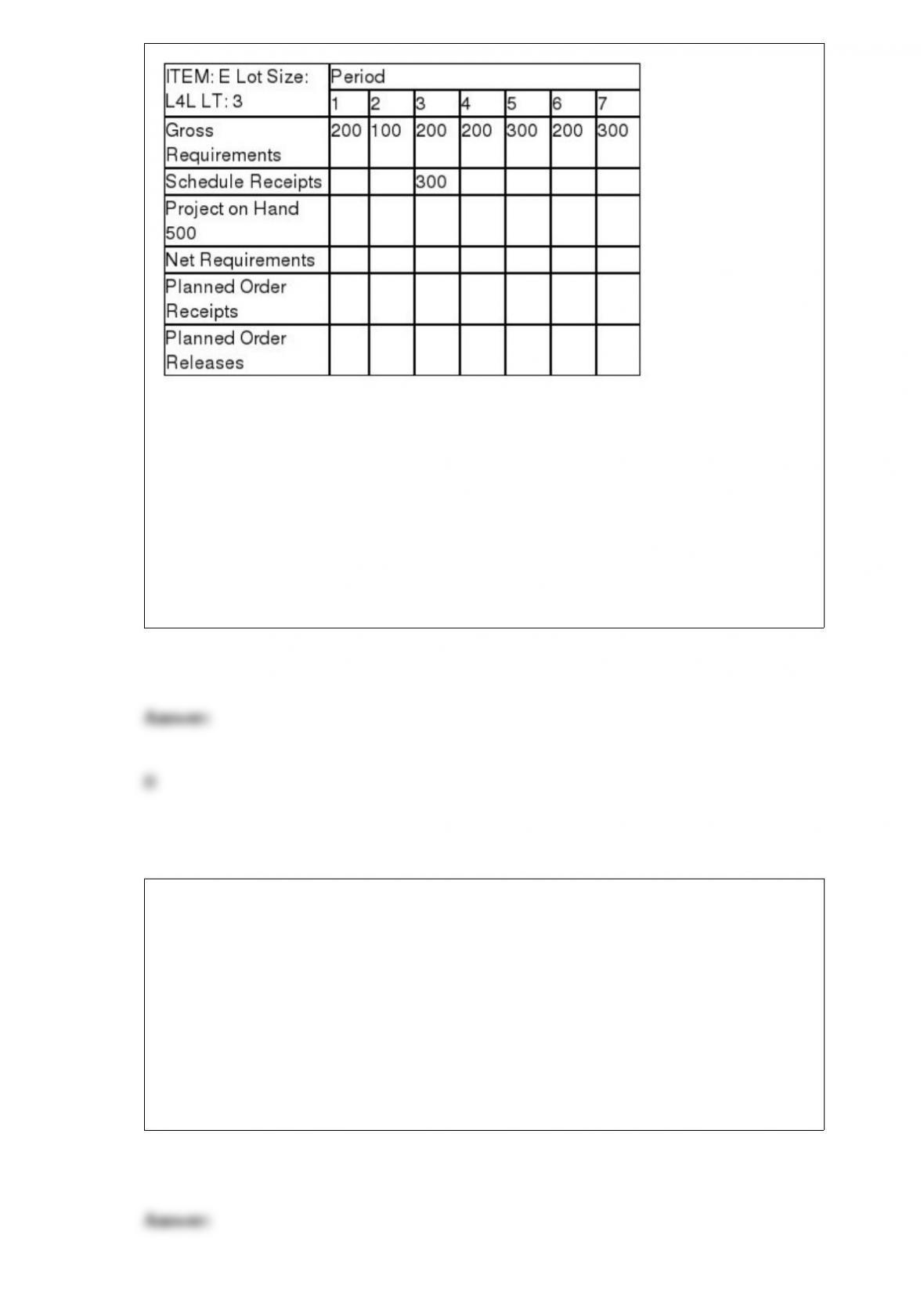
The planned order releases for period 3 is
a. 300.
b. 200.
c. 75.
d. 0.
A company wants to produce 150 units during a 7-hour day. The desired cycle time
needed to achieve this level of output is
a. 3.5 minutes.
b. 3.25 minutes.
c. 3.00 minutes.
d. 2.8 minutes.
Linear programming, waiting line, simulation, and PERT/CPM are all elements of
which era of operations and supply chain management?
a) Quality Research
b) Operations Research
c) Internet Revolution
d) Globalization
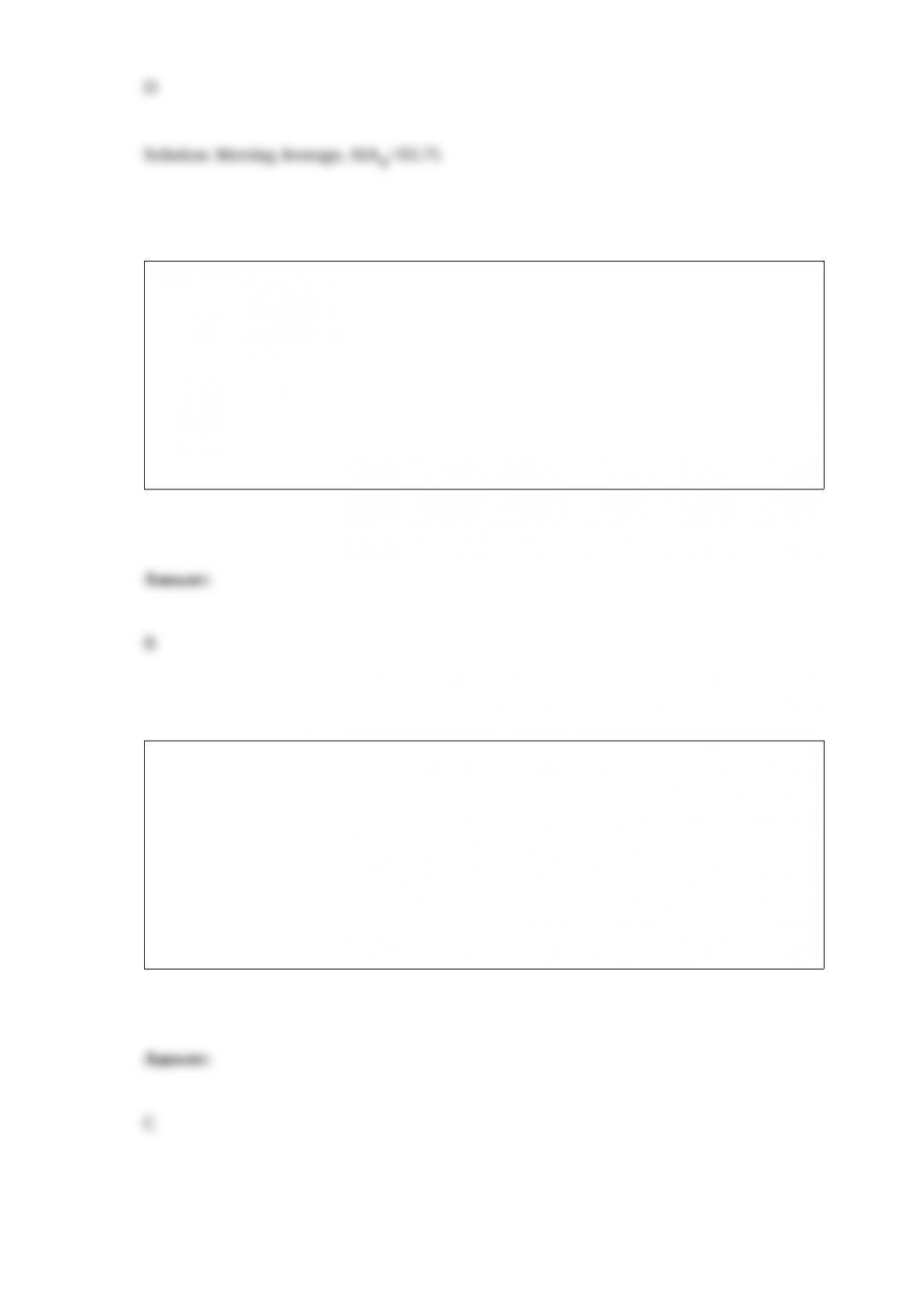
Given the following demand data for the past five months, the four-period moving
average forecast for June is
a. 96.25.
b. 99.00.
c. 110.00.
d. 93.75.
Mass production is well suited to all of the following except
a. producing large volumes of goods quickly.
b. adapting quickly to changes in market demand.
c. producing standardized products for a large market.
d. All of these answer choices are correct.
___________ is generally credited with the development of lean production.
a. Frederick Taylor
b. W. Edwards Deming
c. Taiichi Ohno
d. None of the answer choices is correct.
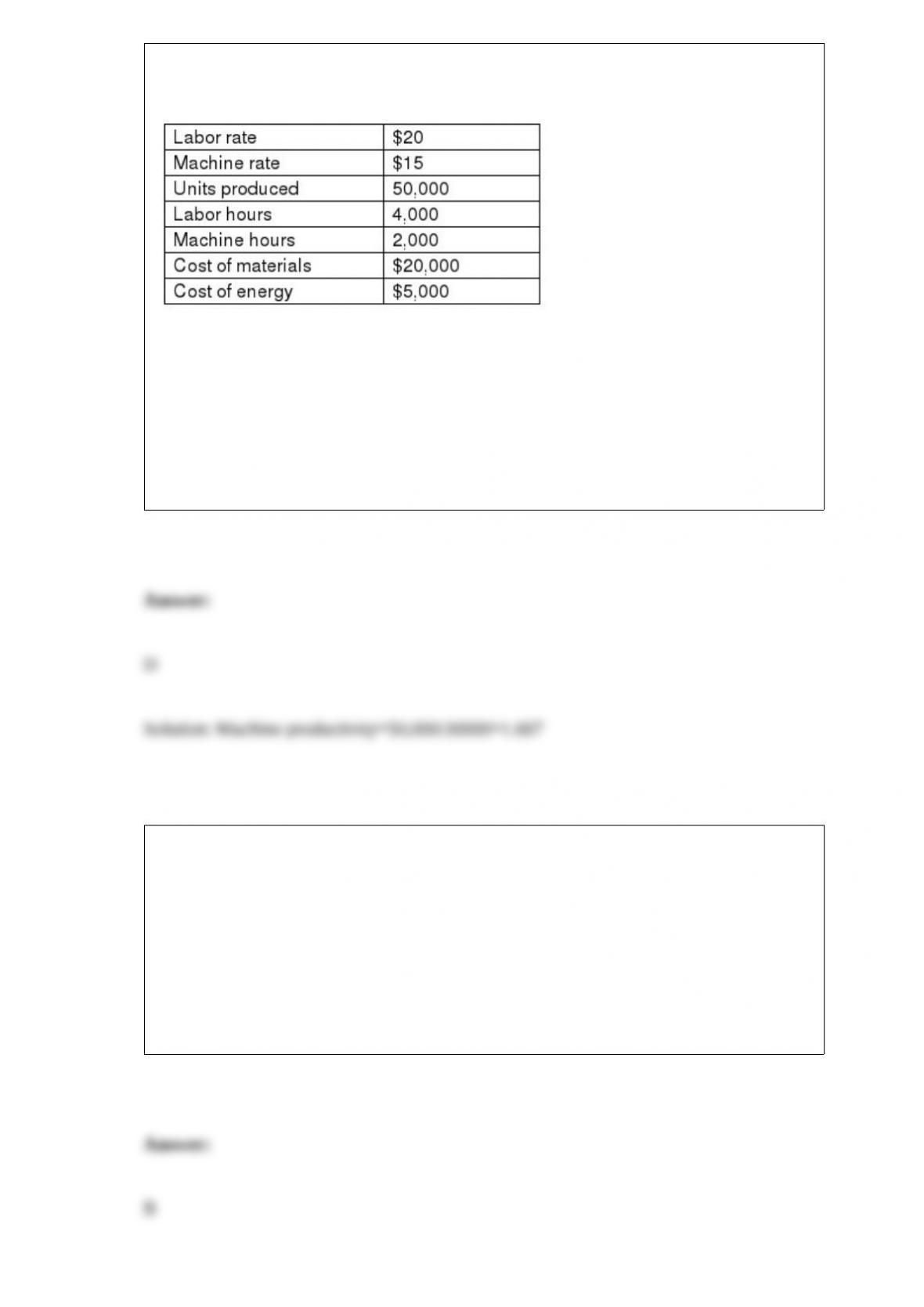
Telco Inc., a manufacturing firm, is calculating its monthly productivity report. From
the following data calculate the machine productivity.
a. 0..370
b. 0.625
c. 1.500
d. 1.667
_________________ is the process of ensuring on-time delivery of customers’ orders.
a. Logistics
b. Order fulfillment
c. Customer service.
d. Maintaining inventories
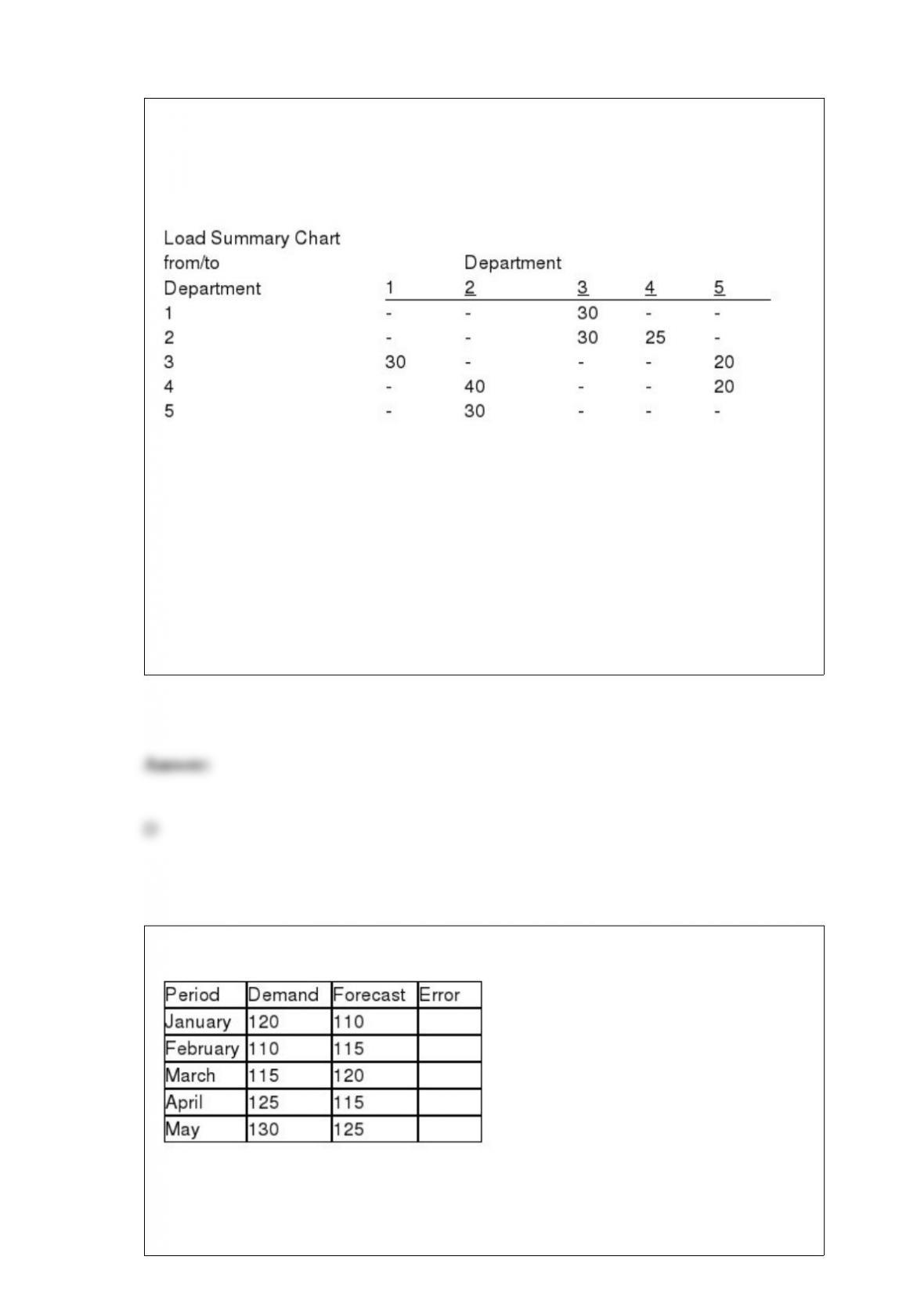
A company produces shovels in five departments. The average number of loads
transported between the five departments per month is given in the load summary chart.
(Insert 2 x 3 grid ‘“ see page 268)
Determine the number nonadjacent loads.
a. 25
b. 30
c. 50
d. 60
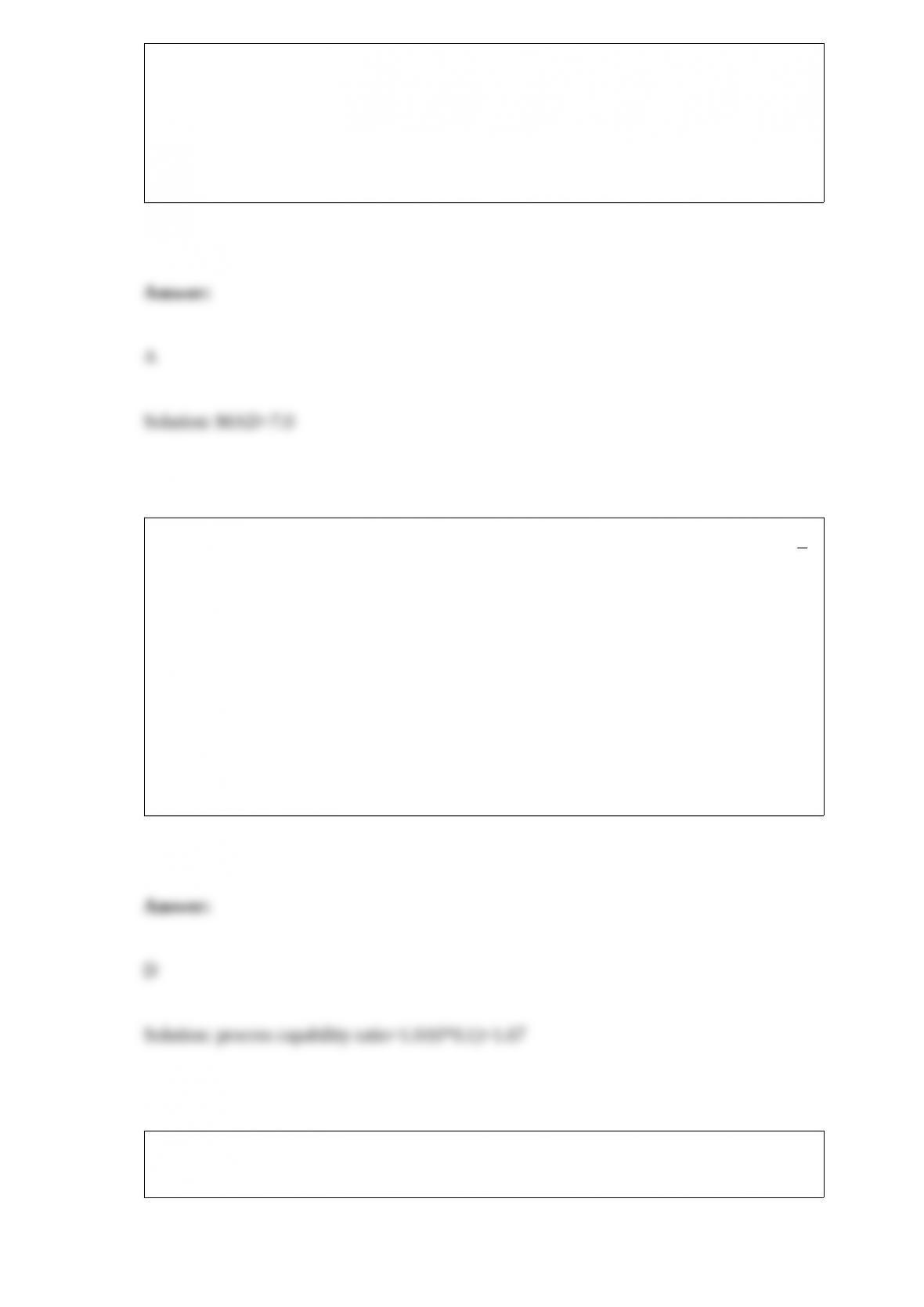
A forecasting model has produced the following forecasts:
The mean absolute deviation (MAD) for the end of May is
a. 7.0.
b. 7.5.
c. 10.0.
d. 3.0
A company produces a product which is designed to weigh 10 oz., with a tolerance of +
0.5 oz. The process produces products with an average weight of 9.95 oz. and a
standard deviation of 0.10 oz. According to the process capability ratio is the process
capable of meeting design specifications?
a. No, the process capability ratio is less than 1.0
b. Yes, the process capability ratio is less than 1.0
c. No, the process capability ratio is greater than 1.0
d. Yes, the process capability ratio is greater than 1.0
The number of daily calls received by a help desk between the hours of 9:00 a.m. to
10:00 a.m. can be described by the following probability distribution.
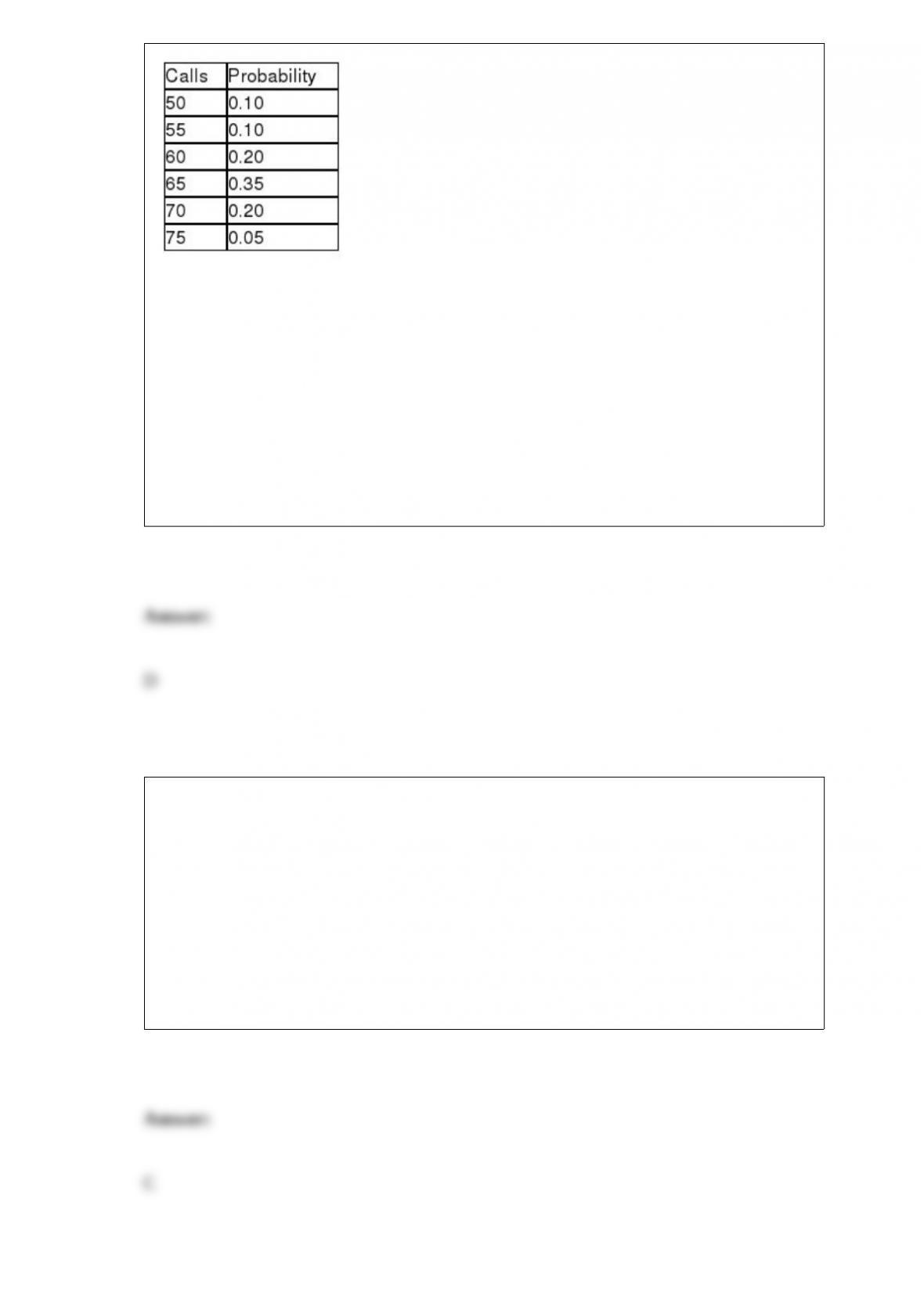
Based on the distribution of calls above, the expected value, or average, number of calls
to the help desk between 9:00 and 10:00 a.m. is
a. 61.5.
b. 62.0.
c. 62.5.
d. 63.0.
The ______________________ is the expected number of defective items that will pass
on to the customer with a sampling. plan is known as the
a. lot tolerance percent defective.
b. acceptable quality level.
c. average outgoing quality.
d. sampling plan.
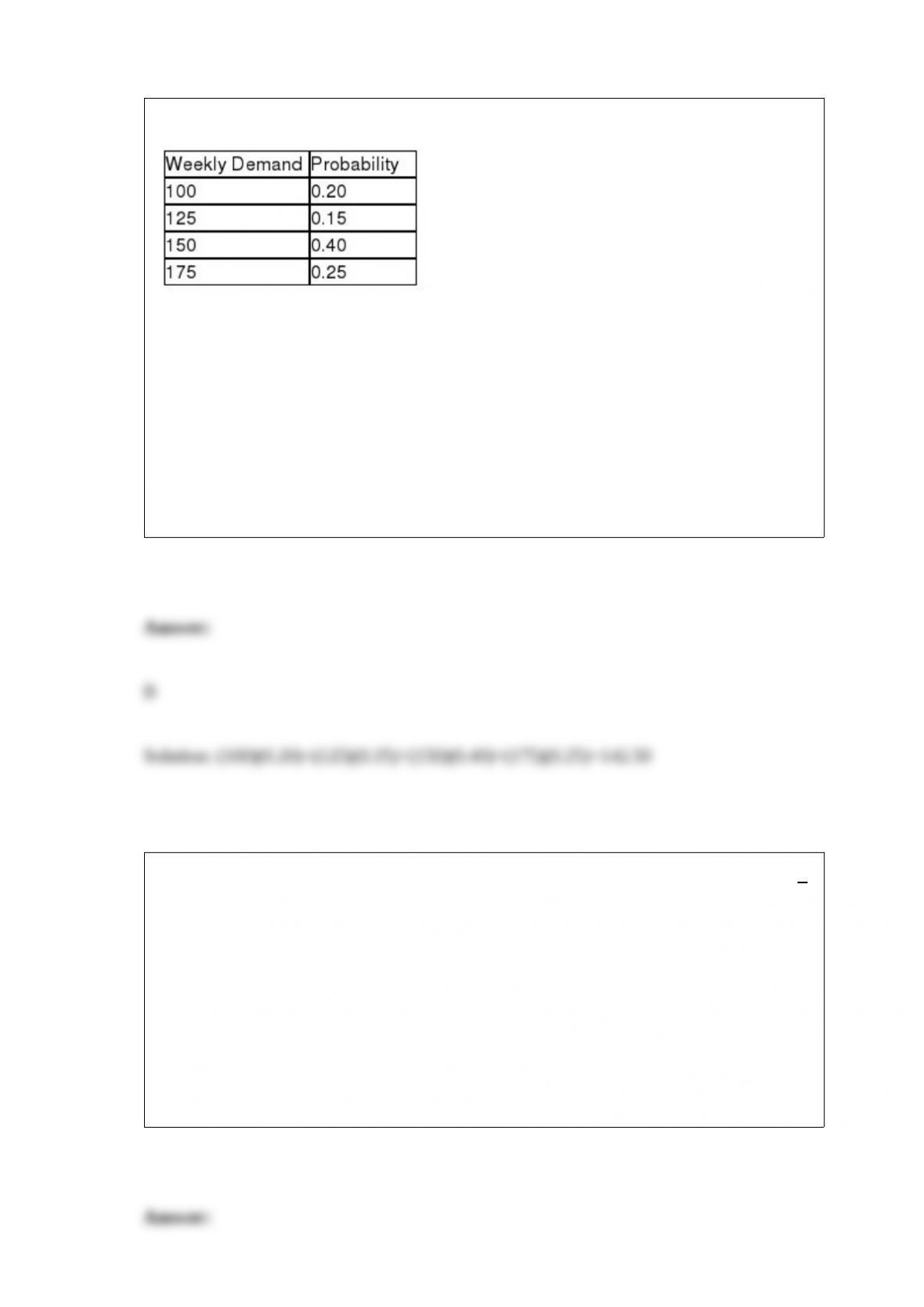
The weekly demand for a company’s product follows the probability distribution below.
The expected value, or average, weekly demand is
a. 137.50.
b. 142.50.
c. 153.75.
d. 165.75
A company produces a product which is designed to weigh 10 oz., with a tolerance of +
0.5 oz. The process produces products with an average weight of 9.95 oz. and a
standard deviation of 0.10 oz. According to the process capability index
a. the process mean is off center having shifted to the right
b. the process mean is off center having shifted to the left
c. the process mean is centered on the design target
d. None of these answer choices is correct.
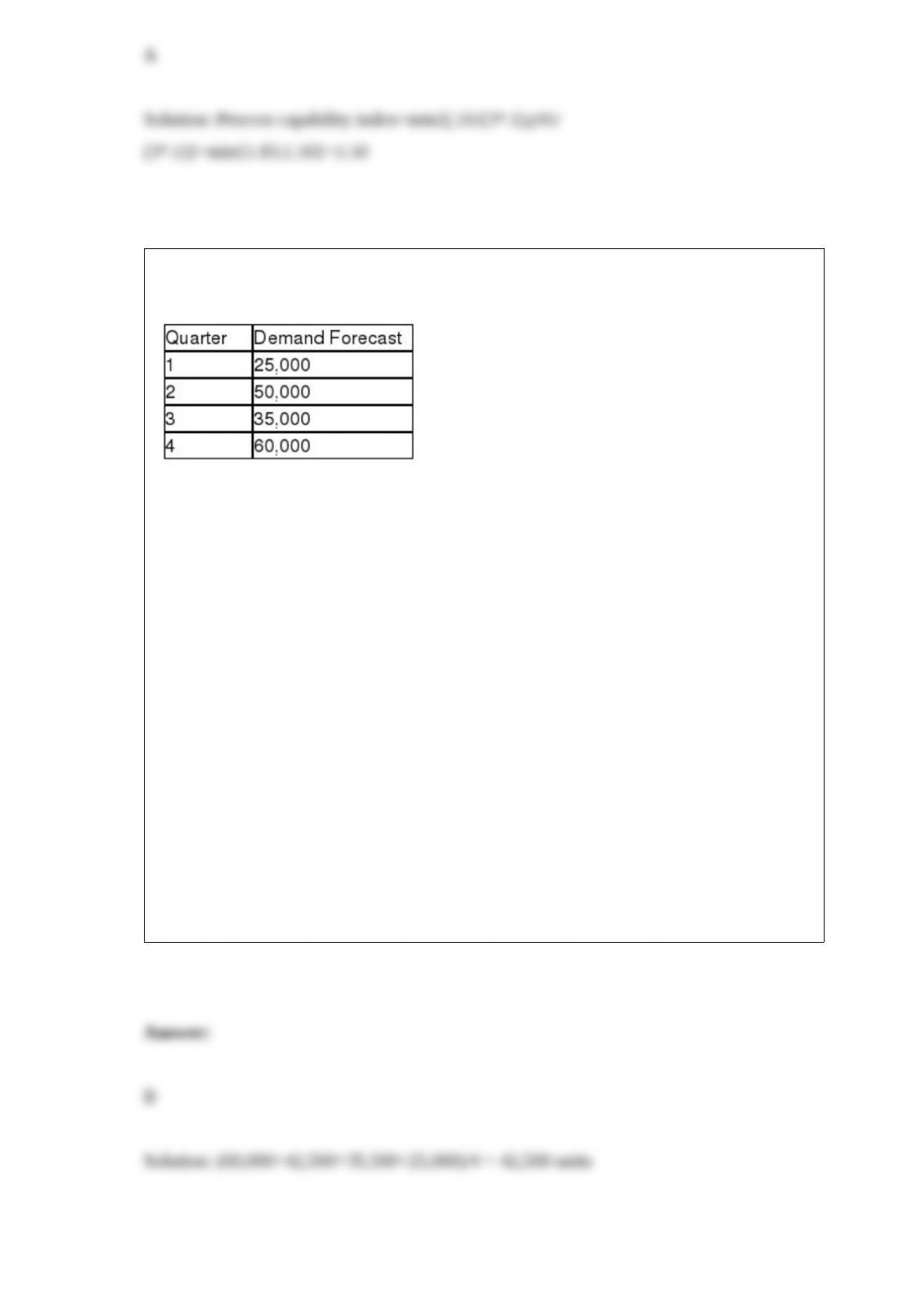
The following information relates to a company’s aggregate production planning
activities:
Beginning Workforce = 50 workers
Production per Employee = 250 units per quarter
Hiring Cost = $1000 per worker
Firing Cost = $1,500 per worker
Inventory Carrying Cost = $15 per unit per quarter
If a level production strategy is used then the required output per quarter is
a. 60,000 units.
b. 42,500 units.
c. 35,000 units.
d. 25,000 units.
_____________ is how the mission of a firm is accomplished.
a. Strategy
b. Design
c. An operational decision
d. None of these answer choices is correct.
Empowerment involves giving employees _________________ to make decisions.
a. responsibility
b. authority
c. both responsibility and authority
d. None of these answer choices is correct.
Briefly discuss project management and what it involves.
What is a kanban and how is it used in a pull system?
Explain the difference between qualitative and quantitative forecasting methods.
Describe a flexible manufacturing system (FMS).