While business organizations can seek to achieve the Baldrige National Quality Award
educational institutions, like universities, can’t.
Answer:
CAE and CAD software systems are both used in the evaluation of products.
Answer:
The most common production management tools used in planning and designing the
process flow are assembly drawings, assembly charts, route sheets and flow process
charts.
Answer:
In solving a decision tree problem, calculations start at the ends of the “branches” of the
tree and work backwards to the base “trunk” of the tree.
Answer:
The CIM system is referred to as “total factory automation”.
Answer:
Core capabilities are the skills that differentiate the service or manufacturing firm from
its competitors.
Answer:
A constant arrival rate is more common in waiting line management than a variable
arrival rate.
Answer:
A favorable business climate in facility location decision-making might include local
government providing basic skill training for prospective members of the workforce.
Answer:
Fixed-order quantity inventory systems determine the order point, R and the order
quantity, Q values.
Answer:
Using the SAP Financials segment requires that a firm adopt Activity-Based Costing
(ABC).
Answer:
In variables sampling the actual measurements of the variable observed are used
regardless of whether the unit is good or bad.
Answer:
To obtain a 99.7 percent confidence level in a “p” chart we would use a value of 3 for
“z”.
Answer:
When recovering from a defective service encounter a botched task calls for material
compensation.
Answer:
A decision tree problem does not need probabilities or payoffs to generate a solution.
Answer:
The exponential smoothing model permits non-linear forecast values.
Answer:
Which of the following functional areas in an organization do not directly support an
effective mass customization program?
A.Human resources
B.Marketing
C.Finance
D.Manufacturing
E.Distribution
Answer:
Which of the following is not part of the service strategy’s operating focus (set of
performance priorities) that help the service organization compete?
A.Service culture
B.Speed & Convenience
C.Price
D.Unique skills

E.Treatment of customer
Answer:
Under the lot-for-lot (L4L) lot sizing technique as used in MRP, we would expect which
of the following?
A.A consistent lag of supply behind demand
B.Minimized carrying costs
C.Minimized set-up costs
D.A just in time management philosophy
E.Minimized quality problems
Answer:
Which of the following is considered a primary report in an MRP system?
A.Planning reports
B.Performance reports
C.Exception reports
D.Planned order schedules

E.Cycle counting reports
Answer:
Which of the following is an example of General Purpose Simulation Software?
A.Link Trainer Programs
B.SIMSCRIPT II.5
C.SIM-Central
D.Fortran
E.Visual Basic
Answer:
Which of the following is a dimension of design quality?
A.Price
B.Features
C.Color
D.Weight

E.Quality at the source
Answer:
A process flowchart uses symbols to represent which of the following?
A.Factory location
B.Warehouse space available
C.Work force schedules
D.Flows of material or customers
E.Data analysis
Answer:
Which of the following is not a way in which a work center can be organized?
A.According to function in a work center configuration
B.According to function in an assembly line
C.By product in assembly line
D.As a group technology-cell (GT-cell)

E.By product in a flow operation
Answer:
Using the cut-and-try method for aggregate operations planning we can determine the
production requirement in units of product. If the beginning inventory is 100 units, the
demand forecast is 1,200 and the necessary safety stock is 20% of the demand forecast,
which of the following is the production requirement?
A.1,200
B.1,300
C.1,340
D.1,500
E.1,540
Answer:
In the service-system design matrix, a mail contact service encounter is expected to
have which of the following?
A.High sales opportunity
B.High degree of customer/server contact
C.High production efficiency
D.Low sales opportunity
E.None of the above
Answer:
Which of the following is not a lot sizing technique used in MRP systems?
A.Lot-for-lot (L4L)
B.Economic order quantity (EOQ)
C.Least total cost (LTC)
D.Least unit cost (LUC)
E.Two-bin system (TBS)
Answer:
Below are the data for a Time-Cost CPM Scheduling model analysis. The time is in
days and the costs include both direct and indirect costs.
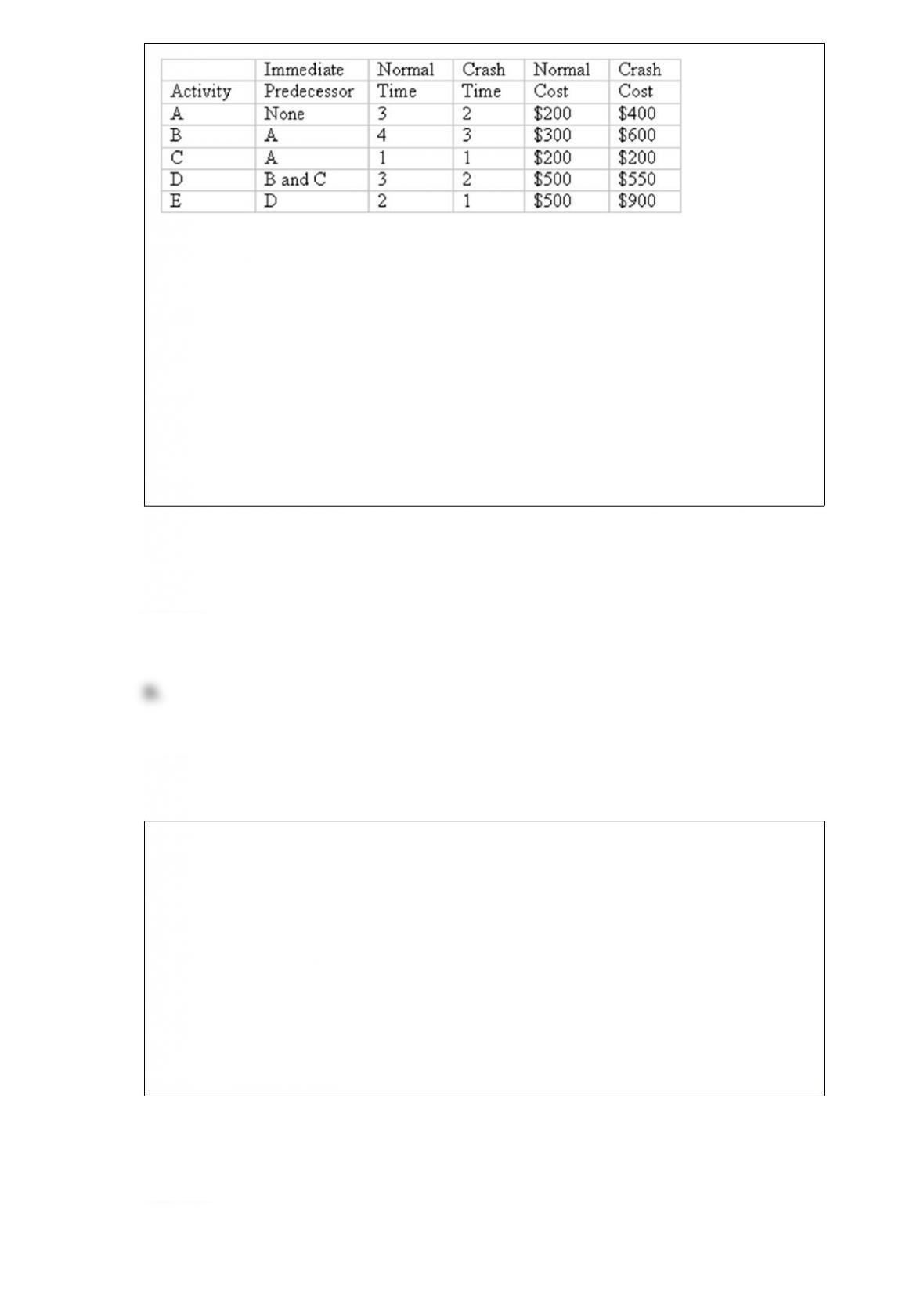
What are the total time of this project and total normal cost?
A.Total time is 13 days, total cost is $1,200
B.Total time is 12 days, total cost is $1,700
C.Total time is 11 days, total cost is $1,600
D.Total time is 10 days, total cost is $1,750
E.Total time is 9 days, total cost is $1,700
Answer:
Which of the following is one of the primary reasons for work sampling?
A.To exploit the Hawthorne effect
B.To measure performance
C.Re-sequencing tasks on an assembly line
D.To keep the work force alert
E.To try out different jobs
Answer:

The general guidelines provided in the textbook on improving individual learning based
on learning curves does not include which of the following?
A.Proper training
B.Work specialization
C.Early removal of workers who do not improve
D.Motivation
E.Doing one or very few jobs at a time
Answer:
Standing in line to buy a ticket for a movie where there are multiple windows to buy
tickets is which type of queuing system Line Structure?
A.Single channel, single phase
B.Single channel, multiphase
C.Multichannel, single phase
D.Multichannel, multiphase
E.None of the above
Answer:

Which of the following aggregate planning methods uses mathematically derived
coefficients to specify production rates and workforce Levels in a series of equations?
A.Linear decision rules
B.Linear programming
C.Graphing and charting
D.Simulation of aggregate plan
E.Cut and try
Answer:
An agribusiness company mixes and sells chicken feed to farmers. The costs of the
chicken feed ingredients vary throughout the chicken feeding season but the selling
price of chicken feed is independent of the ingredients. On August 1, management
needs to know how many units of each of three grains (Q, R and S) should be included
in their chicken feed in order to produce the product most economically. The cost of
each grain is, for a unit of Q, $30; for a unit of R, $37; and for a unit of S, $78.
Applying linear programming to this problem, which of the following is the objective
function?
A.Minimize Z = 30 Q + 37 R + 78 S
B.Maximize Z = 30 Q + 37 R + 78 S
C.Minimize Z = (Q x R x S)/3
D.Minimize Z = Q + R + S
E.Maximize Z = Q + R + S
Answer:
Which of the following is usually included as an inventory holding cost?
A.Breakage
B.Order placing
C.Typing up an order
D.Quantity discounts
E.Annualized cost of materials
Answer:
Why were ISO-9000 standards developed?
Answer:
If the best operating level of a piece of equipment is at a rate of 400 units per hour and
the actual output during an hour is 300 units, what is the capacity cushion?
Answer:
Strategy typically breaks down into what three major components?
Answer:
Describe the relationship between capacity utilization and quality in a service
operation?
Answer:
According to Dr. Goldratt, what is the goal of the firm?
Answer:
If the best operating level of a piece of equipment is at a rate of 400 units per hour and
the actual output during an hour is 300 units, what is the capacity utilization rate?
Answer:
What are the four basic methods for measuring work and setting standards?
Answer:

If demand for product “A” were forecast at 1,000,000 units for the coming year and
your factory has trained labor and equipment sufficient to produce 150,000 units per
month is the capacity cushion positive or negative?
Answer: