Process planning determines how a manufactured good is produced or a service is
provided.
An 80% learning curve describes an improvement rate of 80% each time production
doubles.
The earliest start time for the first activity in a project is generally at time zero.
The objective function in a linear programming formulation defines the feasible
solution space.

With total quality management (TQM), employees receive broad job training giving
them more flexible in where they can work
Typically, there are more options available when scheduling employees because labor is
a very flexible resource.
Because simulation is used to analyze probabilistic problems, it provides information
that is used to make a decision versus an optimal solution.
The economic order quantity (EOQ) model determines the optimal order size that
minimizes total annual inventory costs.

A decision criterion that results in the maximum of the minimum payoffs is called a
maximin criterion.
Block diagramming is a design tool for process layouts that takes into account the
number of adjacent and non-adjacent moves.
Forecasts based on mathematical formulas are referred to as qualitative forecasts.
The time required for a job to move through the system is referred to as flow time.

Takt time is the pace at which production output is maximum.
In the U.S, affirmative action and equal opportunity are basically the same.
A steady state results when a simulation is repeated enough times that the random
variable being investigated reaches the expected value or average demand.
Asian cultures tend to embrace project management’s methodical approach more than
western cultures.

China has reshaped the way firms compete globally.
Outsourcing supports vertical integration of a firm’s supply chain.
One reason time series methods are popular for forecasting is that they are relatively
easy to use and understand.
Diversity among project team members brings different
a. views.
b. experiences.

c. values.
d. All of these answer choices are correct.
W. Edwards Deming believed that primary responsibility for quality improvement
rested with
a. the firm’s employees only.
b. the fIrm’s management only.
c. research engineers and consulting statisticians only.
d. both the employees and management of the firm.
One of the best known computerized packages available for designing process layouts
is CRAFT. CRAFT stands for
a. computerized relationship activity and flow technique.
b. computerized relative allocation of facilities technique.
c. computerized relative assembly and flow technology.
d. computerized relationship assembly flow time.
For some manufacturing companies, transportation can run as much as _____________
of total production cost, and run as high as _____________ of revenue.
a) 20 percent, 6 percent
b) 30 percent, 10 percent
c) 40 percent, 14 percent
d) None of these answer choices is correct.
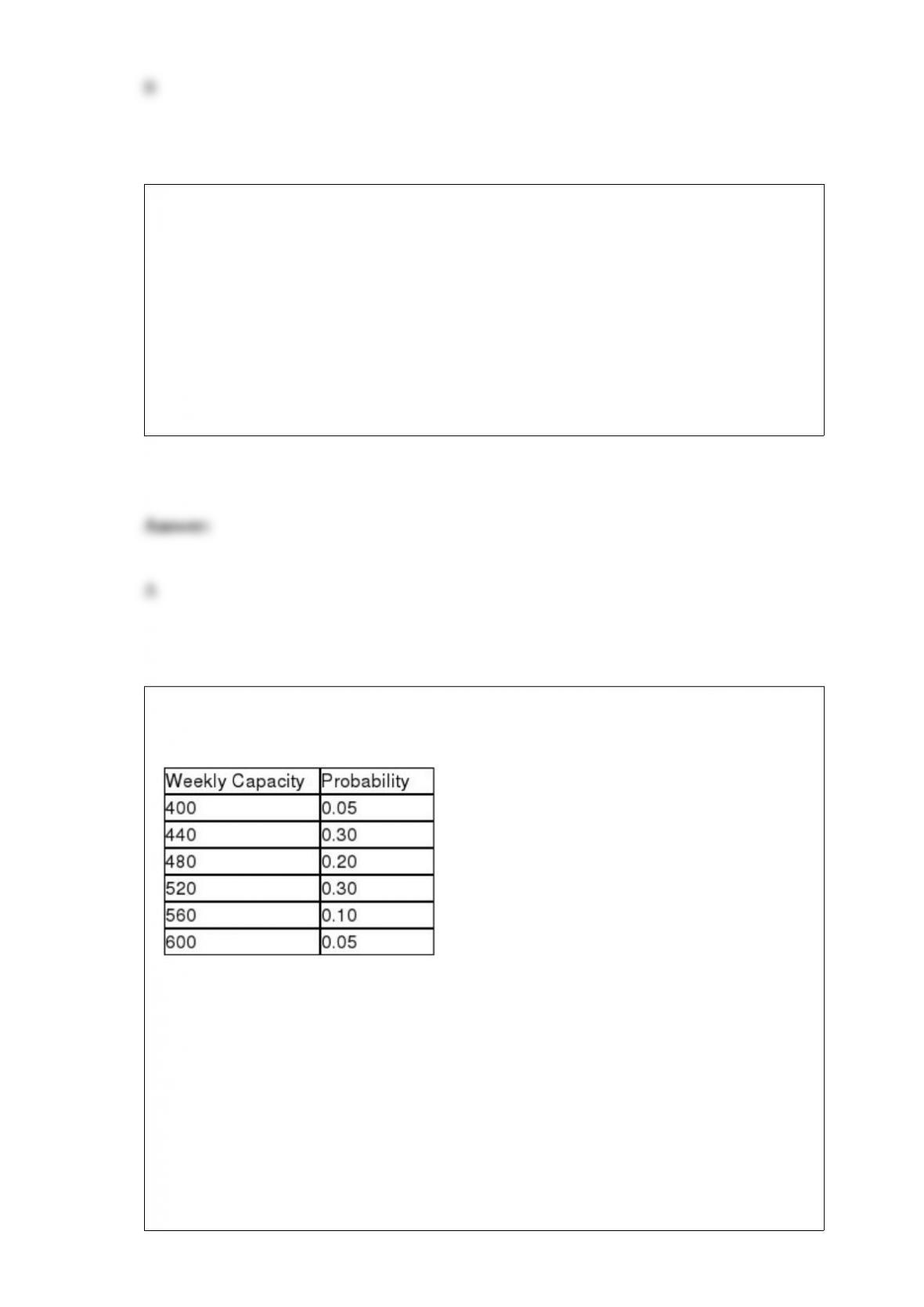
The weekly capacity measured in machine hours for a small machine shop follows the
probability distribution shown below.
Based on the probability distribution above, the expected value, or average hours of
weekly capacity for the machine shop is
a. 500 hours.
b. 490 hours.
c. 480 hours.
d. 475 hours.

Facility design has an impact on
a. quality.
b. productivity.
c. both quality and productivity.
d. None of these answer choices is correct.
In ERP systems, advanced analytical capabilities that support decision making
collectively is called business
a. intelligence.
b. support systems.
c. decision protocol.
d. None of these answer choices is correct.

Which of the following is not an example of product technology?
a. CAD
b. PLM
c. FMS
d. CAE
One disadvantage of Gantt charts, especially for large projects, is that it does not
a. clearly show precedence relationships.
b. indicate activity start times.
c. indicate activity finish times.
d. use bars to represent activities.
Easy Tax is a service company that prepares tax returns. An outside auditor has
examined 20 samples each containing one completed tax return. The total number of
defects observed over the 20 samples is 200. The centerline for the control chart
constructed is
a. 5
b. 10
c. 15

d. 20
Spend analysis is a formal process for __________________________ spending data.
a) collecting
b) cleansing
c) classifying
d) All of these answer choices are correct.
The degree to which a product meets pre-established standards is known as
a. conformance.
b. performance.
c. reliability.
d. None of these answer choices is correct.
Which of the following is not an advantage of batch production?
a. frequent changes in product mix
b. flexibility
c. customization of output
d. quality reputation
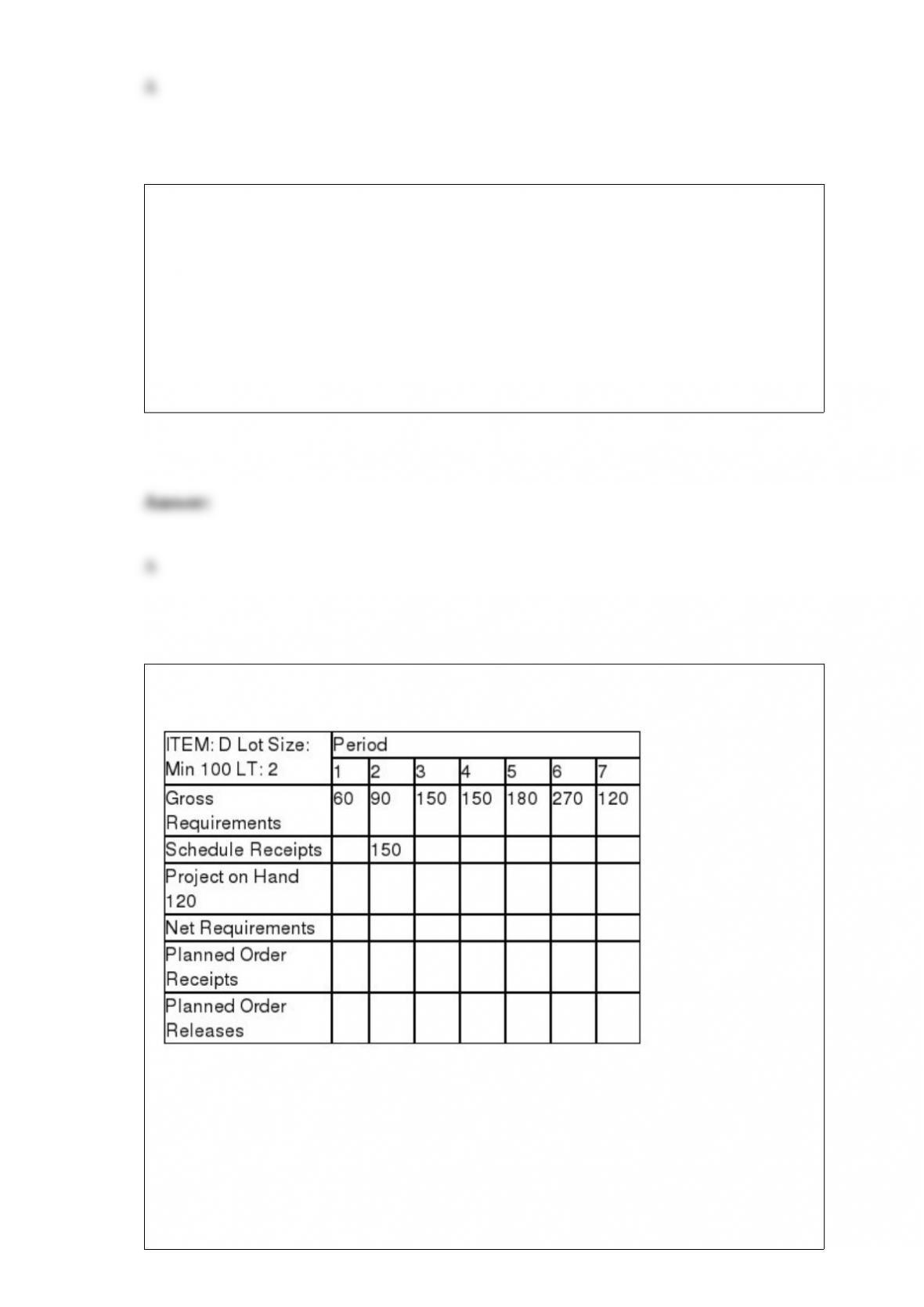
Given the following MRP matrix for Item D:
The planned order receipt for period 6 is
a. 100.
b. 120.
c. 160.

d. 270.
Regression forecasting methods relate _________to other factors that cause demand
behavior.
a) supply
b) demand
c) time
d) money
______ failure costs include scrap, rework, and downtime.
a) External
b) Internal
c) Process
d) System
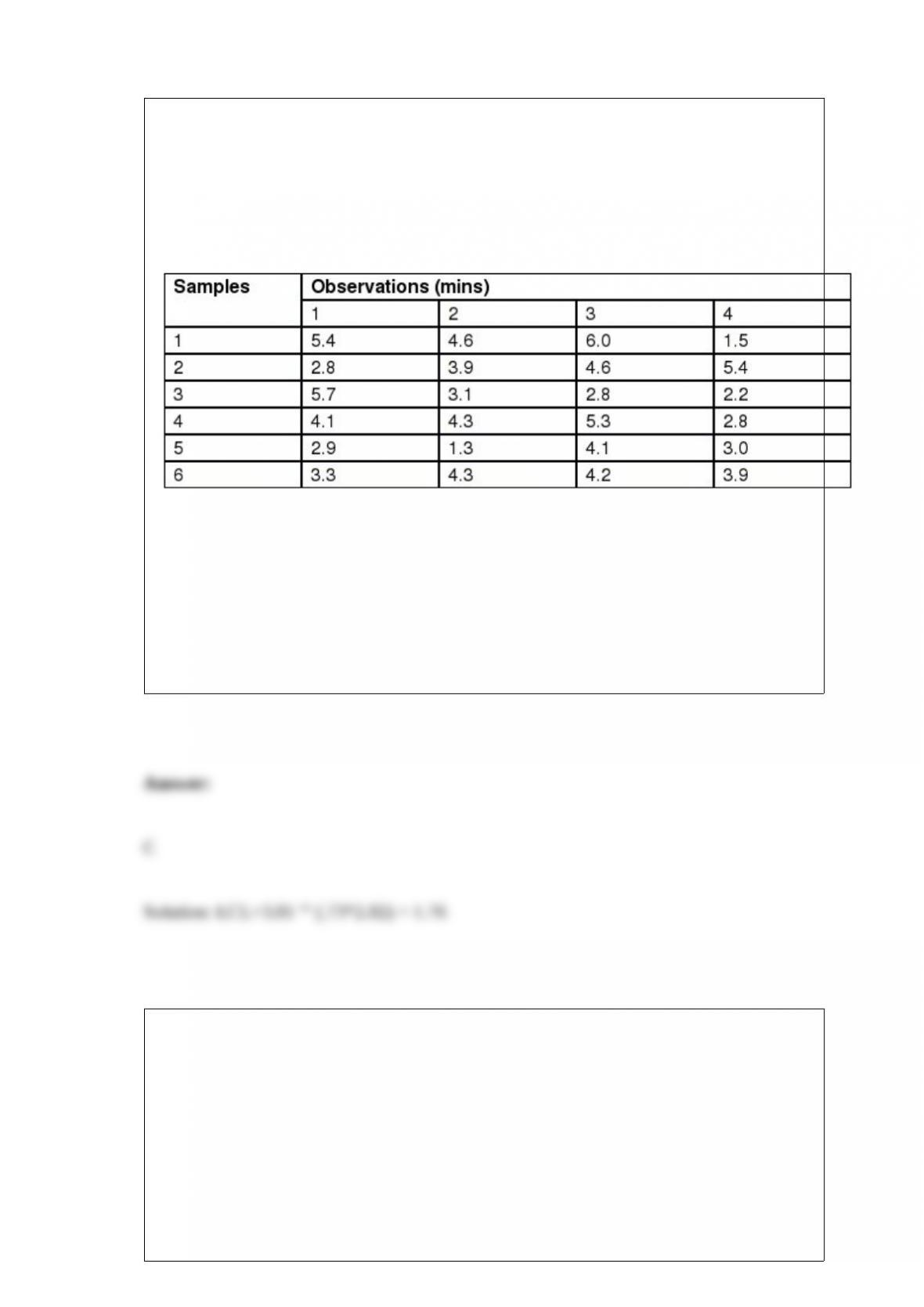
Dumplings ‘“To-Go (DTG) provides take-out dumplings and noodle dishes to
customers at its chain of drive-through restaurants. The target for a customer’s waiting
time is 3.0 minutes +/- 1 minute. Each month, one of the managers observes the
drive-through process and collects a sample of 4 waiting times a day over a 6 day
period. The data from one restaurant appears below. If DTG were to construct an X-bar
chart from this data, the 3-sigma LCL would be
a. 0.00
b. 1.00
c. 1.76
d. 2.82
Atlas Inc. produces product A and product B. Each product must go through two
processes. Each A produced requires two hours in process 1 and five hours in process 2.
Each B produced requires six hours in process 1 and three hours in process 2. There are
80 hours of capacity available each week in each process. Each A produced generates
$6.00 in profit for the company. Each B produced generates $9.00 in profit for the
company. If the company produces 6 units of A and 9 units of B the value of the
objective function is equal to
a. $36.

b. $81.
c. $108.
d. $117.
Atlas Inc. produces product A and product B. Each product must go through two
processes. Each A produced requires two hours in process 1 and five hours in process 2.
Each B produced requires six hours in process 1 and three hours in process 2. There are
80 hours of capacity available each week in each process. Each A produced generates
$6.00 in profit for the company. Each B produced generates $9.00 in profit for the
company. The constraint for process 1 is represented by
a. 2A + 5B < 80.
b. 2A + 6B > 80.
c. 2A + 6B < 80.
d. 2A + 6B < 80.
What makes scheduling so difficult in a job shop?

Modern Inc. manufactures low-cost tables at a processing cost of $80 per table. The
company produces 100 units per day and averages 90% good quality resulting in 10%
defective items. Fifty percent of the defective units are reworked prior to shipment to
Modern’s distribution center. The rework cost is $10 per unit. If the percent good
quality increases from 90% to 95%, the quality productivity ratio (QPR) is
a. approximately 1.20.
b. approximately 1.40.
c. approximately 1.60.
d. approximately 180.
How is linear programming useful to an operations manager?
Briefly describe a cellular layout and its objectives.
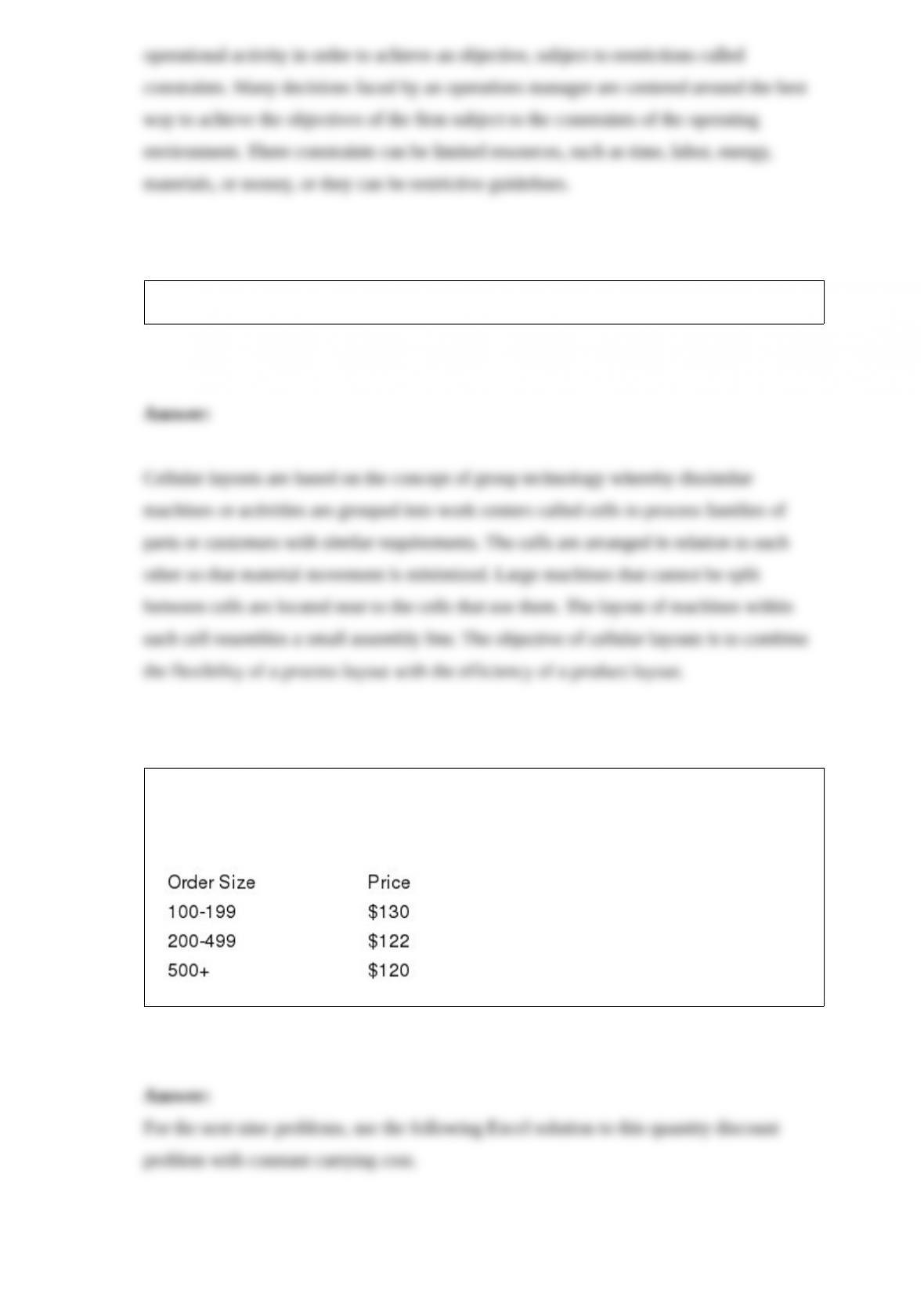
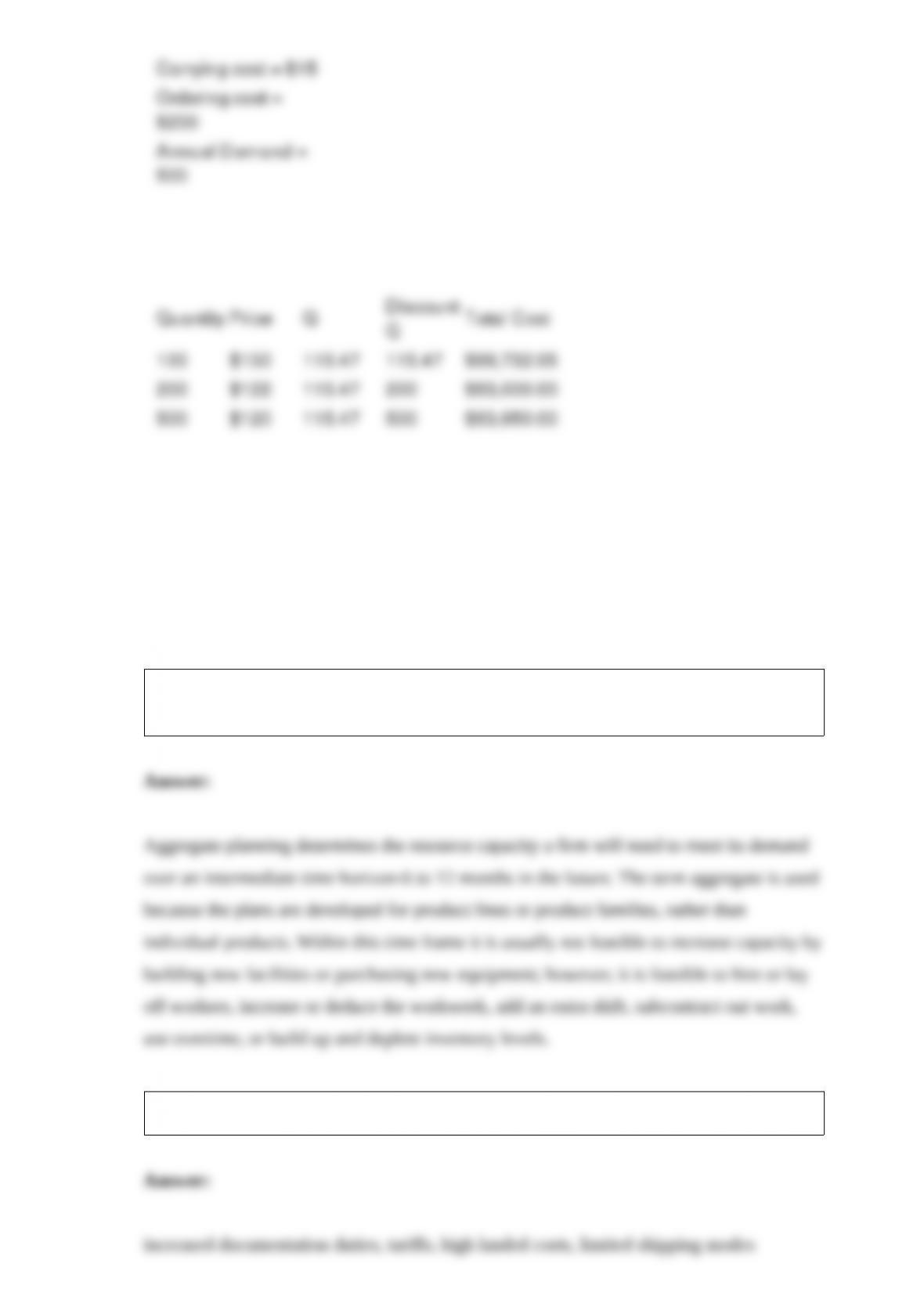
Consider a university that purchases replacement chairs for its classrooms. The
purchasing manager knows that the annual demand for replacement chairs is 500. The
pricing schedule is as follows:
What is aggregate planning and what alternatives are generally feasible when
developing the aggregate production plans?
Identify some of the obstacles to global supply chain management.