1) Which of the following statements concerning the F distribution is true?
A) The F distribution is discrete.
B) The F distribution is symmetrical.
C) The F distribution is useful in modeling customer arrivals.
D) The F distribution is useful in testing hypotheses about variance.
E) The F distribution is interchangeable with the normal distribution for large sample
sizes.
2) The number -2 in the X2 column and X1 row of a simplex tableau implies that
A) if 1 unit of X2 is added to the solution, X1 will decrease by 2.
B) if 1 unit of X1 is added to the solution, X2 will decrease by 2.
C) if 1 unit of X2 is added to the solution, X1 will increase by 2.
D) if 1 unit of X1 is added to the solution, X2 will increase by 2.
E) None of the above
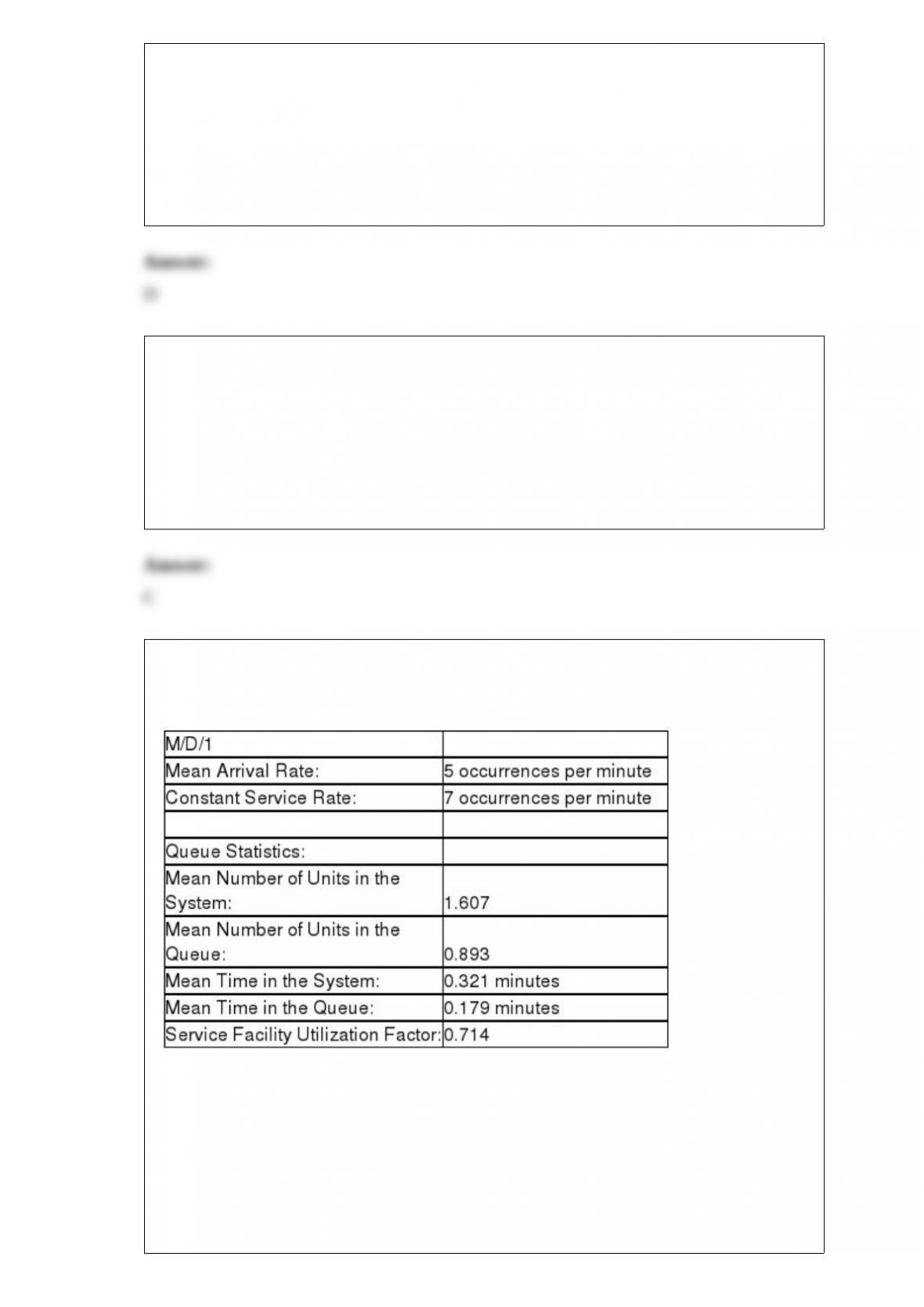
3) Table 12-5
According to the information provided in Table 12-5, which presents the solution for a
queuing problem with a constant service rate, on average, how many minutes does a
customer spend in the system?
A) 0.893 minute
B) 0.321 minute
C) 0.714 minute
D) 1.607 minutes
E) None of the above

4) Which of the following is true about surplus variables in a simplex tableau?
A) They are used to convert ¤ constraint inequalities to equations.
B) They require the addition of an artificial variable.
C) They represent unused resources.
D) They should be added to the left-hand side of the equation.
E) They yield a positive profit.
5) Table 8-7
Ivana Myrocle wishes to invest her inheritance of $200,000 so that her return on
investment is maximized, but she also wishes to keep her risk level relatively low. She
has decided to invest her money in any of three possible ways: CDs, which pay a
guaranteed 6 percent; stocks, which have an expected return of 13 percent; and a money
market mutual fund, which is expected to return 8 percent. She has decided that any or
all of the $200,000 may be invested, but any part (or all) of it may be put in any of the 3
alternatives. Thus, she may have some money invested in all three alternatives. In
formulating this as a linear programming problem, define the variables as follows:
C = dollars invested in CDs
S = dollars invested in stocks
M = dollars invested in the money market mutual fund
According to Table 8-7, which describes an investment problem, which of the following
would be the most appropriate constraint in the linear programming problem?
A) 0.06C + 0.13S + 0.08M =< 200000
B) C + S + M >=200000
C) C + S + M =< 200000
D) C + S + M = 200000
E) None of the above
6) In 1984, who developed an alternative to the simplex algorithm, which often takes
significantly less computer time to solve very large-scale LP problems?
A) Carmichael
B) Kruskev
C) Karmarkar
D) Krakov
E) Carpenter
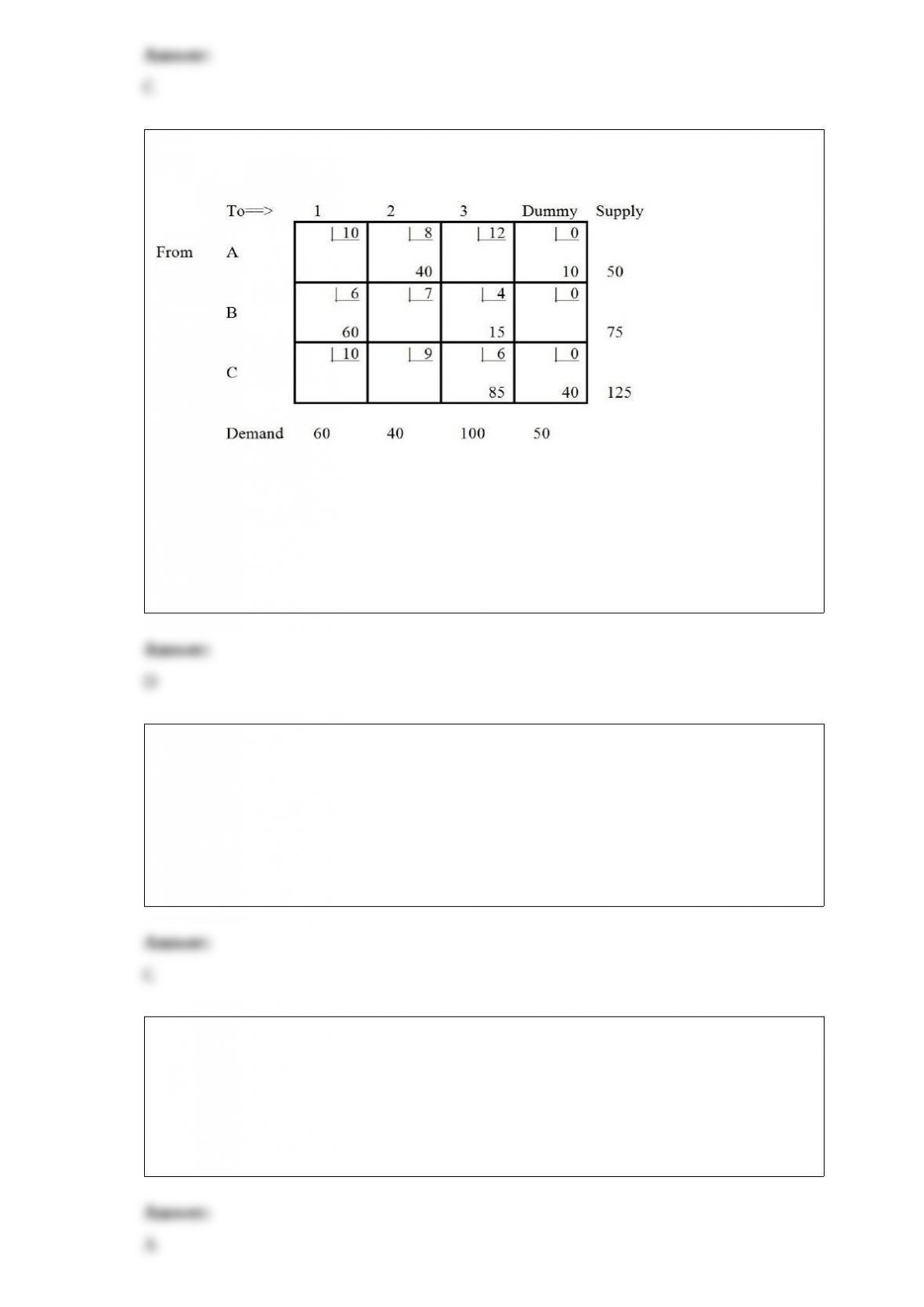
7) Table M8-14
The solution shown in Table M8-14 is
A) infeasible.
B) one of a number of alternate solutions.
C) unbounded.
D) optimal.
E) None of the above
8) In Markov analysis, the likelihood that any system will change from one period to
the next is revealed by the
A) cross-elasticities.
B) fundamental matrix.
C) matrix of transition probabilities.
D) vector of state probabilities.
E) state of technology.
9) Using the data in Table 11-4, compute the slack time for activity D.
A) 0
B) 5
C) 3
D) 6
E) None of the above
10) A single automatic car wash with one bay and a service time that is normally
distributed is what type of model?
A) M/M/1
B) M/M/2
C) M/D/2
D) M/D/1
E) M/G/1
11) The condition of improper data yielding misleading results is referred to as
A) garbage in, garbage out.
B) break-even point.
C) uncontrollable variable.
D) postoptimality.
E) None of the above
12) Data for a particular subdivision near downtown Houston indicate that the average
price per square foot for a home is $100 with a standard deviation of $5 (normally
distributed). What is the probability that the average price per square foot for a home is
less than $108?
A) 0.152
B) 0.097
C) 0.848
D) 0.945
E) None of the above
13) Which of the following is used to summarize conveniently and concisely all
relevant data and to keep track of algorithm computations?
A) source-destination matrix
B) Hungarian table
C) stepping-stone grid
D) transportation table
E) tabulation report
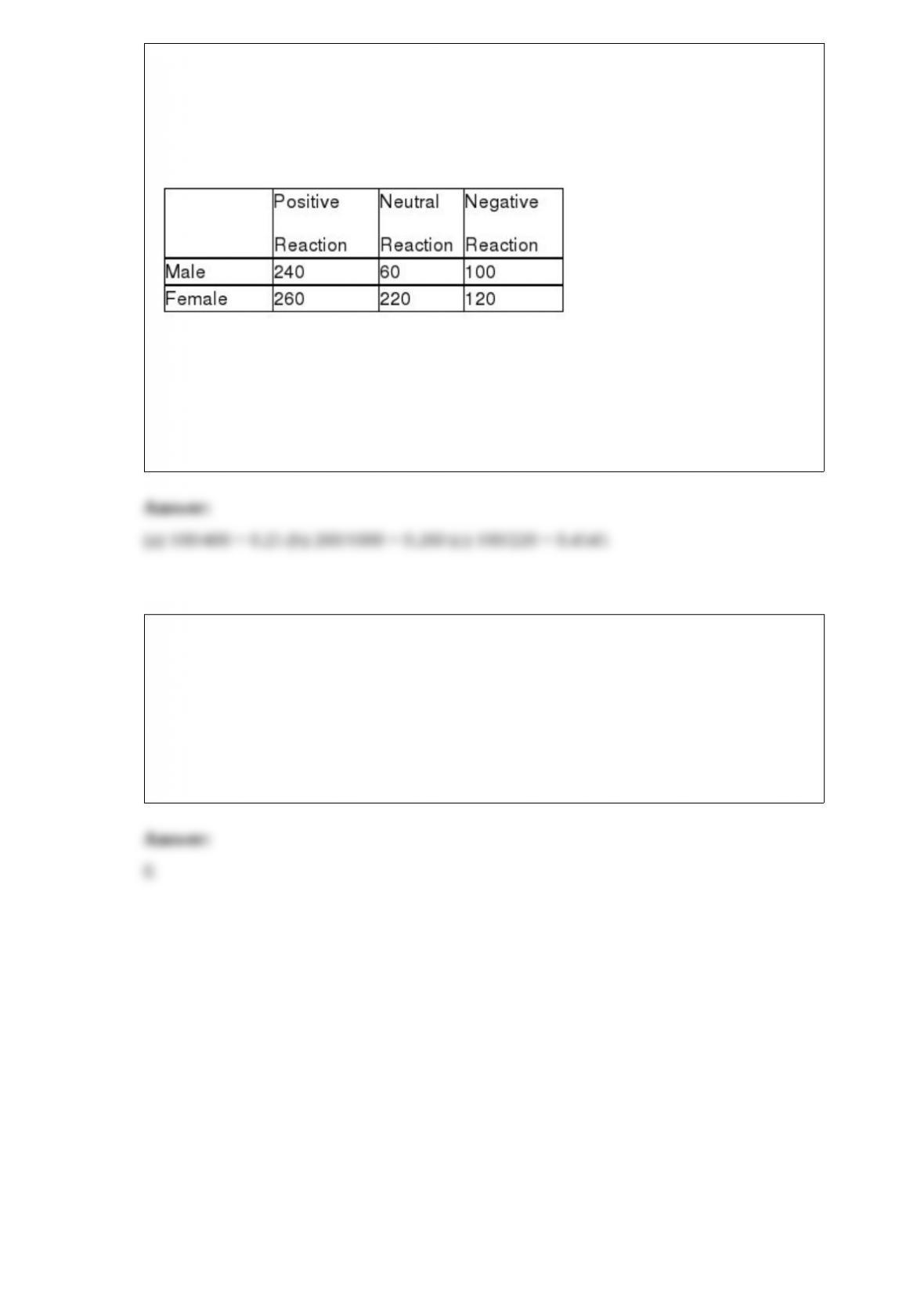
14) A market research study is being conducted to determine if a product modification
will be well received by the public. A total of 1,000 consumers are questioned regarding
this product.
The table below provides information regarding this sample.
(a) What is the probability that a randomly selected male would find this change
unfavorable (negative)?
(b) What is the probability that a randomly selected person would be a female who had
a positive reaction?
(c) If it is known that a person had a negative reaction to the study, what is the
probability that the person is male?
15) A straight line representing all non-negative combinations of X1 and X2 for a
particular profit level is called a(n)
A) constraint line.
B) objective line.
C) sensitivity line.
D) profit line.
E) isoprofit line.