The critical path in a project is that sequence of activities that consume the longest
amount of time in a project network of activities.
Answer:
Capacity can be defined as the ability to hold, receive, store, or accommodate.
Answer:
The aggregate operations planning variable “workforce level” refers to the number of
workers needed to accomplish the planned production.
Answer:
TQM was defined in the textbook as managing the entire organization so that it excels
on all dimensions of products and services that are important to the customer.
Answer:
Market research is a quantitative method of forecasting.
Answer:
Wall Street analysts are not particularly concerned with how efficient companies are
from an operations and supply management view.
Answer:
Experience and trial and error are the simplest ways to choose weights for the weighted
moving average forecasting model.
Answer:
The Poisson probability distribution is used in waiting line management when we are
interested in the number of arrivals to a queue during some fixed time period.
Answer:
Firms that match the production rate to the order rate by hiring and laying off
employees as the order rate varies are following what is known as the chase strategy.
Answer:
A “p chart” has upper and lower control limits expressed as lines on the chart. As long
as the sample values fall between these two lines there is no need to investigate process
behavior.
Answer:
Fixed-time period inventory models are “event triggered.”
Answer:
A process that is in six-sigma control will produce no more than two defects out of
every million units.
Answer:
The first step in balancing an assembly line is to specify the precedence relationships
among tasks to be performed on the line.
Answer:
Sustainability is the ability to maintain profits in a system.
Answer:
Applying lean concepts in manufacturing balances increases in cost with quality
improvement.
Answer:
Lean production replaced JIT in the 1990s because JIT did not address the problem of
reducing waste.
Answer:
Order scheduling is the step in the aggregate operations planning process that
immediately follows material requirements planning.
Answer:
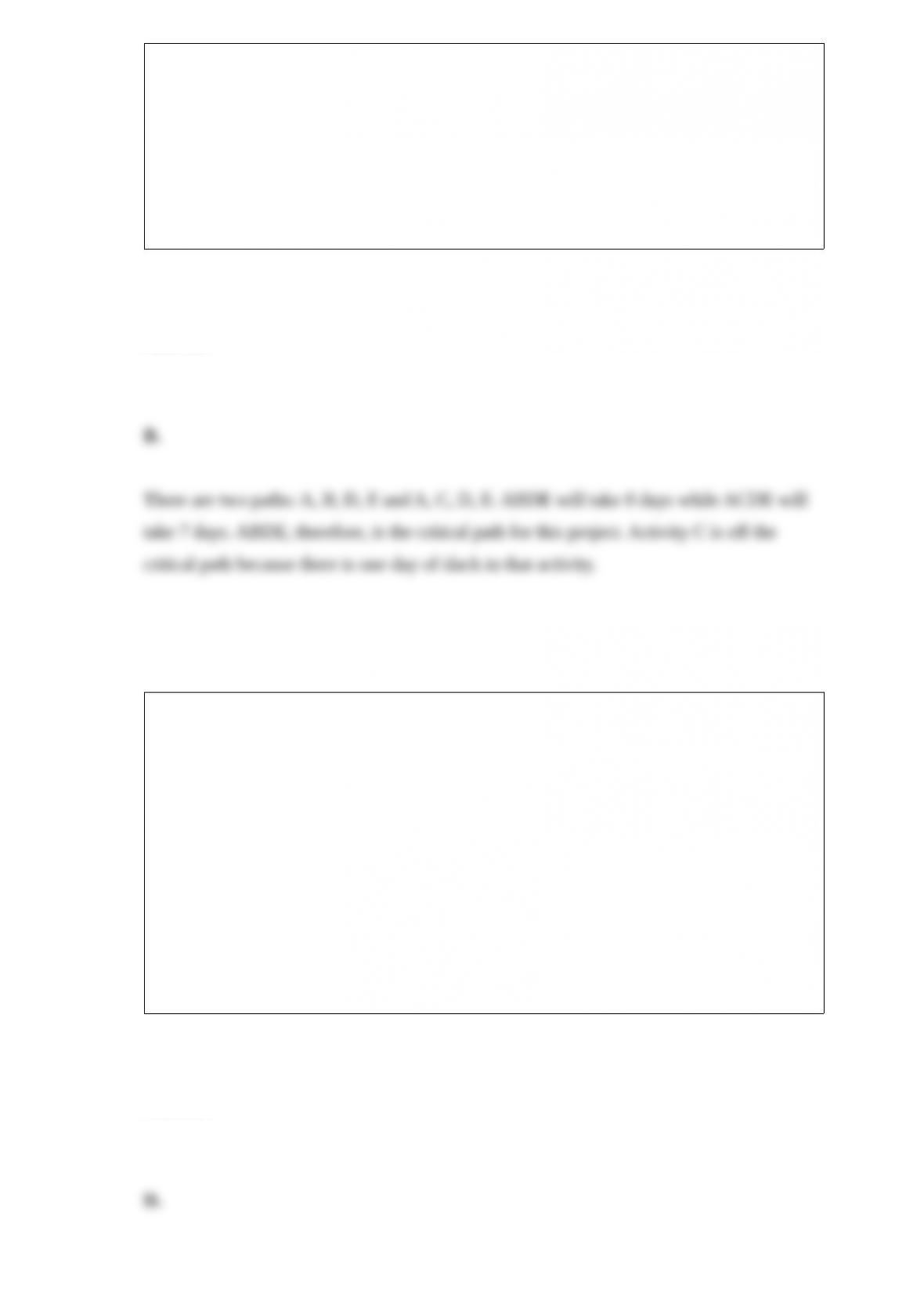
A simple project listing of five activities and their respective time estimates are
presented below:
Using CPM, which activities make up the critical path?
A. A, C, D, E
B. A, B, D, E
C. A, C, B, D, E
D. A, D, E
E. None of the above
Answer:
Which of the following is not a major strategic operational competitive dimension that
forms a company’s competitive position?
A. Cost or price
B. Delivery speed
C. Delivery reliability
D. Management acumen
E. Coping with changes in demand
Answer:
If a firm produced a product that was experiencing growth in demand, the smoothing
constant alpha (reaction rate to differences) used in an exponential smoothing
forecasting model would tend to be which of the following?
A. Close to zero
B. A very low percentage, less than 10%
C. The more rapid the growth, the higher the percentage
D. The more rapid the growth, the lower the percentage
E. 50 % or more
Answer:
In monitoring process quality we might use which of the following statistics?
A. Absolute values
B. Percentage deviation from tolerance centers
C. “k” values for the sample mean
D. Logarithmic control intervals
E. Difference between the highest and lowest value in a sample
Answer:
In conducting aggregate operations planning there are a number of required inputs.
Which of the following are inputs considered external to the firm?
A. Inventory levels and market demand
B. Raw material availability and competitor’s behavior
C. Current workforce and economic conditions
D. Current physical capacity and market demand
E. Subcontractor capacity and inventory levels
Answer:
Which of the following is a suggestion for managing queues that is mentioned in the
textbook?
A. Put up a serpentine lane to keep people from jumping ahead in line
B. Use humor to defuse a potentially irritating situation
C. Train your servers to be friendly
D. Assure customers that the wait is fair and inform them of the queue discipline
E. Tell people in the queue that each will be served as soon as possible
Answer:
Which of the following are eligible companies to be considered for the Baldrige award?
A. Auditing firms
B. Offshore suppliers to U. S. companies
C. Firms operating only outside the U. S.
D. State Government agencies
E. None of the above
Answer:
Which of the following is most closely related to the reason a firm might implement
MRP?
A. So they can order the right parts
B. So they can order parts sufficient for immediate use
C. So they can insure that parts to arrive prior to when they are needed
D. To assure appropriate quality levels
E. To keep process costs between the LCL and the UCL
Answer:
A company wants to generate a forecast for unit demand for year 2014 using
exponential smoothing. The actual demand in year 2013 was 120. The forecast demand
in year 2013 was 110. Using this data and a smoothing constant alpha of 0.1, which of
the following is the resulting year 2014 forecast value?
A. 100
B. 110
C. 111
D. 114
E. 120
Answer:
Buying food at a large food store with multiple checkout counters features which type
of queuing system line structure?
A. Single channel, single phase
B. Single channel, multiphase
C. Multichannel, single phase
D. Multichannel, multiphase
E. None of the above
Answer:
Which is the most challenging kind of supply chain to manage according to Hau Lee?
A. Agile supply chain
B. Efficient supply chain
C. Risk-hedging supply chain
D. Erratic supply chain
E. Responsive supply chain
Answer:
You want to develop a three-sigma “R” chart. You know the average range is 5 based on
several samples of size 10. Which of the following is the resulting UCL?
A. 20.9
B. 8.9
C. 7.02
D. 5
E. 3.1
Answer:
Which of the following is not a step in developing a manufacturing cell layout?
A. Grouping parts into families that follow a common sequence of steps
B. Identifying dominant flow patterns of parts families as a basis for location of
processes
C. Physically grouping machines and processes into cells
D. Disposing of left-over machinery and outsourcing ungrouped processes
E. None of the above
Answer:

In business forecasting, what is usually considered a medium-term time period?
A. Six weeks to one year
B. Three months to two years
C. One to five years
D. One to six months
E. Six months to six years
Answer:
In a lean production system we expect to see which of the following?
A. No extra inventory
B. Extra inventory of critical parts held “just-in-case”
C. More parts and fewer standardized product configurations
D. Managers being held responsible for quality of the work turned out
E. Closer management-labor relationships
Answer:
If the average aggregate inventory value is $100,000 and the cost of goods sold is
$450,000, which of the following is inventory turnover?
A. 19.23
B. 4.5
C. 0.8654
D. 0.2222
E. None of the above
Answer:
In an MRP program, the program accesses the status segment of an inventory record
according to specific periods called which of the following?
A. Cubed time units
B. Time buckets
C. BOM units
D. Time modules
E. Time lines
Answer:
A project starts out as which of the following?
A. A Statement of Work
B. Critical Path Method (CPM)
C. A series of milestones
D. A Gantt chart
E. A latest-start-time estimate
Answer:
What are the five categories of supply chain processes?
1>___________________
2>___________________
3>___________________
4>___________________
5>___________________
Answer:
What are the two “hidden costs” that are often overlooked in determining the total cost
of a facility location decision?
(1) __________________________________
(2) __________________________________
Answer:
A company has calculated its running sum of forecast errors to be 400 and its mean
absolute deviation is exactly 25. What is the company’s tracking signal?
_________________________________
Answer:
Explain how yield management works and why some companies are able to use it to
manage demand patterns?
Answer:
The formula (Inventory = Throughput rate × Flow time.) is known as what?
___________________
Answer: