
When break-even analysis is applied to an outsourcing decision, the break-even
quantity is _____.
a. the ratio of fixed costs to the difference between variable outsourcing cost and
variable in-house production cost
b. the ratio of the difference between variable outsourcing cost and variable in-house
production cost to fixed costs
c. the product of the variable costs and the fixed costs
d. the product of the variable costs and the production quantity
Answer:
Steve, an operations manager at Clan Corp. is promoted to manage the process defined
by the four stages A to D below. This process could be human resource management,
marketing, accounting, finance, or engineering process, and Steve is the manager. This
is his chance to impress his boss and get promoted again. After three months on the job,
Steve realizes something is not right with the process. His employees experience big
pile up of work, things take too long to be processed, the opportunity for error is
increasing, and the entire process is almost chaotic. Do a process and capacity analysis
of this process. The numbers in parenthesis(#) are the time inminutes to complete one
unit of work. Demand on the process averages 30 units per hour and each unit must be
worked on by all four stages. Administrative clerk(s) do Stage A work. The assistant
manager(s) are cross-trained to do both Stages C and D work. The coding specialist(s)
do Stage B work.
What is the current labor utilization of the coders at Stage B if two coding specialists
are currently on duty?
a. Less than 90 percent
b. More than 90% but less than or equal to 95%
c. More than 95% but less than or equal to 100%
d. More than 105 percent
Answer:
A seven-month simple moving average would approximately equate with alpha (α)
factor _____ for simple exponential smoothing.
a. less than or equal to 0.10
b. more than 0.10 but less than or equal to 0.15
c. more than 0.15 but less than or equal to 0.20
d. more than 0.20 but less than or equal to 0.25
Answer:
Identify a TRUE statement about the integrative case study of LensCrafters.
a. LensCrafters primary product is physical goods (i.e., eyewear).
b. Each store has a unique servicescape and layout.
c. The manufacturing process is integrated into the service facility.
d. Low cost makes a long drive to LensCrafters worthwhile.
Answer:

All of the following are limitations of process layouts EXCEPT:
a. high material handling costs.
b. more complicated planning and control systems.
c. low equipment utilization.
d. diverse range of products.
Answer:
Which one of the following statements is true of the models of organizational
performance?
a. The theory of the Service-Profit Chain model is that employees, through the service
delivery system, create customer value and drive profitability.
b. The five performance perspectives of the balanced scorecard model are cost, time,
quality, flexibility, and innovation.
c. The external perspective in the balanced scorecard model includes value-creation and
support processes.
d. The strategic planning category of Baldrige model focuses on reviewing data and
using the results to improve the performance of an organization.
Answer:
_____ provide the basis for decisions at the level at which they are appliedthe value
chain, organization, process, department, workstation, job, and service encounter.
a. Contribution margins
b. Actionable measures
c. Smoothing factors
d. Standard deviations
Answer:
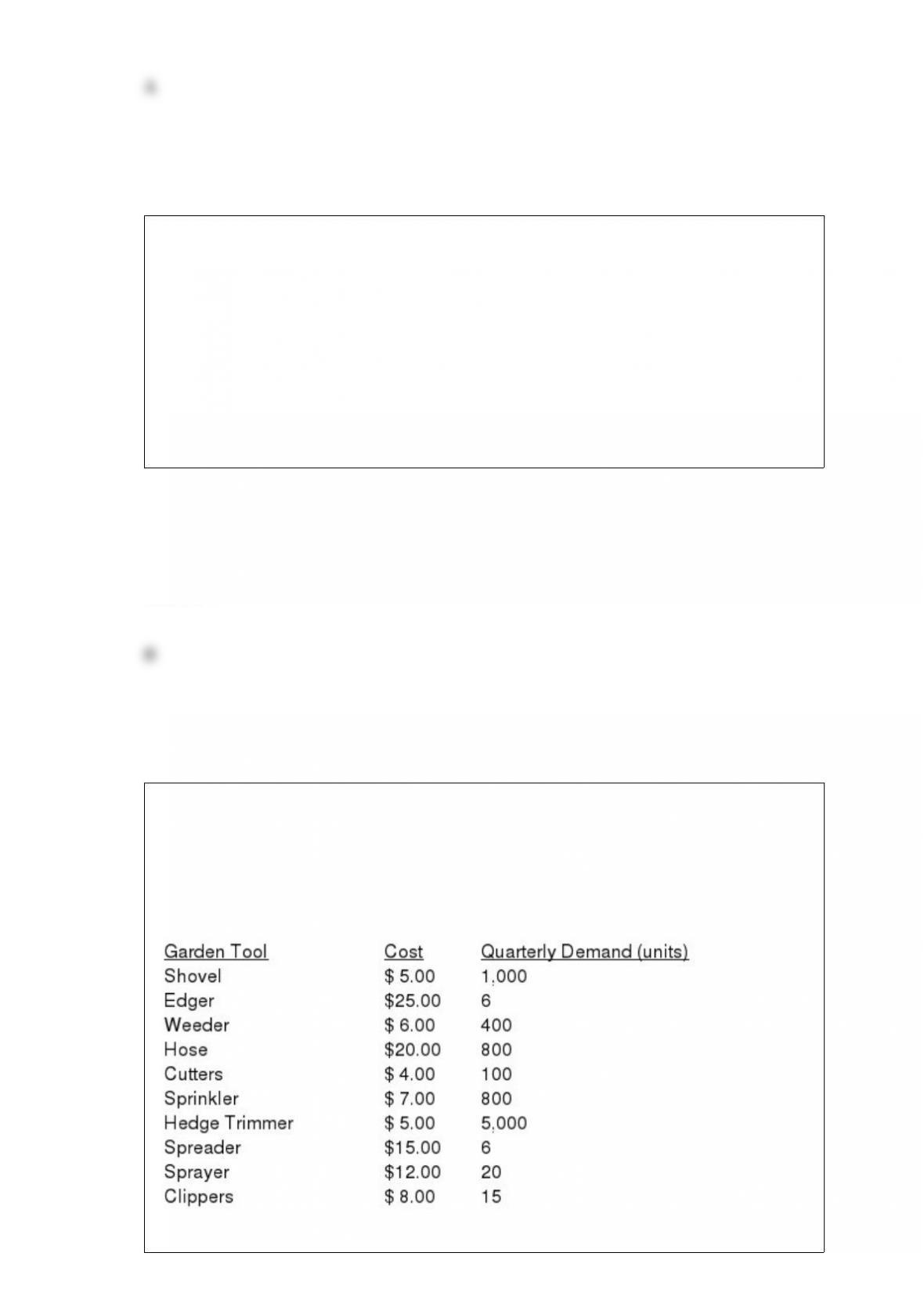
Louisa, the owner of a garden supply store was wondering if she could manage the
inventory better. She has decided to develop an ABC classification system to help
manage the inventory. The company’s inventory consists of the following items:

a. Compute the total dollar value of each of the ten inventory items. What is the total
value of all the inventory items?
b. Which items should be declared “A” items? What percentage of total inventory value
does “A” group represent? What percentage of the total number of inventory items does
“A” group represent?
c. Which items should be declared “B” items? What percentage of total inventory value
does “B” group represent? What percentage of the total number of inventory items does
“B” group represent?
d. Which items should be declared “C” items? What percentage of total inventory value
does “C” group represent? What percentage of the total number of inventory items does
“C” group represent?
Answer:

Which of the following performance perspectives in the balanced scorecard model
includes measures like productivity, flow time, and asset utilization?
a. Financial perspective
b. Customer perspective
c. Innovation and learning perspective
d. Internal perspective
Answer:
Perform a capacity analysis of the process given below. The numbers in parenthesis (#)
are the time in minutes to complete one unit of work. Demand on the process averages
20 units per hour and each unit must be worked on by all four stages. Administrative
clerk(s) do Stage A work. The assistant manager(s) do Stages C and D work and are
cross-trained to do both jobs. The coding specialist(s) do Stage B work.
How many administrative clerks should be hired to do Stage A work, assuming a target
utilization of 85 percent?
a. One
b. Two
c. Three
d. Four
Answer:
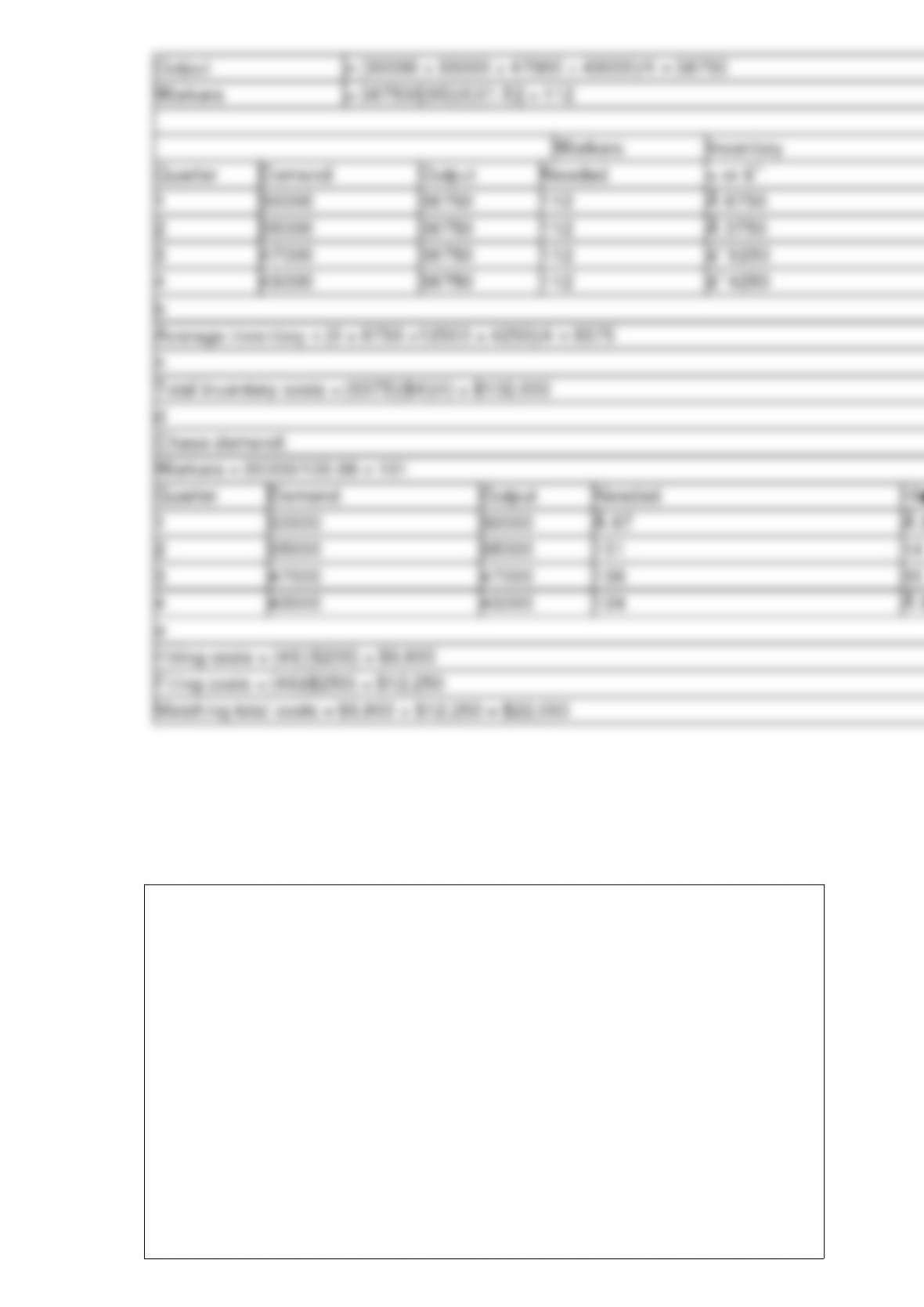
Pacific Chemical Products, Inc. produces a liquid laundry detergent and is currently in
the process of developing an aggregate plan for the upcoming year. They don’t know
whether to use a level production or a chase demand approach. The costs that they are
concerned with are the cost of hiring more workers, the cost of laying off workers, and
the cost of carrying inventory. Currently at Pacific there are 124 workers. It costs $200
to hire a new worker, the cost of laying off one worker is $250, and the
inventory-carrying cost per unit per quarter is $4. The company has 65 working days
per quarter and each person works only an 8 hour day. The labor standard for each
gallon of detergent is 1.5 hours, and the forecasted demand for the next four quarters is
30,000, 35,000, 47,000, and 43,000 gallons.
a. Using a level production plan, how many workers are needed each quarter?
b. What is the average inventory level under the level production plan?
c. What is the total annual inventory cost under a level production plan?
d. Under a chase demand plan, how many workers are needed in the second quarter?
e. What is the total hiring and firing costs using a chase demand plan?
Answer:
The Northwest Flower Company owns a greenhouse, which supplies roses and
carnations to florists in Oregon, Washington, and Idaho. The greenhouse can grow any
combination of the two flowers. They sell the flowers in “bunches” with 25 blooms to a
bunch. They have 10,000 square feet available for planting this year. Each bunch of
roses takes about 4 square feet and each bunch of carnations about 5 square feet. A
special fertilizer is required for the flowers: roses need 5 pounds and carnations 2
pounds. The availability of the fertilizer is limited to 5000 pounds. Sales commitments
require the company to grow at least 500 bunches of roses. Profit contributions are $6
per bunch of roses and $8 per bunch of carnations.
a. What is the objective function if the company wants to maximize its profits?
b. What is the constraint for the square footage assuming x1 corresponds to roses?
c. What is the optimal solution point for this problem?
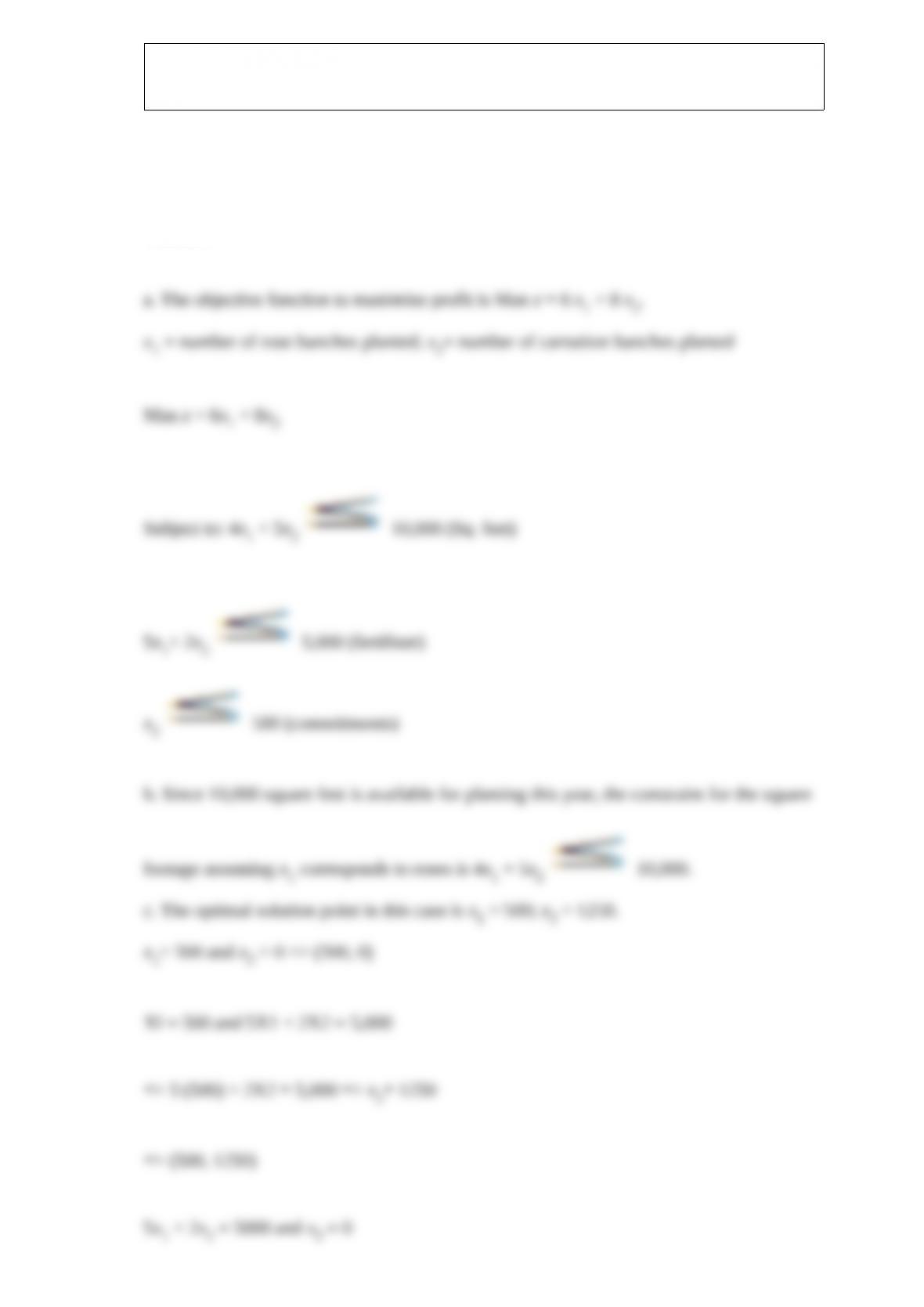
d. What is the optimal value of the objective function?
Answer:
Which one of the following major activities is NOT one of the six major activities to
design a goods-producing or service-providing process?
a. Define the purpose and objectives of the process.
b. Create a detailed process or value stream map that baselines current performance.
c. Use the product life cycle for each good or service to create a future state process
map.
d. Select the appropriate equipment and technology.
Answer:
Information technology has significantly affected health care. Which of the following is
NOT an outcome?
a. Cost reduction
b. Revenue enhancement
c. Faster exchange of handwritten charts between physicians and nurses
d. Improved clinical efficiency and patient care
Answer:
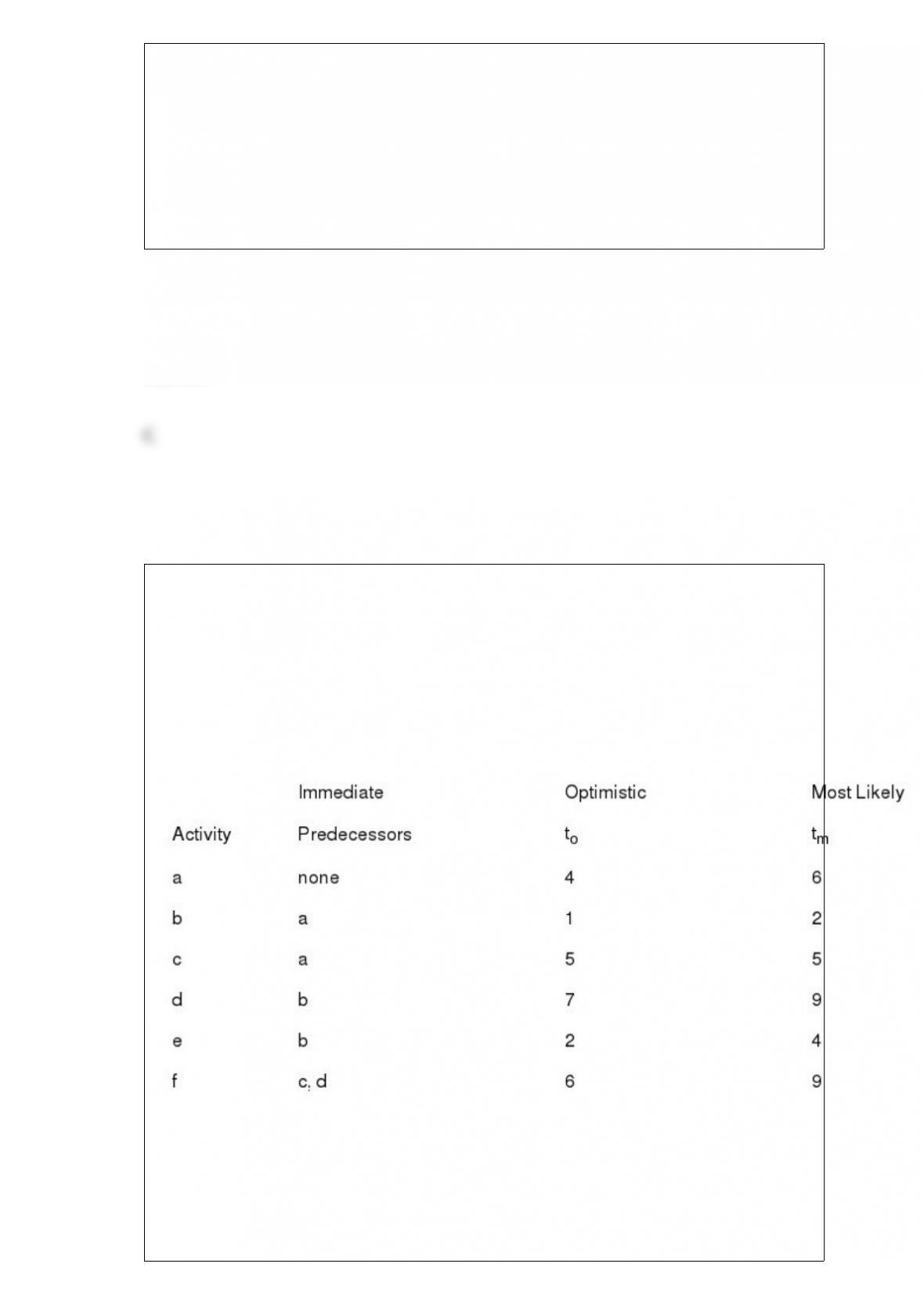
A high definition television manufacturer in Asia wants to develop a new smart
television as fast as possible using Program Evaluation and Review Technique (PERT)
and must complete the design and testing work first. The objective is to be the first to
market the most innovative smart television on the planet and capture the first adopter
market share. The manufacturer has determined the following activities, precedence
relationships, and time estimates in days for the project:
What is the critical path
a. A-B-E
b. A-C-F

c. A-C-D-F
d. A-B-D-F
Answer:
Which one of the following statements regarding the Bookmaster case study is TRUE?
a. Advantages of the bricks-and-mortar value chain include more customization, more
product variety, and using more customer labor (self-service).
b. Operations play no role in the Internet-based value chain.
c. The nature of the service encounter did not change between the bricks-and-mortar
versus Internet-based value chain.
d. The case is an example of where physical assets are replaced by information.
Answer:
Arrival distributions for queuing models:
a. follow a normal distribution.
b. use arbitrary but consistent time periods.
c. follow exponential distributions.
d. assume a non-random pattern.
Answer:
The number of Kanban cards is dependent on all of the following EXCEPT _____.
a. average daily demand rate
b. setup time
c. waiting time
d. safety stock
Answer:
Using the following information about material volume shipped from a factory to four
retail outlets, find the best location for the factory using the center-of-gravity method.
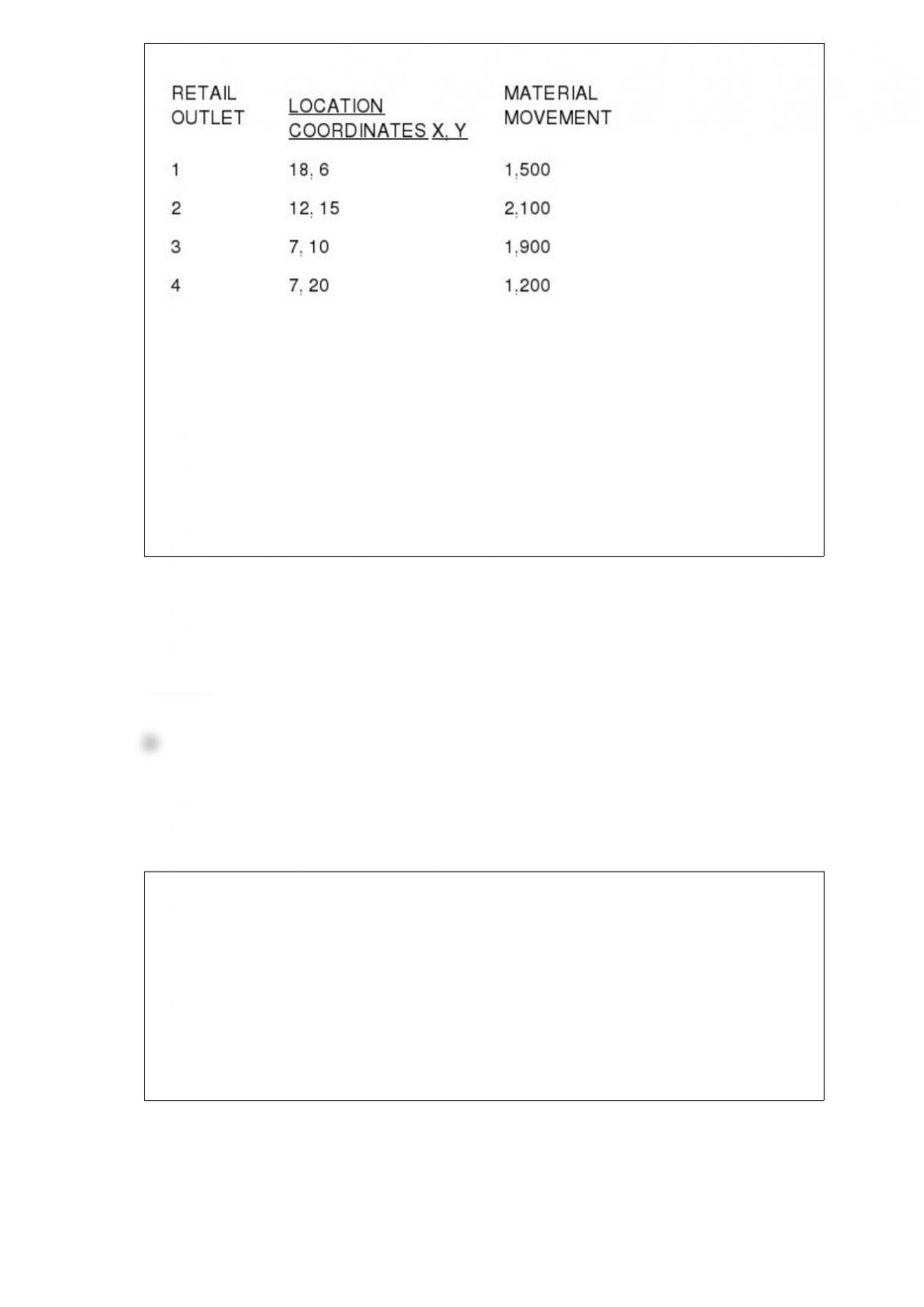
Which one of the following statements is TRUE for this set of center-of-gravity data?
a. Cx is less than 10.00 and Cy is more than 10.00.
b. Cx is more than 10.00 and Cy is less than 10.00.
c. Cx is less than 10.00 and Cy is less than 10.00.
d. Cx is more than 10.00 and Cy is more than 10.00.
Answer:
A competitively dominant customer experience is often called a _____.
a. perceived benefit
b. preemptive strike
c. moment of truth
d. value proposition
Answer:
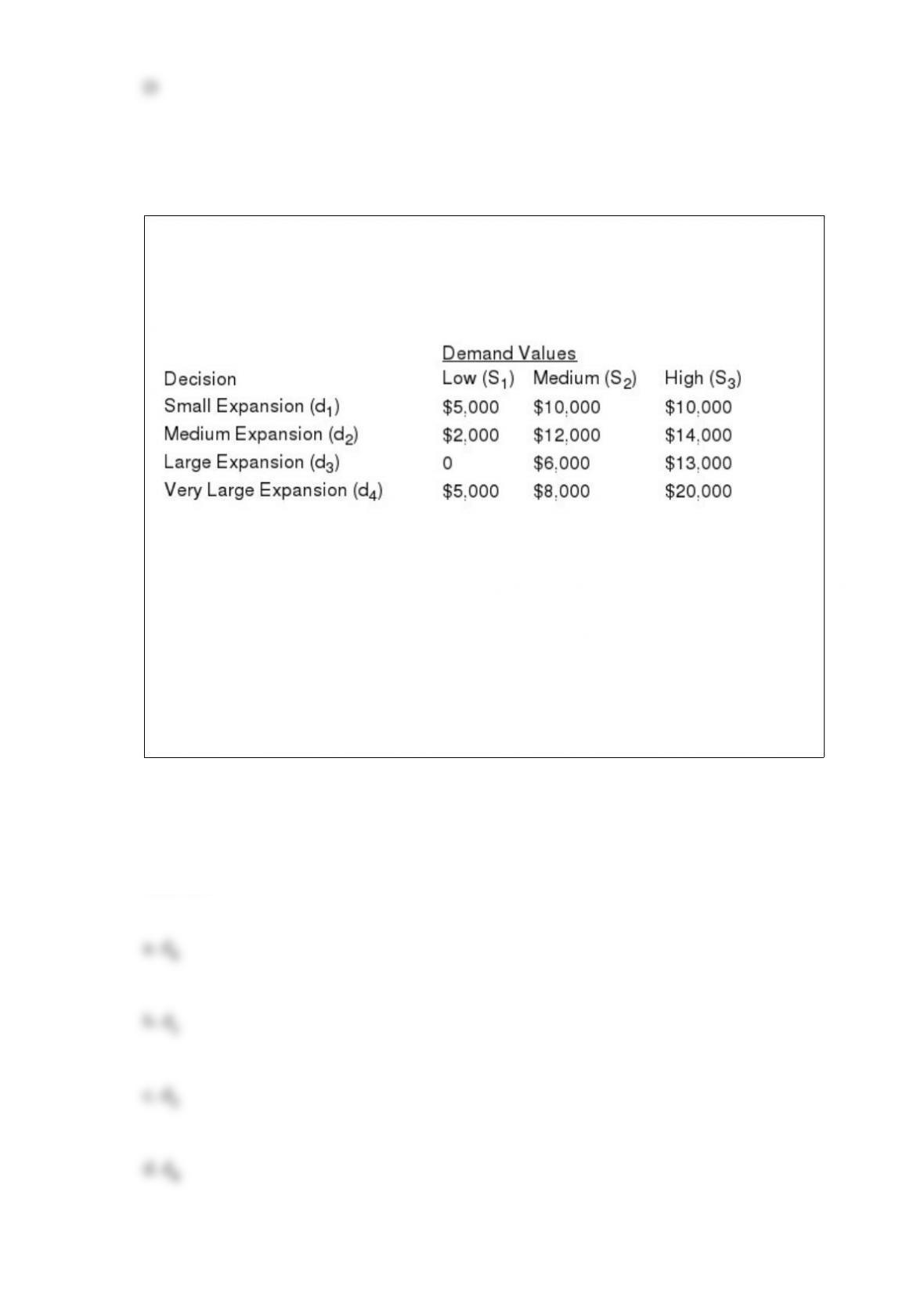
A company is expanding its production capacity. The decision will depend upon
whether the increase in demand is low, medium, or high. The company’s choices for
expansion are small, medium, large, or very large. The following table provides an
estimate of profits over the next two years.
a. Which decision variable would be selected using maximax?
b. Which decision variable would be selected using maximin?
c. Which decision variable would be selected using minimax-regret criteria?
d. Suppose the decision maker assigns the probability of low demand as 0.2, medium
demand as 0.5, and high demand as 0.3. Which decision variable would be selected
using the expected value criterion?
Answer:
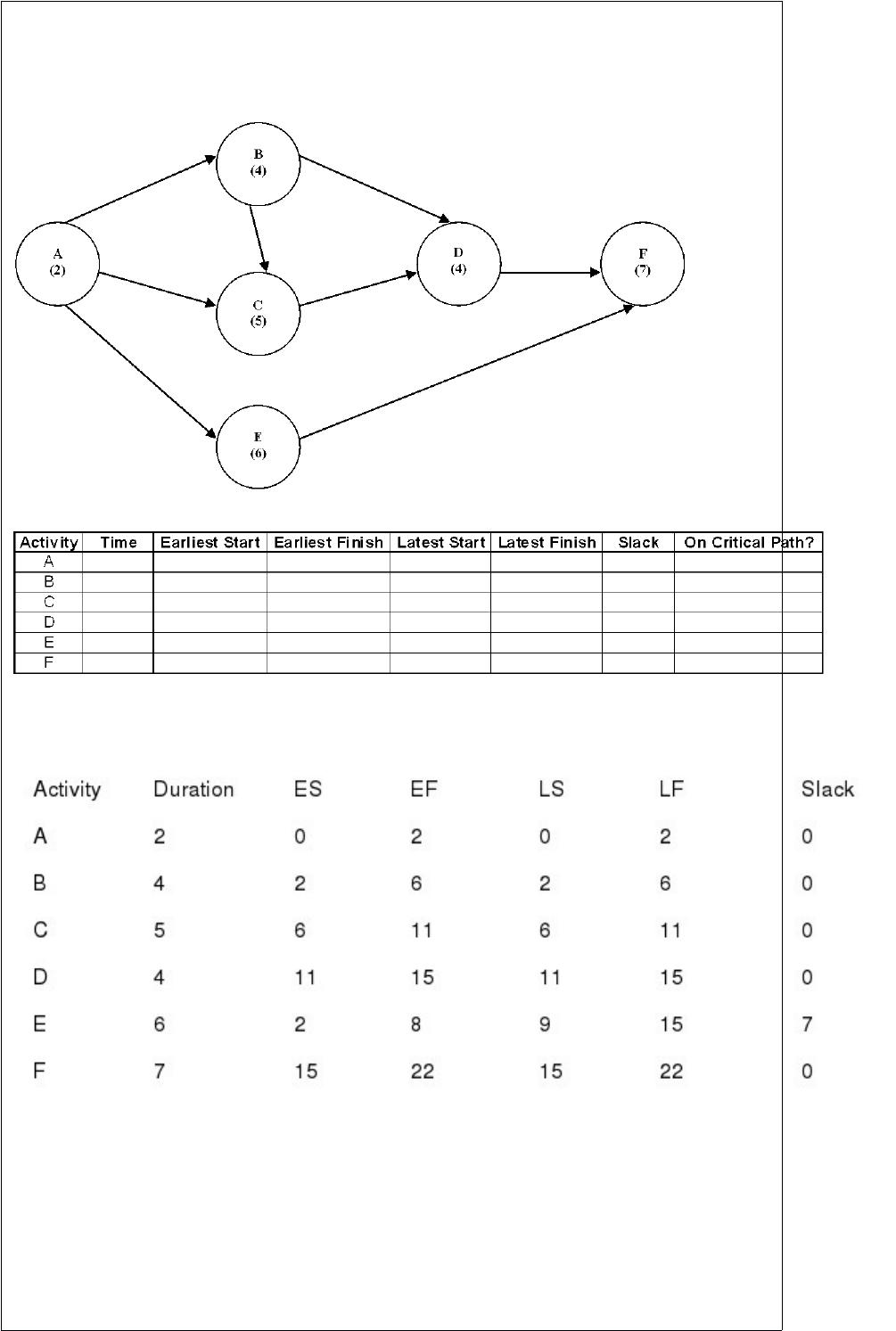
Consider the following project network. Time estimates are in weeks.
Complete the following table and questions 6, 7, and 8:
In the previous project network, the latest finish for activity B is:
a.
b.
c.
d.
Answer:
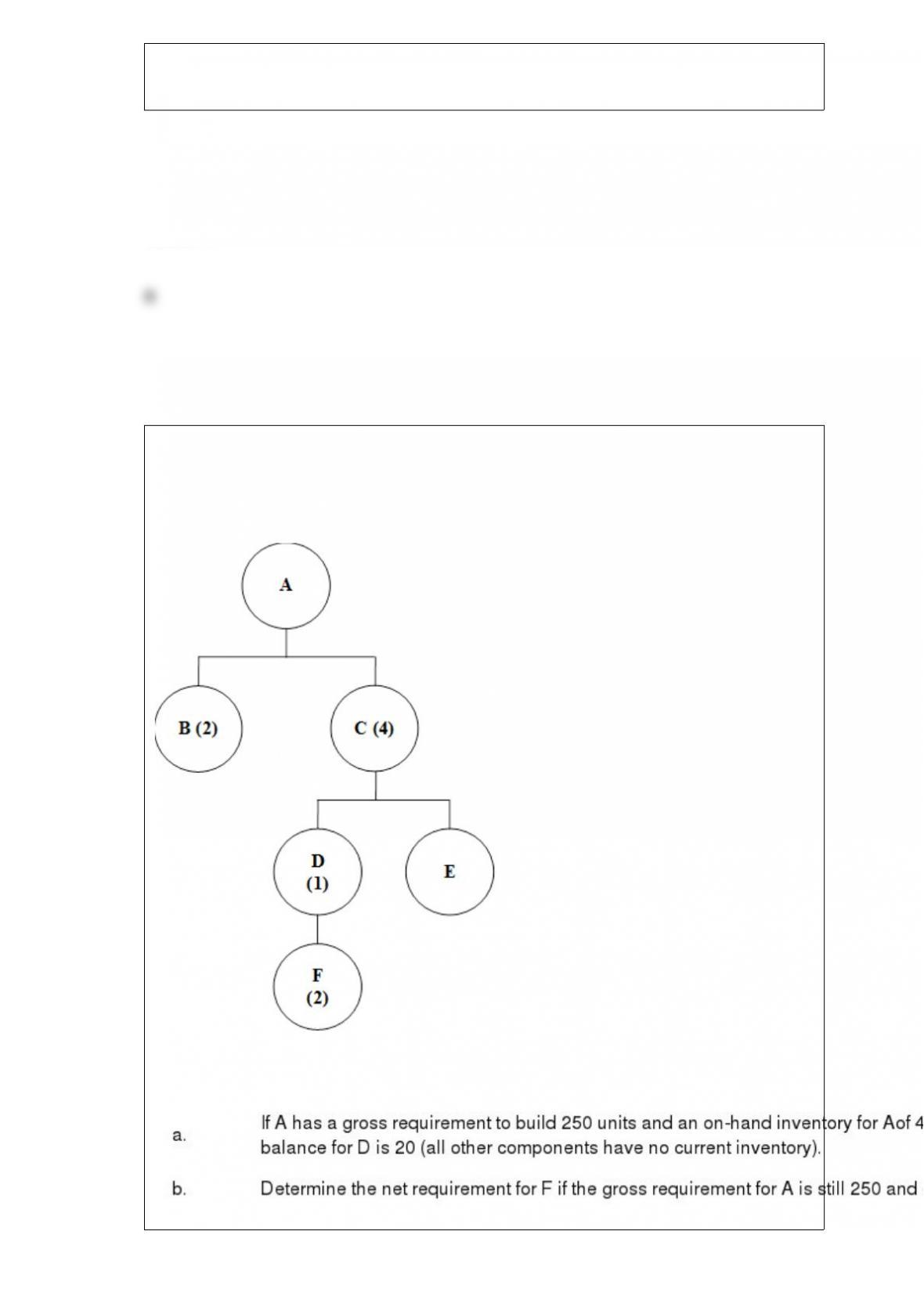
The bill of materials (BOM) for end item A is shown below:
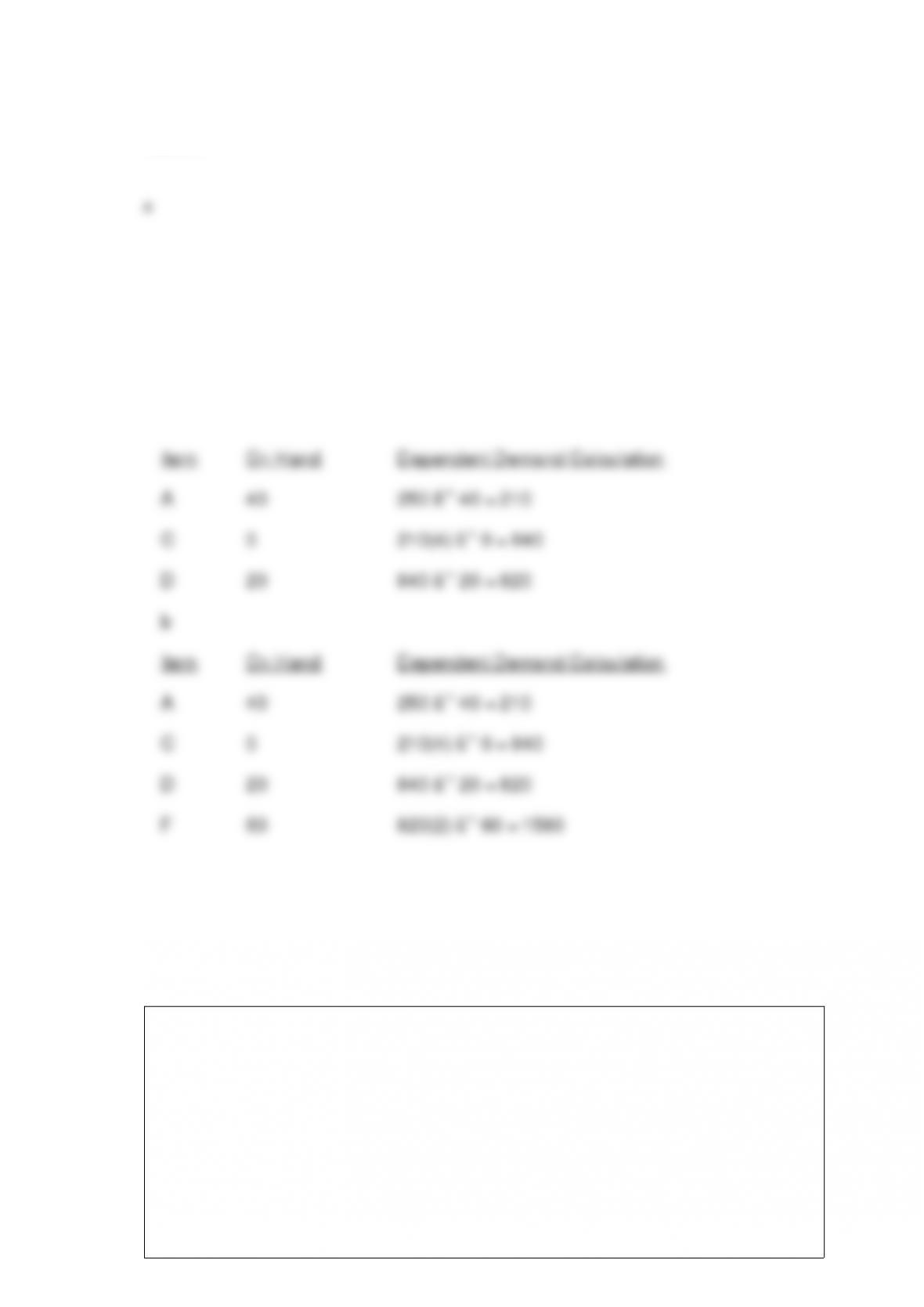
Answer:
Which one of the following statements is TRUEregarding the Greyhound Frequent
Flyer Call Center case?
a. In the four step analysis procedure described in the case, Step 1 uses equation
“Utilization = Demand Rate/[(Service Rate)*(Number of Servers)].”
b. The “travel advice” category of calls was the lowest priority relative to the other three
categories of calls.
c. True demand in the case included the number of calls rerouted to different customer

service representative (CSR) specialists.
d. The analysis of the case data revealed no scheduling problem with the current
customer service representative (CSR) staff schedule.
Answer:
The probability that the project will take longer than 28 weeks to complete is _____.
a. less than or equal to 0.1
b. greater than 0.1 but less than or equal to 0.3
c. greater than 0.3 but less than or equal to 0.6
d. greater than 0.6 but less than or equal to 0.9
Answer:
The system reliability for a three-component series system is 0.80. If the reliabilities of
two of the components are 0.92 and 0.99, determine the reliability of the third
component.
a. Less than 0.60
b. Equal to or greater than 0.60 but less than 0.70
c. Equal to or greater than 0.70 but less than 0.80
d. Equal to or greater than 0.80 but less than 0.90
Answer:
Jim is a quality control manager at a clothing manufacturing company. He studies a
quality problem where zippers are purchased from an outside supplier. He discovers
that they are poorly constructed. When the zipper is manufactured correctly, it should
have a mean length of 15 inches and a range of 0.5 inches. Jamie proposes that 25
samples of five observations each should be collected on a daily basis. He plans to
prepare control charts to monitor the progress of the supplier’s quality performance on
the zippers.
Answer:
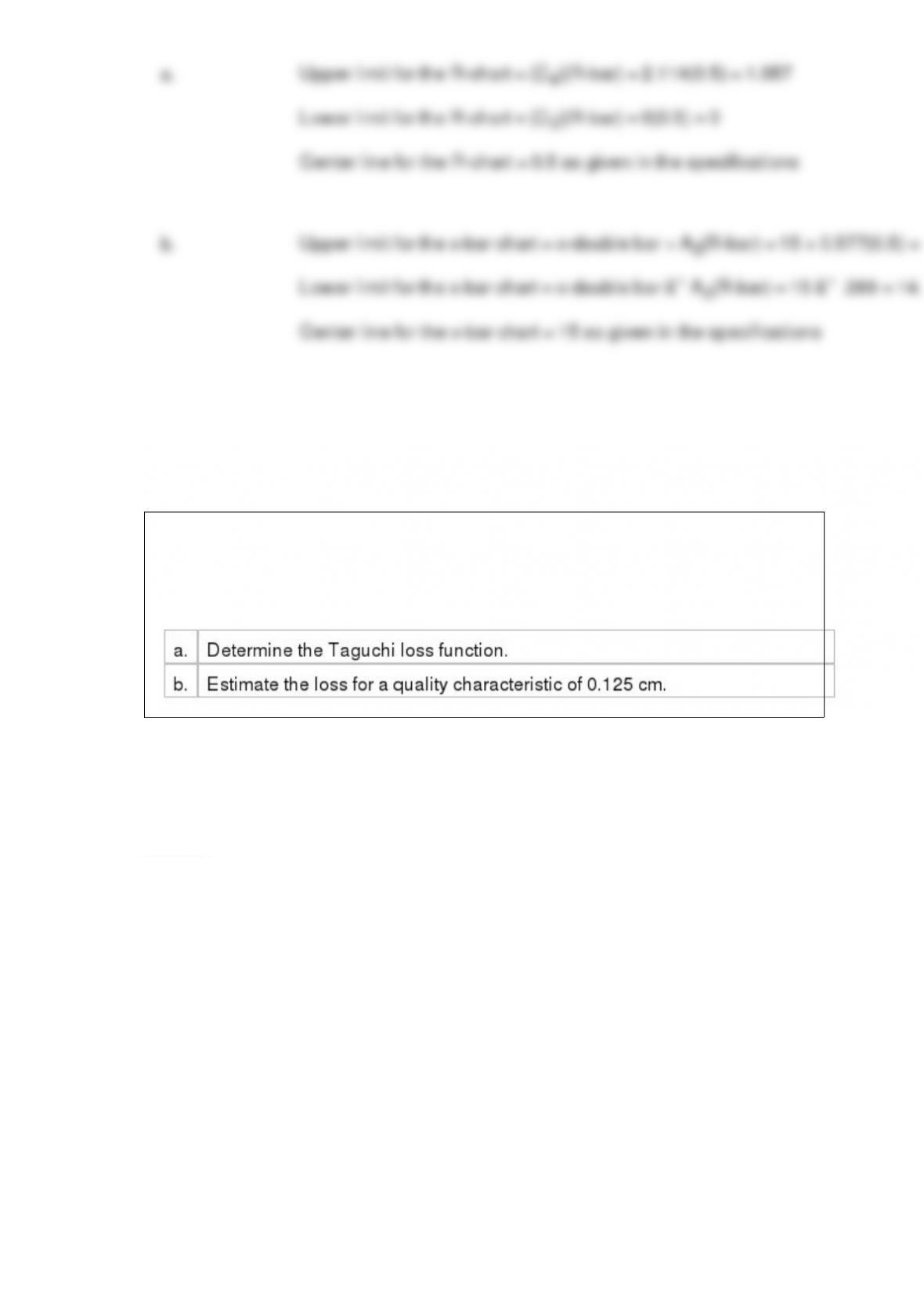
A quality characteristic has a manufacturing specification (in cm) of 100 ± 05.
Historical data indicate that if the quality characteristic takes on values larger than 0.15
cm or smaller than 0.05 cm, the product fails and a cost of $65 is incurred. Based on
this data, answer the questions below.
Answer:
Power Fuels Corporation is developing a new additive for rocket fuel. The additive is a
mixture of liquid ingredients A, B, and C. For proper performance, the total amount of
additive must be at least 18 ounces per gallon of fuel. For safety reasons, the total
amount of additive must not exceed 22 ounces per gallon. At least 2 ounces of A must
be used for every ounce of C. The amount of B must be greater than one-half the
amount of A.
a. The cost per ounce for ingredients A, B, and C is $50, $40, and $70, respectively.
What is the objective function?
b. Develop the constraint for limiting the additives for safety reasons.
c. Develop the constraint for ensuring the performance requirement is met.
d. Develop the constraint for the relationship between Ingredient A and Ingredient C.
e. Develop the constraint that states the relationship between Ingredient B and
Ingredient C.
Answer:
A performance rating factor (PRF) of 1.15 means:
a. a worker is working at a pace that is 15 percent faster than normal.
b. a worker is working at a pace that is 15 percent slower than normal.
c. a worker is working at a pace that is 15 percent faster than standard time.
d. a worker needs to add 15 percent to the standard time.
Answer:
Using the service-positioning matrix, a limited number of customer pathways and
highly repeatable service encounter activity sequences would best relate to:
a. being below the diagonal.
b. continuous flow processes.
c. customer-routed services.
d. provider-routed services.
Answer:
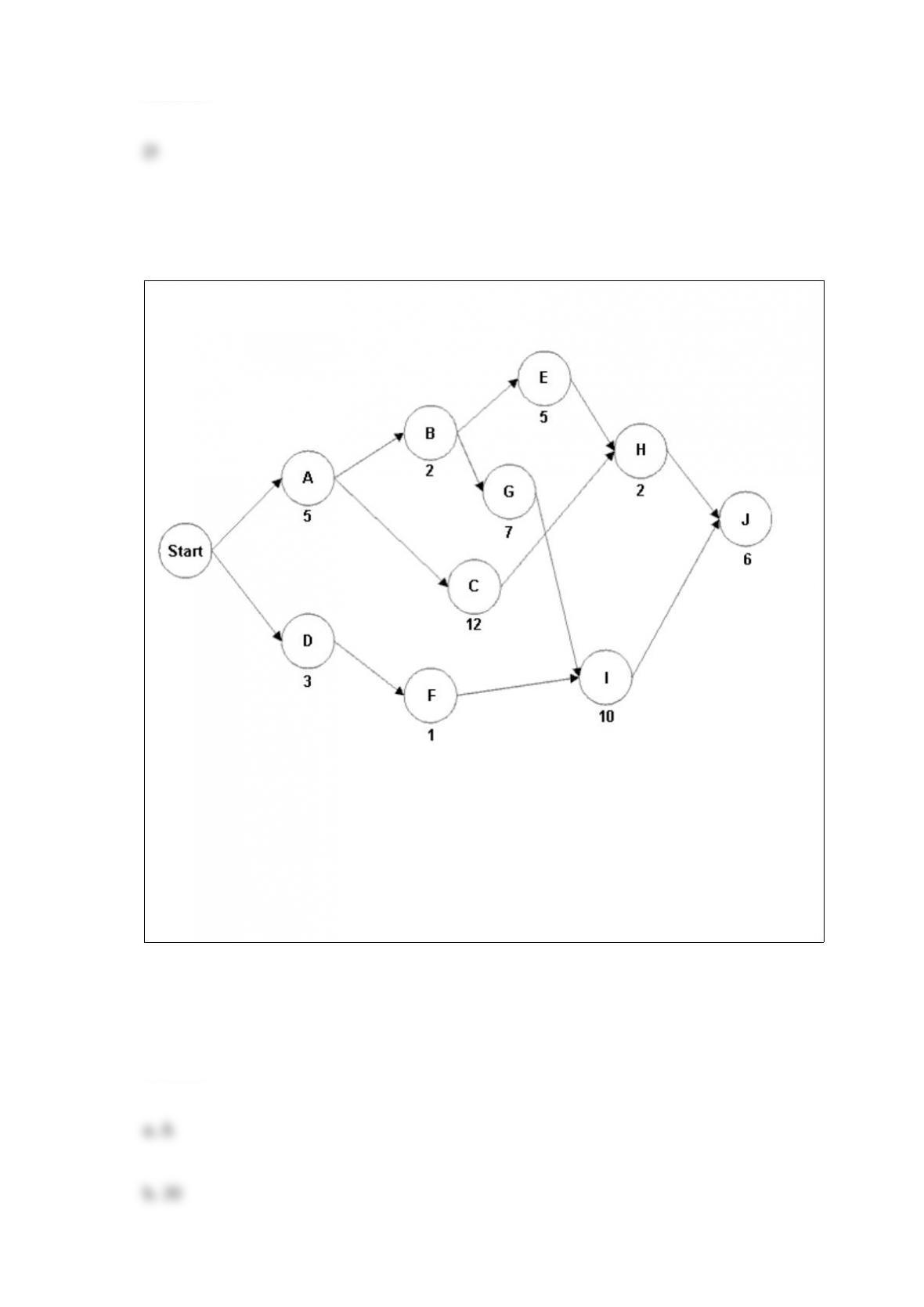
The network below represents a project being analyzed by the Critical Path Method.
a. What activity must be on the critical path, regardless of activity durations?
b. What is the duration of path A-B-E-H-J?
c. What is the critical path of this network?
d. What is the length of the critical path?
Answer:
A durable good is one that does not quickly wear out and typically lasts at least three
years. Vehicles, dishwashers and furniture are some examples. A nondurable good is
one that is no longer useful once it’s used, or lasts for less than three years. Examples
are toothpaste, software, clothing and shoes, and food.
Discuss the significant differences between goods and services.
Answer:
Taking a customer’s order at a quick service restaurant is generally viewed as a support
process.
Answer:
Define time study and describe the basic procedures for conducting a time study.
Answer:
Since all jobs eventually get done, job sequencing has no effect on resource utilization.
Answer:
Long-range forecasts expressed in sales dollars are more meaningful to top managers
than to managers at the operations level.
Answer:
A manufacturer inspected 40 circuit boards and found a total of 640 defects. If the
company wants to use statistical process control (SPC) to control the manufacturing
process by monitoring the number of defects per circuit board, what type of chart
should they use and what should be the control limits?
Answer:

Answer:
Explain and give the significance of the 1:10:100 Rule.
Answer:
Answer:
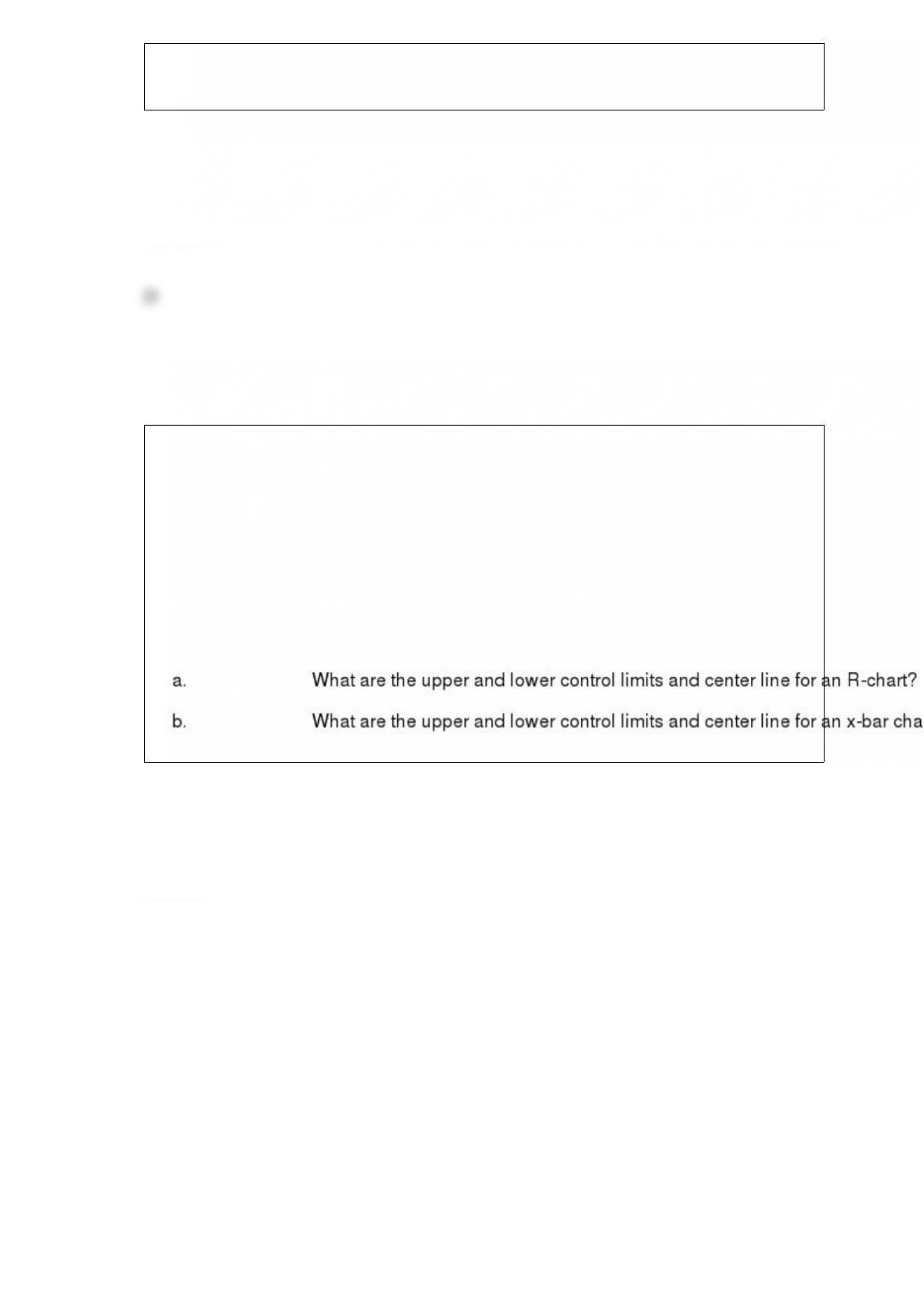
A production process is sampled 24 times with a sample size of 6 yields, an overall
mean of 25.2, and an average range of 0.8. Determine the control limits for the x-bar
and R-charts.
Answer:
In sequencing jobs in a flow shop with two resources, Johnson’s rule finds a sequence
that has the smallest makespan.
Answer:
The maximum authorized inventory for the problem given in #35 is _____.
a. less than or equal to 200 units
b. more than 200 but less than or equal to 300 units
c. more than 300 but less than or equal to 400 units
d. more than 400 units
Answer:
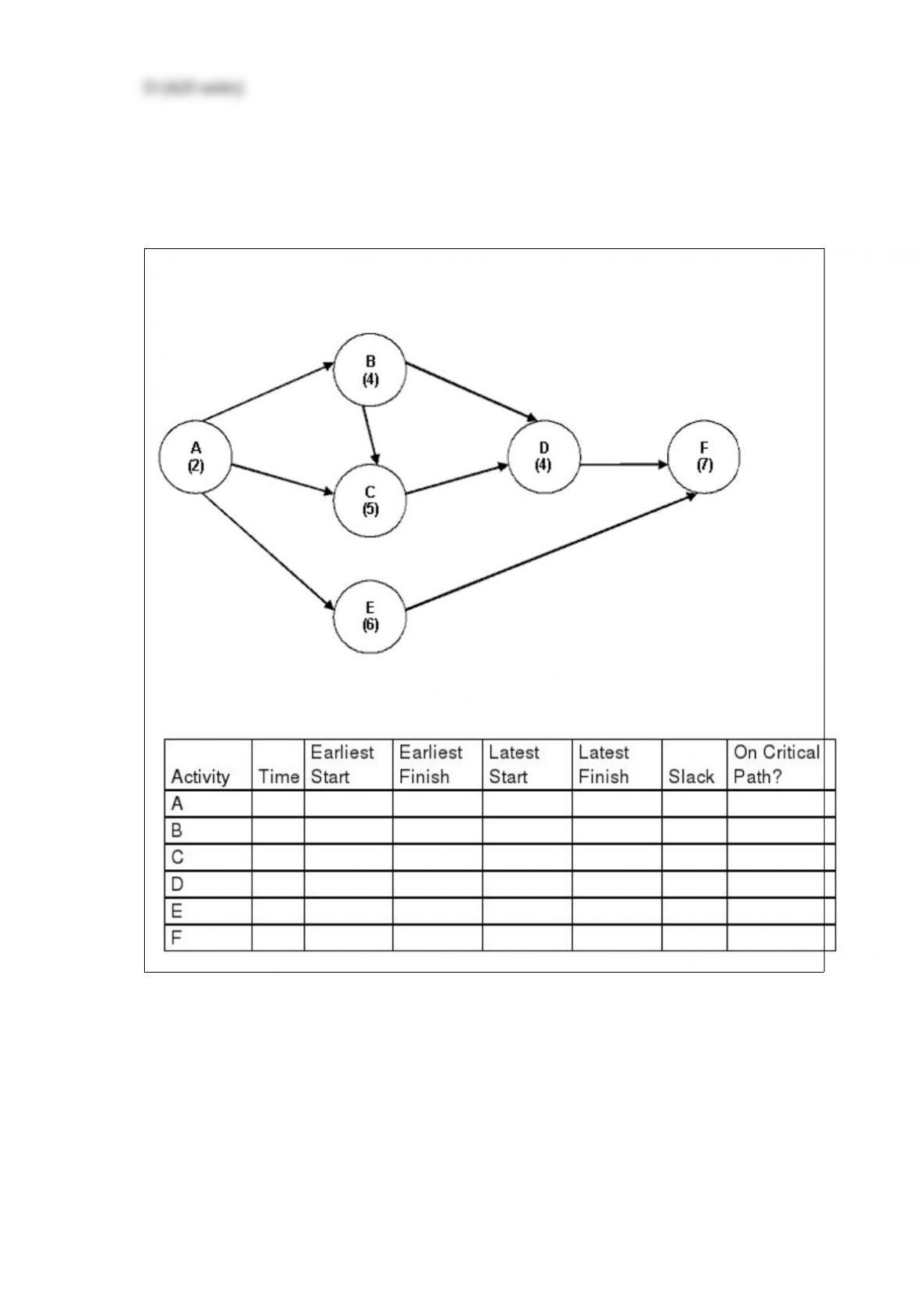
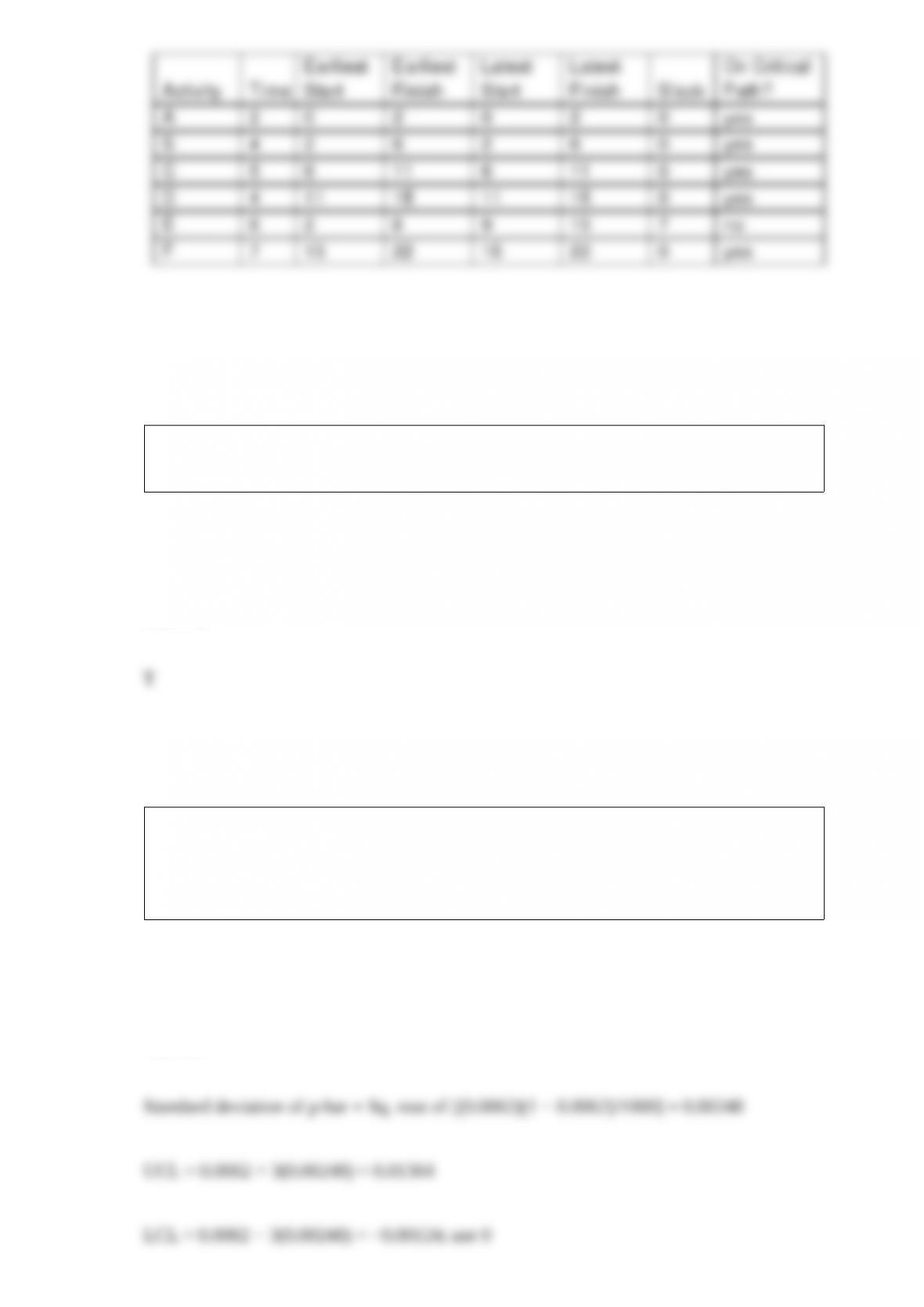
The following network shows the activities on the circles or nodes. Time estimates are
in weeks.
Complete the following table:
Answer:
The Seven QC Tools are designed to be simple so that workers at all levels can use
them.
Answer:
An airline found that on average, 0.62 percent of the luggage they received from
passengers at LAX (Los Angeles Airport) is lost or damaged. On a typical day, 1000
pieces of luggage pass through this airport. What are the control limits for a p-chart for
monitoring the daily fraction nonconforming?
Answer:
Explain the difference between design flexibility and volume flexibility.
Answer:
Over the last year, 1,100 oral medications were administered at a health clinic. Quality
is measured by the proper amount of dosage and the use of the correct drug. In three (3)
instances, an incorrect amount was given, and in two (2) instances, the wrong drug was
selected. What is the epmo metric?
Answer:
Describe the algorithm that defines Johnson’s sequencing rule for the two-resource
sequencing problem.
Answer:
An automobile emission testing center tests 50 vehicles per hour. Each inspector can
inspect one vehicle every four minutes. If the center wants a utilization of 90%, how
many inspectors are required?
a. Two
b. Three
c. Four
d. Five
Answer:
Capacity lag strategy results in constant capacity shortages.
Answer: