
Globalization and foreign competition began to change consumers’ attitudes toward
quality in the 1950s.
In ABC analysis, each class of inventory requires different levels of inventory
monitoring and control.
Material requirements planning (MRP) translates the master production schedule into
requirements for components, subassemblies, and raw materials.
A mixed strategy for adjusting capacity is simpler and easier to implement than any
pure strategy.

Motivation refers to the willingness of an employee to perform as needed to attain a
goal or objective.
Use of radio frequency identification (RFID) technology makes it possible for a
customer to determine production schedules.
Continuous replenishment systems rely heavily on extremely accurate long-term
forecasts.
A location’s collection of physical support systems is known as its infrastructure.

The LaPlace criterion is a decision criterion in which each state of nature is weighted
equally.
In today’s competitive environment, speed is often the most important factor in
logistics.
Employing a systematic approach to analyzing the causes and effects of product failures
is known as design for manufacture (DFM).
The adaptation of mass production to emphasize quality and flexibility, rather than
efficiency, is known as lean production.
Technology decisions are often a significant factor in process planning.
Comparing a product or process against the best-in-class is known as reverse
engineering.
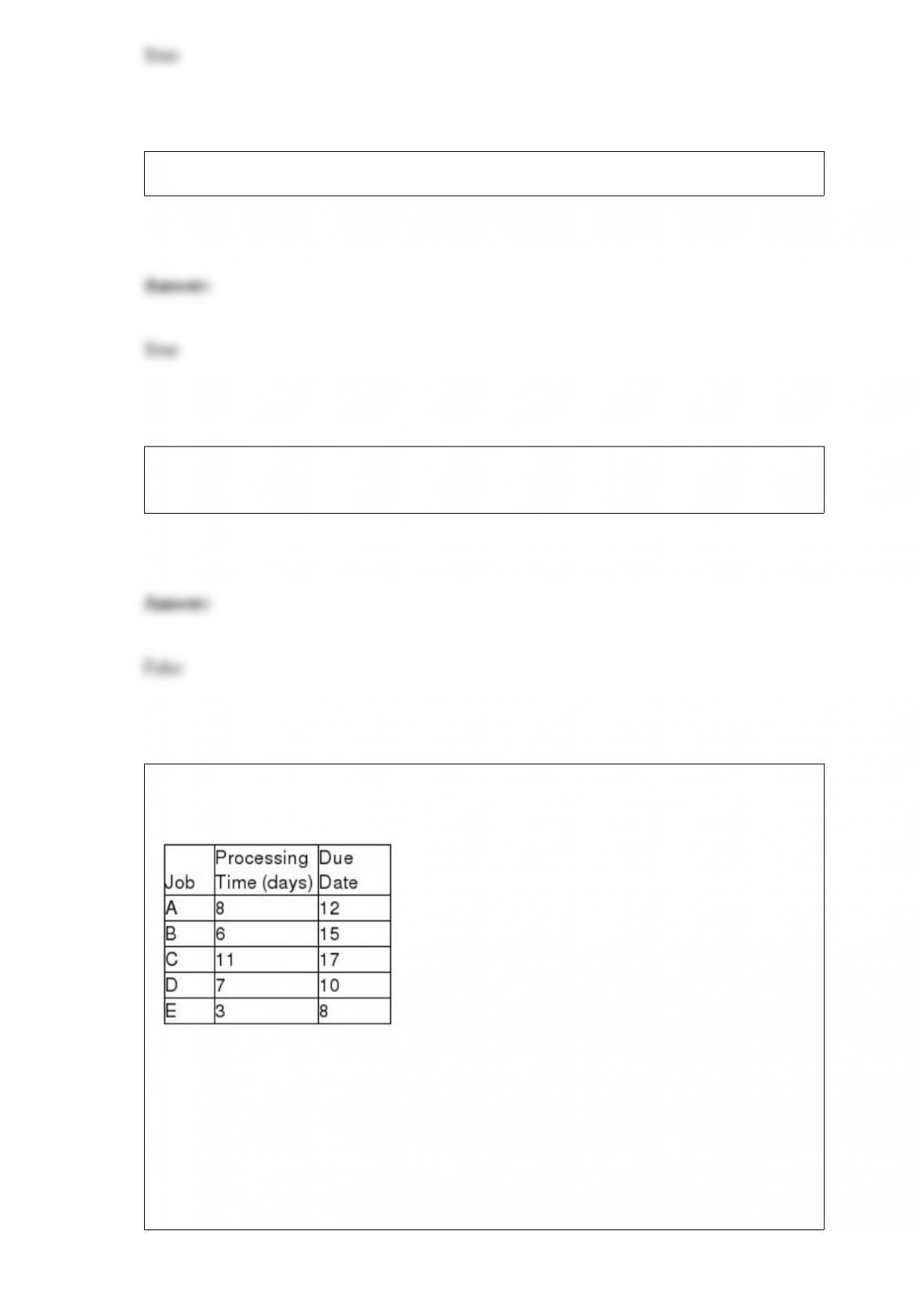
If the following jobs are sequenced according to the SLACK rule then the mean
completion time (in days) for all jobs is (assume zero for today’s date)
a. 35 days.
b. 20.8 days.
c. 18.4 days.
d. 7 days.

Companies that compete on _________________ establish a corporate culture that
encourages risk.
a. Innovation
b. Quality
c. Flexibility
d. Cost
Which of the following charts are frequently used together to monitor and control
quality?
a. p and
b. R and p
c. c and R
d. R and

The benefits of lean production include all of the following except reduced
a. inventory.
b. product variety.
c. costs.
d. lead times.
An attribute measure is a product characteristic such
a. weight.
b. color.
c. length.
d. time.
A(n) __________________ is used to graphically analyze how the steps of a job fit
together into the overall flow of the production process.

a. methods analysis
b. process flowchart
c. task analysis
d. environmental analysis
If a piece of equipment has a mean time between failures (MTBF) of 500 hours with a
mean time to repair (MTTR) of 10 hours, then its uptime or average availability would
be
a. 0.020 or 2.00%
b. 0.980 or 98.00%
c. 0.500 or 50.00%
d. 1.000 or 100.00%
Product lifecycle management is a software system that
a. facilitates collaborative design and development among trading partners.
b. stores, retrieves and updates design data through the lifecycle of a product.
c. retrieves the description and geometry of a design from a database, and tests and
analyzes that design on a computer screen.
d. assists in the creation, modification and analysis of design.
The _________________ forecast method consists of an exponential smoothing
forecast with a trend adjustment factor added to it.
a) exponentially smoothed
b) adjusted exponentially smoothing
c) time series
d) moving average
A small parts manufacturer has just engineered a new product for the automotive
industry. In order to produce the part the company can expand existing facilities,
acquire a competitor, or subcontract production. The company believes the product will
either experience high market demand or low market demand, with probabilities of 0.6
and 0.4, respectively. The following payoff table describes the company’s decision
situation.
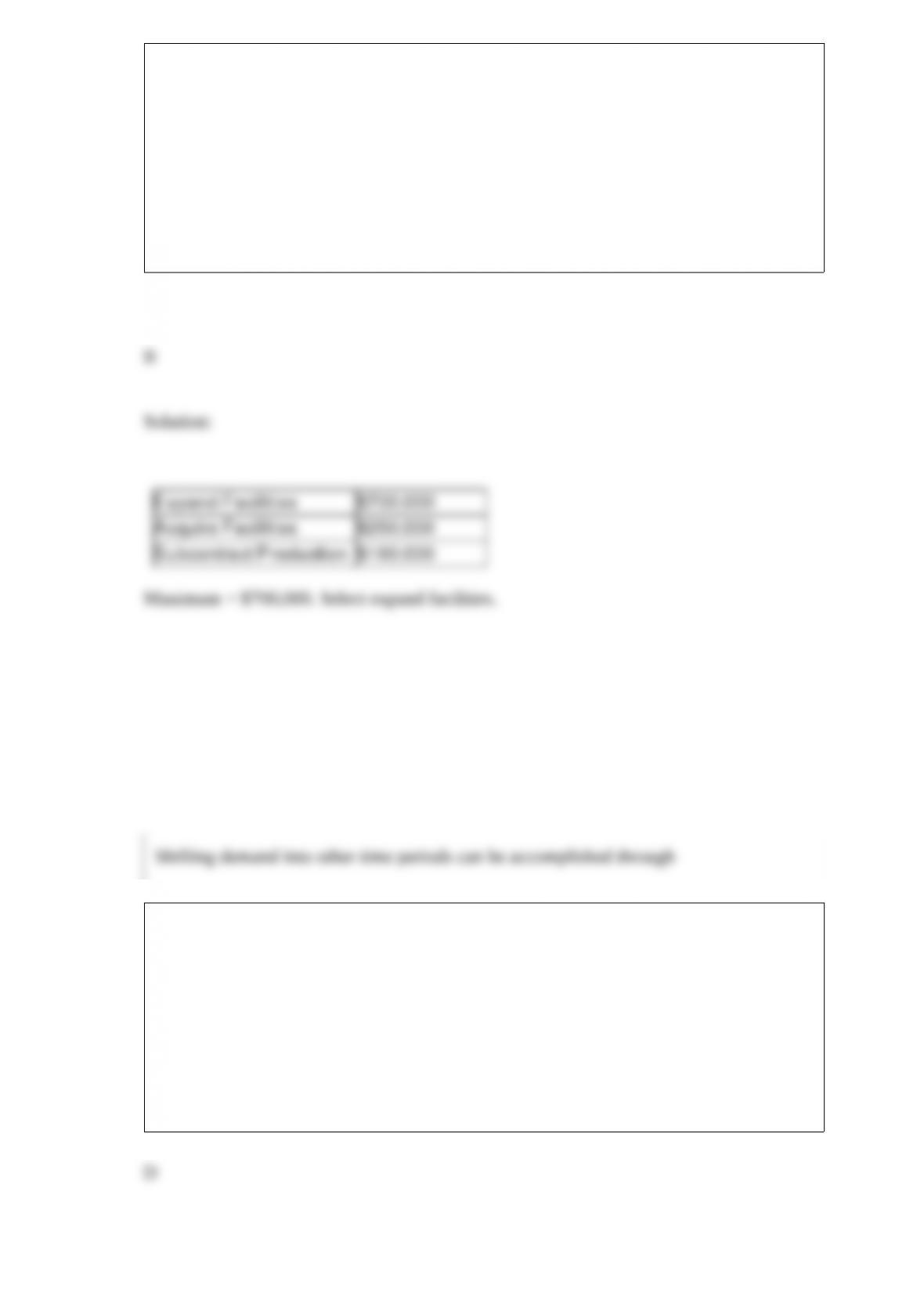
The best decision according to the expected value criterion is
a. Acquire Competitor.
b. Expand Facilities.
c. Subcontract Production.
d. High Demand
Shifting demand into other time periods can be accomplished through
a. Advertising
b. Sales promotions
c. Incentives
d. All of these answer choices are correct.
Which of the following is not a primary purpose of statistical process control?
a. to establish control limits
b. to detect special cause variations
c. to identify specification limits
d. to determine when a process is not in control
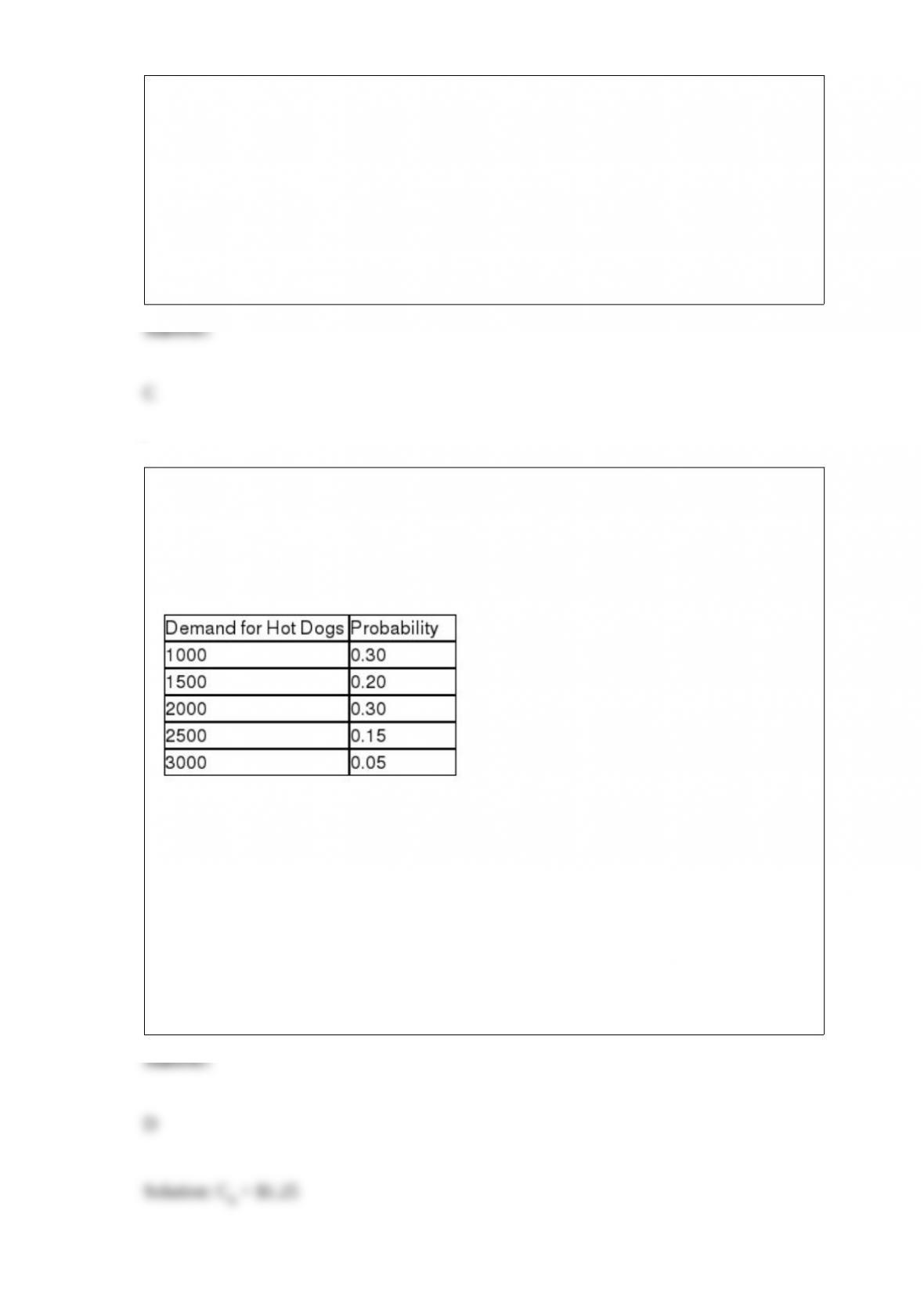
A hot dog vendor must decide on Monday how many hot dogs to have available for the
coming Saturday’s football game. Each hot dog costs the vendor $3.00 and is sold for
$5.00. After the game any unsold hot dogs are discounted and sold to the university
cafeteria for $1.75. The vendor believes that the demand for hot dogs follows the
probability distribution shown below:
The vendor’s cost of overestimating demand, Co, is
a. $5.00
b. $3.00
c. $1.75
d. $1.25
The transformation process associated with health care is best described as
a. locational
b. exchange
c. physiological
d. informational
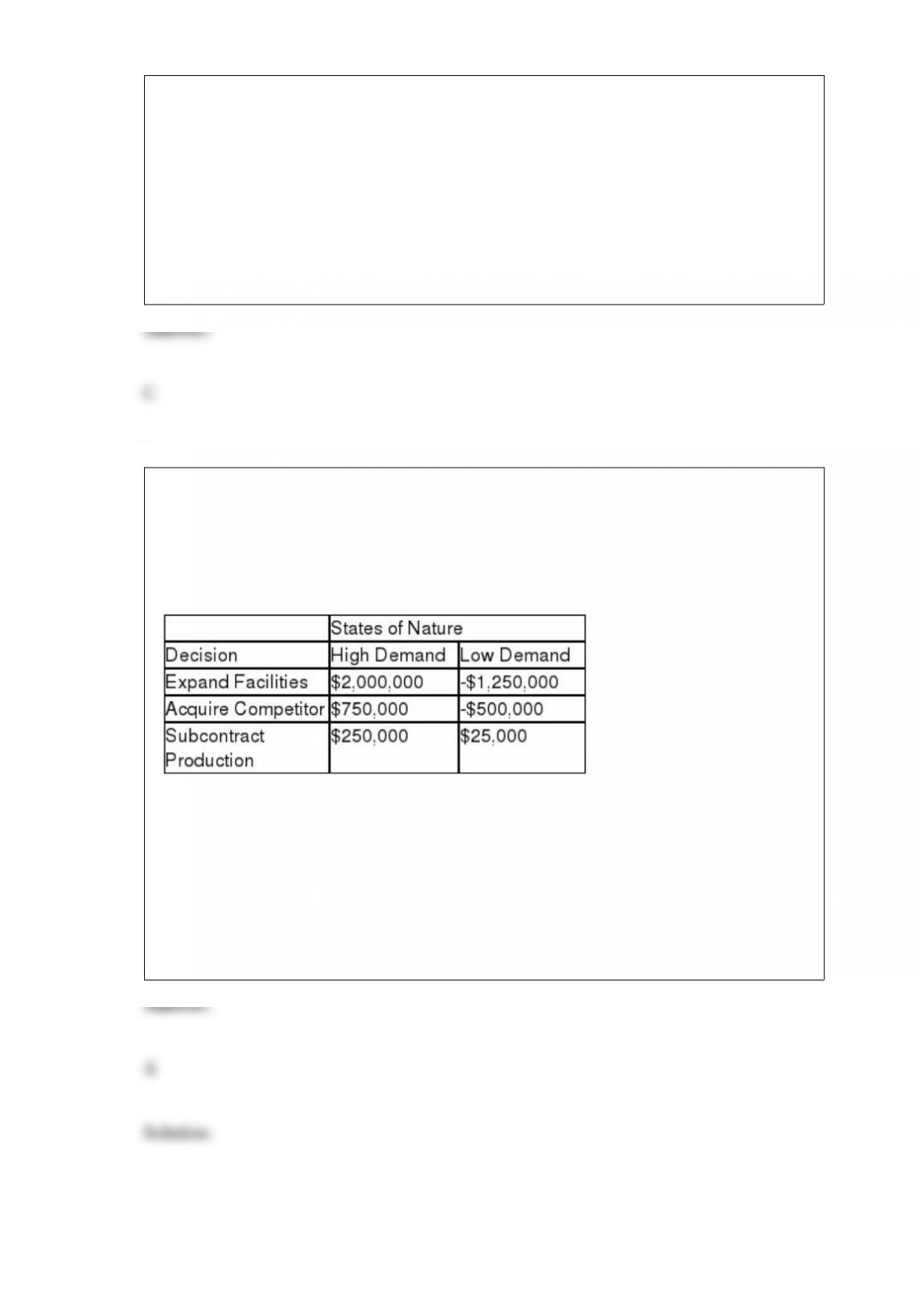
Kallie Inc., a small parts manufacturer, has just engineered a new product for the
automotive industry. In order to produce the part the company can expand existing
facilities, acquire a competitor, or subcontract production. The company believes the
product will either experience high market demand or low market demand. The
following payoff table describes the company’s decision situation.
The best decision for Kallie Inc. using the equal likelihood criterion is to
a. expand facilities.acquire competitor.
b. subcontract production.
c. select high demand.
The ______________ refers to the order in which waiting customers are served.
a. calling population
b. queue discipline
c. number of channels
d. service rate
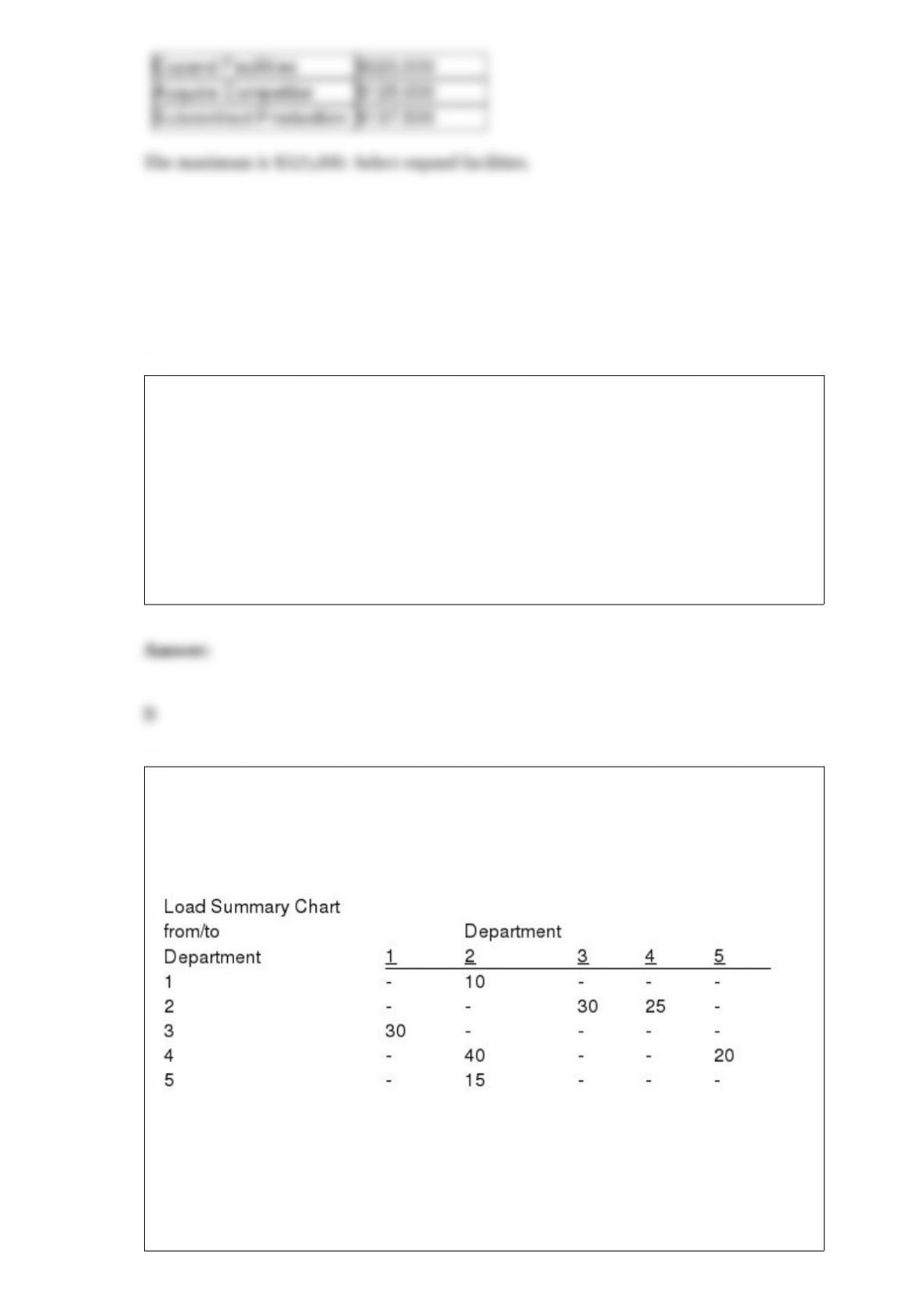
A company produces shovels in five departments. The average number of loads
transported between the five departments per month is given in the load summary chart.
(Insert 2 x 3 grid ‘“ see page 268)
Determine the number nonadjacent loads.
a. 25
b. 30

c. 50
d. 60
Intermodal combines several modes of shipment. The most common intermodal
combination globally is
a) truck-water-rail-truck
b) truck-rail-truck-water
c) rail-water-rail-truck
d) None of these answer choices is correct.
The principles of motion study relate to all of the following categories except
a. the human body.
b. the efficient use of capital.
c. the workplace.
d. the efficient use of equipment and machinery.
Consider a production process that produces batteries. A quality engineer has taken 20
samples each containing 100 batteries. The total number of defective batteries observed
over the 20 samples is 200. The sample standard deviation is

a. 0.03
b. 0.04
c. 0.05
d. 0.10