
In electron transfer, an electron donor reduces the electron receptor and in the process
becomes
a. oxidized.
b. transformed.
c. reduced.
d. flavin mononucleotide.
When oxidized, which nutrient(s) provide(s) the lowest respiratory quotient?
a. carbohydrate
b. protein
c. fat
d. mixed diet
What percentage of the glomerular filtrate volume is excreted as urine each day?
a. 100%
b. 50%

c. 25%
d. 1%
Iodine deficiency associated with growth problems results in _____.
a. cretinism
b. Keshan disease
c. goitrin
d. goiter
The formation of ATP by compounds with a more negative phosphate group transfer
potential than -7,300 cal is called _____.
a. transfer phosphorylation
b. oxidative phosphorylation
c. coupled reactions
d. substrate-level phosphorylation

Which structural component of the gastrointestinal tract is within the muscularis externa
and controls the contractions that cause motility?
a. muscularis mucosae
b. submucosal plexus
c. myenteric plexus
d. lumen
The binding of iron by proteins defends the cells against
a. iron deposition in kidneys and other organs.
b. oxidative damage from free radicals.
c. tissue hypoxia.
d. stellate cells.

Polymolecular aggregates called micelles are small enough to _____.
a. enter the enterocytes
b. stabilize circulating lipoproteins in the blood
c. enter the intramicrovillus spaces to interact with the brush border
d. confer specificity for recognition by receptors on cells
Restoration of normal pH is accomplished by the ratio of bicarbonate to carbonic acid.
Which buffer is controlled by the kidneys?
a. bicarbonate
b. carbonic acid
What enzyme facilitates diffusion of carbon dioxide from tissue cells and its reaction
with water so that carbon dioxide can be carried to the lungs?
a. renin
b. angiotensinogen
c. angiotensin
d. carbonic anhydrase

Incidence of hypertension in populations is considered predictable by _____.
a. serum sodium concentration
b. urinary sodium excretion
c. average daily sodium intake
d. sodium filtration rate by the kidney
Risk of vitamin K deficiency is greatest in:
a. newborns.
b. children.
c. adolescents.
d. older people.
Protein Regulation by Minerals. Zinc, copper, and iron regulate the expression of
specific proteins, particularly those that are involved in ensuring cells receive these
minerals, and those involved in preventing any toxicity associated with too much of a
given mineral. Describe how excess zinc (or copper, but not both) and iron regulate the
expression of a protein involved in their storage. Be specificname any proteins and
define all abbreviations.
All of the following are involved in satiety and suppression of food intake EXCEPT
_____.
a. cholecystokinin
b. corticotropin-releasing hormone
c. neuropeptide Y
d. leptin

Thermoregulation refers to _____.
a. alterations in metabolism to maintain body core temperature
b. alterations in food energy due to cooking
c. the increase in energy expenditure associated with the body’s processing of food
d. the body’s storage of food as fat for insulation
The final molecules that are absorbed from the digestion of the carbohydrate in
spaghetti (noodles) and a cream sauce are _____.
1) sucrose
2) glucose
3) maltose
4) galactose
5) lactose
6) fructose
a. 1, 4
b. 1, 4, 6
c. 1, 5, 3
d. 2, 4

The most important problem resulting from dehydration during exercise is _____.
a. hyperthermia
b. hyponatremia
c. loss of electrolytes
d. excessive sweating
Flavonoids are phytochemicals that can function in the body as
a. free radicals.
b. saponins.
c. antioxidants.
d. conjugates.

Which of the following is NOT considered an accessory organ?
a. pancreas
b. liver
c. gallbladder
d. spleen
Immediately following a balanced meal that contained vitamin E (such as fortified
milk), where would you most likely find most of the vitamin E in the body?
a. in the portal blood as α-tocopherol
b. in the general circulation bound to RBC
c. inside cells as free α-tocopherol
d. stored in adipose tissue
e. in chylomicrons in the lymphatic vessels and general circulation
Fill in the appropriate information in the following table with three different fiber
components. The physico-chemical property and physiological effect associated with
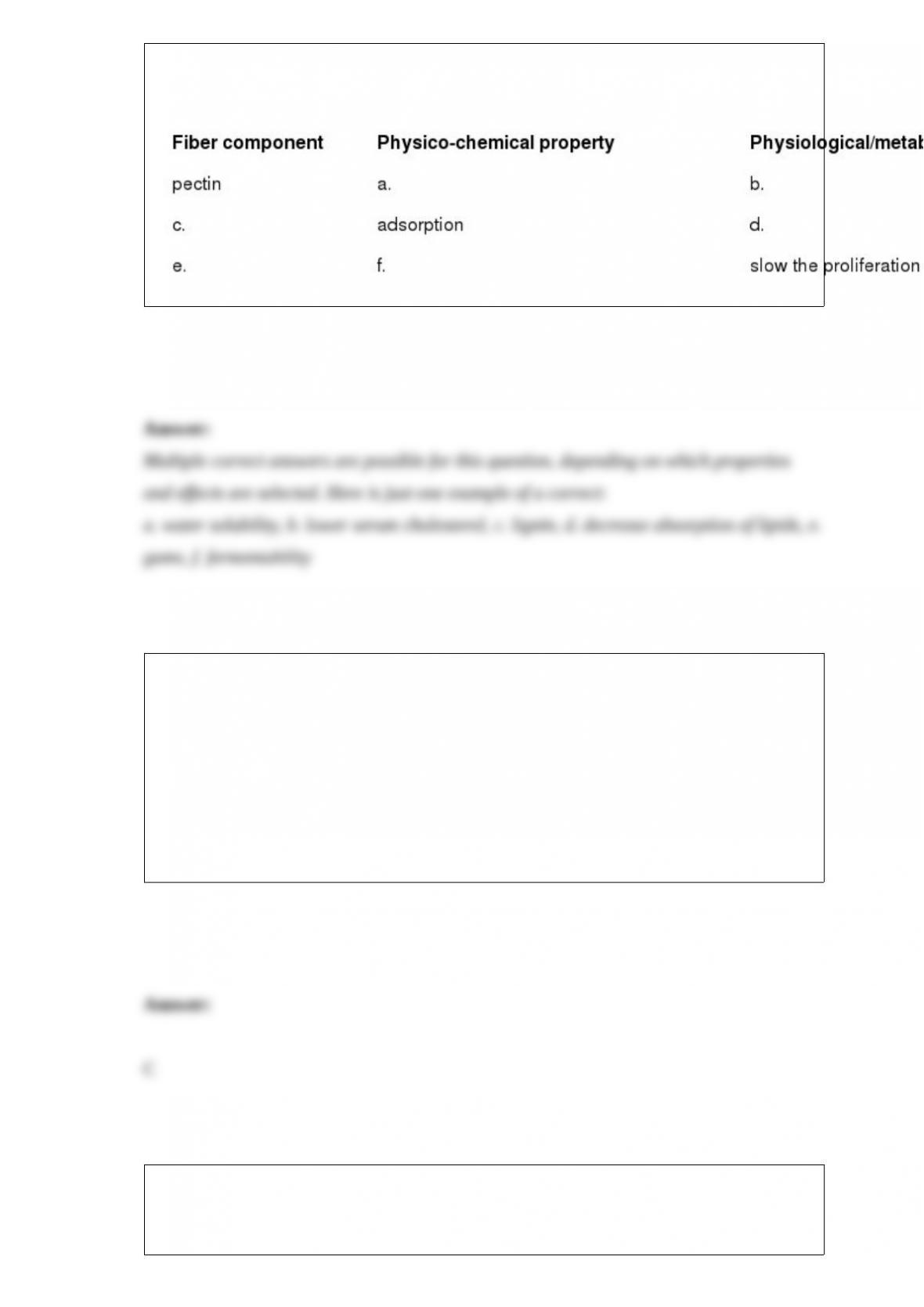
each fiber component must match. The physico-chemical property and the
physiological effect you give for each fiber component must be different.
The fructose : glucose ratio of high-fructose corn syrup is approximately _____.
a. 100:1
b. 80:20
c. 50:50
d. 25:75
If an individual with no blood sugar abnormalities when eating regularly presented with
severe hypoglycemia after 30 hours of fasting, which enzyme would you suspect might
be malfunctioning?
a. phosphofructokinase
b. pyruvate kinase
c. fructose-1,6-bisphosphatase
d. glucose-6-phosphatase
Aspirin at very high (acutely poisonous) doses can function to cause proton leaks from
the intermembrane space back into the matrix of the mitochondria. Explain why a
toddler who ate a bottle of about 150 flavored baby aspirin would develop a very high
body temperature.
Which enzyme or zymogen is secreted from the pancreas?

a. pepsinogen
b. enterokinase
c. procarboxypeptidases
d. maltase
e. acyl-CoA synthetase
What characteristics of fiber may protect against developing colon cancer?
a. Fibers adsorb primary bile acids to promote their excretion.
b. Fibers increase fecal bulk and dilute carcinogen concentrations.
c. Fibers can be fermented to butyric acid, which may slow proliferation of cancer cells.
d. All of the above
What is the major route for ATP production?
a. oxidative phosphorylation
b. hydrolysis

c. peroxidation
d. transformation
Which hormone is considered to be an antagonist of lipolysis?
a. insulin
b. epinephrine
c. glucagon
d. thyroxine
It’s a good thing that milk is fortified with vitamin D so that we can consume the RDA
if we drink the recommended number of glasses of milk each day. The DRI for 9-69
year olds is 600 IU (15 g). This equals _____ cups of milk.
a. two
b. three
c. four
d. six

When the diet is lacking in the amino acids lysine and threonine
a. proteins will be made without one amino acid.
b. the body will synthesize them.
c. protein synthesis will be limited.
d. another amino acid will be substituted so that synthesis is uninterrupted.
In what form is most body fat stored?
a. fatty acids
b. triacylglycerols
c. cholesterol
d. phospholipids

The glucose transporter that is sensitive to insulin is
a. GLUT1.
b. GLUT2.
c. GLUT4.
d. SGLT1.
Which of the following is NOT an attribute common to all membranes?
a. Membranes are symmetrical.
b. Membranes form sheet-like structures.
c. Membranes are fluid structures.
d. Membranes protect cellular components.
The fatty acid chains found in foods and body tissues range from _____ carbon atoms
in length.
a. 1 to 3
b. 2 to 6
c. 3 to 12
d. 4 to 24
Briefly discuss how high-fructose corn syrup is made and why it contains the same
amount of fructose as sucrose or honey and less fructose than apple juice.
True/False
Allosteric regulation of enzymes is carried out by modulators, other proteins that bind
to the enzyme to inhibit its activity.
What happens to reabsorbed bile acids after transport back to the liver?
Indicate whether the statement is true or false. If the statement is false, explain why it is
false.
7-dehydrocholesterol is the form of vitamin D that is added to fortify milk.
Indicate whether the statement is true or false. If the statement is false, explain why it is
false.
Gluconeogenesis occurs exclusively in the liver.
Describe three detrimental physiological effects of excess alcohol consumption and
three beneficial effects of moderate alcohol consumption.
Neural and hormonal events affect the activities of the GI tract. These can be classified
as stimulatory or inhibitory. For questions 56-62, choose “a” if the action described is
stimulatory and “b” if it is inhibitory.Ghrelin on satiety
Certain foods have been classified as containing goitrogens. List three of these foods
and tell how they affect iodide uptake in the thyroid.
The proximal colonic epithelial cells absorb water and the major cation _____. In
contrast, potassium and the anion _____ are secreted into the lumen of the colon.
Indicate whether the statement is true or false. If the statement is false, explain why it is
false.
A fasted state is characterized by protein synthesis.
Indicate whether the statement is true or false. If the statement is false, explain why it is
false.
Metallothionein is a storage protein for excess zinc, copper, and iron.
Pick two (2) of the examples from question #3 and indicate specifically how the signal
you indicated in your answer is altering the pathway listed. For each example, write a
one-sentence answer that includes the condition, the signals, the mechanism, the
protein/ enzyme, the tissue, and the result (all underlined in the example below).
Example: Under fed conditions, high blood glucose leads to insulin secretion by the
pancreas, which in turn induces expression of the key glycolytic enzyme
phosphofructokinase in all cells, thereby increasing glycolysis.
The synthesis of the specific bone protein osteocalcin is dependent on the presence of
three fat-soluble vitamins: _____, _____, and _____.
The catabolic enzyme that degrades hydrogen peroxide into water and molecular
oxygen is _____ and it is located in the _____.
Explain the physiological role of silicon in normal growth and bone development.