Kozier & Erb’s Fundamentals of Nursing, 10/E
Chapter 48
Question 1
Type: MCSA
The nurse is assessing a client’s urinary elimination. Which factor should the nurse keep in mind as influencing
this elimination?
1. Age
2. Body image
3. Knowledge
4. Socioeconomic status
Question 2
Type: MCSA
The nurse realizes that which client is at risk for difficulty in urinary elimination?
1. A client who had bladder cancer and now has a newly created ileal conduit
2. A 25-year-old female client with low self-esteem
3. An 80-year-old male reporting frequent urination at night
4. The client with hypertension who takes a diuretic every day for blood pressure
Question 3
Type: MCSA
A client tells the nurse about the need to get up several times throughout the night to void. The nurse suspects the
client is experiencing nocturia due to which factor?
1. Decrease in bladder tone
2. Decrease in blood supply
3. Decrease in number of nephrons
4. Decrease in cardiac output
Question 4
Type: MCSA
Which intervention would the nurse plan to help a client prevent a urinary tract infection?
1. Encourage the use of bubble baths.
2. Have the client increase sugar in the diet.
3. Instruct the client to empty the bladder completely.
4. Wipe from back to front.
Question 5
Type: MCSA
The nurse should incorporate which instructions into the teaching plan for a client with a urinary diversion?
1. Change the appliance several times a day.
2. Increase fluid intake.
3. Notify the physician if the stoma is deep pink and shiny.
4. Strands of blood may appear in the urine.
Question 6
Type: MCSA
Which nursing intervention is appropriate when caring for a client with a retention catheter?
1. Don sterile gloves.
2. Gently retract the labia majora away from the urinary meatus.
3. Observe urine in the drainage bag.
4. Retape the catheter to the thigh.
Question 7
Type: MCSA
Which nursing diagnosis would be appropriate for a client who has a retention catheter if the drainage bag is
found lying on the floor?
1. Risk for Impaired Skin Integrity related to catheter placement
2. Risk for Infection related to improper handling
3. Self-Care Deficit related to presence of a retention catheter
4. Risk for Incontinence related to an obstruction
Question 8
Type: MCSA
The nurse is identifying outcomes for a client with the nursing diagnosis Stress Urinary Incontinence. Which
outcome would be related to sphincter incompetence?
1. The client will empty her bladder every time she voids.
2. The client will improve her incontinence within 1 month.
3. The client will perform four to five squeezes for 5 to 10 seconds.
4. The client will stop the flow of urine when voiding.
Question 9
Type: MCSA
Which goals should the nurse identify as appropriate for a client with the nursing diagnosis Urinary Pattern
Alteration related to an enlarged prostate?
1. The client will avoid bladder distention.
2. The client will maintain fluid imbalance.
3. The client will remain free of skin breakdown.
4. The client will voice increased discomfort.
Question 10
Type: MCSA
The RN is admitting a client to the medical unit for a urinary disorder. Which physical assessment techniques
should the nurse use in assessing this client’s urinary system?
1. Auscultation and inspection
2. Inspection and percussion
3. Observation and auscultation
4. Palpation and observation
Question 11
Type: MCSA
A client has been admitted with incontinence. What should the nurse expect to assess in this client?
1. Client is wearing cotton undergarments.
2. Leakage of urine occurs when client laughs.
3. Leakage of urine occurs when talking with the client.
4. The skin of the client is clear without discoloration.
Question 12
Type: MCSA
A client is rushed to the emergency department with what the physicians suspect to be necrosis of the urinary
diversion stoma. What evidence presented by the client leads to this conclusion?
1. Black with sloughing
2. Moist stoma
3. Pink and shiny
4. Slight bleeding from stoma
Question 13
Type: MCSA
A client’s results from a urinalysis are as follows: pH 5.2, gross cloudiness, WBC 10–15, glucose negative,
specific gravity 1.012, and protein negative. How should the nurse interpret the results?
1. Dehydration
2. Diabetic ketoacidosis
3. Trauma
4. Urinary tract infection
Question 14
Type: MCSA
A client’s urinalysis is reported as being normal. What were the client’s results?
1. Blood present and no ketones
2. Dark amber color and output less than 500 cc in 24 hours
3. pH 6 and no glucose present
4. Specific gravity 1.035 and faint aromatic odor
Question 15
Type: MCSA
A client is prescribed propranolol (Inderal). What should the nurse instruct the client about this medication?
1. The medication should be discontinued abruptly.
2. Notify the physician if you experience urinary retention.
3. Take a laxative every day.
4. Take the medication on an empty stomach.
Question 16
Type: MCSA
A client is having issues with urinary elimination. What should the nurse instruct this client to promote urinary
elimination?
1. Don’t interrupt your day by going to the bathroom; wait until you’re at a good stopping place.
2. Drink 8 to 10 glasses of water daily.
3. Urine color changes are not important.
4. Wash with soap and water every other day.
Question 17
Type: MCSA
A client is instructed on the care of an indwelling urinary catheter. Which returned demonstration by the client
indicates that teaching has been effective?
1. The client empties the drainage bag once a day.
2. The client hangs the drainage bag on the towel rod.
3. The client refuses drinks one to two 8-ounce glasses of fluid each day.
4. The client takes a shower each day.
Question 18
Type: MCSA
A client recovering from a transurethral resection of the prostate (TURP) with a three-way indwelling catheter
expresses the need to urinate. Which action should the nurse take to help this client?
1. Deflate and then reinflate the balloon.
2. Irrigate the catheter.
3. Reposition the catheter.
4. Retape the catheter to the abdomen.
Question 19
Type: HOTSPOT
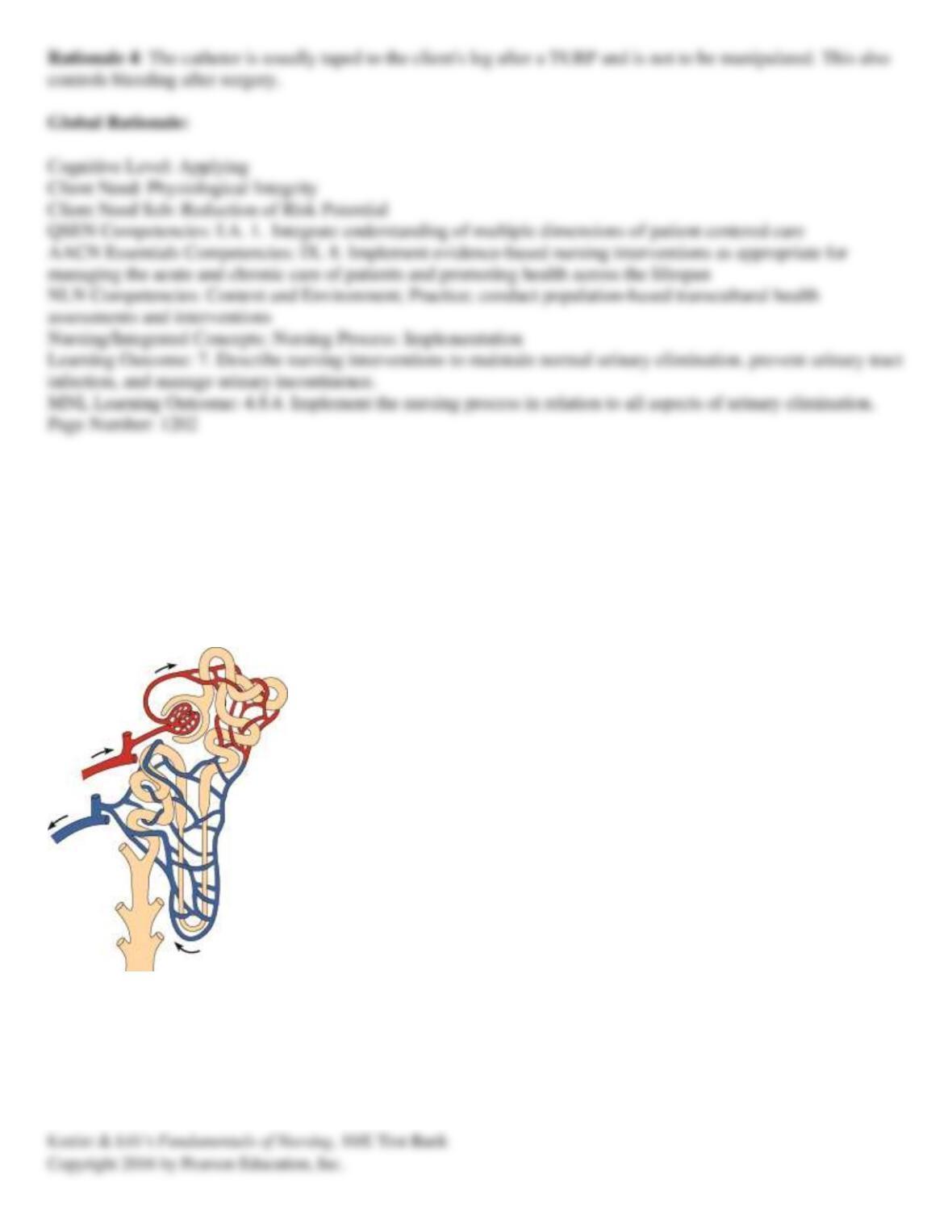
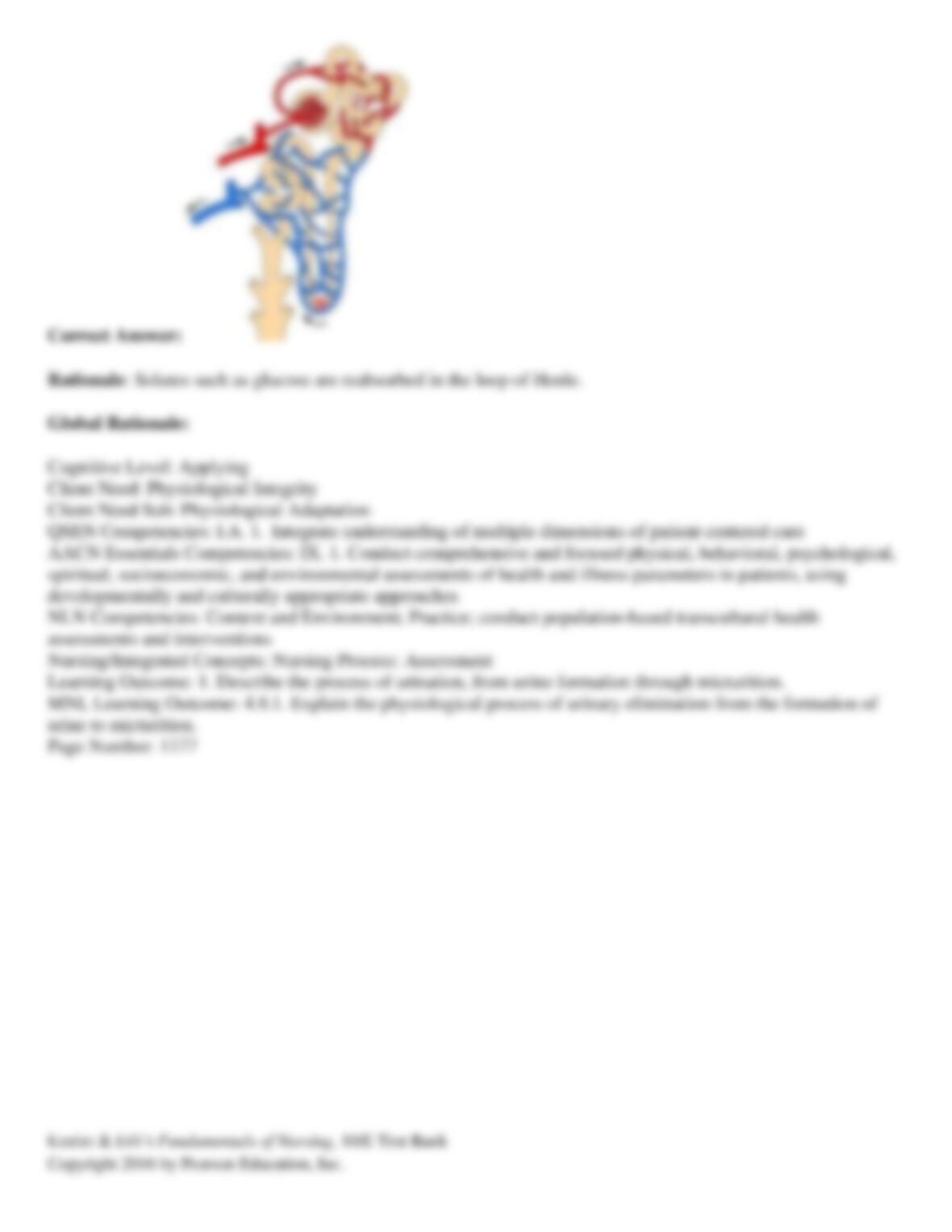
The nurse is reviewing kidney function with a client experiencing renal failure. Identify the area in the nephron
where solutes such as glucose are reabsorbed.
Standard Text: Click on the correct area on the image.
Question 20
Type: MCSA
The nurse is caring for a client with a urinary diversion. For which type of diversion should the nurse plan care for
this client?