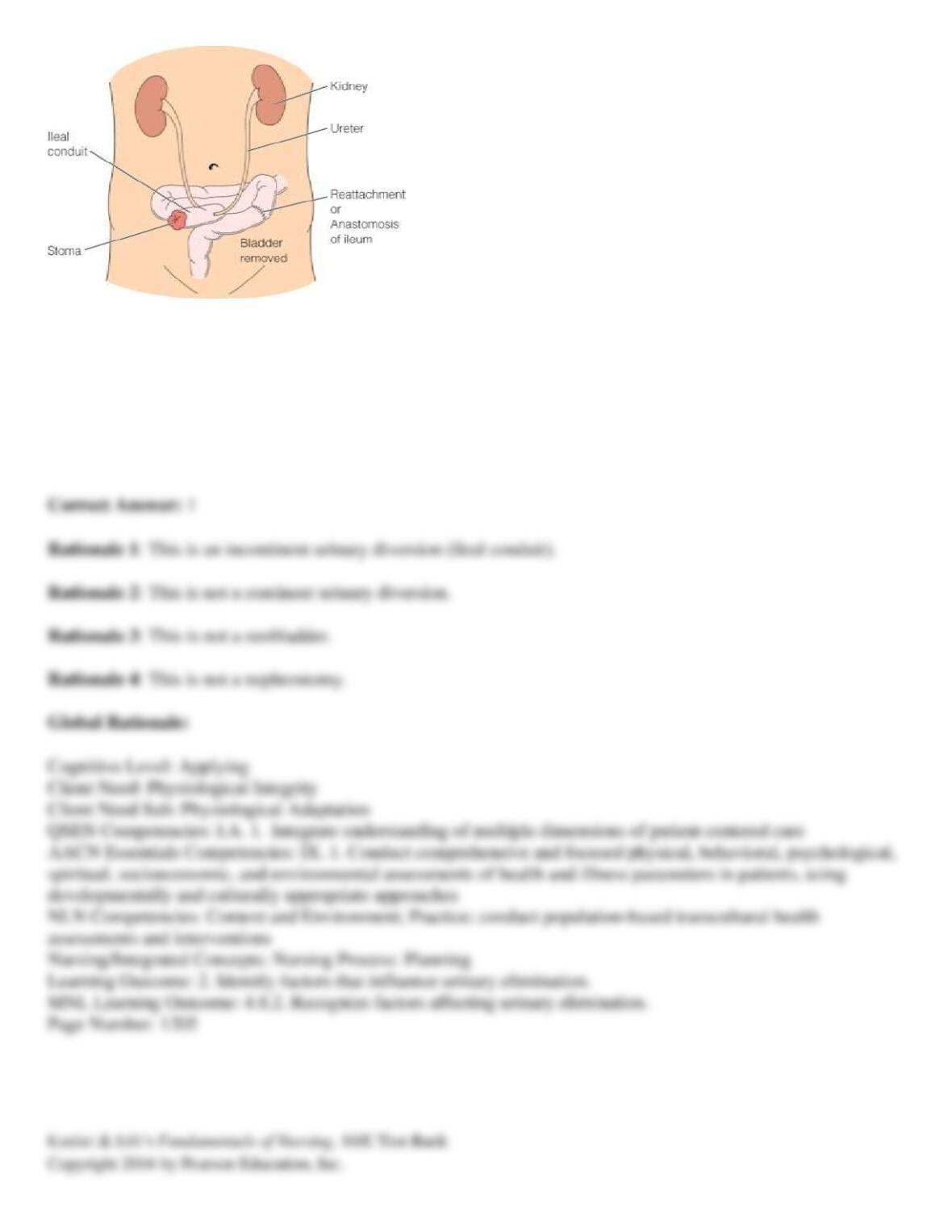
1. Incontinent urinary diversion
2. The kock pouch.
3. Neobladder
4. Nephrostomy
Question 21
Type: MCSA
A client is diagnosed with an elevated aldosterone level. The nurse realizes that this finding will affect what
aspect of urinary elimination?
1. Increased urine output
2. Urinary incontinence
3. Decreased urine output
4. Urinary retention
Question 22
Type: MCSA
A client has a spinal cord injury at the cervical spine area. The nurse realizes that this injury will affect which
aspect of urinary elimination in the client?
1. Elimination of urine from the bladder
2. Ability of the kidneys to absorb solutes
3. Ureteral function
4. Urethra function
Question 23
Type: MCMA
A client is complaining of pain with urination. The nurse realizes that the client needs to be assessed for which
health problems?
Standard Text: Select all that apply.
1. Urethral stricture
2. Renal failure
3. Urethral injury
4. Bladder injury
5. Urinary infection
Question 24
Type: MCMA
A client needs a test to determine the amount of residual urine. The nurse realizes that this assessment is used for
which reason(s)?
Standard Text: Select all that apply.
1. To evaluate the glomerular filtration rate
2. To determine the extent of renal failure
3. To determine the amount of retained urine after voiding
4. To determine the need for medications
5. To evaluate fluid volume status
Question 25
Type: MCMA
A client’s urine pH is 8.0. What further assessments would be indicated for this client?
Standard Text: Select all that apply.
1. Intake of fruits and vegetables
2. Intake of cranberries
3. Intake of high-protein foods
4. Symptoms of diarrhea
5. Symptoms of a urinary tract infection
Question 26
Type: MCMA
The nurse is instructing a client on ways to manage stress urinary incontinence. What should be included in this
client’s teaching?
Standard Text: Select all that apply.
1. Limit intake of caffeine.
2. Limit intake of alcohol.
3. Increase intake of citrus juices.
4. Limit evening fluid intake.
5. Increase intake of beverages with artificial sweeteners.
Question 27
Type: MCSA
The nurse is concerned that a client is at risk for the development of urinary tract infections. What did the nurse
assess to come to this conclusion?
1. The client is wearing tight clothing.
2. The client is employed as a computer operator.
3. The client drinks 8–10 8-ounce glasses of water and low-calorie beverages each day.
4. The client exercises for 30–60 minutes most days of the week.
Question 28
Type: MCSA
The nurse is concerned that an older client with a retention catheter is developing a urinary tract infection. What
assessment finding caused this concern?
1. Elevated blood pressure
2. Elevated heart rate
3. Confusion
4. Leg pain
Question 29
Type: MCSA
The nurse is applying an external urinary device to a client. Before attaching the device to the drainage bag, what
should the nurse do?
1. Wash his or her hands.
2. Document the client’s tolerance of the procedure.
3. Instruct the client about the drainage system.
4. Ensure that the condom is not twisted.
Question 30
Type: MCSA
The nurse is performing urinary catheterization for a client. After using the nondominant hand to separate the
client’s labia for cleansing, the nurse will maintain this hand as being
1. sterile.
2. contaminated.
3. able to evaluate the effectiveness of the catheter balloon.
4. clean.
Question 31
Type: MCSA
The nurse wants to delegate the application of a condom catheter to unlicensed assistive personnel (UAP). What
must the nurse assess prior to delegating this task?
1. Assess whether the client has unique needs.
2. Measure the client’s intake.
3. Assist the client out of bed to a chair.
4. Assess changes in the client’s mobility status.
Question 32
Type: MCSA
The nurse is determining tasks to delegate to unlicensed assistive personnel (UAP). Which task should the nurse
question before delegating to this level of health care provider?
1. Measuring intake and output
2. Assessing vital signs for clients who are clinically stable
3. Performing complete morning care for a client recovering from a stroke
4. Inserting a urinary catheter into a client
Question 33
Type: MCMA
The nurse is documenting the insertion of a retention catheter for a client. What should be included in this
documentation?
Standard Text: Select all that apply.
1. Catheter size
2. Location of the drainage bag
3. Amount of urine that drained after insertion
4. Name of the physician who prescribed the insertion of the catheter
5. Client tolerance of the procedure
Question 34
Type: MCMA
A UAP has applied a condom catheter to a client. The nurse should document what information about this
procedure?
Standard Text: Select all that apply.
1. Number of ml of fluid used to inflate the balloon
2. Location of the drainage bag
3. Name of the UAP who applied the device
4. Time and date that the condom catheter was applied
5. Integrity of the penis
Question 35
Type: MCSA
The nurse has completed closed irrigation of a client’s retention catheter. What specific information should the
nurse document about this procedure?
1. Number of ml of solution used to inflate the balloon of the catheter
2. Abnormal drainage, such as blood clots, pus, or mucous shreds
3. Location of the draining bag
4. Technique used to conduct the irrigation
Question 36
Type: FIB
A client with an indwelling urinary catheter is prescribed to receive sterile normal saline bladder irrigation at 100
mL/hr. After an 8-hour shift the nurse measures the client’s output as being 1425 mL. What is the client’s urine
output for the 8-hour shift?
Standard Text: Calculate to the nearest whole number.
Question 37
Type: MCMA
An older female client with a history of urinary tract infections has an indwelling urinary catheter. What should
the nurse do to reduce this client’s risk of developing an infection because of the catheter?
Standard Text: Select all that apply.
1. Maintain a sterile closed drainage system.
2. Clean the peri-urethral area with antiseptics.
3. Ensure the catheter and tubing are not kinked.
4. Wash his or her hands before manipulating the catheter.
5. Keep the collection bag below the level of the bladder.