Kozier & Erb’s Fundamentals of Nursing, 10/E
Chapter 45
Question 1
Type: MCSA
The mother of a newborn tells the nurse, “I am concerned about my baby. When she first goes to sleep, her eyes
dart around under her eyelids, she doesn’t breathe regularly, and she sometimes twitches.” What advice should the
nurse give this mother?
1. Please bring your baby in immediately for a checkup.
2. These are common behaviors in newborns and are normal.
3. You should ask the physician about these symptoms at your next checkup.
4. If your baby does this again, take her to the emergency department.
Question 2
Type: MCSA
The parents of a 6-month-old tell the nurse that they are exhausted because their baby wakes up several times
every night. What advice should the nurse give these parents?
1. Be certain that the baby is truly awake before picking him up for feeding.
2. Let the baby “cry it out” for a few nights until he can sleep through the night.
3. Continue to respond to the baby whenever he is restless during the night.
4. Bring the baby in for a possible sleep study to check for sleeping disorders.
Question 3
Type: MCSA
The 70-year-old client tells the nurse, “I can go to sleep without a problem, but then I wake up in a couple of
hours and can’t go back to sleep.” What nursing action would help promote rest and sleep in this client?
1. Have the client develop a bedtime ritual of quiet music and a glass of wine.
2. Encourage the client to avoid taking pain medication prior to sleep.
3. Evaluate if the client perceives sleeplessness to be a serious problem.
4. Have the client perform moderate exercises before bedtime.
Question 4
Type: MCSA
A client complains of not being able to stay awake during the day even after sleeping throughout the night. What
should the nurse suggestion to this client?
1. Go to your physician for a physical examination.
2. Go to a mental health professional for evaluation of possible depression.
3. Purchase an over-the-counter sleep aid to deepen nighttime sleep.
4. Drink more caffeinated beverages in the daytime to stay awake.
Question 5
Type: MCSA
The nurse is developing a plan of care for a client diagnosed with narcolepsy. Which intervention should the nurse
include in this plan of care?
1. Encourage the client to take an over-the-counter medication to improve nighttime sleep.
2. Be certain the client has the prescription for modafinil (Provigil) filled.
3. Have the client purchase sodium oxybate (Xyrem) over the counter to prevent daytime drowsiness.
4. Be certain the client obtains antihistamines to control nasal stuffiness.
Question 6
Type: MCSA
The client is being treated with a nasal continuous positive airway pressure device (CPAP) for sleep apnea. What
finding indicates that this treatment has been helpful to the client?
1. The client has lost 7 pounds since treatment began.
2. The client sleeps so soundly that he snores.
3. The client’s diabetes is now under control.
4. The client reports a decrease in morning headache.
Question 7
Type: MCSA
The nurse is admitting a critically ill client to the intensive care unit. What question should the nurse ask
regarding this client’s sleep history?
1. No questions should be asked.
2. “When do you usually go to sleep?”
3. “Do you have any problems with sleeping?”
4. “What are your bedtime rituals?”
Question 8
Type: MCSA
The client who has sleep apnea reports falling asleep while driving, almost being involved in an accident, and
frequent episodes of sleepwalking. What nursing diagnosis should be a priority for this client?
1. Disturbed Sleep Pattern related to difficulty staying asleep
2. Risk for Impaired Gas Exchange related to sleep apnea
3. Disturbed Thought Processes related to chronic insomnia
4. Risk for Injury related to somnambulism
Question 9
Type: MCSA
The nurse is working with a client to develop an expected outcome for the nursing diagnosis Disturbed Sleep
Pattern, difficulty staying asleep related to anxiety secondary to multiple life stressors. Which expected outcome
would be most applicable to this client’s situation?
1. The client will sleep at least 8 hours each night.
2. The client will list three positive coping mechanisms for anxiety relief.
3. The client will report getting sufficient sleep to provide energy for daily activities.
4. The client will manifest less anxiety after taking prescribed medications.
Question 10
Type: MCSA
The nurse is planning interventions for a client who has difficulty falling asleep. Which intervention regarding
sleep times would be most helpful?
1. Maintain a regular bedtime and wake-up time for all days of the week.
2. If bedtime is delayed on one night, go to bed that much earlier the next night.
3. If daytime drowsiness occurs, go to bed earlier that night.
4. Sleep at least 1 hour later on mornings you don’t have to go to work.
Question 11
Type: MCSA
The client reports difficulty sleeping. Which environmental intervention should the nurse recommend?
1. Play soft music throughout the night.
2. Keep a television on in the bedroom.
3. Provide white noise with a fan.
4. Play a talk radio station.
Question 12
Type: MCSA
The client reports difficulty sleeping and awakening several times during the night. What intervention should the
nurse recommend for the client when unable to sleep?
1. Get out of bed, go into another room, and pursue some relaxing activity until drowsy.
2. Get out of bed, go into another room, and exercise until tired before trying to go back to sleep.
3. Sit in bed and watch the bedroom television until drowsy.
4. Stay in bed with eyes closed and do some mental arithmetic until sleepy.
Question 13
Type: MCSA
The hospitalized client requests a bedtime snack. Which food should the nurse offer this client?
1. Hot chocolate
2. Tea and crackers
3. Cereal with milk
4. Chips and salsa
Question 14
Type: MCSA
The client has been prescribed zolpidem (Ambien) for the short-term management of insomnia. What information
should the nurse include when teaching the client about this medication?
1. For best results, take the medication just prior to bedtime.
2. Take the medication at dinnertime to avoid gastric upset.
3. Do not take the medication with any liquid that contains calcium.
4. Drink an entire glass of water with the dose to avoid kidney stones.
Question 15
Type: MCSA
The client who has obstructive sleep apnea is being treated with a nasal continuous positive airway pressure
(CPAP) device, but has just been prescribed modafinil (Provigil). What client statement indicates that teaching
about these therapies has been effective?
1. “I am so glad that I won’t have to sleep in this machine anymore.”
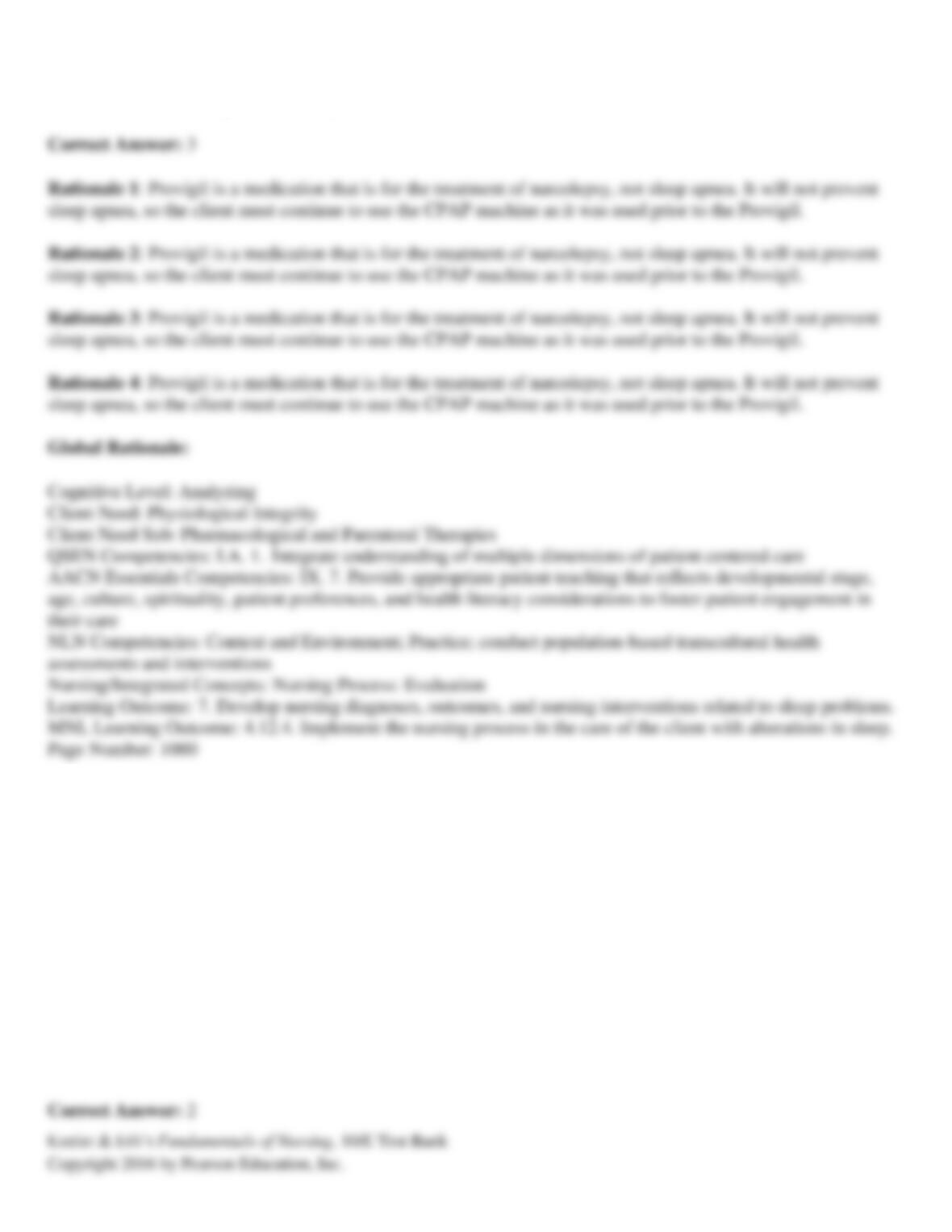
3. “I will continue using my CPAP machine at night.”
4. “I can turn down the pressure on my CPAP machine in about 1 week.”
Question 16
Type: MCSA
A client questions why a medication that is used to treat Parkinson’s disease has been prescribed for the diagnosis
of periodic limb movement disorder (PLMD). What should the nurse do?
1. Contact the physician.
2. Assure the client that medications used to treat Parkinson’s disease are also used to treat PLMD.
3. Tell the client not to take the medication because there is most likely an error.
4. Check with the pharmacy to make sure the correct medication has been provided to the client
Question 17
Type: MCSA
The client has complained of stiffness and muscle tension in his back. The nurse suggests a back rub, but the
client declines the offer. What action should the nurse take?
1. Encourage the client to accept the back rub, saying how much it will relax the back muscles.
2. Document that the client is noncompliant with the nursing plan of care.
3. Accept the declination but tell the client to call if he changes his mind.
4. Instruct the UAP to rub the client’s back while assisting him to change into a clean gown.
Question 18
Type: MCSA
A 5-year-old client has recurrent night terrors. What nursing intervention should the nurse use to help alleviate
this problem?
1. Have the child walk around in the room when night terrors occur.
2. The next morning, ask the child to describe the event.
3. Have the child empty the bladder prior to going to bed.
4. Use an additional pillow behind the child’s head at night.