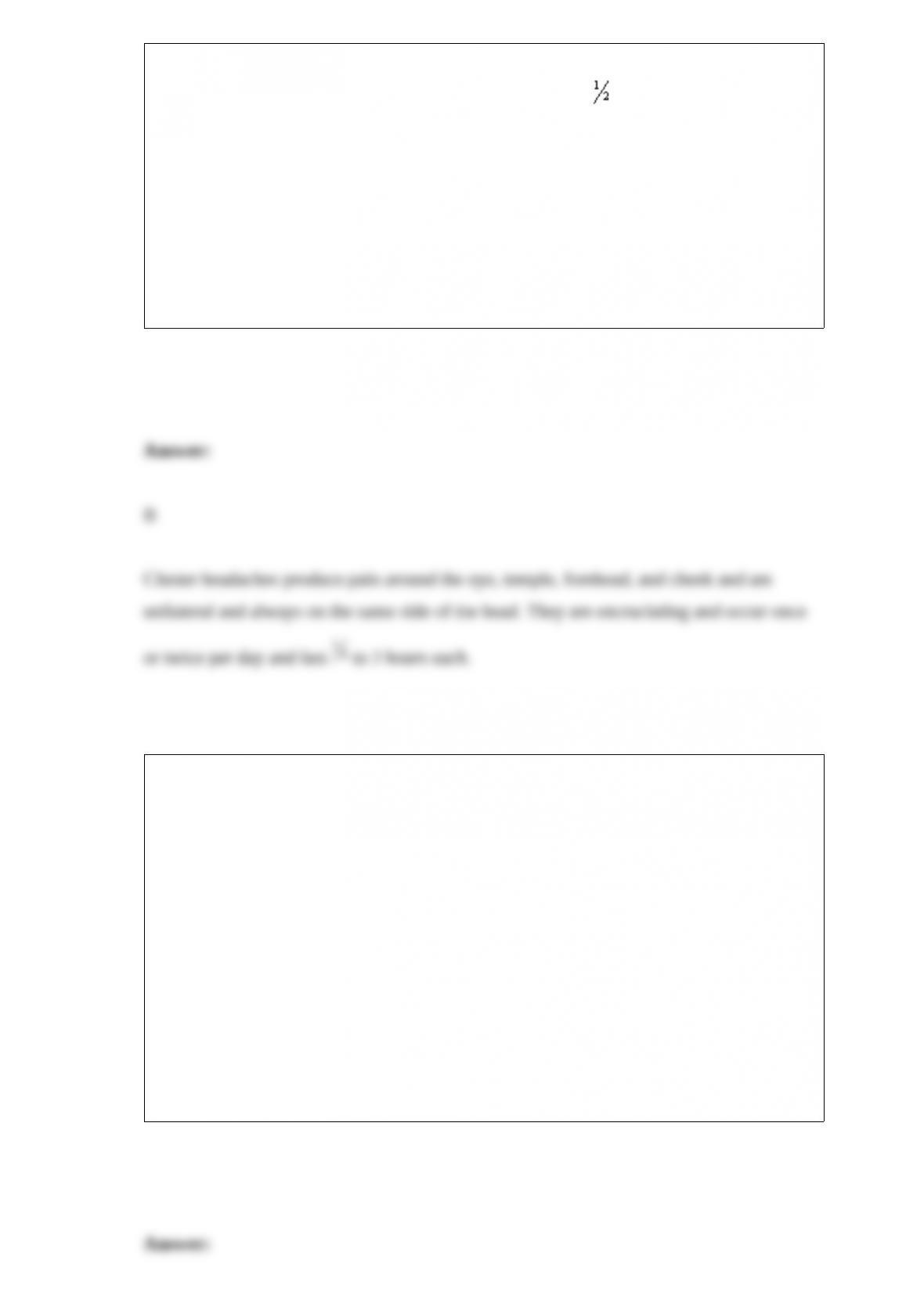
A patient reports excruciating headache pain on one side of his head, especially around
his eye, forehead, and cheek that has lasted approximately to 2 hours, occurring once
or twice each day. The nurse should suspect:
a. Hypertension.
b. Cluster headaches.
c. Tension headaches.
d. Migraine headaches.
A 40-year-old woman reports a change in mole size, accompanied by color changes,
itching, burning, and bleeding over the past month. She has a dark complexion and has
no family history of skin cancer, but she has had many blistering sunburns in the past.
The nurse would:
a. Tell the patient to watch the lesion and report back in 2 months.
b. Refer the patient because of the suggestion of melanoma on the basis of her
symptoms.
c. Ask additional questions regarding environmental irritants that may have caused this
condition.
d. Tell the patient that these signs suggest a compound nevus, which is very common in
young to middle-aged adults.
During the physical examination, the nurse notices that a female patient has an inverted
left nipple. Which statement regarding this is most accurate?
a. Normal nipple inversion is usually bilateral.
b. Unilateral inversion of a nipple is always a serious sign.
c. Whether the inversion is a recent change should be determined.
d. Nipple inversion is not significant unless accompanied by an underlying palpable
mass.
During auscultation of breath sounds, the nurse should correctly use the stethoscope in
which of the following ways?
a. Listening to at least one full respiration in each location
b. Listening as the patient inhales and then going to the next site during exhalation
c. Instructing the patient to breathe in and out rapidly while listening to the breath
sounds
d. If the patient is modest, listening to sounds over his or her clothing or hospital gown
The nurse is preparing to examine a 6-year-old child. Which action is most appropriate?
a. The thorax, abdomen, and genitalia are examined before the head.
b. Talking about the equipment being used is avoided because doing so may increase
the child’s anxiety.
c. The nurse should keep in mind that a child at this age will have a sense of modesty.
d. The child is asked to undress from the waist up.

The nurse is assessing a patient who has liver disease for jaundice. Which of these
assessment findings is indicative of true jaundice?
a. Yellow patches in the outer sclera
b. Yellow color of the sclera that extends up to the iris
c. Skin that appears yellow when examined under low light
d. Yellow deposits on the palms and soles of the feet where jaundice first appears
The nurse is teaching a class on basic assessment skills. Which of these statements is
true regarding the stethoscope and its use?
a. Slope of the earpieces should point posteriorly (toward the occiput).
b. Although the stethoscope does not magnify sound, it does block out extraneous room
noise.
c. Fit and quality of the stethoscope are not as important as its ability to magnify sound.
d. Ideal tubing length should be 22 inches to dampen the distortion of sound.

During morning rounds, the nurse asks a patient, “How are you today?” The patient
responds, “You today, you today, you today!” and mumbles the words. This speech
pattern is an example of:
a. Echolalia
b. Clanging
c. Word salad
d. Perseveration
A 21-year-old woman has been on a low-protein liquid diet for the past 2 months. She
has had adequate intake of calories and appears well nourished. After further
assessment, what would the nurse expect to find?
a. Poor skin turgor
b. Decreased serum albumin
c. Increased lymphocyte count
d. Triceps skinfold less than standard
A 60-year-old male patient has been treated for pneumonia for the past 6 weeks. He is
seen today in the clinic for an “unexplained” weight loss of 10 pounds over the last 6
weeks. The nurse knows that:
a. Weight loss is probably the result of unhealthy eating habits.
b. Chronic diseases such as hypertension cause weight loss.
c. Unexplained weight loss often accompanies short-term illnesses.
d. Weight loss is probably the result of a mental health dysfunction.
The nurse is reviewing the principles of pain. Which type of pain is due to an abnormal
processing of the pain impulse through the peripheral or central nervous system?
a. Visceral
b. Referred
c. Cutaneous
d. Neuropathic
A nurse is taking complete health histories on all of the patients attending a wellness
workshop. On the history form, one of the written questions asks, “You don”t smoke,
drink, or take drugs, do you?” This question is an example of:
a. Talking too much.
b. Using confrontation.
c. Using biased or leading questions.
d. Using blunt language to deal with distasteful topics.

A patient has hypoactive bowel sounds. The nurse knows that a potential cause of
hypoactive bowel sounds is:
a. Diarrhea.
b. Peritonitis.
c. Laxative use.
d. Gastroenteritis.
A patient will be ready to be discharged from the hospital soon, and the patient’s family
members are concerned about whether the patient is able to walk safely outside alone.
The nurse will perform which test to assess this?
a. Get Up and Go Test
b. Performance ADLs
c. Physical Performance Test
d. Tinetti Gait and Balance Evaluation
The electrical stimulus of the cardiac cycle follows which sequence?
a. AV node SA node bundle of His
b. Bundle of His AV node SA node
c. SA node AV node bundle of His bundle branches
d. AV node SA node bundle of His bundle branches
A 90-year-old patient tells the nurse that he cannot remember the names of the
medications he is taking or for what reason he is taking them. An appropriate response
from the nurse would be:
a. “Can you tell me what they look like?”
b. “Don”t worry about it. You are only taking two medications.”
c. “How long have you been taking each of the pills?”
d. “Would you have a family member bring in your medications?”
The nurse is preparing to measure the vital signs of a 6-month-old infant. Which action
by the nurse is correct?
a. Respirations are measured; then pulse and temperature.
b. Vital signs should be measured more frequently than in an adult.
c. Procedures are explained to the parent, and the infant is encouraged to handle the
equipment.
d. The nurse should first perform the physical examination to allow the infant to
become more familiar with her and then measure the infant’s vital signs.
The nurse is examining a patient’s lower leg and notices a draining ulceration. Which of
these actions is most appropriate in this situation?
a. Washing hands, and contacting the physician
b. Continuing to examine the ulceration, and then washing hands
c. Washing hands, putting on gloves, and continuing with the examination of the
ulceration
d. Washing hands, proceeding with rest of the physical examination, and then
continuing with the examination of the leg ulceration
The nurse is helping another nurse to take a blood pressure reading on a patient’s thigh.
Which action is correct regarding thigh pressure?
a. Either the popliteal or femoral vessels should be auscultated to obtain a thigh
pressure.
b. The best position to measure thigh pressure is the supine position with the knee
slightly bent.
c. If the blood pressure in the arm is high in an adolescent, then it should be compared
with the thigh pressure.
d. The thigh pressure is lower than the pressure in the arm, which is attributable to the
distance away from the heart and the size of the popliteal vessels.
A patient’s uvula raises midline when she says “ahh,” and she has a positive gag reflex.
The nurse has just tested which cranial nerves?
a. IX and X
b. IX and XII
c. X and XII
d. XI and XII
The nurse is reviewing statistics for lactose intolerance. In the United States, the
incidence of lactose intolerance is higher in adults of which ethnic group?
a. Blacks
b. Hispanics
c. Whites
d. Asians
When considering priority setting of problems, the nurse keeps in mind that
second-level priority problems include which of these aspects?
a. Low self-esteem
b. Lack of knowledge
c. Abnormal laboratory values
d. Severely abnormal vital signs

The nurse is performing a nutritional assessment on an 80-year-old patient. The nurse
knows that physiologic changes can directly affect the nutritional status of the older
adult and include:
a. Slowed gastrointestinal motility.
b. Hyperstimulation of the salivary glands.
c. Increased sensitivity to spicy and aromatic foods.
d. Decreased gastrointestinal absorption causing esophageal reflux.
The nurse is assessing children in a pediatric clinic. Which statement is true regarding
the measurement of blood pressure in children?
a. Blood pressure guidelines for children are based on age.
b. Phase II Korotkoff sounds are the best indicator of systolic blood pressure in
children.
c. Using a Doppler device is recommended for accurate blood pressure measurements
until adolescence.
d. The disappearance of phase V Korotkoff sounds can be used for the diastolic reading
in children.
The nurse is reviewing percussion techniques with a newly graduated nurse. Which
technique, if used by the new nurse, indicates that more review is needed?
a. Percussing once over each area
b. Quickly lifting the striking finger after each stroke
c. Striking with the fingertip, not the finger pad
d. Using the wrist to make the strikes, not the arm
The nurse suspects that a patient has otitis media. Early signs of otitis media include
which of these findings of the tympanic membrane?
a. Red and bulging
b. Hypomobility
c. Retraction with landmarks clearly visible
d. Flat, slightly pulled in at the center, and moves with insufflation
The nurse knows that one advantage of the tympanic membrane thermometer (TMT) is
that:
a. Rapid measurement is useful for uncooperative younger children.
b. Using the TMT is the most accurate method for measuring body temperature in
newborn infants.
c. Measuring temperature using the TMT is inexpensive.
d. Studies strongly support the use of the TMT in children under the age 6 years.
During an assessment of a healthy adult, where would the nurse expect to palpate the
apical impulse?
a. Third left intercostal space at the midclavicular line
b. Fourth left intercostal space at the sternal border
c. Fourth left intercostal space at the anterior axillary line
d. Fifth left intercostal space at the midclavicular line
The nurse notices that a woman in an exercise class is unable to jump rope. The nurse is
aware that to jump rope, one’s shoulder has to be capable of:
a. Inversion.
b. Supination.
c. Protraction.
d. Circumduction.
A 25-year-old woman is in the clinic for her first prenatal visit. The nurse will prepare
to obtain which laboratory screening test at this time?
a. Urine toxicology
b. Complete blood cell count
c. Alpha-fetoprotein
d. Carrier screening for cystic fibrosis
The nurse is examining a patient’s ears and notices cerumen in the external canal.
Which of these statements about cerumen is correct?
a. Sticky honey-colored cerumen is a sign of infection.
b. The presence of cerumen is indicative of poor hygiene.
c. The purpose of cerumen is to protect and lubricate the ear.
d. Cerumen is necessary for transmitting sound through the auditory canal.
In performing an assessment on a 49-year-old woman who has imbalanced nutrition as
a result of dysphagia, which data would the nurse expect to find?
a. Increase in hair growth
b. Inadequate nutrient food intake
c. Weight 10% to 20% over ideal
d. Sore, inflamed buccal cavity
While recording in a patient’s medical record, the nurse notices that a patient’s Hematest
results are positive. This finding means that there is(are):
a. Crystals in his urine.
b. Parasites in his stool.
c. Occult blood in his stool.
d. Bacteria in his sputum.
The nurse is using the danger assessment (DA) tool to evaluate the risk of homicide.
Which of these statements best describes its use?
a. The DA tool is to be administered by law enforcement personnel.
b. The DA tool should be used in every assessment of suspected abuse.
c. The number of “yes” answers indicates the woman’s understanding of her situation.
d. The higher the number of “yes” answers, the more serious the danger of the woman’s
situation.