
CHAPTER 9 – IMPLEMENTING DISASTER RECOVERY PLANS
TRUE/FALSE
1. The implementation plan requires training for all employees.
2. The deployment of new equipment requires action at the organization level.
3. The Human Resources department takes the lead in processing all the bids and paperwork to acquire
new equipment needed to implement the plan or disaster mitigation steps.
4. The disaster recovery coordinator should compile a monthly report of all accomplishments and any
activities that are ahead of schedule.
5. Organizations should rely on just one method to make documents available to response teams.
6. Backing up computer files is a common approach to avoiding the consequences of system failure or
disk crashes.
7. Only the most important mitigation steps need to have sound economic value.
8. Determining what kind of data back-up systems an organization should use is more difficult than
analyzing the benefits of a UPS.
9. The planning team should use ROI analyses to evaluate mitigation steps that make economic sense.
10. During training, employees should learn the details of the plan and learn their roles and responsibilities
during disaster response.
MODIFIED TRUE/FALSE

1. The goal of the disaster recovery program is to indoctrinate employees about the importance of
disaster response and recovery. _________________________
2. The Disaster recovery planning team should develop a series of announcements that department
managers and supervisors can use in their meetings. _________________________
3. Trainers can use feedback from the evaluation forms to modify content and presentation styles as
training progresses. _________________________
4. All training course attendees should be required to complete a course completion form.
_________________________
5. The training modules should last about one hour. _________________________
6. Training modules designed for executives should be loosely structured, and should include only as
much detail as necessary to explain what is expected of them during a disaster.
_________________________
7. Disaster recovery training for supervisors needs to cover the same topics as that for executives.
_________________________
8. Training specific response teams is the most complicated aspect of disaster response and recovery
training. _________________________
9. All response team members should attend disaster recovery training for middle managers as well as
specialized training designed for their team. _________________________

10. All employees should be required to attend training that is appropriate for their management level and
participation on response teams. _________________________
MULTIPLE CHOICE
1. Who is responsible for directing plan implementation activities?
a.
Disaster recovery planning coordinator
c.
Purchasing manager
b.
Staff in affected departments
d.
Public Relations
2. Who is responsible for the implementation activity of changing existing procedures?
a.
Functional department managers
c.
Disaster recovery coordinator
b.
Staff in affected departments
d.
Disaster recovery teams
3. Staff in affected departments are responsible for which implementation activities?
a.
Changing existing procedures
d.
Both a and b
b.
Purchasing equipment
e.
Both a and c
c.
Deploying equipment
4. Who is responsible for the implementation activity of establishing liaisons?
a.
Disaster recovery coordinator
d.
Both a and b
b.
Functional department managers
e.
a, b, and c
c.
Public Relations
5. Who is responsible for the implementation activity of purchasing equipment?
a.
Staff in affected departments
d.
Both a and b
b.
Purchasing manager
e.
a, b, and c
c.
Public Relations
6. Who is responsible for the implementation activity of raising awareness?
a.
Disaster recovery coordinator
c.
Public Relations
b.
Functional department managers
d.
All of the above
7. For which implementation activities are the purchasing manager along and the disaster recovery team
and functional departments responsible?
a.
Purchasing equipment
d.
Both a and b
b.
Contracting for services
e.
Both b and c
c.
Directing plan activity

8. Who is responsible for managing documentation for the disaster recovery plan?
a.
Disaster recovery coordinator and the Public Relations department
b.
Disaster recovery coordinator
c.
Human Resources department and disaster recovery staff
d.
Product managers and business unit managers
9. Who is responsible for developing awareness material for the disaster recovery plan?
a.
Disaster recovery coordinator
d.
Both a and b
b.
Public Relations
e.
a, b, and c
c.
Disaster recovery staff
10. Who is responsible for creating a training program for the disaster recovery plan?
a.
Human Resources department and the disaster recovery staff
b.
Disaster recovery coordinator
c.
Product managers and business unit managers
d.
None of the above
11. Who is responsible for briefing business partners for the disaster recovery plan?
a.
Public Relations
d.
Both a and b
b.
Product managers
e.
Both a and c
c.
Business unit managers
12. What implementation task are the responsibility of managers who work in areas affected by specific
laws?
a.
Developing awareness materials
c.
Creating training programs
b.
Briefing business partners
d.
Working with regulatory agencies
13. Which distribution method for documentation has the advantage of ease of deployment and low costs?
a.
CD–ROM
c.
Hosted Web Server
b.
Intranet
d.
Paper copies
14. Which distribution method for documentation has the advantage of not relying on computer
availability?
a.
CD–ROM
c.
Intranet
b.
Paper copies
d.
Hosted Web server
15. Which distribution method for documentation has a disadvantage when remote connectivity is lost?
a.
Hosted Web server
d.
Both a and b
b.
Intranet
e.
a, b, and c
c.
CD–ROM

16. Who would be the target audience of the “Overview of Disaster Recovery Plan” training module?
a.
Executives, middle managers
b.
Executives, middle managers, and all employees
c.
Executives, middle managers, supervisors, and all employees
d.
Executives, middle managers, and supervisors
17. Who would be the target audience of the “Procedures for Working with Emergency Services and Law
Enforcement Agencies” training module?
a.
Executives, middle managers, supervisors, and all employees
b.
Executives, middle managers
c.
Executives, middle managers, and all employees
d.
Executives, middle managers, and supervisors
18. Who would be the target audience of the “Internal and Wxternal Communication Procedures” training
module?
a.
Executives, middle managers, supervisors, and all employees
b.
Executives, middle managers, and supervisors
c.
Executives, middle managers, and all employees
d.
Executives, middle managers
19. Who would be the target audience of the “Disaster Classification and Procedures for Direction,
Control, and Administration” training module?
a.
Executives, middle managers, and supervisors
b.
Executives, middle managers, and all employees
c.
Executives, middle managers, supervisors, and all employees
d.
Executives, middle managers
20. In which specialized training module would “facility evacuation” be included?
a.
Safety and health procedures
b.
Containment and property protection procedures
c.
Resuming and recovering operations
d.
Restoring facilities and normalizing operations
21. In which specialized training module would “shutting off utilities” be included?
a.
Safety and health procedures
b.
Containment and property protection procedures
c.
Resuming and recovering operations
d.
Restoring facilities and normalizing operations
22. In which specialized training module would “determining the duration of shutdowns” be included?
a.
Safety and health procedures
b.
Containment and property protection procedures

c.
Resuming and recovering operations
d.
Restoring facilities and normalizing operations
23. In which specialized training module would “temporary repairs” be included?
a.
Safety and health procedures
b.
Containment and property protection procedures
c.
Resuming and recovering operations
d.
Restoring facilities and normalizing operations
24. In which specialized training module would “crisis counseling” be included?
a.
Safety and health procedures
b.
Containment and property protection procedures
c.
Resuming and recovering operations
d.
Restoring facilities and normalizing operations
25. In which specialized training module would “securing and retrieving assets” be included?
a.
Safety and health procedures
b.
Containment and property protection procedures
c.
Resuming and recovering operations
d.
Restoring facilities and normalizing operations
26. In which specialized training module would “activating hot and cold sites” be included?
a.
Safety and health procedures
b.
Containment and property protection procedures
c.
Resuming and recovering operations
d.
Restoring facilities and normalizing operations
27. In which specialized training module would “reoccupation of facilities” be included?
a.
Safety and health procedures
b.
Containment and property protection procedures
c.
Resuming and recovering operations
d.
Restoring facilities and normalizing operations
28. In what format should the “Presentation by trainer” module be?
a.
Stand-up presentation and PowerPoint
b.
PowerPoint
c.
Stand-up presentation printed handouts
d.
Printed handouts
29. In what format should the “Relevant sections of the disaster recovery plan” be?
a.
Workbook format
b.
Workbook format or printed handouts
c.
Printed handouts
d.
PowerPoint
30. Who is the target audience for the “Working with insurance companies” training module for special
procedures?
a.
Executives and selected response teams
b.
Supervisors and selected response teams
c.
Selected response teams
d.
Middle managers and selected response teams
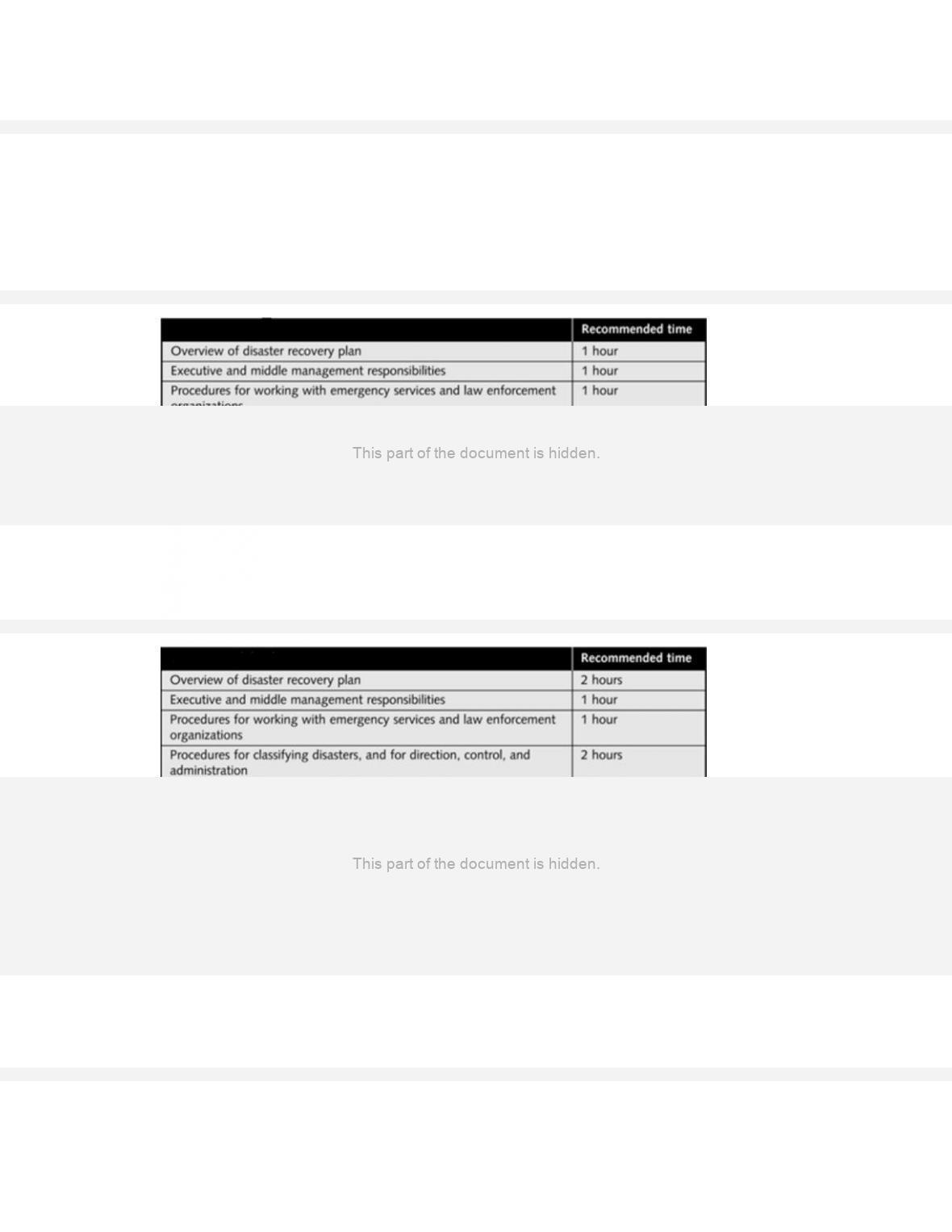
31. At whom is the training in the table above targeted?
a.
Executives
c.
Supervisors
b.
Middle managers
d.
Specific response teams
32. At whom is the training in the table above targeted?
a.
Executives
c.
Supervisors
b.
Middle managers
d.
Selected response teams

33. At whom is the training in the table above targeted?
a.
Executives
c.
Supervisors
b.
Middle Managers
d.
Selected response teams
YES/NO
1. Will an organization be thrown into chaos if employees know how to respond with recovery efforts?
2. Proper training helps to ensure a synchronized and integrated recovery.
3. Do all implementation activities require organization-wide action?
4. The disaster recovery planning coordinator and middle managers assign responsibilities for
implementing the plan.
5. Do managers of functional departments and business units need to assign disaster recovery planning
activities to their employees?
6. Do all members of the planning team need to be involved in day-to–day tasks such as developing
awareness material or conducting training?
7. The planning team can modify the schedule if conditions warrant.
8. The loss of productivity is easier to determine than an ROI.

9. An economic way of increasing awareness about disaster recovery is to use existing corporate
communications.
COMPLETION
1. The disaster recovery coordinator, in conjunction with the Human Resources or Public Relations
departments, should develop a series of ____________________ that department managers and
supervisors can use in their meetings.
2. A disaster recovery ____________________ plan is an essential element of being prepared for a
disaster.
3. Most of the material required to develop a training program should already be included in the
____________________ plan.
4. If trainers use ____________________ to hold their training material, they should use tabs to separate
materials for each session.
5. Training modules for specific ____________________ teams should provide in-depth coverage of
procedures so that team members fully understand their responsibilities in a disaster.
6. The ____________________ takes the lead role in monitoring and evaluating the progress of
implementation.

7. During the ____________________ and risk assessments, the disaster recovery planning team
collected information about how to mitigate and avoid business disruptions.
8. Using a(n) ____________________ to protect servers from sudden power outages can be a
cost-effective mitigation step.
MATCHING
Match the following activities to the proper organizational level.
a.
Training, raising awareness of the plan
b.
Equipment purchase and deployment
c.
Changing procedures and implementing new procedures that affect specific departments
d.
Changing procedures and implementing new procedures that affect specific work groups
1. Department
2. Organization-wide
3. Facility
4. Work-group
Match the following terms to the appropriate definition.
a.
Disaster recovery plan documents
b.
Implementation plan
c.
Implementation schedule
d.
Mitigation steps
5. Used for completing each required activity in the disaster recovery plan
6. Used for implementing all the activities in the disaster recovery plan
7. Used to reduce the impact of system failure or disruption of operations
8. Written analyses that contractors should follow when responding to a disaster
SHORT ANSWER
1. What events occur during disaster recovery planning implementation. (List four)

ANS:
2. Managers of functional departments and business units need to assign activities to their employees.
What do these activities include?
3. With whom do organizations need to establish liaisons?
ANS:
4. In an organization, who needs to work to establish liaisons, as well as maintain the relationships over
the long term? (List three)
ANS:
5. What methods can organizations use to make documents available to response teams?
ANS:
6. What questions should be addressed before selecting a back-up system?

ANS:
7. What are the typical forms of communication within an organization?
ANS:
8. What series of announcements should be developed by the Public Relations department that
department managers and supervisors can use in their meetings?
ANS:
9. What materials should be included in bulletins and announcements to both customers and business
partners?
ANS:
10. What types of special training modules need to be developed?
ANS: