
CHAPTER 6 – ORGANIZATIONAL RELATIONSHIPS IN DISASTER RECOVERY
TRUE/FALSE
1. The disaster recovery planning team needs to develop lists and procedures for establishing
communication.
2. Most organizations have all the skills and equipment to respond to events that create extensive
damage.
3. The disaster response team needs to contract contractors while the disaster is taking place.
4. Most organization can survive a fairly long time without access to computer systems.
5. The basic hot-site service is usually a replicated environment in a data center.
6. Computer and system recovery can run smoothly when procedures are well written and the IT staff is
trained in disaster response.
7. The primary goal of stockholder and investor relations during a disaster is maintaining communication
channels.
8. Honest answers help to build confidence in management and disaster response efforts.
9. People skills is one of the best qualifications a crisis councilor can have.
10. A disaster can create concerns about the future of a local business community.
MODIFIED TRUE/FALSE
1. Disaster response information sheets can be useful for evaluating the response of service
organizations. _________________________
2. An organization works with several remote agencies during disaster response and recovery.
_________________________
3. The need for emergency service varies based on the disaster. _________________________
4. Having a knowledgeable manager who can meet responders, answer questions, and provide assistance
can save valuable time. _________________________
5. Disaster recovery often requires working with private corporations to temporarily cut off services for
safety reasons and then to restore them for normal operations. _________________________
6. Power utilities battle broken water mains on a regular basis. _________________________
7. Electric utilities are continually faced with downed power lines. _________________________
8. The insurance and damage assessment team assembles information to provide to insurance carriers.
_________________________
9. The speed with which an organization initiates insurance claims makes a large difference in its ability
to recover from a disaster. _________________________
10. An organization works with many types of private service companies and equipment vendors during
disaster response and recovery. _________________________
MULTIPLE CHOICE
1. Which of the following groups may be affected by a disaster?
a.
Customers
d.
Surrounding community
b.
Employees
e.
All of the above
c.
Employees families
2. Which of the following are agencies that can assist with the recovery effort?
a.
Law enforcement
d.
Suppliers
b.
Emergency services
e.
All of the above
c.
Contractors
3. Which classification(s) of disasters will involve the cooperation of many organizations and groups?
a.
Severe
d.
Both a and b
b.
Catastrophic
e.
Both b and c
c.
Major
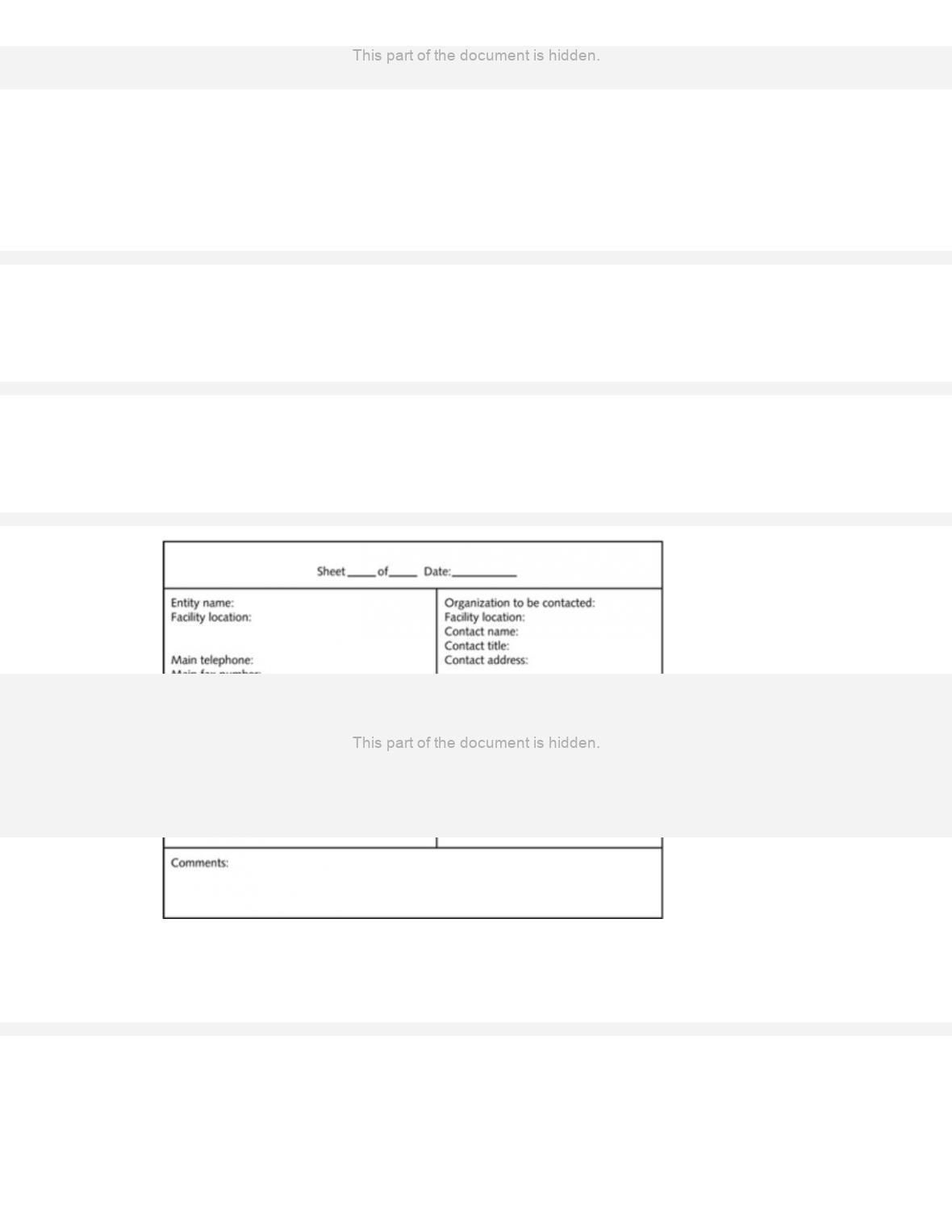
4. What type of disaster response sheet is displayed in the table above?
a.
Risk assessment
c.
Facilities inventory
b.
Contact sheet
d.
Personnel inventory
5. Where is the best place to maintain the contact sheet?
a.
On paper
d.
Both a and c
b.
Database
e.
Both b and c

c.
Web site
6. When a disaster occurs that involves physical damage or destruction, with whom should the first
contact be made?
a.
Law enforcement
c.
Insurance companies
b.
Public utilities
d.
Disaster recovery service providers
7. Which of the following is NOT an emergency response organization?
a.
Ambulance and emergency medical services
b.
Hazardous material response teams
c.
Regulatory control agencies
d.
Vehicle removal and debris removal services
8. Which emergency response organization should be involved when there is the possibility of physical
injury and death?
a.
Ambulance and emergency medical services
b.
Regional and local disaster agencies
c.
Building maintenance and construction contractors
d.
Vehicle removal and debris removal services
9. Which of the following is NOT on the checklist for emergency service contact procedures?
a.
Conditions that require emergency services to be contacted
b.
A list of people that know the layout of the facility
c.
Instructions that emergency service responders need before entering the building
d.
Items that should be available upon arrival
10. Which public utility usually deals with blown transformers?
a.
Water
c.
Road and highway maintenance
b.
Electric
d.
Recycling
11. Broken water mains are usually dealt with by which public utility?
a.
Gas
c.
Flood control
b.
Water
d.
Environmental protection
12. Which of the following is NOT on the checklist for working with public utilities and departments?
a.
Items that should be available upon arrival
b.
Contact information and locations of public utilities departments
c.
Blueprints that show public utility hookups
d.
A list of people who know the layout of the facility

13. Who should be contacted once disaster response begins and dangerous circumstances have been
addressed?
a.
Environmental protection services
b.
Building maintenance and construction contractors
c.
Insurance companies
d.
Regional and local disaster agencies
14. With regards to insurance claims, what makes the biggest difference in the organization’s ability to
recover from a disaster?
a.
Money
c.
Speed
b.
Coverage
d.
Location
15. Which of the following is NOT required on a checklist for insurance company contact procedures?
a.
Contact information and locations of insurance providers
b.
Current insurance policy numbers
c.
How to develop initial and comprehensive insurance claims
d.
Location of building contents prior to the disaster
16. Which of the following is an example of a private service company or equipment vendor?
a.
Software companies
c.
Business partners
b.
Stakeholders
d.
Regional disaster agencies
17. Which of the following are examples of disaster recovery service providers?
a.
Heating and air conditioning contractors
b.
Water removal specialists
c.
Records restoration specialists
d.
All of the above
18. Which of the following is NOT a type of telecommunication system that could be affected by a
disaster?
a.
Voice services
b.
Toll-free customer service lines
c.
Enterprise systems that support business operations
d.
Data communications lines
19. Which of the following is NOT a type of computer system that could be affected by a disaster?
a.
Enterprise systems that support business operations
b.
Servers that support supply-chain applications
c.
Web servers that support e-commerce applications
d.
Access for remote workers, field staff, and regional offices
20. Which of the following computer systems could be affected by a disaster?

a.
Enterprise systems that support business operations
b.
Workstations used in research and development
c.
Web servers that support e-commerce applications
d.
All of the above
21. Some computer systems might be supported by IT service providers or set up for restoration through
a(n) ____ site, which provides replicated computing environments.
a.
host
c.
hot
b.
image
d.
fail-safe
22. Which of the following is NOT included on the IT service recovery checklist?
a.
A prioritized list of computers and systems to be restored
b.
How to access emergency funds to pay for emergency IT services
c.
How facilities should be identified for IT service recovery providers
d.
Serial numbers for all IT equipment
23. Which of the following is included in a checklist for media relations procedures?
a.
How to establish a media area at the emergency operations center
b.
How to establish a media area at affected facilities
c.
Preparation of media statements for distribution
d.
All of the above
YES/NO
1. Should department managers and supervisors attempt to provide counseling themselves?
2. Is it possible that an organization may need to accomplish hundreds of tasks to thoroughly recover
from a disaster?
3. The planning team develops disaster recovery procedures to restore the facilities accordingly before
prioritizing facility restoration needs.
4. The priorities set by the disaster recovery planning team dictate which communications systems are
most important to the organization’s key business processes.
5. The IT and systems recovery planning team decides which computer systems are most critical to
support business operations.
6. Organizations must also develop strategies for contacting and working with the many suppliers and
service providers that make business operations possible.
7. Service providers include organizations that provide raw materials that support business operations.
8. Service providers include assembly contractors and testing contractors.
9. Disaster recovery procedures can help to reduce problems caused by suppliers who keep shipping
material or service providers who show up to do work after a disaster.
10. A disaster can adversely affect customer operations when shipments are delayed.
COMPLETION
1. A disaster often results in extensive ____________________ coverage.
2. The official ____________________ should have a background in working with the media; such
employees often work in the Public Relations department.
3. Before top executives make statements to the media, they should seek assistance from the
____________________ staff.
4. ____________________ include investors, employees and their families, and the surrounding
community, all of whom depend on the facility in some way.
5. ____________________ and ____________________ naturally become concerned when one of their
investments is affected by a disaster.
6. Employees can also face great ____________________ after the disaster because they may be
uncertain of their future or concerned about co-workers who were affected by the disaster.
7. Employees want to know that ____________________ members are kept informed of their health and
safety; otherwise, the stress can hinder employees from focusing on recovery efforts.
8. The response team should report all communications with other organizations in a disaster response
____________________ log.
MATCHING
Match the following terms to the appropriate definition.
a.
Business partners
d.
Emergency response organizations
b.
Disaster recovery service providers
e.
Official media spokesperson
c.
Disaster response contact sheet
f.
Stakeholder
1. Any person or organization that faces risks when disaster strikes a facility
2. Describes the contacts an organization makes after a disaster
3. Provides management-approved information to the media
4. Organizations with which companies have important economic relationships
5. Organizations that can respond to emergencies and disasters
6. Contractors and specialists that can provide services for disaster recovery
Match the following service providers or vendors to the appropriate answers.
a.
Telecommunications
c.
IT equipment providers
b.
IT
d.
Public utilities
7. Desktop systems that support office workers
8. Information on existing contracts
9. Voice mail
10. Electric and gas power
SHORT ANSWER
1. When a disaster is classified as catastrophic or major, what groups does an organization require
cooperation from? (List 10)
ANS:
2. List 6 emergency response organizations.
ANS:
3. List 8 public utilities or Public Works departments.
ANS:

4. List 6 disaster recovery service providers.
ANS:
5. List 8 types of telecommunications that could be affected by a disaster.
ANS:
6. What types of computer systems could be affected by a disaster? (List 6)
ANS:
7. What concerns must be addressed when developing procedures to restore computer systems and
services?
ANS:
8. When working with business relationships, what must organizations do above all after a disaster has
occurred?
ANS:
9. List 4 types of business partners whose operations can be affected by a disaster.
ANS:
10. List 4 types of business service providers.
ANS: