
CHAPTER 5 – DEVELOPING PLANS AND PROCEDURES
TRUE/FALSE
1. There are five major categories of disaster recovery procedures.
2. Each level of disaster requires a different response.
3. Only key members of the disaster recovery team need to review drafts of all recovery procedures.
4. The acceptance of the disaster recovery procedure should be an informal process.
5. All teams that work on disaster response and recovery need copies of the plan.
6. The table of contents should be detailed enough to list the names and phone numbers of appropriate
disaster recovery staff to contact for further information about the plan.
7. Catastrophic disasters are very difficult to classify.
8. The disaster recovery planning team bears the burden of classifying damaging or disruptive events.
9. The disaster recovery plan must include primary and alternate locations for an emergency operations
center.
10. An authorized manager must initiate a first alert.
MODIFIED TRUE/FALSE
1. The response activity logs in the plan can provide information that helps the recovery team understand
which operations an activity may affect. _________________________

2. Building plans can help the teams navigate facilities and locate personnel, utility systems, and valuable
assets in an emergency. _________________________
3. The recovery team contacts all necessary parties during recovery and provides them with consistent
explanations of events. _________________________
4. The communications team should consist of senior employees who can manage internal and external
communications and facilitate disaster response. _________________________
5. A new or temporary facility might be needed in the wake of a catastrophic disaster.
_________________________
6. The evacuation and rescue team should consist of trained employees with the skills to manage
operations and restore critical business systems and functions. _________________________
7. Trainers can use the electronic documents to create slides, handouts, and other instructional material.
_________________________
8. Some organizations may have a blanket regulatory form that covers the contents of the disaster
recovery plan. _________________________
9. Subcommittees of the disaster recovery team must work with the necessary departments to develop
procedures. _________________________

10. Every facility should have at least a basic disaster recovery plan in place.
_________________________
MULTIPLE CHOICE
1. Which of the following is an example of resuming and recovering operations?
a.
Controlling response activities
b.
Ensuring property is properly secured
c.
Relocating staff and resources
d.
Acquiring adequate facilities to support business operations
2. Which of the following is an example of restoring facilities and normalizing operations?
a.
Relocating staff and resources
b.
Acquiring adequate facilities to support business operations
c.
Ensuring that property is properly secured
d.
Determining the level of disaster
3. In which level of disaster could operations be disrupted for more than a week unless disaster recovery
procedures are implemented?
a.
Catastrophic
c.
Severe
b.
Major
d.
Minor
4. In which level of disaster could key business units be left without computer services?
a.
Severe
c.
Minor
b.
Catastrophic
d.
Major
5. What level of disaster would have occurred to cause relatively light damage to a facility?
a.
Severe
c.
Major
b.
Catastrophic
d.
Minor
6. What is the disaster level called when operations are interrupted for longer than one shift, but less than
two days?
a.
Severe
c.
Minor
b.
Major
d.
Catastrophic
7. What is the disaster level called when operations are disrupted from two to seven days?
a.
Catastrophic
c.
Severe
b.
Major
d.
Minor

8. What is the disaster level called when a building is destroyed?
a.
Catastrophic
c.
Major
b.
Severe
d.
Minor
9. What is contained in the title page of a basic disaster recovery plan?
a.
Name and location of the facility
b.
An explanation of how to classify the disaster
c.
Memorandums of support agreements
d.
Organizing the business continuation team
10. An explanation of how to classify the disaster is in which section of a basic disaster recovery plan?
a.
Title page
c.
Introduction
b.
Safety and health procedures
d.
Disaster classification
11. Organizing the response team and the recovery team is in which section of a basic disaster recovery
plan?
a.
Disaster classification
b.
Direction, control, and administration procedures
c.
Procedures for internal and external communications
d.
Procedures for resuming and recovering operations
12. Organizing the insurance and damage assessment team is in which section of a basic disaster recovery
plan?
a.
Procedures for internal and external communication
b.
Procedures for restoring facilities and normalizing operations
c.
Procedures for containment and property protection
d.
Disaster classification
13. Organizing the restoration team is in which section of a basic disaster recovery plan?
a.
Safety and health procedures
b.
Appendix B
c.
Procedures for resuming and recovering operations
d.
Procedures for restoring facilities and normalizing operations
14. Blueprints that show room layouts are in which section of a basic disaster recovery plan?
a.
Appendix A: Contact lists
b.
Appendix B: Building plans
c.
Appendix C: Risk assessment reports
d.
Appendix D: Organizational agreements
15. Specific laws, regulations, or organizational policies that require actions during disaster response and
recovery are in which section of a basic disaster recovery plan?

a.
Disaster classification
b.
Direction, control, and administration procedures
c.
Appendix E: Requirements
d.
Appendix D: Organizational agreements
16. The overview and basic disaster recovery policies is in which section of a basic disaster recovery plan?
a.
Introduction
b.
Direction, control, and administration procedures
c.
Procedures for containment and property protection
d.
Safety and health procedures
17. Organizing the evacuation and rescue team is in which section of a basic disaster recovery plan?
a.
Primary disaster recovery staff
b.
Direction, control, and administration procedures
c.
Safety and health procedures
d.
Procedures for resuming and recovering operations
18. Notifying emergency medical services is in which section of a basic disaster recovery plan?
a.
Safety and health procedures
b.
Procedures for internal and external communications
c.
Procedures for resuming and recovering operations
d.
Direction, control, and administration procedures
19. Determining the duration of shutdown is in which section of a basic disaster recovery plan?
a.
Disaster classification
b.
Procedures for containment and property protection
c.
Procedures for restoring facilities and normalizing operations
d.
Procedures for resuming and recovering operations
20. Communication systems management is in which section of a basic disaster recovery plan?
a.
Direction, control, and administration procedures
b.
Procedures for containment and property protection
c.
Procedures for resuming and recovering operations
d.
Procedures for restoring facilities and normalizing operations
21. Exposure inventories and business process support requirements can be found in which section of a
basic disaster recovery plan?
a.
Appendix A: Contact lists
b.
Appendix B: Building plans
c.
Appendix C: Risk assessment reports
d.
Appendix D: Organizational agreements

22. Who would be possible members involved in safety and health activities?
a.
Middle- to upper-level managers
c.
Specialists in support functions
b.
Corporate security staff
d.
Facilities managers or staff
23. Who would be possible members involved in resuming and recovering operations?
a.
Disaster recovery coordinator
c.
Manufacturing engineers
b.
Medical specialist
d.
IT and network management
24. Who would be possible members involved in restoring facilities and normalizing operations?
a.
Facilities managers
c.
Public Relations manager
b.
Specialists in support functions
d.
On-site nurse
25. Who would be possible members involved in the overall direction of activities?
a.
Specialists in support functions
c.
Upper-level managers
b.
Facilities managers or staff
d.
Corporate security staff
26. Who would be possible members involved in internal and external communications?
a.
Medical specialist
c.
Disaster recovery coordinator
b.
Human Resources manager
d.
Operations director
27. Which of the following would NOT be members involved in resuming and recovering operations?
a.
Specialists in support functions
c.
Operations director
b.
IT and network management
d.
Facilities manager
28. On the security team, who would be possible members involved in securing valuable assets?
a.
Local police
d.
Both a and b
b.
Corporate security
e.
Both b and c
c.
Department managers
29. On the security team, who would be possible members involved in perimeter security?
a.
Corporate security
c.
Contract security company
b.
Local police
d.
All of the above
30. On the security team, who would be possible members involved in securing computers and essential
computer data?
a.
IT and network staff
d.
Both a and b
b.
Corporate security
e.
Both b and c
c.
Department managers
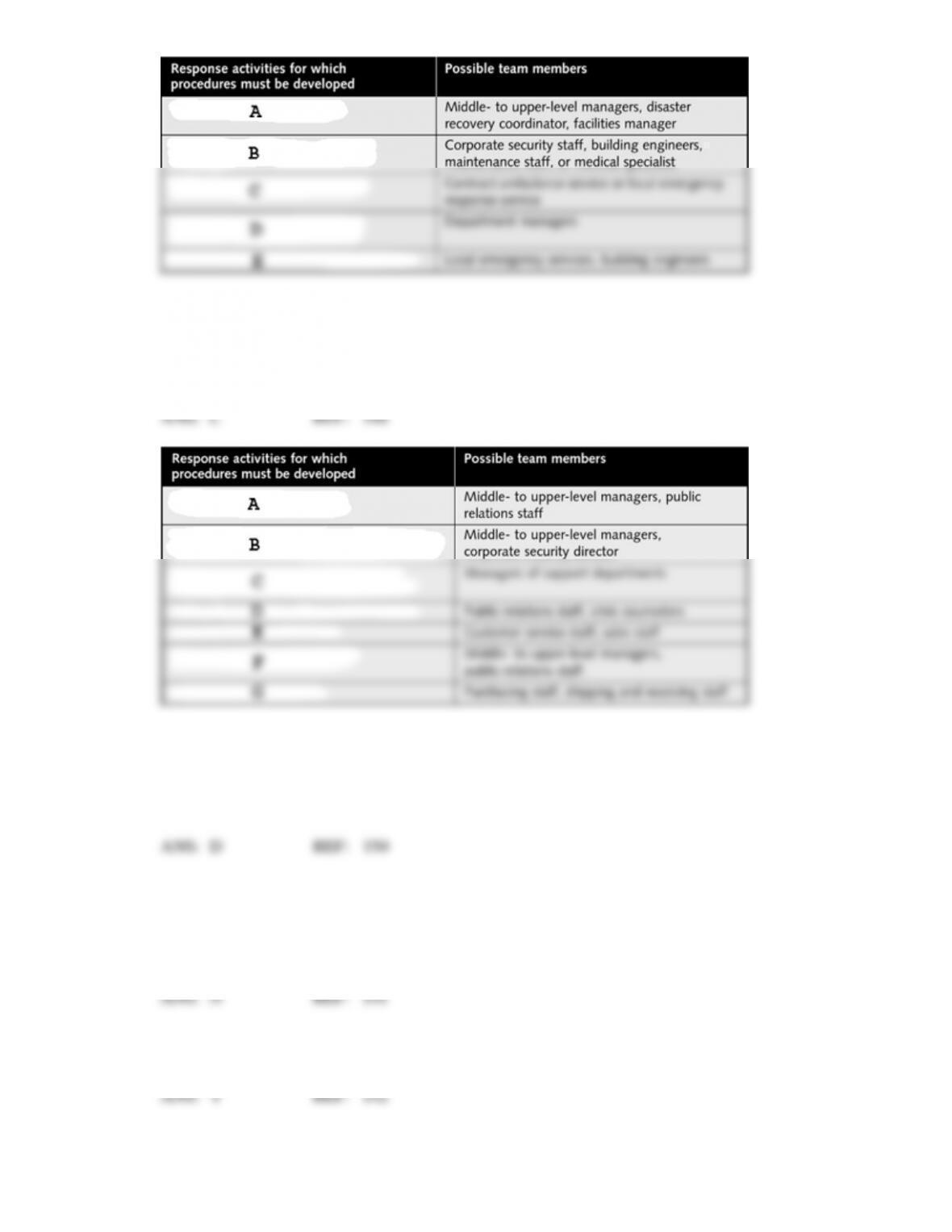
31. In the table above, what response activity does “C” represent?
a.
Overall direction of activities
b.
Supervising assembly areas
c.
Medical evacuation
d.
Physically evacuating people from a facility
32. In the table above, what response activity does “E” represent?
a.
Interactions with employees and families
b.
Interactions with media
c.
Interactions with suppliers
d.
Interactions with customers
YES/NO
1. The disaster classification should summarize any specific laws, regulations, or organizational policies
that relate to disaster response and recovery.
2. The response team should include employees from major departments and people with the necessary
skills to deal with disasters at specific facilities.

3. Can most organizations afford to shut down for a false alarm?
4. Building plans can help the teams navigate facilities and locate personnel, utility systems, and valuable
assets in an emergency.
5. The medical aid teams should help to develop procedures for facility evacuation, reentry, movement of
employees, and crisis counseling.
6. The communications team should keep an activity log that shows which organizations and people have
been contacted, and when they were contacted.
7. The rescue team is responsible for making necessary contacts with law enforcement agencies,
government agencies that regulate the organization, the media, and the general public.
8. Once published, the disaster recovery plan is distributed to all departments.
9. Each disaster recovery procedure must be clearly written so that employees can quickly refer to it and
understand their responsibilities during response and recovery.
10. Members of each team should be listed on the same page in the risk assessment plan, along with their
titles, departments, and contact information.
COMPLETION
1. There are ____________________ major classifications of disasters.
2. The disaster recovery procedures must be drafted and approved by all affected parties, as well as by
employees who must ____________________ the procedures.

3. The ____________________ should be detailed enough to show all section headings, chapter titles,
and subheadings within each chapter, as well as a separate list of tables and figures.
4. The ____________________ procedures, provide a methodical and structured process for notifying
managers, employees, and emergency service organizations that a disaster has occurred.
5. Once an event is confirmed, the leader of the response team or another designate must issue a formal
____________________.
6. During the first hectic hours after a disaster, the ____________________ and ____________________
teams must work quickly and urgently.
7. During disaster recovery, it is very time consuming to ___________________ all the people an
organization depends on for day-to–day operations.
8. The communication team should also include its ____________________ as an appendix to the
disaster recovery plan.
MATCHING
Match the following terms to the appropriate definitions.
a.
Emergency operations center
b.
Emergency operations center information sheet
c.
Evacuation and rescue team

d.
First alert information sheet
e.
First alert procedures
f.
Insurance and damage assessment team
g.
Plan publishing team leader
h.
Response team
i.
Restoration team
j.
Security team
1. Supervise evacuation procedures and initiate rescue efforts
2. Ensure that facilities and valuable property are secured during evacuation
3. A list of managers, employees, and emergency service organizations
4. Makes sure that published material has been approved and is accurate
5. Manage the restoration or rebuilding of facilities after a disaster
6. A facility from which leaders of the response team can direct activities
7. Notifies managers and emergency service organizations of a disaster
8. Employees from major departments who are prepared to deal with disasters
9. Describes the primary and alternate emergency operations centers
10. A team that prepares initial, detailed damage assessments after a disaster
SHORT ANSWER
1. What is the business continuation team and what are they responsible for?
2. What are containment and property protection procedures?
3. What is a disaster confirmation and declaration report?
4. What is a disaster declaration?
5. What are the major categories of disaster recovery procedures?
ANS:
6. List the major classifications of disasters.
ANS:
7. What do disaster recovery procedure reviewers need to ensure?
ANS:
8. Regardless of an organization’s size, what basic rules apply to writing disaster recovery plans?
ANS:
9. What important documents and procedures enable organization managers to direct, control, and
administer the response to a disaster, and then move into the recovery phase?
ANS:
10. List eight disaster recovery procedures that could be necessary to resume operations in the wake of a
catastrophic disaster.
ANS: