
CHAPTER 4 – PRIORITIZING SYSTEMS AND FUNCTIONS FOR RECOVERY
TRUE/FALSE
1. If consensus building is necessary, the disaster recovery planning coordinator should start with the
most difficult process.
2. The planning coordinator should make a comprehensive list of all the business processes and facilities
described in the inventory risk assessment reports.
3. Minority opinions and dissenters need to be minimized as much as possible to reduce the possibility of
impacting other members.
4. If the planning team cannot reach a consensus after independently ranking the possible recovery
priorities, then the coordinator needs to make the decision.
5. In a presentation, the introduction item’s purpose is to ensure that all planning team members
understand exactly what the department group is discussing.
6. When a disaster occurs, organizations try to maintain a full level of functionality and achieve their key
goals.
7. The support departments should perform detailed studies of the systems or support functions required
to meet disaster recovery priorities.
8. The IT system and support analysis sheet, describes specific IT systems and the business processes
they support.
9. If a department does not have direct responsibility for recovery of a facility or business process, it
should still be involved in developing recovery procedures.
10. Every two out of 10 organizations say they have business continuity coverage.
MODIFIED TRUE/FALSE
1. 25% of organizations said they believed their company insurance would cover potential losses.
_________________________
2. Flooding was the most frequent type of U.S.disaster during the 1990s.
_________________________
3. The Northridge earthquake in California occurred in 1992. _________________________
4. Hurricane Andrew occurred in 1992. _________________________
5. California was the number one ranking location for disasters from 1972 to 2000 with a total of 51.
_________________________
6. Palau was the lowest ranking territory for disasters from 1972 to 2000 with a total of one.
_________________________
7. The planing team should develop a chart of issuance to show which facilities, departments, and staff
must participate in developing recovery procedures. _________________________
8. Each disagreeing party should be allowed about 20 minutes to make its case when a consensus cannot
be reached. _________________________

9. The summary statement of the department position during a business priority discussion helps to
solidify its stance and provide a platform for further discussion. _________________________
10. There are no absolute definitions for critical, essential, necessary, and desirable systems and functions.
_________________________
MULTIPLE CHOICE
1. How many organizations out of 10, did not have business continuity coverage?
a.
1
c.
3
b.
2
d.
5
2. One of the possible consequences of noncompliance with social expectations is ____.
a.
loss of license or permits
c.
shift in cash positions
b.
loss of business
d.
damaged reputation
3. One of the possible consequences of noncompliance with regulatory requirements is ____.
a.
labor disputes
d.
civil litigation
b.
loss of major customers
e.
none of the above
c.
criminal charges
4. One of the possible consequences of noncompliance with financial pressures is ____.
a.
loss of license
c.
loss of market share
b.
penalties for late delivery
d.
walkouts
5. One of the possible consequences of noncompliance with contractual requirements is ____.
a.
criminal charges
d.
termination of managers
b.
loss of business
e.
all of the above
c.
civil litigation
6. One of the possible consequences of noncompliance with management mandates is ____.
a.
termination of managers
d.
fines
b.
a shift in cash positions
e.
none of the above
c.
civil litigation
7. One of the possible consequences of noncompliance with social expectations is ____.
a.
class action lawsuits
c.
damaged reputation

b.
civil litigation
d.
all of the above
8. One of the possible consequences of noncompliance with financial pressures is ____.
a.
class action lawsuits
c.
required borrowing of funds
b.
government investigations
d.
loss of market share
9. Which of the following systems and functions absolutely must be in place for any business process to
continue at all?
a.
Desirable
c.
Critical
b.
Necessary
d.
Essential
10. Which of the following systems and functions must be in place to support day-to–day operations?
a.
Critical
c.
Desirable
b.
Essential
d.
Necessary
11. Which of the following systems and functions contribute to smooth operations and comfortable
working conditions for employees?
a.
Critical
c.
Necessary
b.
Essential
d.
Desirable
12. Which of the following systems and functions improve working conditions and help to enhance the
organization’s performance?
a.
Critical
c.
Necessary
b.
Desirable
d.
Essential
13. Which systems support analysis sheet should list all of the software needed to support the processes?
a.
IT
c.
Facilities management
b.
Computer network
d.
Telecommunications
14. Which systems support analysis sheet should list any software or communications connectivity needed
for network access?
a.
IT
c.
Corporate security
b.
Computer network
d.
Telecommunications
15. Which systems support analysis sheet could be numbered FMSS01?
a.
Faculty management
c.
Focus management
b.
Facilities management
d.
Focus module
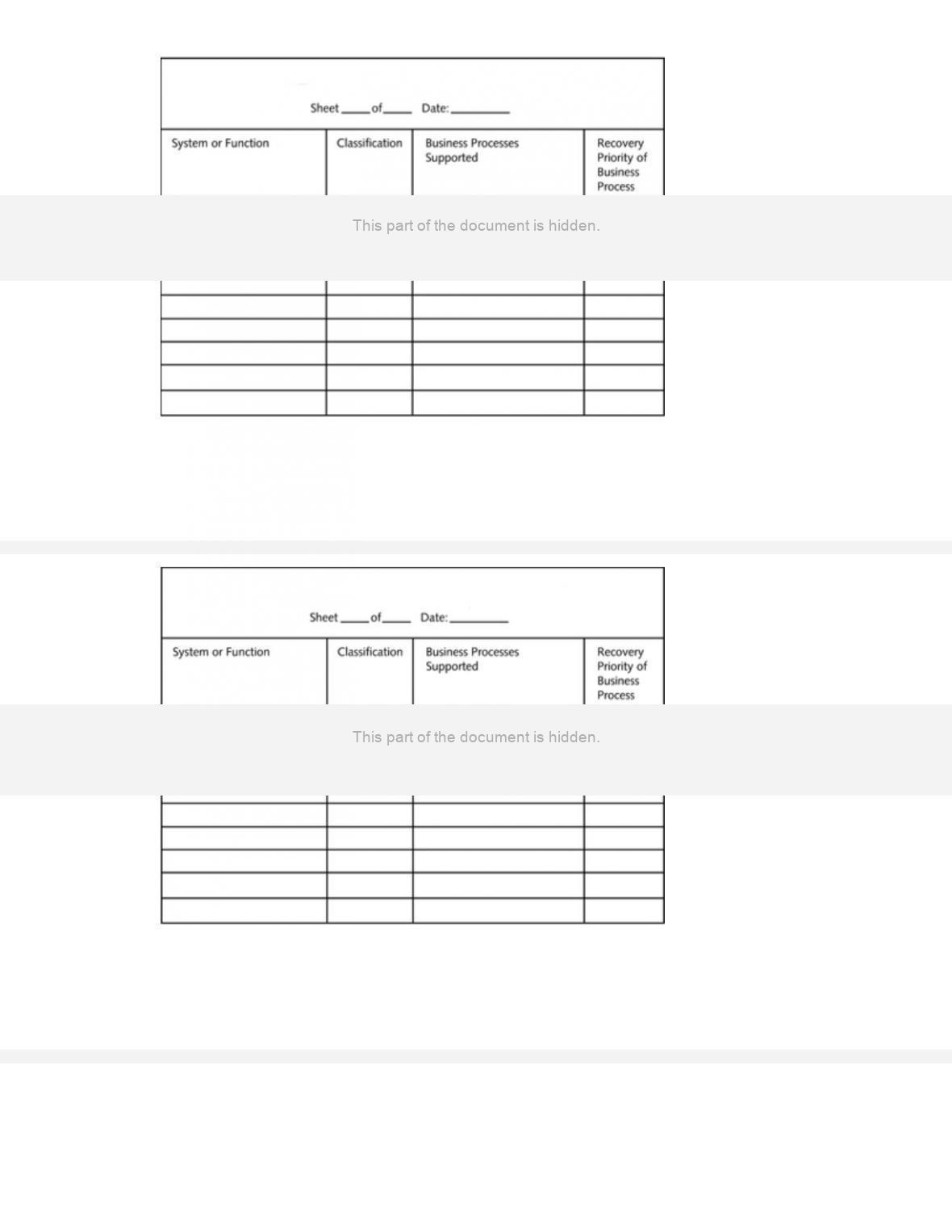
16. What should the numbering scheme be for the systems support analysis sheet displayed in the table
above?
a.
CSSS01
c.
CNSS01
b.
HRSS01
d.
HRSS01
17. What should the numbering scheme be for the systems support analysis sheet displayed in the table
above?
a.
SRSS01
c.
FMSS01
b.
HRSS01
d.
ITSS01
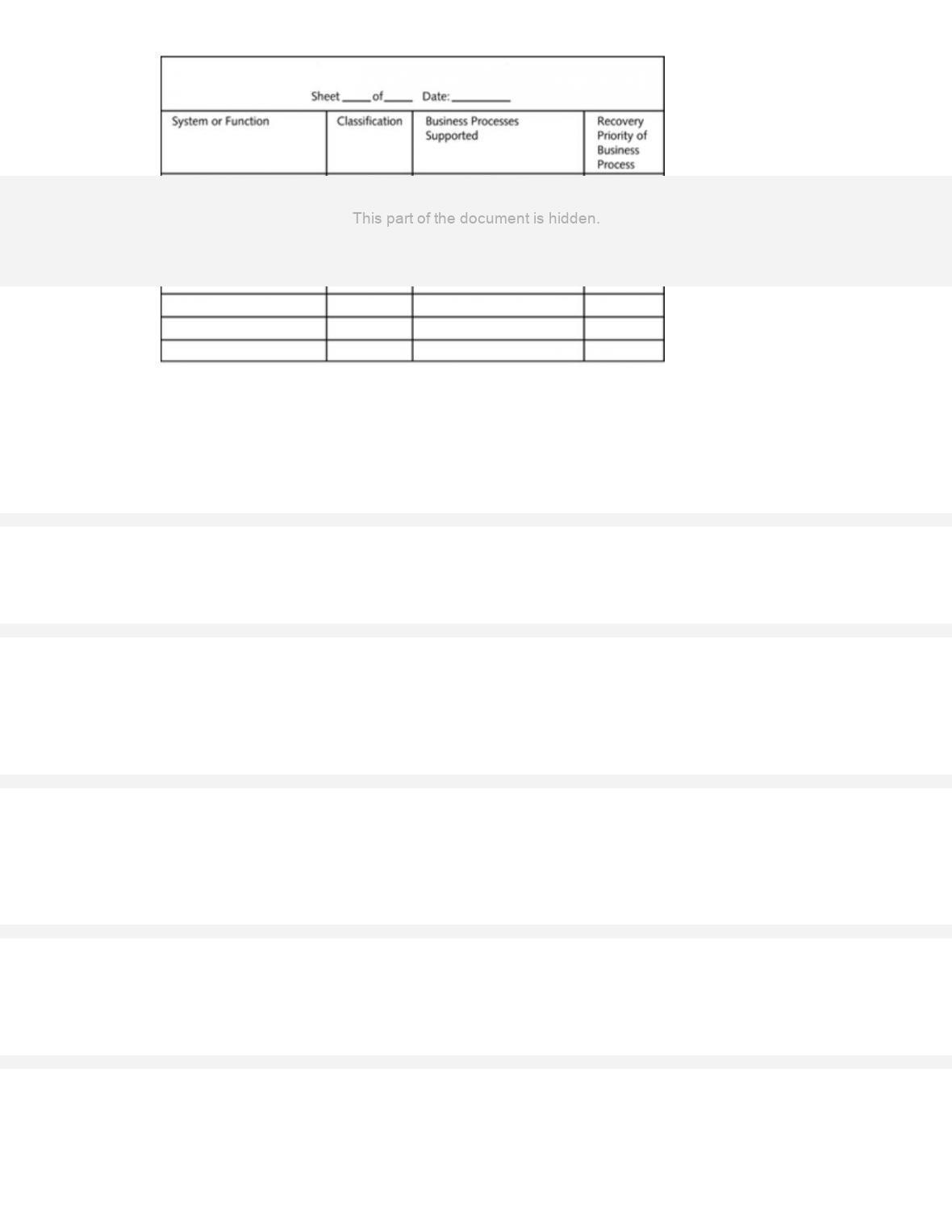
18. What should the numbering scheme be for the systems support analysis sheet displayed in the table
above?
a.
CSSS01
c.
CNSS01
b.
SRSS01
d.
ITSS01
19. Which of the following spaces are common to all of the disaster recovery charts of responsibility?
a.
Facility number
c.
Contact information
b.
Department name
d.
Number of employees
20. Which disaster recovery chart of responsibilities has spaces for the facility number, the number of
buildings and employees at the facility, and contact information for responders?
a.
Business process
d.
Both a and b
b.
Facility
e.
a, b, and c
c.
Department
21. Which disaster recovery chart of responsibilities has spaces for the department name, facility number,
and building number(s)?
a.
Department
d.
Both a and b
b.
Business process
e.
Both a and c
c.
Facility
22. Which disaster recovery chart of responsibilities has spaces for the business entity name, the
department name, facility number, building number(s), and process number?
a.
Facility
c.
Business process
b.
Department
d.
None of the above
23. From ____ to ____ FEMA spent more than $25.4 billion for disasters and emergencies.

a.
1980, 1989
c.
1990, 2002
b.
1990, 1999
d.
1985, 1995
24. Which of the following were the most costly weather related disasters in the 1990s?
a.
Tornados
d.
Earthquakes
b.
Typhoons
e.
Both b and c
c.
Hurricanes
25. How many declarations for disasters and emergencies were issued by FEMA in 1999?
a.
15
c.
19
b.
18
d.
21
26. What was the most frequent type of U.S. disaster during the 1990s?
a.
Fires
c.
Tornados
b.
Flooding
d.
Hurricanes
27. Almost ____ of FEMA funding was required by the 1994 Northbridge earthquake.
a.
$5 billion
c.
$9 billion
b.
$7 billion
d.
$11 billion
28. What is the total number of disasters declared in the U.S from 1972 to 2000 in 50 states, the District of
Columbia, and 9 U.S. territories?
a.
1007
c.
1037
b.
1027
d.
1047
29. Which checklist is a helpful review tool to evaluate progress before the disaster recovery planning
team moves on to develop recovery procedures?
a.
Risk assessment
c.
Disaster review
b.
Disaster recovery planning
d.
Disaster priority review
YES/NO
1. Are there absolute definitions for critical, essential, necessary, and desirable systems and functions?
2. Support departments complete analysis sheets to help the team to prepare disaster recovery procedures.
3. The planning team should develop five disaster recovery charts of responsibilities.
4. The Loma Prieta earthquake was the decade’s most expensive disaster not caused by weather.
5. When evaluating the most basic aspects of an insurance policy, the planning team must first determine
the kinds of disasters for which the insurance policy will pay recovery expenses, either in part or in
full.
6. The planning team must consider input from all departments when prioritizing business processes for
disaster recovery.
7. During consensus building discussions, the disaster recovery planning coordinator needs to choose one
position to adopt for the organization.
8. To begin classifying, disaster recovery planners should worry less about the nature, mission, and goals
of the organization, than the need to fully understand the definitions.
9. IT and Network management may be the best resource for explaining which processes are supported
by each network, server, minicomputer, or mainframe.
10. Should support departments prepare presentations for the planning team that clearly classify the
importance of their systems and functions?
COMPLETION
1. To begin prioritizing systems and functions for recovery, the disaster recovery planning team must
____________________ the data collected during risk assessment and exposure inventories.
2. The planning coordinator should make a comprehensive list of all the business processes and facilities
described in the ____________________ assessment reports when prioritizing business processes for
disaster recovery.
3. If the planning team cannot reach a consensus after independently ranking the possible recovery
____________________, then the coordinator needs to decide how to move the team toward a
consensus.
4. Clarifying business processes in the ____________________ of the business priorities presentation is
the best opportunity to avoid problems.
5. The ____________________ statement of the department position helps to solidify its stance and
provide a platform for further discussion during the business process priorities presentation.
6. Disaster recovery planners need to examine the processes that make their organization
____________________, and then classify these processes.
7. When ____________________ systems, the planning team will discover that some systems support
more than one business process.
8. All planning team representatives from support departments need to take the ____________________
list of business processes and facilities back to their departments for analysis.
9. To determine which departments are responsible for developing recovery procedures for critical
business processes or operations at specific facilities, the planning team should develop a series of
disaster recovery ____________________ charts.
10. The business ____________________ number should match the number assigned during the business
process inventory.
MATCHING
Match the disasters listed to the appropriate year that they occurred in.
a.
2001
f.
1993
b.
1999
g.
1994
c.
1997
h.
1989
d.
1998
i.
1996
e.
1992
1. Red River Valley floods (MN, ND, SD)
2. Loma Prieta earthquake (CA)
3. Hurricane Floyd(CT, DE, FL, ME, MD, NH, NJ, NY, NC, PA, SC, VT, VA)
4. Hurricane Andrew (FL, LA)
5. Tropical storm Allison (FL, LA, MS, PA, TX)
6. Northridge earthquake (CA)
7. Hurricane Fran (MD, NC, PA, VA, WV)
8. Hurricane Georges (AL, FL, LA, MS, PR, VI)
9. Midwest floods (IL, IA, KS, MN, MO, NE, ND, SD, WI)
SHORT ANSWER
1. What questions does the insurance review subcommittee need to ask after evaluating the terms and
conditions of the insurance coverage?
ANS:
2. In addition to examining terms and conditions of coverage, which areas does the insurance review
subcommittee need to evaluate insurance coverage and needs?
ANS:
3. What purposes does analyzing high-priority systems or functions serve?
4. What are the four classifications of systems or functions for recovery?
ANS:
5. What three disaster recovery charts of responsibilities should be developed?
ANS:
6. What four things need to happen once the disaster recovery planning team has compiled exposure
inventories, risk inventories, and risk assessment reports?
ANS:
7. What are three possible consequences of noncompliance with competitive pressures?
ANS:
8. What does the most senior manager need to do to resolve a dispute if a consensus cannot be reached?
ANS:
9. What should the analysis of the requirements for supporting the business process, which the planning
team conducted during the risk assessment show?
ANS:
10. What has happened with business continuity insurance as a result of major hurricanes, tornadoes,
floods, earthquakes, and terrorist attacks during the last decade?
ANS: