
CHAPTER 11 – CONTINUED ASSESSMENT OF NEEDS, THREATS, AND
SOLUTIONS
TRUE/FALSE
1. Team members who do not have substantial responsibilities for disaster response or critical
infrastructures should work with the team on a full-time basis.
2. A major difficulty in maintaining a disaster recovery plan is determining when changes are needed to
the plan or procedures.
3. Random samplings of monitoring reports should be submitted to the disaster recovery coordinator
office for review and action by the planning team.
4. The purchasing decision for most organizations with complex technology infrastructures and
architectures is generally very simple.
5. To maintain operations at the highest possible level, disaster recovery plans and procedures are
designed to deal with relationships between organizations.
6. If an organization acquires an organization with which there was no previous relationship, the acquired
organization must be assimilated into the disaster recovery plan.
7. One of the easiest aspects of maintaining a high level of disaster preparedness is to make sure that
training materials are updated and that employees are trained on current procedures.
8. Organizations tend to maintain the same structure over long periods of time.
9. New disaster recovery planning procedures must be developed in the same manner as original
procedures.
10. As technology evolves and customer expectations of technology become more sophisticated, the
demands of the customer increase.

MODIFIED TRUE/FALSE
1. In the balanced team option for disaster recovery planning, team members who have the greatest
recovery responsibilities or work with the most critical systems stay on the team full-time.
_________________________
2. Modifying existing procedures is less complex than creating new ones.
_________________________
3. Systems are constantly evolving, which means that some of the technology an organization deploys
can become obsolete._________________________
4. When manufacturers introduce new products, a variety of market research and sales activities often
accompany the introduction. _________________________
5. A major item to keep current in the disaster recovery plan is the maintenance list.
_________________________
6. Existing procedures need to be evaluated in conjunction with the new ownership to ensure that
procedures are still workable, or to ensure that needed changes are recommended.
_________________________
7. Maintaining disaster recovery plans requires discipline and appropriate resource allocation.
_________________________
8. Even in the most favorable circumstances, some employees or departments resent how much time is
dedicated to disaster recovery planning. _________________________

9. All employees who are familiar with an organization business directives should use the disaster
planning monitoring report. _________________________
MULTIPLE CHOICE
1. Which member of the original disaster recovery planning team plays a key role on many disaster
response teams?
a.
Corporate security
c.
Public Relations
b.
Administrative division
d.
Business unit
2. Which representative of the original disaster recovery planning team may execute many critical
functions for an organization such as order management?
a.
Building maintenance
c.
Business unit
b.
Human Resources
d.
Administrative division
3. Which representative of the original disaster recovery planning team can play a key role in training
new employees?
a.
Business unit
c.
Public Relations
b.
Human Resources
d.
Production department
4. Which representative of the original disaster recovery planning team can play a key role in dealing
with outside entities during disaster response?
a.
Public Relations
c.
IT department
b.
Human Resources
d.
Administrative division
5. Which representative of the original disaster recovery planning team may have ongoing exposure in
facility layout and how the facility is used?
a.
Administrative division
c.
Building maintenance
b.
Production department
d.
Business unit
6. Which representative of the original disaster recovery planning team maintains critical infrastructure
that is often evolving and changing?
a.
Business unit
d.
IT management
b.
Human Resources
e.
Both c and d
c.
Network management
7. Which representative of the original disaster recovery planning team is usually aware of changes in
business practices and business relationships?
a.
Public Relations
c.
Administrative division

b.
Business unit
d.
Network management
8. Which representative of the original disaster recovery planning team is usually aware of changes in
manufacturing processes and facilities involved in manufacturing?
a.
IT department
c.
Production department
b.
Business unit
d.
Building maintenance
9. Which of the following is NOT an organizational option for maintaining a disaster recovery plan?
a.
The existing disaster recovery planning team stays in place
b.
Some members of the team stay in place, while others are called on as necessary
c.
No one on the planning team stays in place; the team is replaced by middle managers
d.
The planning is outsourced to a specialized disaster planning organization
10. In the core team option, which of the following are full-time members who participate in all activities?
a.
Administrative division
d.
Both a and b
b.
Corporate security
e.
a, b, and c
c.
Public Relations
11. In the core team option, which of the following are part-time members?
a.
Building maintenance
c.
Production department
b.
Business unit
d.
All of the above
12. Which source of information is responsible for changes in staff that require changes in contact team
composition?
a.
Human Resources
d.
Both a and b
b.
Department managers
e.
Both a and c
c.
IT management
13. Which source of information is responsible for changes or additions to art, antique, or collectible
inventories?
a.
Department managers
d.
Both a and b
b.
Legal council
e.
Both b and c
c.
Human Resources department
14. Which source of information is responsible for changes in the use of life forms that require procedures
to be modified?
a.
Manufacturing managers
c.
Research and Development staff
b.
Product designers
d.
All of the above

15. Which source of information is responsible for changes in the manufacturing process that introduces
new materials that may be hazardous?
a.
Business unit managers
c.
Department managers
b.
Product designers
d.
Both a and b
16. Which source of information is responsible for changes in business relationships that require contact
lists to be modified or updated?
a.
Business unit managers
d.
Both a and b
b.
Department managers
e.
a, b, and c
c.
Manufacturing managers
17. Which source of information is responsible for new trade secrets and proprietary processes?
a.
Business unit managers
d.
Both a and b
b.
Collection managers
e.
Both b and c
c.
Research and Development staff
18. What information is maintained on the disaster recovery procedure inventory sheet?
a.
Procedure status
d.
Both a and b
b.
Procedure number
e.
Both b and c
c.
Compliance status
19. What do all manufacturers want to do?
a.
Expand market share
d.
Increase profit
b.
Increase product use
e.
All of the above
c.
Increase revenue
20. Which of the following is a market research or sales activity that often accompanies the introduction of
a new product?
a.
Interviews with customers
c.
Feedback analysis
b.
Radio advertising
d.
Both a and b
21. What was one of the major technology issues in the late 1980s and early 1990s?
a.
The loss of productivity due to the implementation of computer systems
b.
The features provided by computer system vendors
c.
The downtime of computer systems and peripherals
d.
The lack of processing capabilities of computer systems
22. In the late 1990s, many organizations became more concerned about computer and network ____.
a.
scalability
c.
reliability
b.
speed
d.
security

23. What is a major item to keep current in the disaster recovery plan?
a.
Procedures for activating hot-sites with providers
b.
Names and contact information
c.
Procedures related to handling incoming material or supplies from business partners
d.
Procedures for halting or postponing services from business partners
24. What is an advantage of setting dates for a comprehensive review of the disaster recovery plan?
a.
It focuses on units or facilities that have put forth the least effort
b.
It ensures complete reviews of all plans and procedures
c.
It allows unit independence and autonomy
d.
It covers the entire organization and identifies the weakest areas
25. What is an advantage of allowing departments or facilities to schedule their own reviews and monitor
themselves?
a.
It focuses on units or facilities that have put forth the least effort
b.
It ensures complete reviews of all plans and procedures
c.
It allows unit independence and autonomy
d.
It covers the entire organization and identifies the weakest areas
26. What is an advantage of scheduling reviews in departments and facilities that have not submitted
monitoring reports during the last six months?
a.
It focuses on units or facilities that have put forth the least effort
b.
It ensures complete reviews of all plans and procedures
c.
It allows unit independence and autonomy
d.
It covers the entire organization and identifies the weakest areas
27. What is an advantage of conducting spot checks of compliance with procedures in all units and
facilities, and then require comprehensive reviews in areas with the most problems?
a.
It focuses on units or facilities that have put forth the least effort
b.
It ensures complete reviews of all plans and procedures
c.
It allows unit independence and autonomy
d.
It covers the entire organization and identifies the weakest areas
28. What is displayed in the table above?
a.
Methods to counter resistance to disaster recovery planning
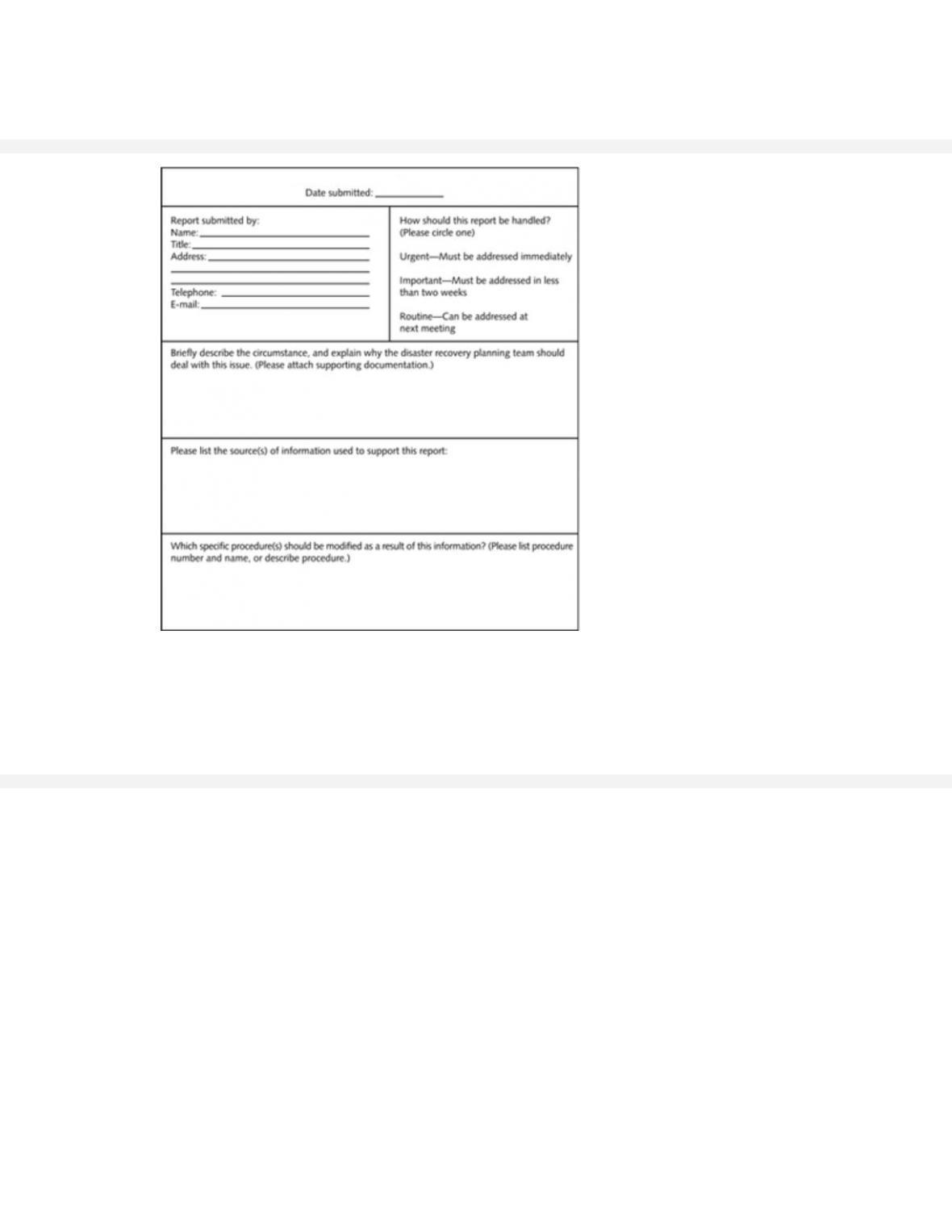
b.
Checklist for managing updates to intranet and Web server documents
c.
Checklist for managing updates to paper and CD-ROM documents
d.
Checklist for updating training materials
29. What report is displayed in the table above?
a.
Sample disaster planning risk assessment report
b.
Sample disaster planning monitoring report
c.
Sample disaster recovery procedure inventory sheet
d.
Technology design and marketing cycles
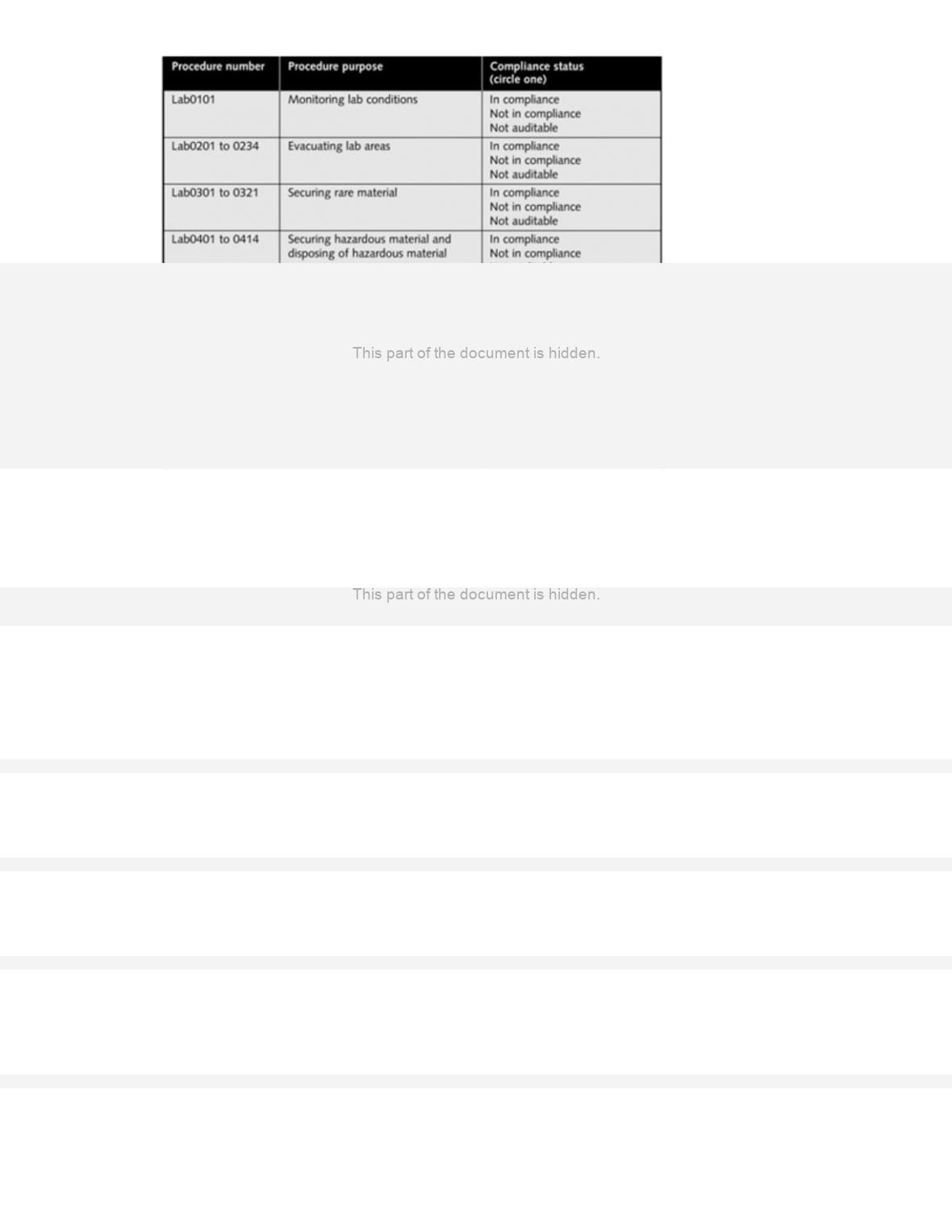
30. What is displayed in the table above?
a.
Sample disaster planning risk assessment report
b.
Sample disaster planning monitoring report
c.
Sample disaster recovery procedure inventory sheet
d.
Technology design and marketing cycles
YES/NO
1. In the maintenance mode, is the disaster recovery planning work as intense and time consuming as it is
in the planning mode?
2. Changes in organizational structures and business relationships may dictate the need for changes to the
disaster recovery plan and procedures.
3. Should disaster recovery planning team members continually evaluate new technologies to determine
whether they can make the recovery process easier and more economical?
4. If the existing disaster recovery planning team stays in place, is there much to decide about how the
disaster recovery task force should work after developing, implementing, and testing the recovery
plan?

5. Are there any advantages to leaving some members of the planning team in place, while calling upon
others as necessary to help maintain the plan?
6. Do modified disaster recovery procedures require reviews and testing?
7. Compared to internal sources, does an organization have much control over external sources?
8. Depending on an organization’s activities and locations, it may also need to monitor changes in
political and social conditions that could constitute threats.
9. In general, does each new wave of technology have design features that increase problems with
previous models?
10. As technology becomes more reliable and more resilient to failure, will organizations have new
opportunities to acquire and deploy technologies that can reduce downtime and ease the process of
disaster recovery?
COMPLETION
1. Maintaining disaster recovery plans requires ____________________ and appropriate resource
allocation.
2. Changes to the disaster recovery plan should be made to each ____________________ method and
then edited to ensure correctness.
3. If ____________________documents are used for updating the disaster recovery plan, employees
must receive instructions for removing and inserting material from older binders or books.

4. A major challenge in maintaining a high level of disaster preparedness is to make sure that
____________________ materials are updated and that employees are trained on current procedures.
5. ____________________ must be willing to schedule time for new employees to attend training and
reinforce its importance.
6. Updating training material requires ____________________ steps similar to those for distributed
disaster recovery documents.
7. Organizations should review training records to find the last time each employee completed training
____________________ that have since been modified.
8. The disaster recovery planning team must ensure that changes to an organization’s
____________________ do not make the disaster recovery plan and procedures obsolete.
9. Many changes to the disaster recovery plan may be needed as a result of ____________________,
new construction, or the acquisition of new buildings or new equipment.
MATCHING
Match the type of information to the external source of information to update procedures.
a.
Emergency service organizations
b.
Local and state public works departments
c.
Chambers of commerce
d.
Public utilities
e.
Regional planning commissions
f.
Professional organizations
1. Changes in roads, exits, and public construction projects

2. Changes in flood plain management
3. Changes in public utility infrastructures
4. Additional emergency services for local response organizations
5. Changes in laws or regulations that may affect an organization directly
6. Changes to regional manufacturing facilities that may eliminate threats
Match the type of information to the source of information for political and social conditions.
a.
National law enforcement agencies
b.
The U.S. Department of State and counterparts in other countries
c.
International organizations such as the World Bank and United Nations
d.
Industry associations, business organizations
7. General security conditions and alerts for specific regions or countries
8. Shifts in political, economic, and social conditions in specific countries
9. Internal and cross-border terrorist threats
10. Security conditions and alerts for specific industry groups
SHORT ANSWER
1. What is a disaster planning monitoring report?
2. What is the disaster recovery plan monitoring process?
3. What is a disaster recovery procedure inventory sheet?

4. What is the maintenance mode of a disaster recovery plan?
5. List four situations that frequently affect the structure of most organizations.
ANS:
6. What are the advantages to leaving some members of the planning team in place?
7. What is an excellent way to develop relationships that can facilitate the flow of information with
external organizations?
8. What types of organizations may need to monitor changes in political and social conditions that could
constitute threats?
ANS:
9. What changes may have been necessary to improve evacuation response time or the speed with which
systems or processes could be shut down in dangerous conditions or situations?
ANS:

10. What two reasons may cause a specific work area to be noncompliant with a specific procedure?
ANS: