
What group of animals were the first to leave the ocean to become the first amphibians?
A) horn-beaked Cephalopods
B) trilobites
C) lobe-finned fish
D) salamanders
The earth is estimated to be approximately 4.6 billion years old. Life appeared early in
the history of Earth, but metazoans (multicelled organisms) did not appear until about
600 million years ago. If the history of Earth were compressed into a single year, when
would metazoans appear?
A) late September
B) late November
C) mid-December
D) late January
The Atlantic Ocean is saltier than the other oceans on Earth because ________.
A) it spans all of the latitudes

B) it is getting smaller and this decrease the surface area for salt to evaporate.
C) it is getting larger, and this increases the area where salt can flow into the ocean
D) it has less rainfall and runoff and more evaporation than other oceans
E) it has more rainfall and runoff and less evaporation than other oceans
Mountain building uplifts rocks against the force of gravity raising their potential
energy, which requires work by the earth system. Based on the relative motion of fault
blocks, what type of fault would you expect to require more energy than the others?
A) normal
B) strike-slip
C) thrust
D) There is no way of knowing.
Grabens are formed by what type of faulting?
A) normal
B) reverse
C) strike-slip

D) collision
Which of the following is not true of the rings of Saturn
A) They are remnants of the formation of the planet and have not changed over time.
B) They are comprised of various sized objects ranging from dust to moon-size objects.
C) They are mostly very thin, forming a large planar disk.
D) The faintest outer rings are closely associated with the moon Enceladus.
Which of the following best describes bedded gypsum and rock salt?
A) detrital sedimentary rocks
B) varieties of dolostone
C) varieties of coal and peat
D) evaporates; chemical, sedimentary rocks

Slate is ________ than shale.
A) more planar
B) darker
C) denser
D) lighter
In Wegener’s time, scientists thought that the occurrence of fossils of the same organism
in two different, disconnected continents was proof that ________.
A) there had once been land bridges separating the continents
B) the weather patterns had changed over time such that some organisms could be
blown by the wind from one place to another.
C) there were icebergs in the Atlantic Ocean that could carry organisms from Africa to
South America
D) birds flew between the continents and carried the organisms with them.

The recent (geologically) volcanic activity in Yellowstone National Park is ________.
A) related to plate subduction
B) related to a divergent plate boundary
C) related to a transform plate boundary
D) related to intraplate, hot spot volcanism
As a stream changes from its headwaters to its mouth, which of the following is not
likely to occur?
A) Flow velocity decreases.
B) The channel gets wider downstream.
C) Sediment size gets smaller downstream.
D) The channel gets smoother.
E) The volume of water increases.
You are walking north across dipping beds in sedimentary rocks. You walk across 200m
of rocks with a relatively constant dip of 20 degrees to the south. Suddenly you come to

beds with lower dip that become flat lying, and then dip north across a horizontal
distance of only about 30m. As you walk on the beds become more steeply dipping
until they dip almost 80 degrees to the north. You walk across these steeply dipping
beds for 40m, and then beds return to a south dip of about 20 degrees. What kind of
structure(s) did you just walk across? (A sketch may help you solve this problem.)
A) a symmetric anticline
B) an asymmetric syncline
C) an asymmetric anticline and syncline
D) an asymmetric anticline
E) a symmetric syncline
“Rain long foretold, long last; short notice, soon past.” The first five words of this
weather proverb ________.
A) refer to a cold front
B) refer to a warm front
C) refer to an anticyclone
D) have no basis in fact

In the late 1700s James Hutton published his important work titled ________.
A) Catastrophism
B) Principles of Geology
C) Modern Earth Science
D) Theory of the Earth
The most conspicuous features on the surface of the Sun are dark areas called
________.
A) granules
B) helium lines
C) flares
D) spicules
E) sunspots
The most explosive events to occur on the Sun are ________.
A) umbras

B) solar flares
C) sunspots
D) filaments
E) solar winds
Features like rock ledges in badlands or rock fins standing above adjacent valleys are
all examples of ________.
A) glacial erosion
B) river erosion
C) differential weathering
D) chemical weathering
Cinder cones ________.
A) have very steep slopes
B) are usually less than 300 meters (1000 feet) high
C) consist largely of pyroclastics

D) all of these
Two cities are located at the same latitude (40o). City A is in the Southern Hemisphere
and City B is in the Northern Hemisphere. Assume the two cities reflect the general
characteristics of the hemispheres where they are located. Which city should have the
warmest winter temperatures?
A) City A
B) City B
C) Both cities should have nearly identical winter temperatures.
D) More information is required to answer the question.
How is sea ice different from glacial ice?
A) Sea ice is thicker than glacial ice, and sea ice floats while glacial ice does not float.
B) Sea ice is thicker than glacial ice, and both sea ice and glacial ice can float.
C) Sea ice is thinner than glacial ice, and both sea ice and glacial ice can float.
D) Sea ice is thinner than glacial ice, and sea ice floats while glacial ice does not float.

The city of New Orleans is in the delta of a great river. During hurricane Katrina most
of the city flooded but the area along the river, like the French Quarter, did not. Why
didn’t these areas flood?
A) The army corps of engineers must have dredged the river and built these areas up
before the city was built.
B) These areas were natural levees of the river, and were higher in elevation than
adjacent areas.
C) The water couldn’t flow fast enough to cover these areas and was halted before it
could flood these areas.
D) The river flowed away from these areas into other parts of the city when it broke the
levees, and these areas just happened to be spared.
Rhyolite is the fine-grained equivalent of this igneous rock.
A) basalt
B) andesite
C) granite
D) diorite

If 2 grams of water absorbs 20 calories of heat, the resulting water temperature change
is ________.
A) +10oC
B) +20oC
C) -10oC
D) -20oC
E) 0oC
Island arc systems now on the Tibet plateau record subduction prior to the collision of
India with Eurasia. Geologists would map these pre-collisional arc rocks as ________.
A) hot spot tracks
B) terranes
C) rift zones
D) pre-collisional transform zones

A geologist is working in an area with exposed sedimentary rocks and finds a well
exposed sequence of stratified rocks. As he works through a thick sequence of
limestone, he sees abundant large clam fossils that produce an interlocking texture
suggesting a reef, but within the limestone section these clams disappear and the
overlying limestone is made up primarily of fragments of corals. He now moves 50 km
away and finds limestones interbedded with shales, and the limestones contain the same
clam fossils he had seen previously 50 km away. As he continues through this section,
the rocks become entirely limestone, and the clams disappear again with coral fossils
above forming a reef structure. He concludes ________.
A) this is impossible; the rocks are different at the same place the fossils change
B) the horizon where the clams disappear occurred at the same time in the two sections
when the clams went extinct
C) clams have nothing to do with reefs, so he needs to go back to the first section to
determine what he missed
D) sea level must have risen abruptly in a great catastrophe to produce the coral
fragments scattered over 50 km
The source of the Sun’s energy is ________.
A) chemical burning
B) nuclear fission
C) nuclear fusion
D) heat of contraction
E) potential energy

Shield areas in continental interiors are characterized by ________.
A) linear chains of mountains less than 100 million years old
B) flat areas that include rocks older than 1 billion years old
C) flat river valleys that cut through older mountain ranges
D) ancient coastal regions that have become abandoned and eroded
Long oceanic mountain chains typically are characterized by ________.
A) highly deformed sedimentary rocks
B) granitic plutons and batholiths
C) layers of igneous rocks
D) rocks older than 1 billion years old

The most common sedimentary rock is ________.
A) sandstone
B) shale
C) conglomerate
D) breccia
The Southern Cross is a Southern Hemisphere constellation that is as famous the big
dipper in the Northern Hemisphere because of the brightness of the stars. It has a
Southern Hemisphere declination slightly higher than the big dipper’s Northern
Hemisphere declination. Is it visible anywhere in the United States?
A) No, it is not visible anywhere in the U.S. because the entire country is too far north.
B) Yes, it is visible in most of the southern tier of states during summer months.
C) Yes, it is visible during much of the year, but it is obscured by the full moon.
D) Yes, it is visible in Hawaii during the summer months.
Which process of mass wasting occurs primarily in permafrost regions?

Highly impermeable layers such as compacted clay or shale are known as ________.
When several radio telescopes are connected together, the resulting network is called
a(n) ________.
The term used to describe clouds that consist of globular masses that take on a billowy
form is ________.

Wintertime precipitation in ________ and ________ climates is chiefly associated with
the passage of fronts connected with traveling middle-latitude cyclones.
Earth’s physical environment is traditionally divided in the hydrosphere, atmosphere,
and the solid Earth. Remembering the scientific method, why do you think that
scientists tend to categorize and classify various features, phenomena, and
characteristics of the natural world into groups or subdivisions? Also, are there potential
pitfalls or problems if we only consider the natural world as individual groups or
categories rather than as a whole?
Examine Figure 12.12 below which illustrates the distribution of cratons and orogens
(mountain belts) on Earth today. Briefly discuss how have these regions have developed
over time using the concept of plate tectonics. Include the relationship between specific
types of plate boundaries to the various regions if possible.
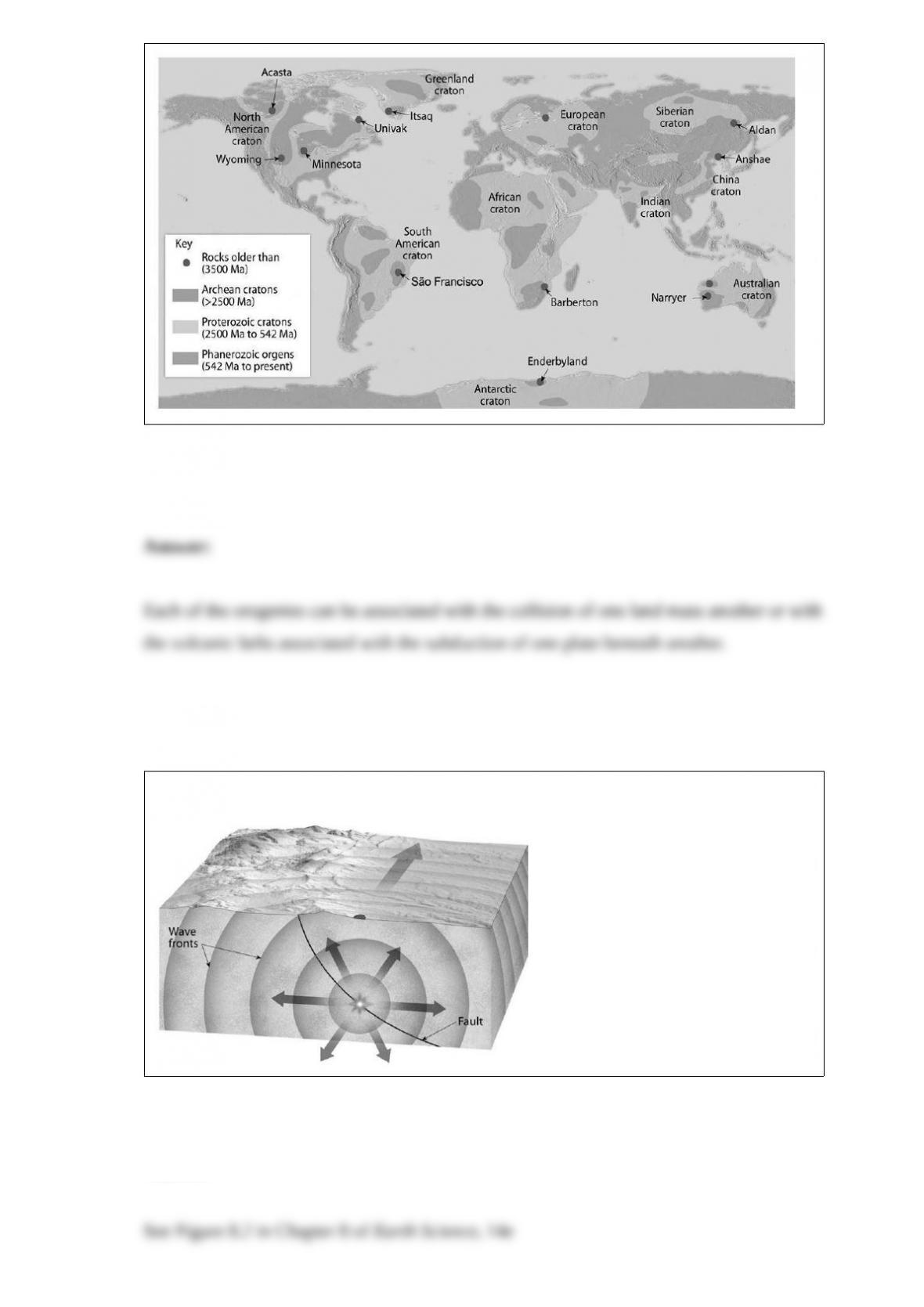
Label the focus and epicenter on the diagram below.

Examine the words and/or phrases for each question below and determine the
relationship among the majority of words/phrases. Choose the option which does not fit
the pattern.
abyssal plain seamount oceanic ridge
continental crust
Examine the words and/or phrases for each question below and determine the
relationship among the majority of words/phrases. Choose the option which does not fit
the pattern.
Use one of the following five terms to fill in the blanks for the questions below:
Continental crust, Asthenosphere, Mantle, Lithosphere, Oceanic crust
The upper part of the ________ has the approximate composition of peridotite.

The nuclear reaction process of converting hydrogen nuclei into helium nuclei is called
the ________ chain.
The ________ period was the “golden age of trilobites.”
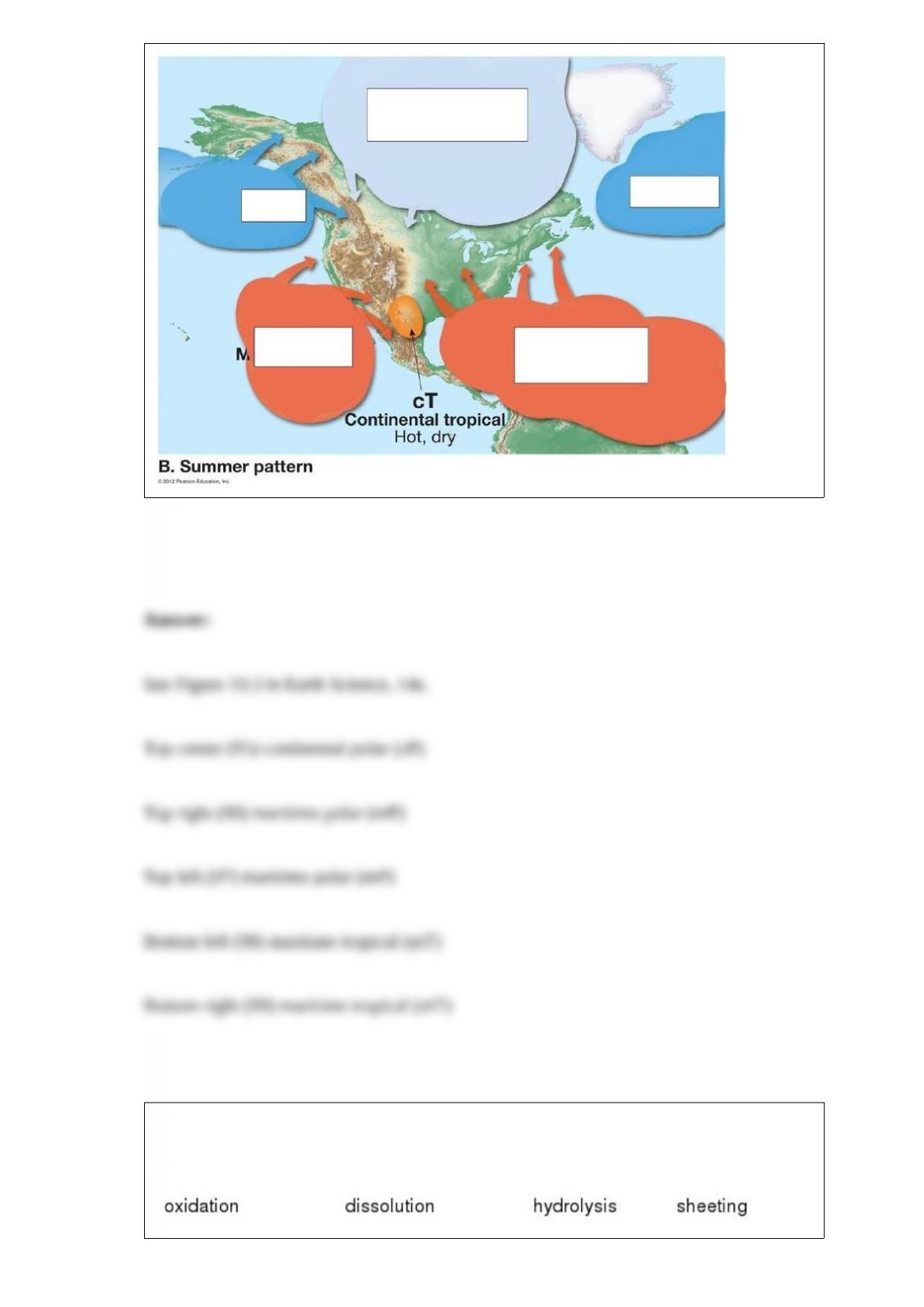
Label the air masses on the diagram below.
Examine the words and/or phrases for each question below and determine the
relationship among the majority of words/phrases. Choose the option which does not fit
the pattern.