
Groins are constructed for the purpose of maintaining or widening beaches that are
losing sand.
During the Ice Age, the climate was occasionally warmer than it is today.
Continental rocks do not rift because they are too thick.
We are fortunate in the United States that large tsunamis do not affect most of our
coastal regions except in Hawaii.

The hydrosphere refers to the snow and ice that exist at Earth’s surface.
When you are swimming in the surf and ride a wave into the limit of the wave washup,
you are deposited on the shoreline.
Continental polar air masses seldom influence the weather south of the Great Lakes.
In the Northern Hemisphere, winds blow clockwise and outward from the center of
anticyclones.

The change from a sediment to a sedimentary rock typically involves burying the
sediment.
Horizontal movement of air is called wind.
Tornadoes are most often generated along the cold front of a middle-latitude cyclone.

The Richter earthquake magnitude scale is based on the energy released by the
earthquake.
Cleavage is related to the internal structure of a mineral.
During the Alaskan earthquake of 1964, the buildings that survived the best were made
of wood.
Sheeting is mainly a process of mechanical weathering.

Melting and calving are two forms of ablation.
Oceanic Ridges are wider than most mountain belts.
Most Mesozoic rocks are devoid of fossils; consequently this is the least understood
span of Earth’s history.

The asthenosphere is the liquid layer in the upper mantle that the plates move on.
The North Star (Polaris) will always be in this position in the night sky.
Slate is associated with high-grade metamorphism.
Torricelli invented the mercurial barometer.

The southeastern United States is a good example of a humid subtropical climate.
Most deserts are associated with the subtropical high.
When a beta particle is emitted, the mass number of the isotope remains unchanged.
Deserts are hot, lifeless sand-covered landscapes shaped largely by the forces of wind.

Doppler radar aids tornado detection by detecting motion within clouds.
Sedimentary rocks are an important source of information about the Earth’s history.
Oceans cover slightly less than half of the earth’s surface.

Oil and gas resources are rare on the continental slope and continental rise.
All of the Jovian planets except Uranus have rings.
Coal beds originate in ________.
A) shallow lakes in a dry, desert region
B) channels of fast-moving streams
C) deep, marine basins below wave action
D) freshwater coastal swamps and bogs
A cT air mass is ________.

A) cold and dry
B) cold and humid
C) warm and dry
D) warm and humid
Any change in the air’s ________ content could alter temperatures in the lower
atmosphere.
A) nitrogen
B) acid
C) oxygen
D) carbon dioxide
E) smoke
Which of the following best defines a mineral and a rock?
A) A rock has an orderly, repetitive, geometrical, internal arrangement of minerals; a
mineral is a lithified or consolidated aggregate of rocks.

B) A mineral consists of its constituent atoms arranged in a geometrically repetitive
structure; in a rock, the atoms are randomly bonded without any geometric pattern.
C) In a mineral the constituent atoms are bonded in a regular, repetitive, internal
structure; a rock is a lithified or consolidated aggregate of different mineral grains.
D) A rock consists of atoms bonded in a regular, geometrically predictable arrangement;
a mineral is a consolidated aggregate of different rock particles.
When a radioactive isotope decays by electron capture, the electron ________.
A) combines with a neutron in the nucleus, raising the mass number of the daughter
isotope by one
B) combines with a proton in the nucleus; the atomic number of the daughter is one less
than the parent
C) makes the parent isotope into an ion with a charge of negative one
D) makes the daughter isotope into an ion with a charge of positive one
X-rays have shorter wavelength than visible light; therefore, X-rays ________.
A) have lower energy than light waves
B) are higher energy than light waves

C) cannot be detected because of their wavelength
D) pass through materials because their photons are smaller than light photons
The problems encountered with lenses caused this scientist to build reflecting
telescopes of his own design.
A) Albert Einstein
B) Sir Isaac Newton
C) Galileo
D) George Hale
E) Niels Bohr
A(n) ________ is a thick accumulation of sediments and small tectonic blocks formed
of material scraped off subducting oceanic lithosphere at a convergent margin.
A) mass movement complex
B) continental shelf, terrain complex
C) accretionary-wedge complex
D) subterranean-accumulation complex

Relative to the celestial background, the moon moves ________.
A) east to west
B) west to east
C) southeast to northwest
D) south to north
Glaze is not a common weather term in the U.S., but it is probably associated with
weather forecasts of ________.
A) thunderstorms
B) snowstorms
C) blizzards
D) ice storms
E) hail storms

Which of the following is not true of deep ocean trenches?
A) They are long and narrow depressions.
B) They are sites where plates plunge back into the mantle.
C) They are geologically very stable.
D) They may act as sediment traps.
The Dry Adiabatic rate of change for unsaturated air is 10oC/1000 m. What does this
mean?
A) Saturated air will not change.
B) Unsaturated air will get warmer or colder as it travels north or south.
C) Unsaturated air will get warmer or colder as it travels in any direction.
D) Unsaturated air will get warmer as it rises and colder as it sinks.
E) Unsaturated air will get warmer as it sinks and colder as it rises.

The movement of sand parallel to the shore ________.
A) is created by waves approaching at an oblique angle
B) may create spits
C) is achieved by longshore currents
D) all of the above
The first minerals to be mined were ________ and ________.
A) gold, silver
B) copper, bronze
C) flint, chert
D) lead, quartz
Climate models indicate that ________ is(are) one of the strongest indications of global
warming.
A) retreating glaciers in Alaska
B) loss of sea ice in the Arctic

C) the hole in the ozone in Australia
D) melting of Antarctica
E) El Nio
Ice sheets can be ________.
A) several centimeters thick
B) several meters thick
C) several kilometers thick
D) tens of kilometers thick
Upper air winds ________.
A) are generally faster than surface winds
B) are unaffected by the Coriolis force
C) are greatly influenced by friction
D) both A and B

Midwestern farmers used to say “mare’s tail and mackerel scales bring the storm down
on you head”; Mare’s tails are cirrus clouds and mackerel scales are cirrostratus. When
this sequence is followed by altostratus the old farmers were talking about an
approaching ________ front.
A) warm
B) cold
C) warm or cold
D) none of these
Which of the following describes radioactive decay by beta particle emission?
A) The atomic number of the daughter isotope is one more than the parent; the mass
numbers are the same.
B) The mass number of the daughter isotope is one more than the parent, and both
isotopes have the same atomic number.
C) The daughter isotope has an atomic number two less than the parent and a mass
number four less.
D) The daughter isotope has an atomic number one less than the parent and a mass
number two less.

What is the modern explanation for “guest stars” that appear in the night sky and then
disappear?
A) unusually bright planets produced when they pass closest to earth
B) comets passing close to Earth
C) stars that go Nova or Supernova and appear as bright objects during the event
D) alignments of stars that make them suddenly appear bright
Which main-sequence stars are the most massive?
A) red
B) orange
C) yellow
D) blue

Consider a weathered rock or soil particle lying on a slope. How will the gravitational
force pulling the particle downward along the land surface vary with the inclination of
the slope?
A) It will increase as the slope angle is lessened.
B) It will decrease as the slope angle is lessened.
C) It is not affected by the slope angle.
D) It will possibly increase or decrease as slope angle is lessened, depending upon other
factors.
The principle of inclusions which states that the source of rock fragments found in a
unit must be older than the unit with the fragments is important because ________.
A) it provided a tool for sorting out the relative timing of various geologic events
B) it provided a way to recognize if rocks had been deformed
C) it showed that igneous rocks were younger than sedimentary rocks
D) it allowed geologists to correlate rock units over large distances
The famous destruction of the Roman city of Pompeii was produced by ________.
A) a large cinder cone burying the city in tephra

B) a composite volcano erupted lava that buried the city, fossilizing people who were
overridden by the fast moving flows
C) a volcanic mudflow from Mt. Vesuvius that buried the people and the city
D) a pyroclastic eruption from a composite volcano that buried the city in ash and
smothered the people living there
Who wrote the book entitled Of the Revolutions of Celestial Spheres (De
Revolutionibus)?
A) Sir Isaac Newton
B) Galileo
C) Tycho Brahe
D) Nicolaus Copernicus
E) Johannes Kepler
Which statement about the May, 1980, eruption of Mount St. Helens is false?
A) During the eruptive period, the mountain peak was substantially built up by new
lava flows and pyroclastic debris.

B) Plumes of ash rose high into the atmosphere during the major eruptive events.
C) Mudflows accompanied the major eruptive events.
D) The most powerful explosive event was preceded by a massive landslide.
Which mass wasting process has the slowest rate of movement?
A) slump
B) rock avalanche
C) rock fall
D) creep
The common rock produced by the metamorphism of limestone is ________.
A) marble
B) mica schist
C) phyllite
D) gneiss

Jupiter’s atmosphere displays spectacular cyclonic and anticyclonic storms, some
persisting for long periods of time. How do these storms form?
A) Like on Earth, they result from differential solar heating of the equatorial region
versus poles, and resultant atmospheric circulation.
B) They form like storms on the Sun, for low level nuclear fusion in Jupiter’s core.
C) They are due to internal heat exchange within the planet, basically convection
currents transferring internal heat to the surface.
D) Jupiter has a very strong magnetic field, and these storms both form the field and are
strengthened by it as it feeds electric currents in the atmosphere.
Laminar flow, where water moves in approximately straight-line paths, characterizes
________.
A) fast-moving streams
B) slow-moving streams
C) the edges of channels
D) the bottoms of channels
E) all of the above

Oceanic crust is generated at ________.
A) hot spots on the sea floor, like Iceland
B) spreading ridges
C) convergent plate margins
D) transform plate margins
Changes in the shape of a rock body in response to a differential stress is called
________.
________ refers to the total amount of dissolved materials in water.

________ is the mass of water vapor in a unit of air compared to the remaining mass of
dry air.
The fraction of the total radiation encountered that is reflected by a surface is called its
________.
________ refers to the mass of all living organisms on Earth.
Clams, sponges, and crabs are all examples of ________ organisms.

An instrument that measures air pressure using a partially evacuated chamber is called
a(n) ________ barometer.
Extending from Norway to the Pacific coast of Russia is a great expanse of ________
climate, often referred to as the taiga climate.
What is the inert gas, daughter product of the radioactive isotope, K-40?

Examine the words and/or phrases for each question below and determine the
relationship among the majority of words/phrases. Choose the option which does not fit
the pattern.
The first scientist to use a telescope for astronomical purposes was ________.
Ocean life appears to be affected by a relatively small number of variables such as
temperature, density, available sunlight, available nutrients. If any one of these
variables changes how do you think it might it impact the human food web?
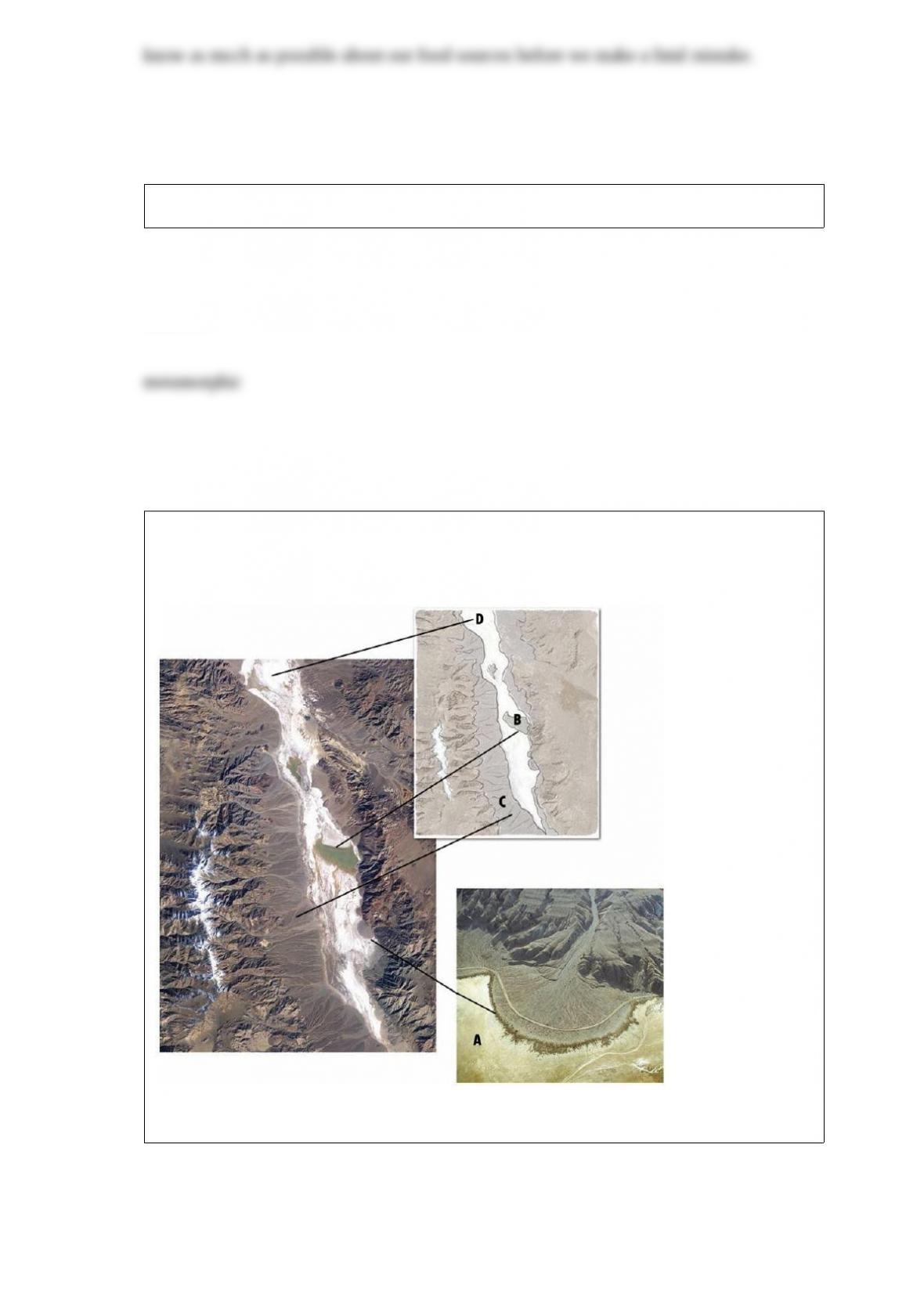
The most common Precambrian rock type is ________ rock.
In the figure above, identify the letter corresponding to an alluvial fan.

Examine the words and/or phrases for each question below and determine the
relationship among the majority of words/phrases. Choose the option which does not fit
the pattern.
Give the term of ocean floor sediment for each phrase.
manganese nodule
Briefly describe how time, temperature, mineralogy, and confining pressure affect the
way a rock will deform when the differential stresses on the rock exceed the strength of
the rock.

The rising of cold water from deeper layers to replace warmer surface water is called
________.
The proposal that contends that Earth is in the center of the universe is called the
________ view.
Examine the words and/or phrases for each question below and determine the
relationship among the majority of words/phrases. Choose the option which does not fit
the pattern.