
There are five dimensions to emotional intelligence: self-motivation; self-awareness;
the ability to manage one’s emotions and impulses; __________; and social skills.
a. empathy
b. sense of humor
c. the ability to read body language
d. the ability to be positive
e. a need to be in control
Answer:
Marketing ROI (return on investment) refers to
a. the application of modern measurement technologies to understand, quantify, and
optimize production costs.
b. the application of modern measurement technologies to understand, quantify, and
optimize marketing spending.
c. the application of modern measurement technologies to understand, quantify, and
optimize production expenses.
d. the allocation of funds based on a percentage of the total marketing budget
determined by assessing the anticipated revenue return for a given marketing action.
e. the allocation of funds based upon the minimum expenditure possible to create the
maximum results in terms of total sales.

Answer:
Viral marketing refers to
a. an embedded message that causes a popup screen to appear every time a user types in
a specific word.
b. malicious spyware that is used to create doppelgangers at competitors’ websites.
c. a subversive program that automatically transfers inquiries from one website to
another.
d. an Internet-enabled promotional strategy that encourages individuals to forward
marketer-initiated messages to others via e-mail, social networking, and blogs.
e. an online promotion that awards points to participants based upon how many friends
they can friend on personal social networking sites such as Facebook or Twitter.
Answer:
When you order a sweater from an L. L. Bean mail-order catalog, what type of
marketing channel are you and the company using?
a. cash and carry marketing channel
b. intensive distribution channel
c. selective distribution channel
d. indirect marketing channel

e. direct marketing channel
Answer:
Estimating cost, conducting a marginal analysis, and performing a break-even analysis
are issues that would be addressed during __________ of the price-setting process.
a. Step 1
b. Step 2
c. Step 3
d. Step 4
e. Step 5
Answer:
An example of __________ utility involves intermediaries shipping goods to buyers of
a product.
a. time

b. form
c. place
d. possession
e. transactional
Answer:
A _________ exists when a franchisor licenses individuals or firms to dispense a
service under a trade name and specific guidelines.
a. service-sponsored retail franchise system
b. manufacturer-sponsored wholesale franchise system
c. manufacturer-sponsored retail franchise system
d. administered vertical marketing system
e. service-sponsored franchise system
Answer:
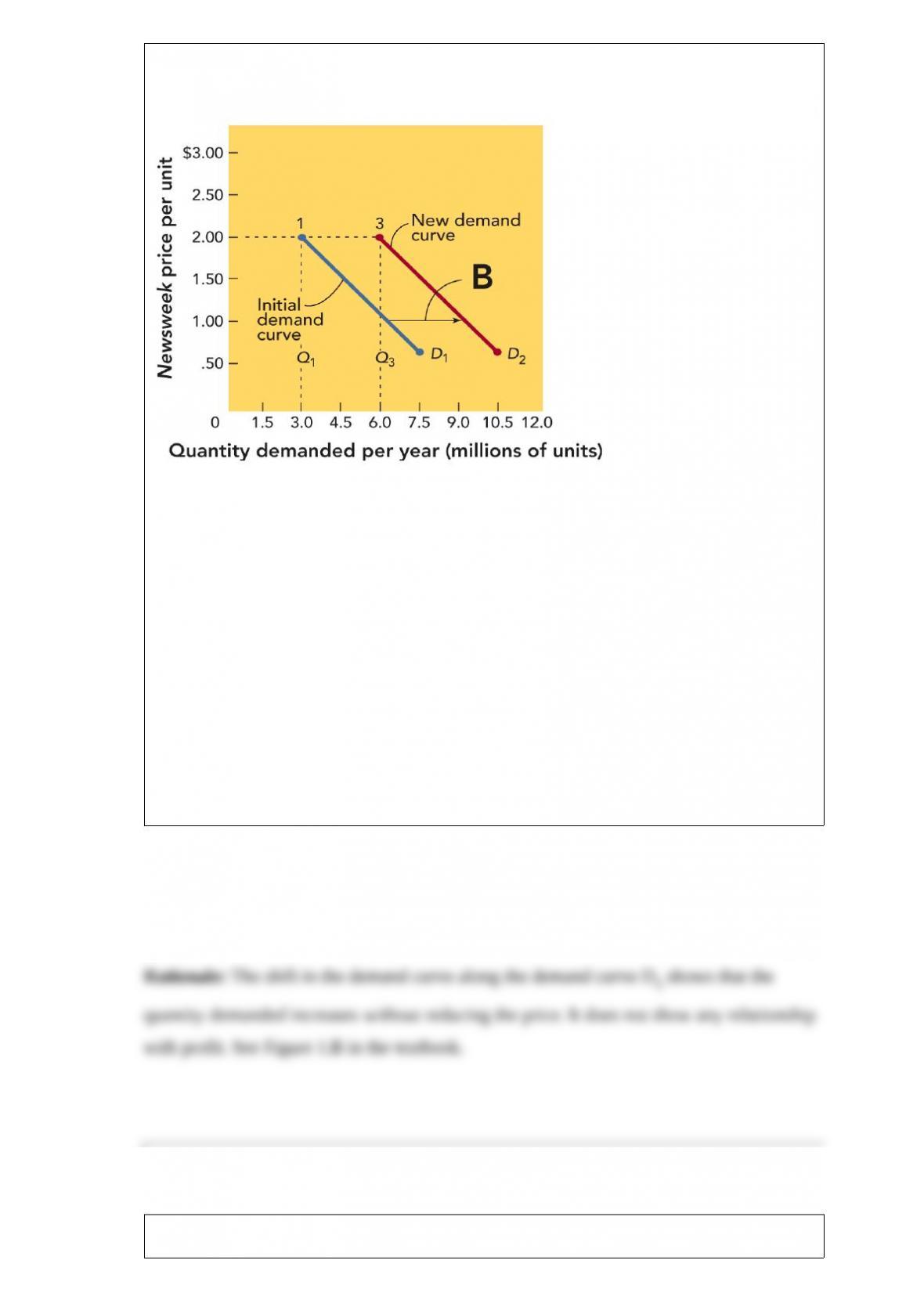
Figure 1.B
Figure 1.B above shows that when the quantity demanded moves from 3.0 to 6.0
million units along the demand curve D1, the profit
a. increases from $1. to $2.00 per unit.
b. decreases from $2.00 to $1. per unit.
c. stays the same per unit.
d. increases from $0.50 to $1. per unit.
e. Figure 1.B does not indicate what happens to profit when the quantity demanded
moves.
Answer:

In the personal selling process, the stage that includes making certain the customer’s
purchase has been properly delivered and installed and difficulties experienced with the
use of the item are addressed is referred to as the __________ stage.
a. urgency close
b. follow-up
c. assumptive close
d. presentation
e. trial close
Answer:
Collaborative filtering refers to
a. a process that automatically groups people with similar buying intentions,
preferences, and behaviors and predicts future purchases.
b. the two-way buyer-seller electronic communication in a computer-mediated
environment in which the buyer controls the kind and amount of information received
from the seller.
c. the interactive, Internet-enabled system that allows individual customers to design
their own products and services by answering a few questions and choosing from a
menu of product or service attributes, prices, and delivery options.
d. the consumer-initiated practice of generating content on a marketer’s website that is
custom-tailored to an individual’s specific needs and preferences.
e. an Internet-enabled digital environment characterized by face-to-screen exchange
relationships and electronic images and offerings.
Answer:
Experience curve pricing is considered to be a __________ approach to pricing.
a. demand-oriented
b. cost-oriented
c. profit-oriented
d. competition-oriented
e. service-oriented
Answer:
A salesclerk at L. L. Bean uses __________ when he asks customers if they also need a
pair of hiking socks with the purchase of their mountain boots.
a. a stimulus-response presentation
b. a transactional sales presentation
c. need-satisfaction selling
d. consultative selling
e. formula selling
Answer:
During the 2010 winter immunization campaign, the Centers for Disease Control and
Prevention used the media to encourage all Americans to get vaccinated against the
seasonal flu virus. This is an example of a __________, where the media donated free
space and air time.
a. news release
b. news conference
c. public service announcement
d. cooperative advertising
e. limited-service advertising
Answer:
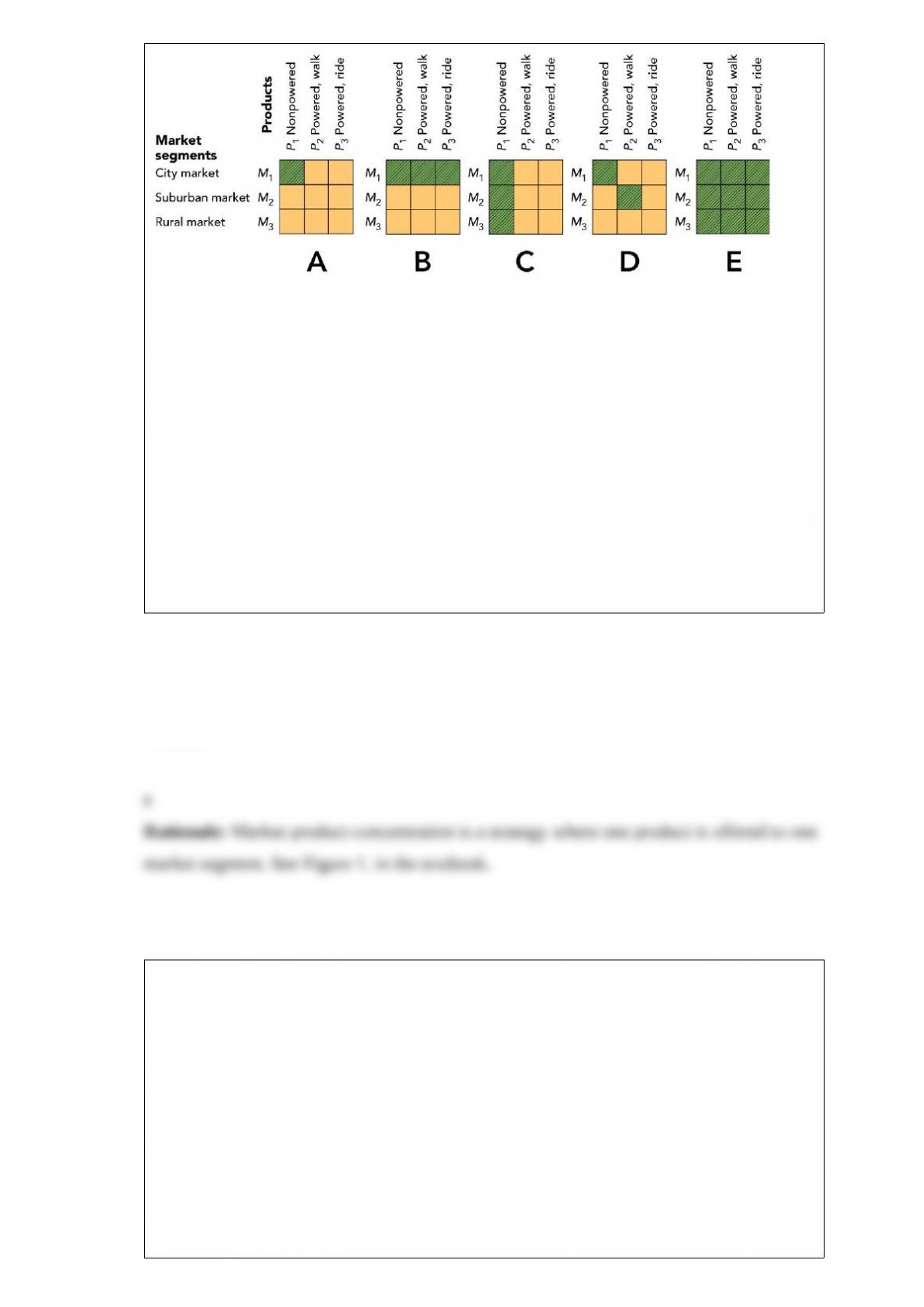
Figure 1.
In Figure 1. above, the market-product grid labeled “A” illustrates which of the
following market-product strategies?
a. full coverage
b. market specialization
c. product specialization
d. selective specialization
e. market-product concentration
Answer:
Which pricing approach complements the demand-oriented pricing strategy of
skimming followed by penetration pricing?
a. cost-plus percentage-of-cost pricing
b. cost-plus fixed-fee pricing
c. standard markup pricing
d. derived demand pricing
e. experience curve pricing
Answer:
Which of the following products would have a fashion product life cycle curve?
a. parabolic skis
b. personal flotation devices
c. razor blades
d. high-top sneakers
e. hockey helmets
Answer:

A university has changed and updated its logo. It now finds needs to order new
stationery and business cards for departments and staff of the university. This purchase
would be a
a. modified rebuy.
b. straight rebuy.
c. new buy.
d. standard reorder.
e. class buy.
Answer:
According to Robert Stephens of the Geek Squad, the biggest complaint about technical
support people is
a. their inability to communicate in laymen’s terms.
b. they are difficult to understand.
c. they take too long to answer the telephone.
d. they lack product knowledge.
e. they are rude and egotistical.
Answer:
The marketing mix refers to
a. the multiple strategies that can be used to promote a product.
b. the controllable forcessocial, economic, technological, competitive, and regulatoryto
which a marketing manager must constantly adapt.
c. the blending of different communication and delivery channels that are mutually
reinforcing in attracting, retaining, and building relationships with consumers who shop
and buy in traditional intermediaries and online.
d. the marketing manager’s controllable factors that can be used to solve marketing
problems.
e. a set of complementary products that when sold together generate more sales than
when sold separately.
Answer:
The AOI marketing team planned a(n) __________ between the Bitter Girls name and
the __________ of the girls in the description of them.
a. positive, supportive connection; dark, “edgy,” sullen nature
b. an empowering connection; typical “tween and teen” characteristics
c. ironic disconnect; bitter, sullen nature
d. similarity; dark, “edgy,” sullen nature

e. deliberate disconnect; positive nature
Answer:
A significant difference between the Mall of America and other regional shopping
centers is that
a. all MOA employees are required to be multilingual because of the store’s
international draw.
b. MOA has twice as much space devoted to specialty stores than to anchor stores.
c. retail store owners can live in attached condominiums, at reduced rates, so they don”t
have to worry about getting to work in bad weather.
d. employees can take classes on the premises offered through a local community
college.
e. employees get a 50% discount at all the food establishments.
Answer:

A graphic presentation of the break-even analysis that shows when total revenue and
total cost intersect to identify profit or loss for a given quantity sold is referred to as a
__________.
a. Gantt chart
b. demand curve
c. ROI analysis
d. cross-tabulation
e. break-even chart
Answer:
John Whitaker works for American Greetings. Included in his job description are the
following responsibilities: (1) stock and arrange point-of-purchase displays of present
customers60 percent of his work week, and (2) receive orders from customers and
complete the transactions40 percent of his work week. Whitaker is primarily engaged in
which type of selling?
a. outside order taking
b. relationship selling
c. inside order taking
d. outside order getting
e. missionary sales

Answer:
Allocating funds to promotion by matching the competitor’s absolute level of spending
or the proportion per point of market share is referred to as __________ budgeting.
a. percentage of sales
b. competitive parity
c. all-you-can-afford
d. objective and task
e. linear forecast
Answer:
Which of the following is an example of green marketing?
a. McDonald’s adding apple snacks to its Happy Meals targeted at children.
b. Lowe’s and Home Depot discontinuing the sale of lumber and other wood products.
c. Levi-Strauss marketing prewashed jeans.

d. Joe’s Lawn Service offering a special spring cleanup promotion.
e. Walmart implementing buying practices that encourage it suppliers to use containers
and packing made from corn, not oil-based resins.
Answer:
The primary purpose of a trademark is to __________.
a. legally protect a product’s brand name or trade name and prevent others from using it
b. allow a company to use the brand name on multiple products in its product line
c. legally identify the product as having met government standards for its product item
d. help consumers identify a genuine product from a counterfeit product
e. capitalize on the brand equity a consumer associates with the symbol, sound, or
image
Answer:

Red Carpet Baby!, a children’s accessory and toy store, is considering expanding the
size of the store. The manager queries its marketing database to understand how a
change in square footage might impact sales. She is performing a(n) __________.
a. marketing action analysis
b. environmental scan
c. situational analysis
d. sensitivity analysis
e. problem search
Answer:
Secret deodorant’s ad, “Strong enough for a man, but made for a woman,” reflected
a. the need to market products to a single gender at a time.
b. highlight that women were just as ‘strong” as men.
c. a bridge of the gap between men and women in terms of market focus.
d. the desire to highlight the differences between genders.
e. a way to capitalize on the sex appeal of a clean scent to attract women.
Answer:

One of the problems associated with self-regulation is
a. the lack of a written code of ethics by firms in the industry.
b. the intrusive enforcement by the FTC.
c. the opportunity corporate for espionage by competitors.
d. the absence of an industry association with the power to use moral suasion.
e. noncompliance by members.
Answer:
In the marketspace, consumers can tell marketers exactly what their requirements are,
making customization of a product or service to fit their exact needs possible. This
means that marketers can use electronic commerce to enhance customer value by
contributing to
a. place utility.
b. form utility.
c. time utility.
d. possession utility.
e. product utility.

Answer:
Which of the following statements about advertising is most accurate?
a. Advertising has limited control as to when and where an advertisement will be used.
b. Advertising allows a firm to reach a mass market.
c. A key advantage of advertising is its ability to use customized interactions.
d. Advertising can be a very effective “attention getter” especially for new products, but
has little impact for repeat buys.
e. Advertising is one of the least costly forms of promotion because it reaches a
pretested market.
Answer:
IBM’s business strategy to help its clients be more efficient, productive, and responsive
to the data generated from the revolution in the global marketplace concerning the
instrumentation and integration of the world’s processes and infrastructures is referred
to as

a. “The IBM Way.”
b. “Smarter Planet.”
c. “Reinvent Business.”
d. “The 2015 Road Map.”
e. “Big Blue.”
Answer: