Which of the following are examples of elements involved in Step 1 of the price-setting
process: identify pricing objectives?
a. profit, market share, and survival
b. estimation of demand, sales revenue, and price elasticity
c. cost estimation, marginal analysis, and break-even analysis
d. demand for the product class and brand, newness of the product, and competition
e. market segmentation targeting, and positioning
Answer:
Short-term price reductions commonly used to increase trial among potential customers
or to retaliate against a competitor’s actions is commonly referred to as a _________.
a. coupon
b. deal
c. sample
d. premium
e. product placement
Answer:
Which type of outlet is most likely in its decline stage of the retail life cycle?
a. single-price stores
b. value-retail centers
c. online retailers
d. business-district retailers
e. convenience stores
Answer:
The Wall Street Journal, CNBC, and Fox Business News
a. provide information on U.S. business, economic and trade activity collected by the
federal government.
b. are portals to all government websites that can be found by topic or keyword.
c. provide information in online databases and an index of blogs by primary topic.
d. are the most popular Internet portals to enter key words or topics for specific
searches.
e. provide up-to-the-minute business news and video clips about companies, industries,
and trends.
Answer:
Which of the following terms best describes the marketing concept era?
a. consumer-oriented
b. production-oriented
c. sales-oriented
d. society-oriented
e. competition-oriented
Answer:
Independent firms or individuals whose principal function is to bring buyers and sellers
together to make sales are referred to as __________.
a. manufacturer’s agents
b. brokers
c. selling agents
d. manufacturer’s branches
e. manufacturer’s sales offices
Answer:
Your product has been suffering from steadily eroding sales. You have tried a number of
options to revitalize the product’s sales and profits, but after seven changes in your
strategy, you have yet to find success. Which of the following actions would be the
LEAST appropriate next step?
a. delete the product from the line
b. retain the product, but reduce its marketing costs
c. stimulate primary demand
d. stimulate selective demand
e. rebrand the product
Answer:
When a firm sells its domestically produced goods in a foreign country through an
intermediary, it is referred to as
a. direct exporting.
b. indirect exporting.
c. licensing.
d. contract manufacturing.
e. foreign assembly.
Answer:
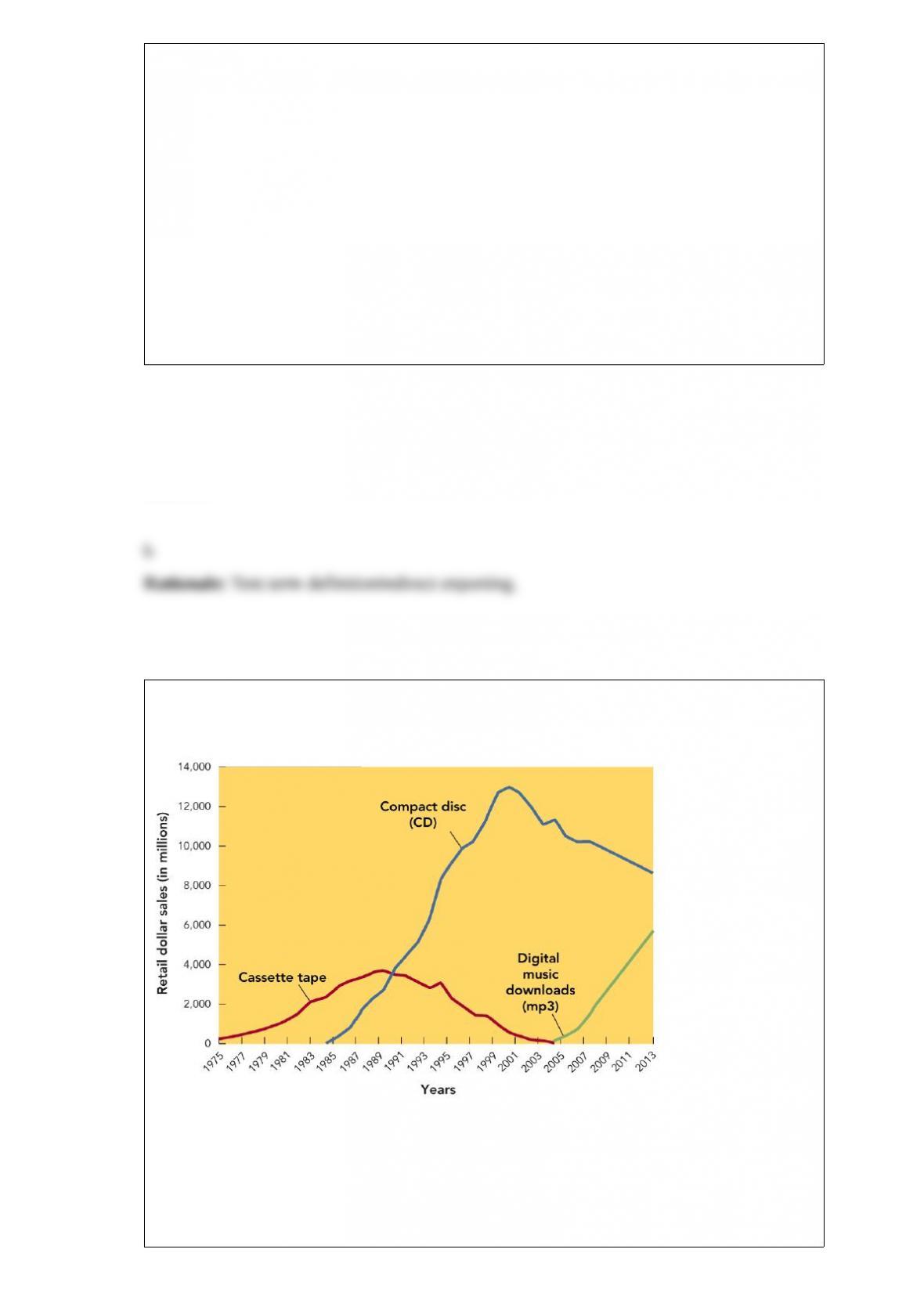
Figure 1.
Figure 1. above shows that in 1983 cassette tapes were in which stage of the product
life cycle?
a. introduction
b. growth
c. maturity
d. harvest
e. decline
Answer:
Source Perrier S.A., the supplier of Perrier bottled water, exercised __________ when it
recalled 160 million bottles of water in 120 countries after traces of a toxic chemical
was found in 13 bottles. The recall cost the company $35 million, and the profit from
$40 million in lost sales. Even though the chemical was not harmful to humans, the
president of the company believed it was his duty to remove “the least doubt, as
minimal as it might be, to weigh on the image of the quality and purity of our product.”
a. moral idealism
b. utilitarianism
c. cause marketing
d. profit responsibility
e. stakeholder responsibility
Answer:
Methods for obtaining nonpersonal presentation of an organization, product, or service
without direct cost, such as news releases, news conferences, and public service
announcements, are referred to as
a. promotional tools.
b. free advertising.
c. public promotions.
d. market-oriented promotions.
e. publicity tools.
Answer:
At one point, people were willing to pay hundreds of dollars on eBay for a Beanie Baby
toy that originally cost a fraction of that amount. Today, those same Beanie Babies can
be found at garage sales all over the country for a less than a dollar apiece. This is most
likely due to
a. faulty craftsmanship in later production batches.
b. a sharp downturn in the economy.
c. the new, more nostalgic fad of bobble-head dolls.
d. too many counterfeit Beanie Babies entering the country.
e. a product becoming a fad and then losing its fad appeal.
Answer:
In a direct channel, all channel functions are performed by __________.
a. retailers
b. wholesalers
c. producers
d. brokers and agents
e. middlemen
Answer:
In the automobile industry, the __________ manager is responsible for translating
customer requirements into actual orders and arranging for delivery dates.
a. marketing
b. information technology
c. intermodal
d. supply chain
e. financial
Answer:
In its research for Disney Online, C&R Research identified a mother who works outside
the home, goes online eight hours per week, and values the convenience of obtaining
information about products and services as the “__________” segment.
a. Yes Mom
b. Mrs. NetSkeptic
c. Tech Nester
d. Passive Under Pressure
e. Drifting Surfers
Answer:
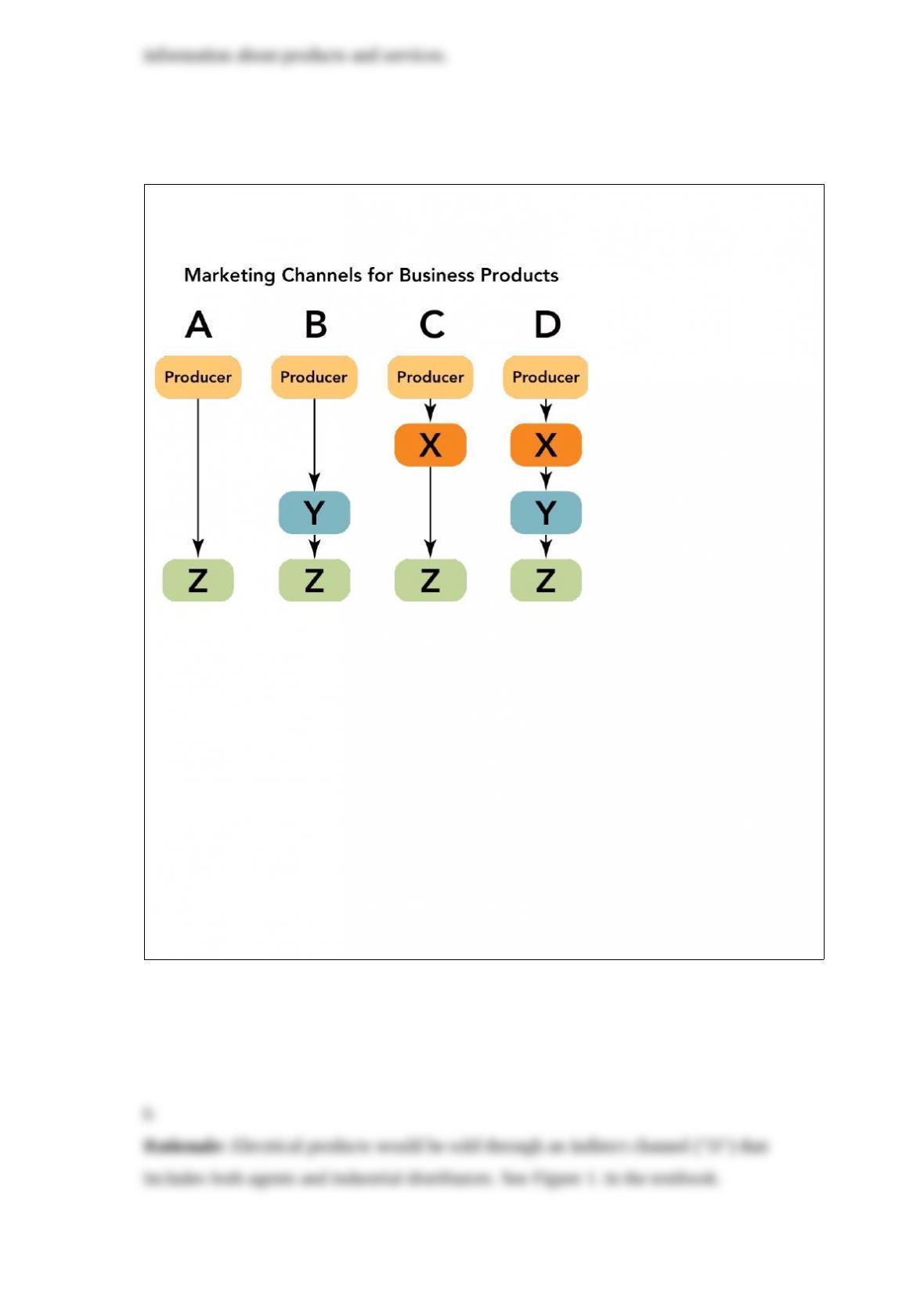
Figure 1.
Figure 1. above depicts the four most common marketing channels for business
products and services. Channel “D” would be an appropriate marketing channel for
__________.
a. supercomputers
b. electrical products
c. Boeing aircraft
d. Caterpillar tractors
e. industrial fasteners
Answer:

Indirect channels for consumer products
a. occur when one firm’s marketing channels are used to sell another firm’s products.
b. include producers and end-users dealing directly with each other.
c. include intermediaries that are between the producer and consumer and perform
numerous channel functions.
d. are arrangements whereby a firm reaches different buyers by employing two or more
different types of channels for the same basic product.
e. occurs when a retailer sells its product in a store and on the Internet.
Answer:
The use of ‘special fees” and ‘surcharges” is driven by consumers’ zeal for low prices
and __________.
a. the ease of making price comparisons on the Internet
b. value, the idea of getting “more” for their money
c. the need for extra accessories
d. avoiding state sales taxes from Internet purchases
e. a dislike of price haggling or negotiating
Answer:
Imagine a small retailer saying, “Well, after budgeting for all of our expenses for next
year, we still have about $7,500 remaining for emergencies. Let’s budget 20 percent of
that amount for advertising.” What budgeting technique is the small retailer using?
a. percentage of sales budgeting
b. competitive parity budgeting
c. objective and task budgeting
d. all-you-can-afford budgeting
e. linear forecast budgeting
Answer:
IBM has adopted a(n) __________ supply chain strategy to better serve its customers.
a. efficient
b. responsive
c. harmonized
d. integrated
e. multi-tiered
Answer:
Step 2 in the planning phase of the strategic marketing process consists of
a. the situation (SWOT) analysis.
b. market-product focus and goal setting.
c. the marketing program.
d. business portfolio analysis.
e. diversification analysis.
Answer:

A group of 50 to 150 stores that typically attract customers who live or work within a 5-
to 10-mile range, often containing two or three anchor stores is referred to as a
__________.
a. power center
b. regional shopping center
c. strip mall
d. central business district
e. urban megacenter
Answer:
Statements of an accomplishment of a task to be achieved, often by a specific time are
referred to as _________.
a. plans
b. procedures
c. strategies
d. core values
e. goals.
Answer:

Wholesalers and retailers that buy physical products and resell them without any
reprocessing are referred to as
a. industrial firms.
b. reseller firms.
c. government agencies.
d. consumer product firms.
e. nonprofit firms.
Answer:
Which of the following statements regarding the Geek Squad is MOST accurate?
a. Men in need of help from the Geek squad do not want women “Geeks” to help them
because it makes them feel inferior.
b. The Geek Squad has exclusive rights to the home-help segment thanks to their
relationship with Best Buy.
c. The Geek Squad can only assist customers who purchase Dell computers.
d. The need for the Geek Squad was the result of many environmental factors, not
simply a need for technological knowledge.
e. Although the Geek Squad brought more customers into Best Buy, the rate of product
returns has only dropped a negligible amount.
Answer:
Which of the following statements regarding quantity discounts is most accurate?
a. Noncumulative quantity discounts encourage large individual purchase orders, not a
series of orders.
b. Noncumulative quantity discounts encourage repeat buying by a single customer to a
far greater degree than do cumulative quantity discounts.
c. Quantity discounts are primarily used to undercut competitors’ prices.
d. Noncumulative quantity discounts encourage smaller long-term repeat purchases
rather than less-frequent, larger short-term purchases.
e. Quantity discounts can basically be used only once with each reseller or the price will
increase.
Answer:
A variation of the case allowance is the __________ approach, whereby retailers
receive some amount of the product free based on the amount ordered, such as 1 case
free for every 10 cases ordered.
a. complementary
b. harmonizing
c. balancing
d. free goods
e. paired
Answer:
Figure 1.
According to Figure 1. above, “C” represents which step in the price-setting process?
a. estimate demand and revenue
b. identify pricing objectives and constraints
c. scan competitors for prices of similar products or services
d. determine cost, volume, and profit relationships
e. establish the price range

Answer:
Experience curve pricing refers to
a. the method of pricing where the price of a product often rises following the
expansion of costs associated with the firm’s producing and selling an increased volume
of the product.
b. the point at which profits double then double again as more consumers buy the
product.
c. a predictive pricing plan based upon the knowledge that the prices will fluctuate in a
predictable pattern within a given industry.
d. a method of pricing based on the learning effect, which holds that the unit cost of
many products and services declines by 10 percent to 30 percent each time a firm’s
experience at producing and selling them doubles.
e. a pricing strategy that uses price estimates based upon the consensus of the salesforce
and the firm’s top management team.
Answer:
The clear, broad, underlying industry or market sector of an organization’s offerings is

referred to as (a) __________.
a. business
b. commerce
c. marketing
d. competitive set
e. product grouping
Answer:
Various product-rating organizations such as government agencies and TV “consumer
programs” are called
a. relational sources.
b. marketer sources.
c. personal sources.
d. public sources.
e. stakeholder sources.
Answer:

Seven Cycles creates __________ in the making of customized bikes for its customers
in 40 countries.
a. time utility
b. form utility
c. place utility
d. possession utility
e. possession and place utility
Answer:
Why did 3M stop production of Scotchgard fabric protector?
a. New advances in fabric manufacturing, such as dirt repellant fibers, made the need
for the product obsolete.
b. The product accidentally violated patent rights of a competitor.
c. Traces of the potentially harmful chemical were found in humans, so the product was
voluntarily halted.
d. New governmental legislation banned the production of one of the product’s
component chemicals.
e. 3M developed a new product that didn’t contain this chemical and which cost less to
produce, resulting in a significantly higher profit margin.
Answer:
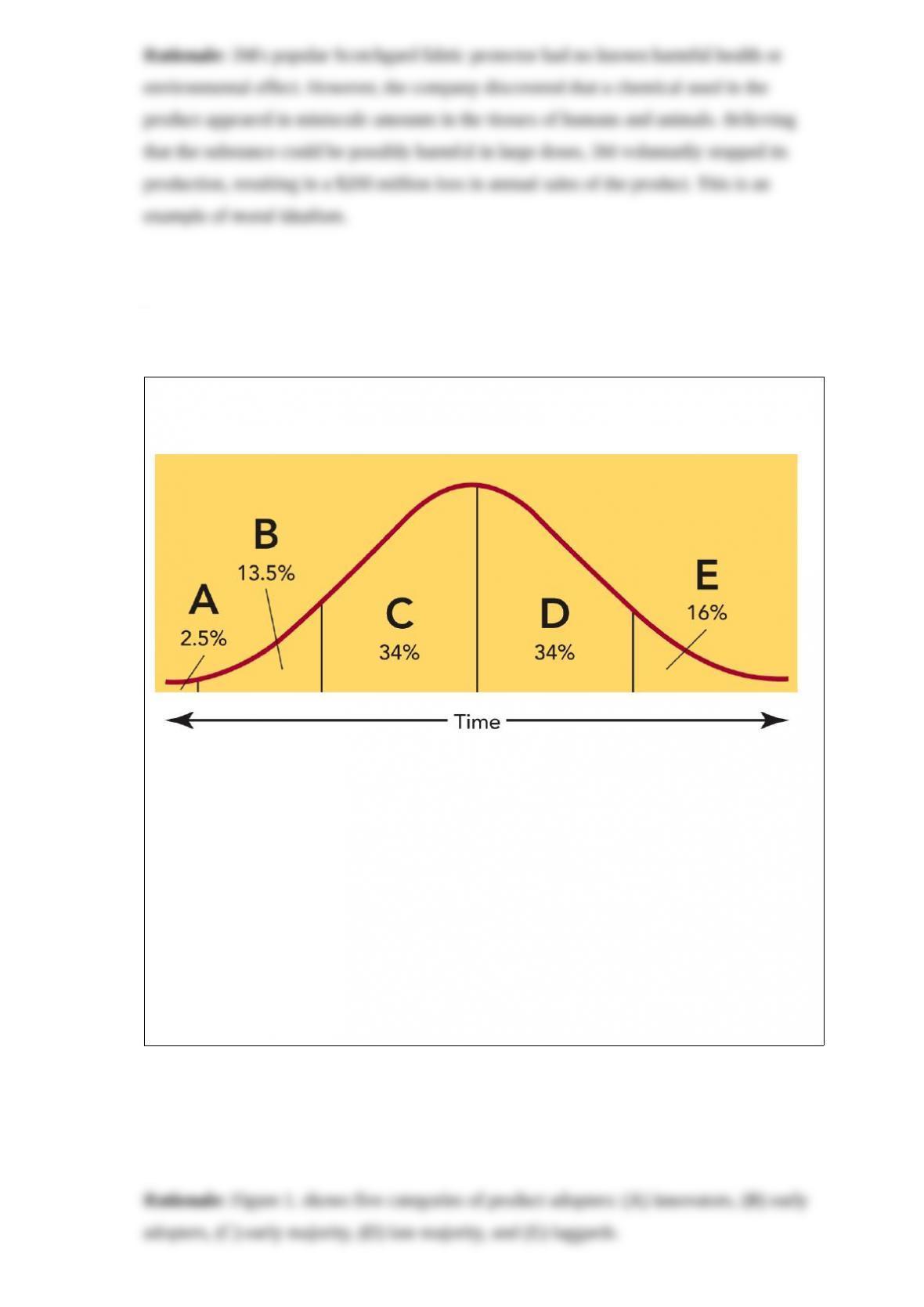
Figure 1.
The consumers represented by “E” in Figure 1. above are called __________.
a. innovators
b. late majority
c. early majority
d. early adopters
e. laggards
Answer:
Generating insights leading to actions based on massive numbers of peoples’ ideas is
called __________.
a. brainstorming
b. groupthink
c. crowdsourcing
d. outsourcing
e. NIH syndrome
Answer:
What is an organization’s mission? What are some elements of a well-written mission
statement?
Answer:
What is the difference between standard charitable contributions and cause marketing?
Answer:
What are social media?
Answer:
Why do some executives feel that environmental factors are NOT entirely outside their
influence?
Answer:
Explain how the wheel of retailing works.
Answer:
Business culture affects ethical behavior in competition. Briefly discuss the two most
common kinds of unethical competitive behavior. In answering, provide concrete
examples for both.
Answer:
List the six reasons why consumers shop and buy online.
Answer:
What are the five steps in a social audit?
Answer:
Briefly explain the differences between the terms supply chain management and the
marketing channel.
Answer:
Name each of the four utilities offered by retailing and with each, identify a retailer that
provides that utility.
Answer:
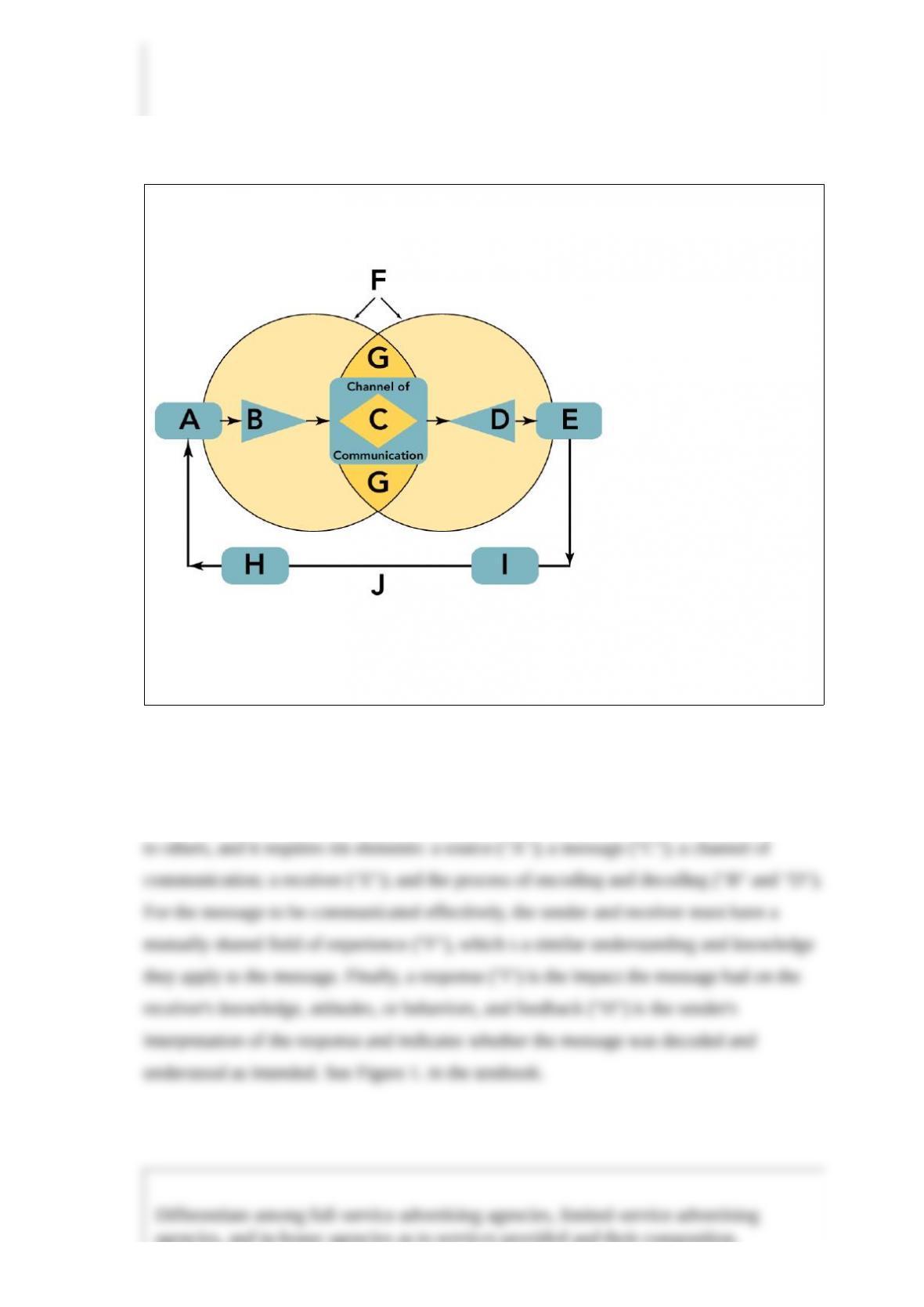
Figure 1.
Figure 1. above depicts the communication process, which consists of ten key elements
(“A” through “J”). Identify and briefly describe each of the ten elements.
Answer:
Differentiate among full-service advertising agencies, limited-service advertising
agencies, and in-house agencies as to services provided and their composition.
Answer:
Explain the marketing program that 3M used to reach the student target market for the
Post-itFlag Highlighter and the rationale used for each element of the marketing mix.
Answer:
Step 1 of the price-setting process identifies pricing objectives and constraints. Describe
the reasons these objectives may change and give examples of objectives a firm may
set.
Answer:
List and define the five dimensions of service quality described in the text.
Answer:
What is loss-leader pricing and why do retailers use it?
Answer:
Management experts call for a “bias for action.” How can this attitude be important in
marketing program implementation?
Answer:
Why is learning important to marketing?
Answer:
Describe the three types of organizational markets and give examples of each.
Answer: