
Economic espionage refers to
A. the destruction of a competitor’s products or services through physical damage of
property or damage to their reputation.
B. persuading someone to act in one’s favor, typically illegally or dishonestly, by a gift
of money or other inducement.
C. an illicit payment made to someone who has facilitated a transaction or appointment.
D. the collection of trade secrets or other intellectual property from foreign countries or
governments.
E. the clandestine collection of trade secrets or proprietary information about a
company’s competitors.
Answer:
The back of a box of Hinode Harvest Blend rice mix suggests cooking with chicken
broth for added flavor. This is an example of
A. using a behavioral learning technique.
B. reducing perceived risk.
C. creating stimulus generalization.
D. using a cognitive learning technique.
E. using an attitudinal learning technique.
Answer:

A __________ product requires little learning by the consumer, and the benefits of the
purchase are readily understood.
A. high-learning
B. fashion
C. fad
D. substitute
E. low-learning
Answer:
A political ad that incorporates a fear appeal would most likely be expressed as
A. religious repercussions after death.

B. disenfranchisement from mainstream society.
C. a lack of patriotic responsibility.
D. a lack of self-respect or self-worth.
E. warnings against the rise of extreme or dangerous ideologies.
Answer:
Which of the following products would have a fad product life cycle curve?
A. women’s hosiery
B. electric cars
C. convection ovens
D. pet rocks
E. sport drinks
Answer:

The lag from ordering an item until it is received and ready for use or sale is referred to
as
A. order cycle time.
B. order handling time.
C. order-to-ship duration.
D. purchase cycle.
E. logistics cycle.
Answer:
Pharmaceutical companies now spend more than $3.4 billion annually on __________
prescription drug advertising to complement traditional personal selling and free
samples directed only at doctors.
A. consumer integrated
B. doctor cohort
C. informational DVD
D. direct-to-consumer

E. customized on-line
Answer:
Which of the following is an inherent weakness of personal selling?
A. difficult to receive good feedback
B. difficult to get media cooperation
C. messages may differ between salespeople
D. easily duplicated
E. can easily lead to promotion wars
Answer:
Which form of retail outlet would most likely offer customers convenience, quality
personal service, and lifestyle compatibility?
A. corporate chain
B. independent retailer
C. administered system
D. contractual system
E. sole incorporation
Answer:
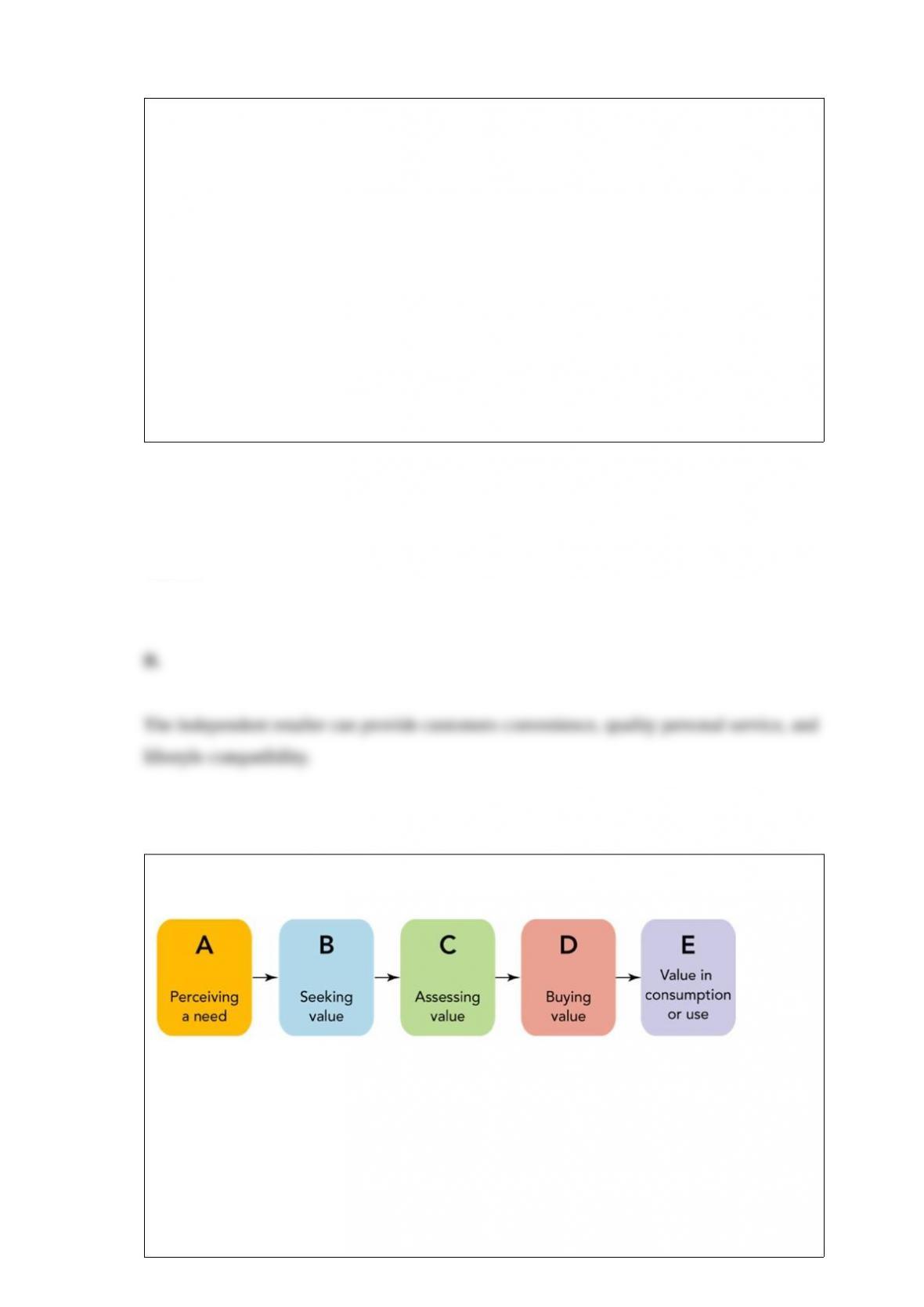
Figure 4-1
In Figure 4-1 above, D represents which stage of the consumer purchase decision
process?
A. purchase decision
B. information search
C. financial transaction
D. alternative evaluation
E. postpurchase behavior
Answer:
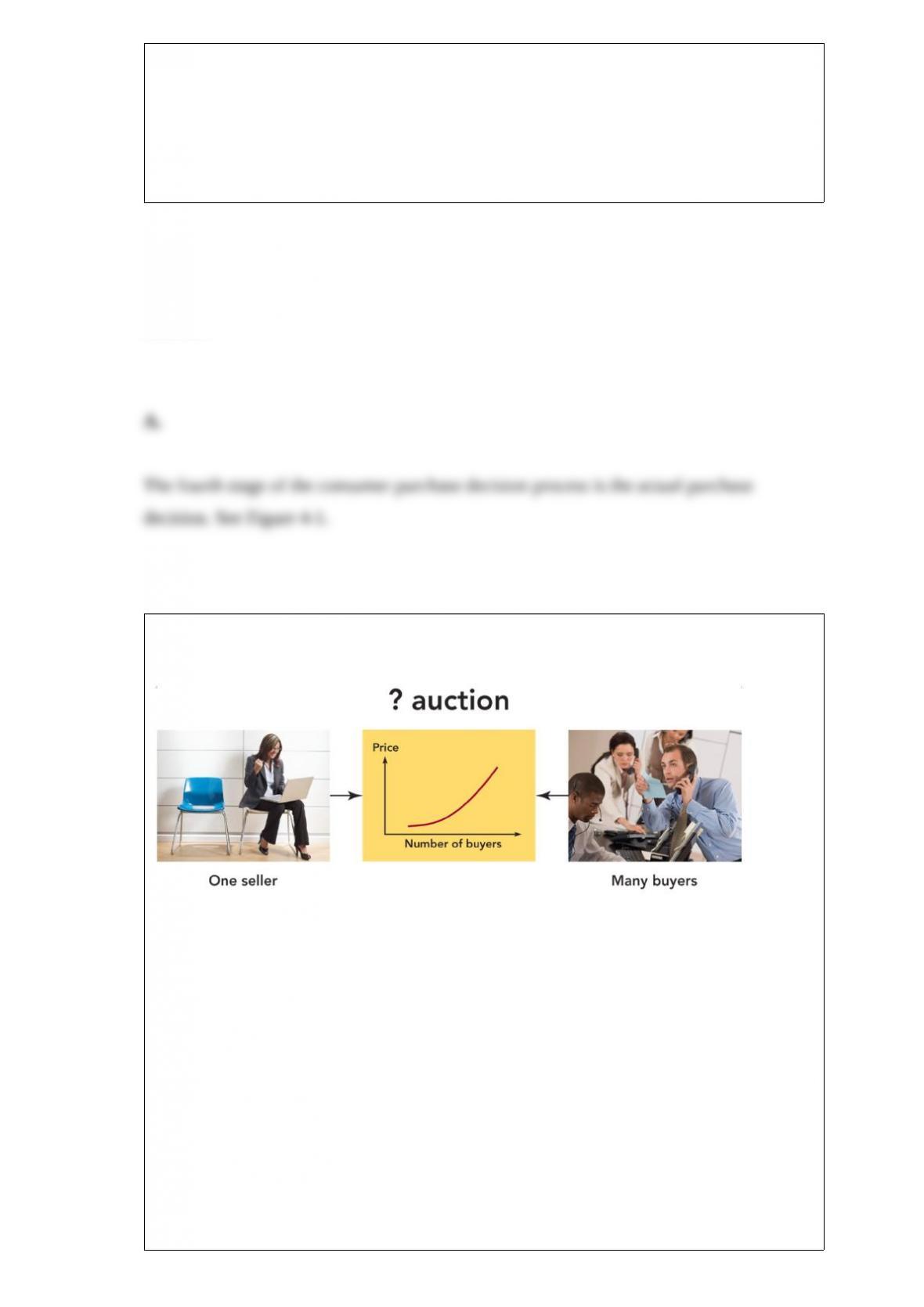
Figure 5-6A
As shown in Figure 5-6A above, what type of online auction does one seller and many
buyers typify?
A. forward auction.
B. reverse auction.
C. traditional auction.
D. vertical auction.
E. bidder’s war.

Answer:
Web 2.0 is based on
A. a technical update of the World Wide Web.
B. the high degree of interactivity among users.
C. the second generation of Internet browsers.
D. the decreased interactivity of user generated content.
E. the second revision of marketer-generated web content.
Answer:
The communication aspect of packaging on a can of Campbell’s soup would most likely
be of the greatest benefit to __________.
A. people in a hurry to get to work
B. people on a tight budget
C. people with dietary restrictions
D. people who are brand loyal
E. people who love to try new things
Answer:
Very infrequent purchases with some comparison shopping are characteristic of the
purchasing behavior for a type of consumer product (such as a thesaurus) that a
prospective buyer may not initially want. This type of consumer service is referred to as
a(n)
A. unsought product.
B. shopping product.
C. convenience product.
D. specialty product.
E. support product.

Answer:
One of the biggest problems online retailers face is that nearly two-thirds of online
shoppers make it to “checkout” and then leave the website to compare shipping costs
and prices on other sites. Of the shoppers who leave, __________ do not return.
A. 30%
B. 40%
C. 50%
D. 60%
E. 70%
Answer:

The PRS group maintains a website that can be used to determine
A. changing demographic and psychographic data for each country in the registry.
B. a country’s political risk ratings using multiple databases of country-specific
information.
C. the tariffs of each country and their relative effect on product and services sales.
D. the rankings of American products relative to domestic equivalents in each country.
E. changing social trends within different segments of the economy.
Answer:
A wholesaler that carries a narrow range of products and performs all channel functions
is referred to as a __________.
A. general merchandise wholesaler
B. truck jobber
C. specialty merchandise wholesaler
D. rack jobber
E. drop shipper
Answer:

The second step of the marketing research approach is to __________.
A. develop findings
B. define the problem
C. take marketing actions
D. develop the research plan
E. collect relevant information
Answer:
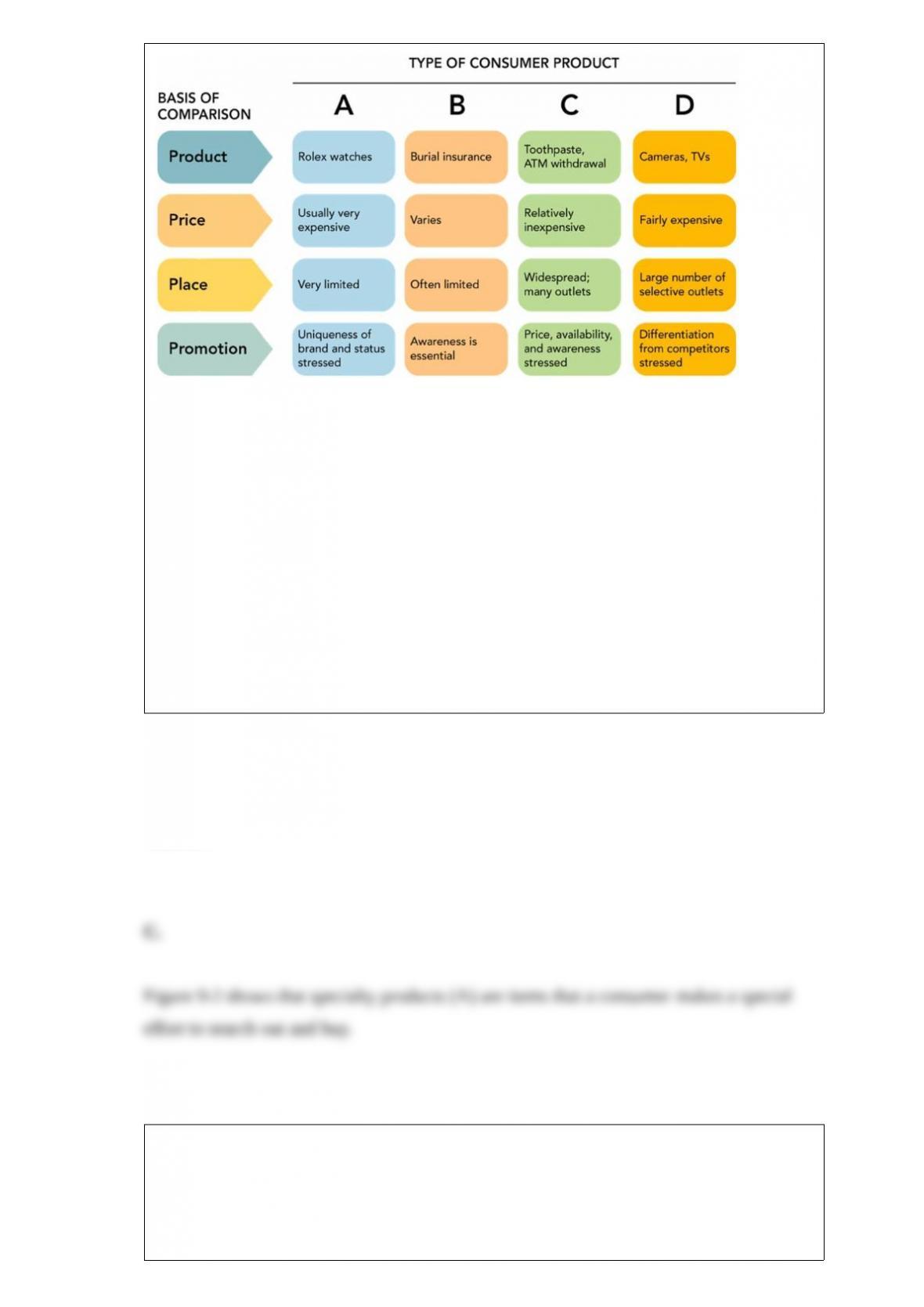
Figure 9-2
According to Figure 9-2 above, column A would represent which type of product?
A. shopping
B. convenience
C. specialty
D. prestige
E. unsought
Answer:
Which of the following is a multiproduct branding strategy?
A. mixed branding

B. product line extensions
C. multibranding
D. brand licensing
E. private branding
Answer:
All of the following are elements in a statement of job qualifications for an for
order-getting salesperson EXCEPT:
A. the physical and mental demands of the job.
B. the customers to be called on.
C. the types of products and services to be sold.
D. to whom a salesperson reports.
E. effective communication and listening skills.
Answer:
Spruceland Millworks in Canada makes wooden pallets for transporting and storing
new appliances such as stoves, freezers, and refrigerators. The demand for Spruceland
pallets would be classified as
A. reactive demand, which is tied to the sales of appliances, not the sale of the pallets.
B. unitary demand, which is tied to the sales of appliances.
C. derived demand, which is tied to the sales of appliances.
D. inelastic demand, which is tied to the cost of the components of the pallets.
E. elastic demand, which is tied to the cost of the components of the pallets.
Answer:

When retailers set prices on new models or styles of products, the price of existing
models often is __________ to quickly sell them.
A. marked up
B. off-priced
C. value-added
D. marked down
E. maintained
Answer:
An “active receiver” who is “delighted” with the brand advertised and sends messages
to her online friends about the brand is referred to as a(n) __________.
A. “expert”
B. “follower”
C. “end-receiver”
D. “traditional consumer”
E. “evangelist”

Answer:
During the planning phase of an IMC program, a firm will __________, specify the
promotion objectives, set the budget, select the right promotional tools, design the
promotion, and schedule the promotion.
A. pretest the promotion
B. identify the target audience
C. state the mission
D. identify possible advertising or promotional firms
E. carry out the promotion
Answer:
Under the concept of the diffusion of innovation, consumers who are venturesome,
highly educated, and use multiple information sources are called what kind of product
adopters?
A. innovators
B. early adopters
C. early majority
D. late majority
E. laggards
Answer:
A box of Cascade dishwasher detergent shrink-wrapped with a bottle of Jet Dry for 10
cents more than the regular price of the dishwasher detergent is an example of
__________ pricing.
A. penetration
B. prestige
C. bundle
D. odd-even
E. standard mark-up

Answer:
New Balance makes the Minimus line of shoes with a Vibram outsole and REVlite
cushioning for those who want to “feel the trail.” Its 1260v2 shoe incorporates
Stabilicore technology to “deliver a plush, smooth, and stable ride.” And its Made in
America, top of the line, 990v3 traditional running/walking shoe uses a “premium
pigskin upper with mesh inserts for breathability, a stability-enhancing ABZORB→
idsole, and ENCAP to promote a healthy gait.” The strategy of appealing to different
types of customers in this way is an example of
A. mass customization.
B. product definition.
C. market segmentation.
D. single chain marketing.
E. market specific selection.
Answer:

A company can protect its competitive position under __________, which gives
inventors of new and novel products the right to exclude others from making, using, or
selling products that infringe on the invention.
A. copyright law
B. patent law
C. trademark law
D. commercial law
E. antitrust law
Answer:
The marketing manager’s controllable factors – product, price, promotion, and place –
that can be used to solve a marketing problem are referred to as(the) __________.
A. marketing concept
B. marketing mix
C. marketing program
D. environmental forces
E. marketing toolbox

Answer:
Frequency marketing is a strategy that focuses on
A. demographics.
B. benefits offered.
C. usage rate.
D. geography.
E. lifestyle.
Answer:
Marketspace refers to
A. the two-way buyer-seller electronic communication in a computer-mediated
environment in which the buyer controls the kind and amount of information received
from the seller.
B. websites that allow people to congregate online and exchange views on topics of
common interest.

C. Internet search engines used for the purpose of data mining.
D. an information- and communication-based electronic exchange environment mostly
occupied by sophisticated computer and telecommunication technologies and digitized
offerings.
E. the blending of different communication and delivery channels that are mutually
reinforcing in attracting, retaining, and building relationships with consumers who shop
and buy in traditional intermediaries and online.
Answer: