Marissa, a college student, and her father, a wealthy businessman, were each
considering the purchase of a new automobile. As a college student with limited
financial resources, Marissa went from car dealer to car dealer in several different cities
searching for the lowest price on a new economy car. She devoted a great deal of time
and energy to getting the best value for her money. For Marissa, an automobile was a
__________.
a. specialty product
b. unsought product
c. discretionary product
d. shopping product
e. convenience product
Answer:
Dependability is the consistency of replenishment. This is important to all firms in a
supply chain and to consumers. It can be broken into three elements: consistent lead
time, complete delivery, and __________.
a. honest and accurate pricing
b. quality products
c. a well-informed delivery staff
d. product warranties
e. safe delivery
Answer:
Southern gardeners normally pay $5 for a 2-cubit-foot bag of pine bark mulch that they
buy at their local gardening-supply and home-improvement stores to keep the weeds
down in their gardens. If the price being charged by a retailer is not within a narrow
range that gardeners feel is appropriate, they will use substitutionsnewspaper, grass
clippings, or some other kind of ground covering. When pricing pine bark mulch, a
garden-supply or home-improvement retailer should use
a. customary pricing.
b. at-market pricing.
c. loss-leader pricing.
d. penetration pricing.
e. bundle pricing.
Answer:
Products (such as tools and repair services) that are used to assist in producing other
goods and services are referred to as __________.
a. components

b. complementary products
c. support products
d. derived products
e. materials
Answer:
The second stage in the hierarchy of effects is __________.
a. interest
b. awareness
c. adoption
d. trial
e. evaluation
Answer:

The online consumer lifestyle segment called “hunter-gatherers”
a. rarely spend money online and use the Internet only as an information source.
b. regularly visit their favorite bookmarked websites and spend the most money online.
c. regard the Internet as a convenient tool for buying music, books, and computer
software.
d. are married couples with children at home who use the Internet like a consumer
magazine.
e. consist of young, affluent single consumers who spend more time online than any
other segment.
Answer:
The Family Talk about Drinking guidebook developed by Anheuser-Busch to help
parents address the topic of underage drinking is an example of
a. consumerism.
b. preemptive marketing.
c. ethical behavior in marketing.
d. the social marketing concept.
e. cause marketing.
Answer:
The group of brands a consumer would consider acceptable from among all the brands
in the product class of which he or she is aware, is referred to as
a. evaluative set.
b. evolved set.
c. consideration set.
d. alternative selection group.
e. aspiration group.
Answer:
One evening while watching TV, your stomach growls. You see an ad for Subway. You
walk to the Subway shop and buy a sandwich, which tastes great. In terms of behavioral
learning, your hunger is a __________.
a. reinforcement
b. cue
c. response
d. prompt
e. drive
Answer:
Another term for gross margin is __________.
a. original markup
b. markdown
c. return on sales
d. discounted price
e. maintained markup
Answer:
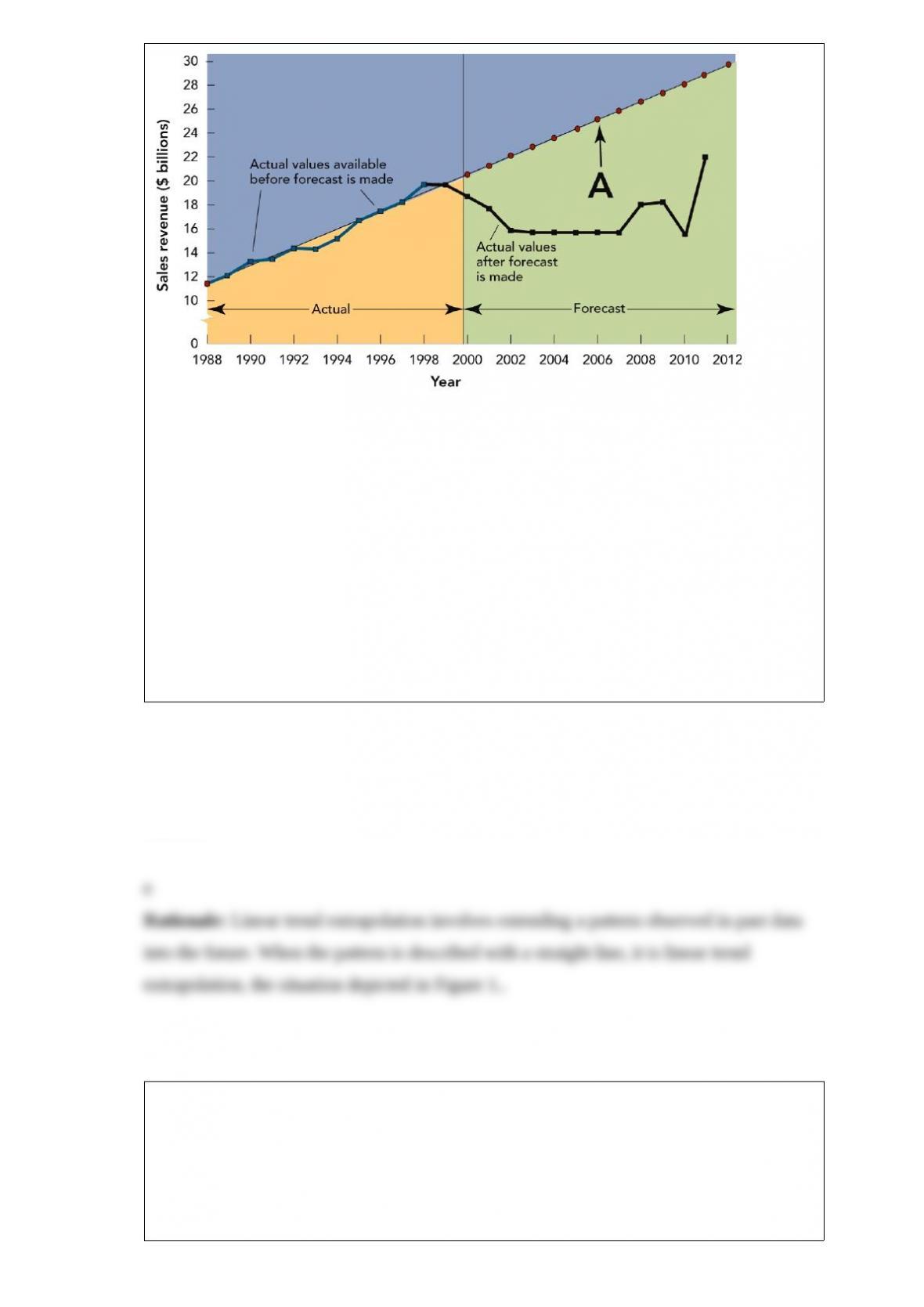
Figure 1.
Figure 1. above depicts what type of statistical forecasting?
a. causal analysis
b. non-parametric regression
c. curvilinear extrapolation
d. infinite dimension
e. linear trend extrapolation
Answer:
Practices that include filing warranty claims after the claim period, misredeeming
coupons, and making fraudulent returns of merchandise are examples of
a. normal and reasonable consumer behavior.
b. unethical practices by consumers.
c. acceptable consumer code of ethics.
d. costs to be passed along to shareholders as a part of doing business.
e. violations of the Consumer Bill of Rights.
Answer:
The most popular loyalty programs today are __________ reward programs.
a. fast food
b. airline travel
c. hotel accommodations
d. credit card
e. grocery store items
Answer:
These senior managers have an increasingly important role in top management because
of their ability to think strategically. Most of them bring multi-industry backgrounds,
cross-functional management expertise, analytical skills, and intuitive marketing
insights to their job. These individuals are referred to as
a. chief marketing officers (CMOs).
b. chief financial officers (CFOs).
c. chief executive officers (CEOs).
d. chief human resource officers (CHROs).
e. chief operating officers (COOs).
Answer:
When Dell sells various laptops, it also pre-installs Microsoft Office and other software
customers order at a discount before a laptop is shipped. This is an example of
a. price lining.
b. product line pricing.
c. bundle pricing.
d. customary pricing.
e. prestige pricing.
Answer:
For marketers, the primary objective of coupons is to __________.
a. increase foot traffic in supermarkets
b. encourage repeat purchases
c. stimulate demand
d. retaliate against competitor’s actions
e. minimize brand-switching
Answer:
Ron had a craving for sushi so he searched yellowpages.com for the name of a
restaurant in his vicinity that serves this type of food. When he arrived at his
destination, he was impressed with the menu posted outside the door and decided to go
in. He was greeted with a smile by a hostess and then immediately seated at a
well-appointed table where he was given a warm cloth for his hands. The food was
beautifully presented, the rice was the perfect texture and temperature, and the fish was
fresh and delicious. Halfway thought the meal, he excused himself to go to the
restroom. It was clean, but unfortunately was out of paper towels. He returned to his
table, finished his meal, and paid his check. The hostess said goodbye and asked him to
return. The first point in his customer contact audit was __________.
a. searching yellowpages.com
b. reading the menu on the door
c. being greeted by the hostess
d. being seated at his table
e. receiving his meal
Answer:
Permission marketing is also referred to as _________.
a. opt-in marketing
b. seller personalization
c. e-mail intermediation
d. e-mail facilitation
e. opt-out marketing
Answer:
During the consumer purchase decision process, an individual at the __________ stage
will perceive differences between his or her ideal and actual situations big enough to
trigger a decision.
a. problem recognition
b. alternative evaluation
c. cognitive dissonance
d. information search
e. postpurchase behavior
Answer:
Even though primary data can be especially valuable to an individual firm, it often
plays ‘second fiddle” to secondary data because
a. secondary data is much more up-to-date and tailored to a specific firm or industry.
b. secondary data, although far more expensive, is also much more reliable.
c. primary data is usually more costly and time consuming to collect.
d. primary data can be accessed by virtually anyone so the information generated loses
much of its value.
e. primary data is less fact and figure based; it is more subjective and therefore more
vulnerable to misinterpretation.

Answer:
Philips Sonicare recently introduced the FlexCare+ rechargeable toothbrush. A key
innovation is a new “gum care” mode that prompts consumers to brush for a full
3-minute cycle for improved gum health. This is an example of which type of
innovation?
a. disruptive innovation
b. continuous innovation
c. discontinuous innovation
d. dynamically continuous innovation
e. evolutionary innovation
Answer:
Support products are items used to assist in producing other goods and services. These
include installations, accessory equipment, supplies, and __________.
a. industrial services

b. components
c. materials
d. derived products
e. complementary products
Answer:
Converting socially responsible ideas into actions involves careful planning and
monitoring of programs. Many companies develop, implement, and evaluate their social
responsibility efforts by means of a(n)
a. social audit.
b. financial audit
c. action plan.
d. tactical plan.
e. research plan.
Answer:

Walmart recently introduced “Pick Up Today” service that
a. offers shoppers a virtual reality shopping experience from their home computers.
b. allows customers to order online and receive free same-day pickup at a local store.
c. allows customers to place lay-away orders online and keep them at the store until
they are fully paid.
d. allows customers to surf the Internet to compare prices; for those that find a better
deal, they can e-mail Walmart and the retailer will honor competitors’ lowest price.
e. allows customers hold online auctions for Walmart overstock or seasonal items that
are being discontinued to make room for new inventory.
Answer:
Data visualization is
a. the visual computer display of the essential information related to achieving a
marketing objective.
b. a road map for the marketing activities of an organization for a specified future time
period.
c. the process of (1) continuously collecting information about customers’ needs, (2)
sharing this information across departments, and (3) using it to create marketing
metrics.
d. a measure of the quantitative value or trend of a marketing activity or result is the
visual computer display of the essential information related to achieving a marketing
objective.
e. the information about an organization’s marketing metrics graphically so marketers
can quickly (1) spot deviations from plans and (2) take corrective actions.
Answer:
All of the following are time periods that the U.S. economy experienced a period of
recession EXCEPT:
a. 1973−1975
b. 1981−1982
c. 1990−1991
d. 2007−2009
e. 2010−2011 (as of late-2011)
Answer:

Three different objectives relate to a firm’s profit, which is often measured in terms of
return on investment. One objective, known as _________, is common in many firms
because the targets can be set and performance measured quickly.
a. managing for long-run profits
b. target return
c. break-even strategy
d. maximizing current profit
e. minimizing risk
Answer:
A product line is a group of product or service items that are closely related because
they satisfy a class of needs, are used together, are sold to the same customer group, and
are distributed through the same type of outlets, or __________.
a. are made of similar components
b. made from the same formulations
c. require high levels of R&D
d. require high levels of R&D
e. fall within a given price range
Answer:
Selling a product to a different market segment usually requires a different marketing
action that in turn means greater costs. If increased revenues don”t offset extra costs of
this action, a marketer should __________.
a. increase the advertising budget
b. prune the product offerings
c. family brand their products
d. combine segments
e. group products into categories
Answer:
A company or person who has information to convey during the communication
process is referred to as a(n) __________.
a. encryptor
b. message carrier
c. originator

d. receiver
e. source
Answer:
Raw materials, such as grain or lumber as well as assemblies or parts, are referred to as
a. production goods
b. components
c. accessories
d. support products
e. raw assemblies
Answer:
A commonly used indirect channel moves product from producer to retailer to
consumer. This channel is used when
a. the cost of maintaining inventory is low.
b. the cost of inventory makes it too expensive to use a wholesaler.

c. there is little if any seasonal demand.
d. the risk lies solely with the manufacturer.
e. the retail outlets are regionally located.
Answer:
The vertical axis of a demand curve graph represents __________.
a. market growth rate
b. relative market share
c. price per unit
d. potential profit in dollars
e. quantity demanded
Answer:
Define marginal analysis.
Answer:
Describe the types of competitive markets and give an example of each one.
Answer:
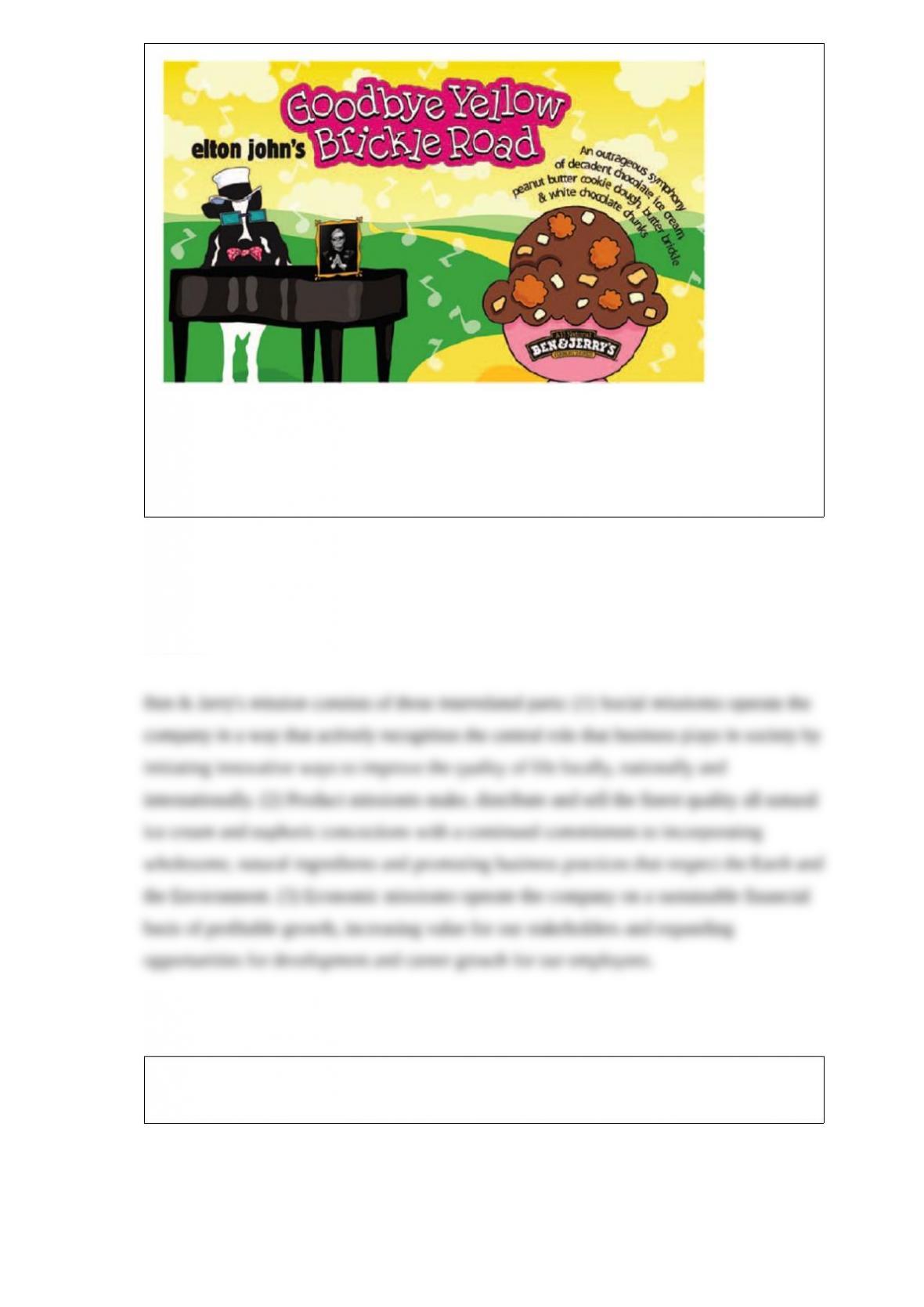
Elton John Image
Ben & Jerry’s introduces products like its Goodbye Yellow Brickle Road ice cream
flavor (see the Elton John image) for a limited time each year as a response to its
mission. Name and briefly describe the three interrelated parts of Ben & Jerry’s mission.
Answer:
Explain the differences between independent e-marketplaces and private exchanges.
Answer:
Explain the difference(s) between the Sherman Act, the Clayton Act, and the
Robinson-Patman Act, all of which were enacted to protect competition.
Answer:
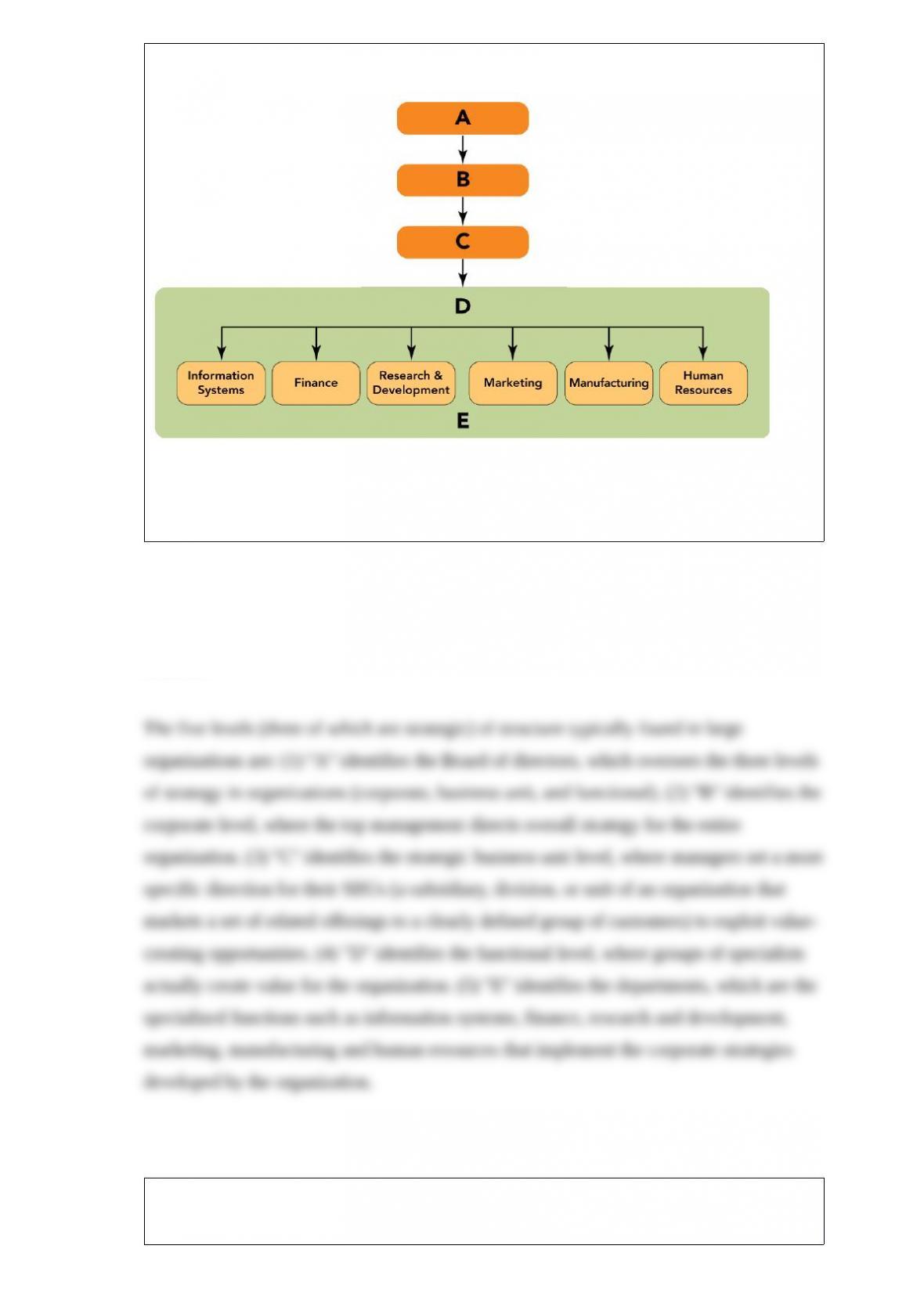
Figure 1.
Using Figure 1. above, identify and briefly describe the five levels in a hierarchical
organizational structure, including the three that are strategic in nature.
Answer:
Why are warranties important from the perspectives of both consumers and
manufacturers?
Answer:
When is skimming pricing an effective strategy?
Answer:
For more than 30 years, Starkist put 6.5 ounces of tuna into its regular-sized can. Today,
Starkist puts only 6.125 ounces of tuna into the same-size can but charges the same
price. Georgia-Pacific reduced the content of its Brawny paper towel six-roll pack by 20
percent without lowering the price. There are two sides to the ethical argument about
this practice: that of consumer advocates and that of manufacturers. What is the practice
called and what is the basic position of each side?
Answer:
Describe the retail life cycle.
Answer:
Describe two different target markets for two different products or services you, your
friends, or your family have recently purchased or used.
Answer:
Briefly describe the two general types of franchises.
Answer:
Explain the difference between societal culture and business culture.
Answer:
Not all Internet users use the technology the same way, nor are they likely to be
exclusive online consumers. What are the six distinct online consumer lifestyle
segments defined by Harris Interactive, the U.S. market research firm?
Answer:
Of what significance to marketing is the family life cycle?
Answer:
What are the strengths/advantages and weaknesses/disadvantages of using direct
marketing in the promotional mix?
Answer:
What are the strengths/advantages and weaknesses/disadvantages of using publicity in
the promotional mix?
Answer:
List the key elements of the promotional mix. Why are they used?
Answer: