Mixed branding refers to a branding strategy in which a firm __________.
a. gives each product a distinct name when each brand is intended for a different market
segment
b. uses different brand names for the same product across multiple countries
c. uses one name for all its products in a product class
d. produces products but sell them under the brand name of a wholesaler or retailer
e. markets some products under its own name(s) and other products under the name of a
reseller because the segment attracted to the reseller is different from its own market
Answer:
The J. D. Power & Associates and other market research firms recruit large groups of
consumers, who are paid to record all of their purchases on a regular basis. Known as
__________, they economically collect data using a paper or electronic diary.
Businesses pay firms like J. D. Power for their reports that answer the question “How
many times did our customers buy our products this year compared to last year?”
a. focus groups
b. experiments
c. syndicated panels
d. syndicated data mining
e. professional respondents
Answer:
The FedEx brand suggests the possibility that it is government sanctioned and fast. This
perception is important because of which unique characteristic of services?
a. inventory costs
b. inseparability
c. inconsistency
d. invisibility
e. intangibility
Answer:
Life insurance companies like Prudential attempt to appeal to a person’s sense of “Don”t
wait until it’s too late.” The purpose of these ads is to convince an individual that his or
her loved ones won”t be able to provide for themselves once he/she is dead. Because of
the consequences of dying without insurance are so grim, the insurance company urges
viewers to act before it’s too late. This is an example of a _________.
a. fear appeal
b. rhetorical appeal
c. life cycle appeal
d. humorous appeal
e. security appeal
Answer:
Derived demand refers to
a. a graph relating the quantity sold and price, which shows the maximum number of
units that will be sold at a given price.
b. the demand for industrial products and services that is driven by the demand for
consumer products and services.
c. the relationship between total revenue and total cost to determine profitability at
various levels of output.
d. the point on a demand curve where supply and demand intersect.
e. the percentage change in quantity demanded relative to a percentage change in price.
Answer:
Product-line pricing involves determining: (1) the lowest-priced product and price; (2)
the highest-priced product and price; and (3) __________.
a. the single most popular item in the line
b. the least vulnerable product in the line
c. the most frequently sold product in the line
d. the most price insensitive product in the line
e. the price differentials for all other products in the line
Answer:
A reminder ad
a. reinforces previous knowledge of a product.
b. assures current users they made the right choice.
c. promotes a specific brand’s features and benefits.
d. tells people what a product is, what it can do, and where it can be found.
e. shows one brand’s strengths relative to those of competitors.
Answer:
The four major types of limited-service merchant wholesalers are drop shippers, rack
jobbers, cash and carry wholesalers, and __________.
a. machine vendors
b. credit line wholesalers
c. transport vendors
d. truck jobbers
e. container transport vendors
Answer:
Setting research objectives and identifying possible marketing actions would take place
during which stage of the five-step marketing research approach?
a. collect relevant information
b. develop the research plan
c. develop findings
d. take marketing actions
e. define the problem
Answer:
There are three general forms of retail ownership: independent retailer, corporate chain,
and __________.
a. dual ownership
b. industry consortium
c. retailing cooperative
d. contractual system
e. multi-national cartel
Answer:
When Philip Morris changed its name to Altria, it ran __________institutional ads to
inform consumers.
a. competitive
b. advocacy
c. pioneering
d. reminder
e. stakeholder
Answer:
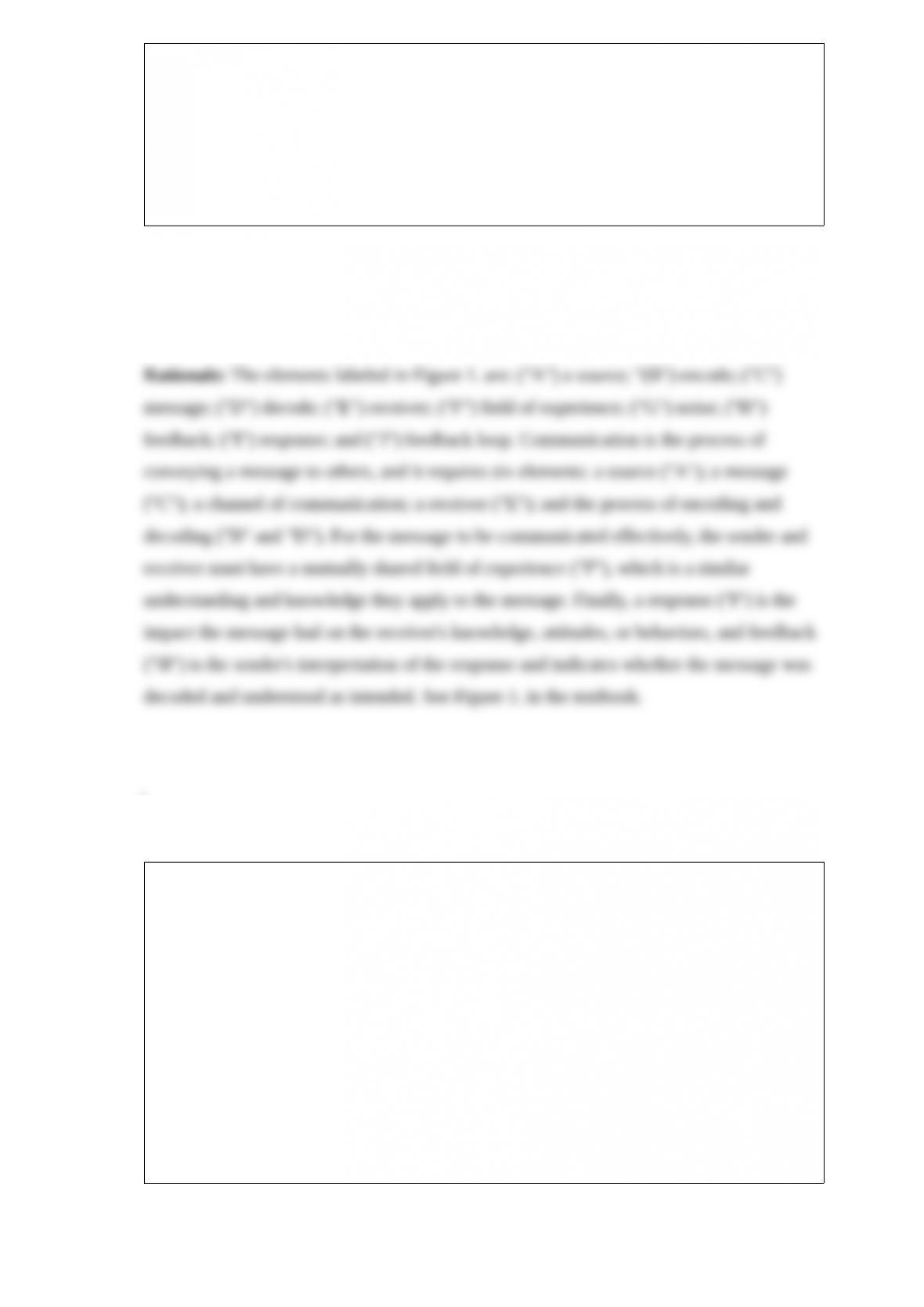
Figure 1.
Figure 1. above depicts the communication process, which consists of ten key elements
(“A” through “J”). The position labeled “E” is referred to as __________.
a. the source
b. the message
c. the field of experience
d. feedback
e. the receiver
Answer:
The sale of brand name merchandise at lower than regular prices is referred to as
__________.
a. discount pricing
b. everyday low pricing
c. markdown pricing
d. off-price retailing
e. loss-leader pricing
Answer:
People who tried a product, were satisfied, and bought it again are called __________
purchasers.
a. replicate
b. recurring
c. reiterate
d. die-hard
e. repeat
Answer:
An “active receiver” who is “delighted” with the brand advertised and sends messages
to his or her online friends about the brand is referred to as a(n) __________.
a. “expert”
b. “follower”
c. “end-receiver”
d. “traditional consumer”
e. “evangelist”
Answer:
Because orders in organizational buying are typically much larger than in consumer
buying, buyers must often __________ when the order is above a specific amount, such
as $5,000.
a. pay estimated sales taxes in advance
b. move up the time required to execute a purchase agreement
c. get competitive bids from at least three prospective suppliers
d. forgo the purchase
e. forgo identifying the members of the supplying center and their roles in the selling
process
Answer:
An example of a smart system is(are)
a. social networking sites at colleges and universities.
b. location-based app downloaded to a GPS-enabled smartphone.
c. global marketing strategies that leverage advertising assets to multiple countries.
d. convergence systems.
e. online retailers.
Answer:
The promotional mix refers to
a. the three underlying appeals used that make promotions effective: (1) sex appeal, (2)
humor appeal, and (3) fear appeal.
b. the combination of both paid and non-paid marketing tools used to promote product
interest.
c. the set of promotional tools designed to motivate prospective buyers to purchase
products and services: (1) awareness, (2) interest, (3) evaluation, (4) trial, and (5)
adoption.
d. the composition of the objectives of the promotion: (1) to inform, (2) to persuade, (3)
to remind, and (4) to phase out.
e. the combination of one or more communication tools used to: (1) inform prospective
buyers about the benefits of the product, (2) persuade them to try it, and (3) remind
them later about the benefits they enjoyed by using the product.
Answer:
Global companies have five strategies for matching products and their promotion
efforts to global markets. Designing a product to serve the unmet needs of a foreign
nation is which type of product strategy?
a. product extension
b. product customization
c. product adaptation
d. product invention
e. product integration
Answer:
If a firm’s marketing dashboard displays a BDI over 100 for a consumer packaged good,
such as General Mills’ Warm Delights Minis, this indicates which of the following?
a. a weak brand position in a segment
b. a strong brand position in a segment
c. above-average product category purchases by a market segment
d. below-average product category purchases by a market segment
e. There is not enough information to make any conclusions.
Answer:
Imagine a confectionary company has introduced a new nutty candy bar during the
1930s (the sales era in U.S. business history). Which of the following statements would
you MOST LIKELY expect management to make if sales of this new candy bar were
much lower than expected?
a. “We”d better do some market testing to determine why people are dissatisfied.”
b. “Perhaps we should make candy bars with raisins.”
c. “Let’s put more aggressive salespeople in the field.”
d. “Let’s lower the price and change the name.”
e. “Don”t worry about it; we”re the largest candy manufacturer in the area. Sooner or
later they”ll get hungry enough that they”ll come to us.”
Answer:
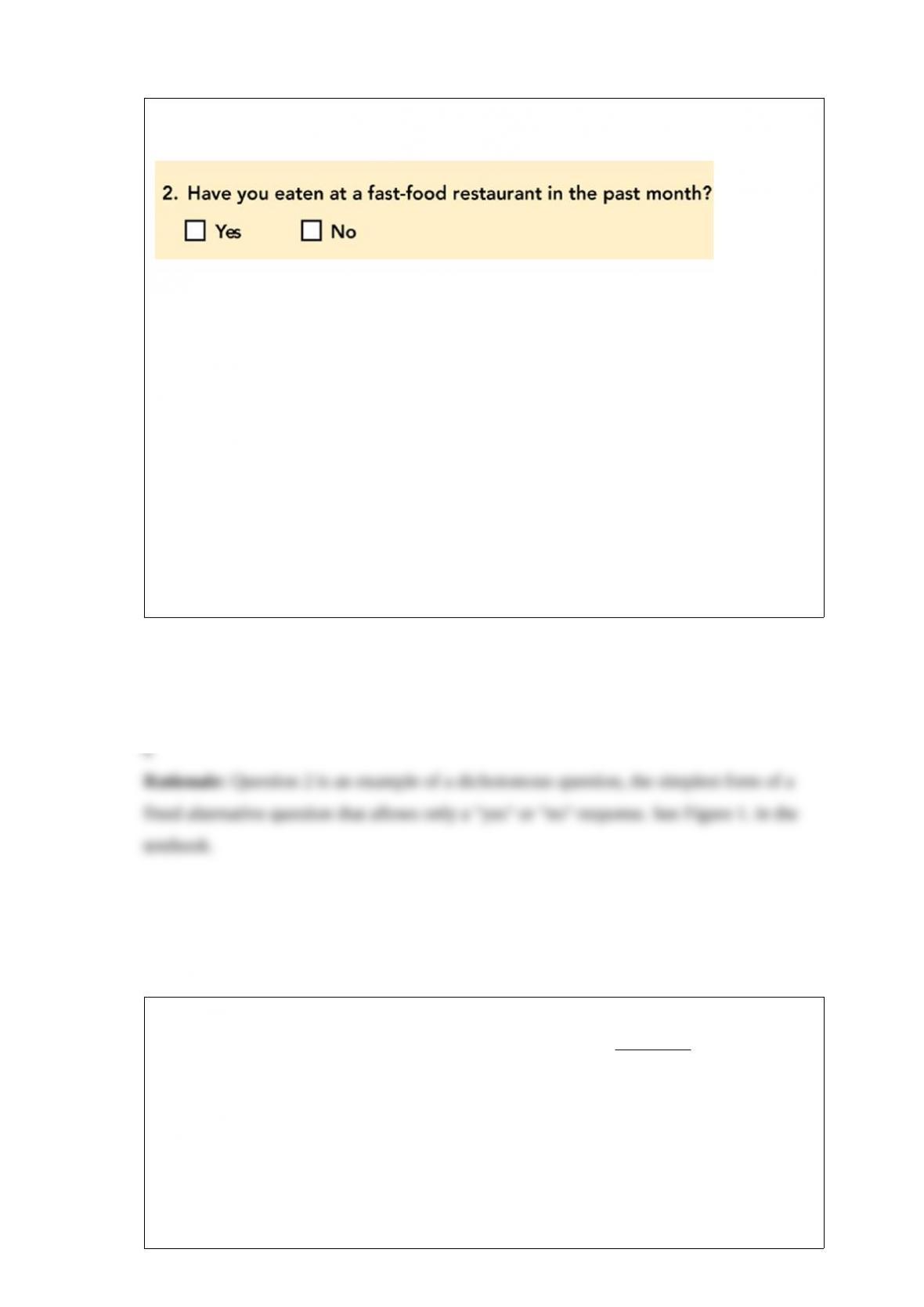
Figure 1.: Question 2
Consider Figure 1.: Question 2 above, which is part of a Wendy’s survey that assessed
fast-food restaurant preferences among present and prospective consumers. Question 2
illustrates which type of question format?
a. dichotomous
b. open-ended
c. Likert scale
d. attitudinal
e. semantic differential
Answer:
All of the following are examples of marketing outcome data EXCEPT:
a. customer phone calls.
b. repeat sales reports.
c. billing records.
d. salespeople’s call reports.
e. sales reports by geographic region.
Answer:
The result of organizations’ efforts to create profiles of customers so that direct
marketing tools, such as e-mail and catalogs, can be directed at specific customers are
referred to as
a. databases.
b. direct order fulfillments.
c. lead generations.
d. first-mover advantages.
e. direct order consignments.
Answer:
The 6 million vending machines currently operating in the United States generate more
than __________ in annual sales.
a. $359 million
b. $985 million
c. $3.8 billion
d. $19 billion
e. $46 billion
Answer:
The primary reason companies have placed an emphasis on buying from minority- and
women-owned suppliers and vendors is because
a. new federal government regulations require it.
b. they can help a firm meet its objectives in sales, profits, and/or customer satisfaction.
c. it is the socially responsible thing to do.
d. it can attract new customer target markets.
e. these companies will work harder for less.
Answer:

Suggestive selling is a form of the __________ presentation.
a. formula-selling
b. stimulus-response
c. needs-satisfaction
d. hard-sell
e. formalized-sales
Answer:
“To remind” is the promotional objective of which stage of the product life cycle?
a. early growth
b. growth
c. accelerated development
d. maturity
e. introduction
Answer:

Effective decision makers develop specific __________, which are criteria or standards
used in evaluating proposed solutions to the problem.
a. standards of accuracy
b. measures of success
c. measures of variability
d. limits of consideration
e. limits of probability
Answer:
Fisher Price watches young children play with their toys to determine if and how
various toys should be changed or improved. Fisher Price is collecting __________
data.
a. observational
b. questionnaire
c. interview
d. on-site
e. focus group
Answer:
A product that requires no new behaviors be learned by consumers is a
a. continuous innovation.
b. discontinuous innovation.
c. dynamically continuous innovation.
d. product transformation.
e. concurrent innovation.
Answer:
Integrated marketing communications is the concept of designing marketing
communications programs that coordinate all promotional activitiesadvertising,
personal selling, sales promotion, public relations, and direct marketingto provide
__________.
a. retailers with cooperative media buys
b. a consistent message across all audiences
c. the firm with a feedback loop
d. a marketing matrix
e. a media mix useful to all types of companies
Answer:
An administered vertical marketing system refers to a marketing system
a. that achieves coordination at successive stages of production and distribution by
contractual agreements between channel members.
b. that achieves coordination at successive stages of production and distribution by
cooperation and consensus among all members of the marketing chain.
c. that achieves coordination at successive stages of production and distribution by the
size and influence of one channel member rather than through ownership.
d. where a channel member (producer, wholesaler, or retailer) is elected to coordinate,
direct, and support all other channel members.
e. that is run and coordinated completely outside the traditional chain of distribution by
a firm that specializes in that industry’s specific logistics needs.
Answer:
By 2050, the world’s population is expected to be __________.
a. 5.0 billion
b. 5.7 billion
c. 6.9 billion
d. 7.9 billion
e. 9.4 billion
Answer:
Regardless of the product or industry involved, the strategy that a firm adopts to
achieve a competitive advantage is referred to as a(n) __________.
a. generic business strategy
b. annual business plan
c. long-range marketing plan
d. marketing action program
e. synergy analysis framework
Answer: