Trading up refers to __________.
a. adding product features but reducing the price
b. changing the distribution channel members to higher-service-quality retailers
c. adding value to the product (or line) through additional features or higher-quality
materials
d. reallocating marketing resources from a performing-poorly target market to one that
demonstrates greater potential for future growth
e. offering consumers a discount when they purchase a more expensive version of the
product
Answer:
To counteract product counterfeiting, the U.S. government passed the __________ in
2006.
a. Counterfeiting Prohibition Act
b. Counterfeiting and Industrial Espionage Act
c. Stop Counterfeiting Act
d. Stop Counterfeiting in Manufactured Goods Act
e. Unauthorized Manufacturing and Copyright Act
Answer:
Much of Google’s success is based on the ten guidelines of its corporate philosophy.
Guideline 2 states, “It’s best to do __________ really, really well.”
a. one thing
b. everything
c. whatever you love
d. what you are afraid of
e. your job
Answer:
Which of the following statements regarding telemarketing is most accurate?
a. Shopping bots are computers that place automated or “robo” (i.e. robotic)
telemarketing calls.
b. Direct-mail is typically viewed as more efficient means of targeting consumers than
telemarketing.
c. Telemarketing has risen in popularity as a result of the National Please-Do-Call
registry legislation.
d. Consumer privacy, industry standards, and ethical guidelines have become important
issues.
e. Some firms are considering shifting their direct-mail and door-to-door budgets to
telemarketing techniques.
Answer:
The first step in any social audit is to
a. evaluate current social responsibility programs.
b. determine the amount of money that can be allocated for societal marketing
programs.
c. recognize a firm’s social expectations and the rationale for engaging in social
responsibility endeavors.
d. identify social responsibility causes consistent with the company’s mission.
e. determine the types of resources needed to achieve social responsibility objectives.
Answer:
All of the following are the four more widely social media networks discussed in the
text EXCEPT:
a. Twitter.
b. YouTube.
c. Facebook.
d. LinkedIn.
e. Groupon.
Answer:
Paul Avery is a salesperson at the only Ford automobile dealership in Wausau,
Wisconsin. However, there are several other auto dealerships in town, offering both
domestic and foreign cars and trucks. Paul works hard to keep his customers satisfied
because he knows that if his customers are unhappy, they can simply buy a car from one
of the several other comparable dealers in Wausau. This is an example of
a. pure competition.
b. monopolistic competition.
c. an oligopoly.
d. a monopoly.
e. marginal competition.
Answer:
Products organizations buy that assist in providing other products for resale are referred
to as __________.
a. reseller goods
b. wholesale goods
c. ancillary products
d. retail products
e. business products
Answer:
Retailing that occurs outside a retail outlet, such as through direct marketing, direct
selling, and automatic vending is referred to as __________.
a. limited-line retailing
b. nonstore retailing
c. scrambled merchandising
d. a hypermarket
e. intertype competition
Answer:
One advantage of using newspapers as an advertising medium is
a. their ability to cover local markets.
b. the long lead time for placing an ad.
c. the long life span.
d. the relatively high cost.
e. competition for reader attention with other features in the newspaper.
Answer:
Although not strictly illegal, the U.S. Justice Department frowns on reciprocity because
the practice
a. gives an unfair advantage to smaller companies.
b. gives an unfair advantage to larger corporations.
c. reduces the amount of taxes paid by the parties involved.
d. restricts the normal operation of the free market.
e. encourages free trade.
Answer:
Figure 1.
The question mark (?) represented by the wedge DBC in Figure 1. above is the
__________.
a. contribution margin
b. marginal trend
c. breakeven point
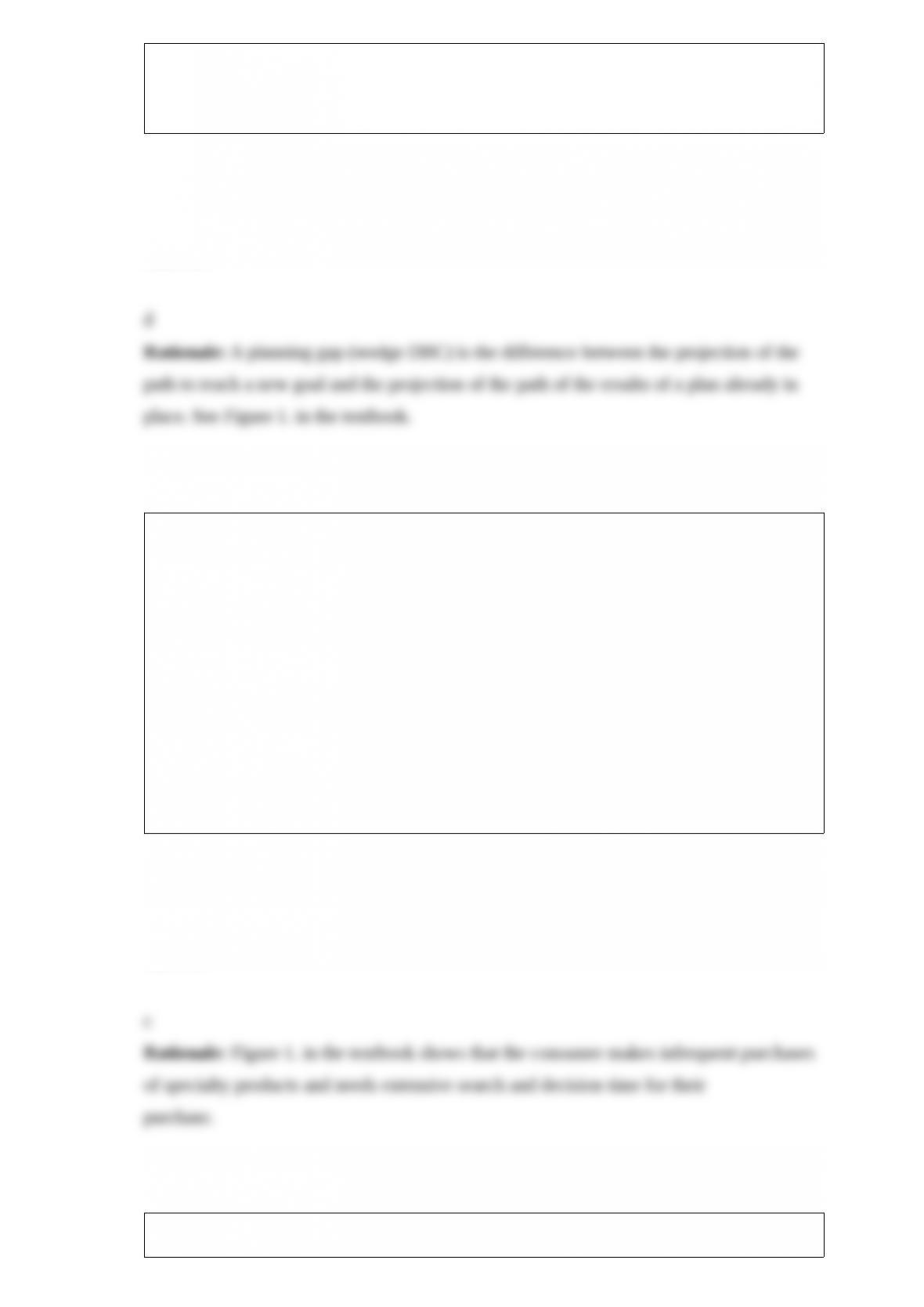
d. planning gap
e. sales differential
Answer:
Which type of consumer product is purchased infrequently and takes an extensive
amount of time to make the purchase decision?
a. convenience product
b. shopping product
c. specialty product
d. unsought product
e. discretionary product
Answer:
Personal selling refers to
a. a seller-directed flow of communications, often in a face-to-face encounter, designed
to promote a product with the purpose of making a sale.
b. an individualized communications program specifically designed for a single
customer because the item being sold is unique to that person.
c. a mass selling approach that has been be tailored to meet the more select needs of a
target market based on age, gender, ethnicity, or occupation.
d. the two-way flow of communication between a buyer and a seller, often in a
face-to-face encounter, designed to influence a person’s or group’s purchase decision.
e. any spoken (rather than visual or print) attempt to promote a product for the purpose
of making a sale.
Answer:
The view that an organization has an obligation to those who can affect the achievement
of its objectives is referred to as _________.
a. social responsibility
b. value consciousness
c. benefit marketing
d. stakeholder responsibility
e. profit responsibility
Answer:
Which of the following statements about brand loyalty is most accurate?
a. Learning has little affect on brand loyalty because most habits are instinctual.
b. Brand loyalty increases the perceived risk associated with impulse purchases.
c. The incidence of brand loyalty is steadily rising in North America.
d. Brand loyalty results from the positive reinforcement of previous actions.
e. The best way to enhance brand loyalty is to brand all new products with the same
brand name.
Answer:
Cash and carry wholesalers
a. handle bulky items like lumber, bricks, and telephone poles.
b. handle perishable items like flowers, baked goods, and deli meats.
c. handle office supplies, electrical supplies, hardware products, and groceries.
d. are a kind of full-service wholesaler.
e. lease vending machines to merchants and refill them as needed on a cash only basis.
Answer:
The __________ is the unique identification number that defines an item for ordering or
inventory purposes.
a. unique stock mark
b. QR code
c. stock keeping unit
d. order quantity code
e. NAICS stock code
Answer:
Which type of consumer product is purchased relatively infrequently and takes some
time to make the purchase decision because the consumer needs much comparison
shopping time?
a. convenience product
b. shopping product
c. specialty product
d. unsought product
e. discretionary product
Answer:
Managers often use two special indexes to help identify strong and weak market
segments in order to provide direction for marketing efforts. The two indexes are (1)
__________ (CDI) and (2) brand development index (BDI).
a. category development index
b. consumer development index
c. competitive development index
d. channel development index
e. customization development index
Answer:
Economists would most likely recommend that marketing managers allocate the firm’s
marketing resources to the markets and products where
a. the firm has its greatest sales.
b. an SBU is considered a cash cow.
c. there is the greatest current market share and the fastest industry growth rate.
d. the excess of incremental revenues over incremental costs is greatest.
e. total revenue equals total cost.
Answer:
STAT-USA and the U.S. Census Bureau
a. are depositories of information on U.S. business, economic and trade activity
collected by the federal government.
b. are portals to all government websites that can be found by topic or keyword.
c. provide up-to-the-minute business news and security prices plus research reports of
companies, industries, and countries.
d. are the most popular Internet portals to enter key words or topics for specific
searches.
e. access information in online databases and blogs by primary topic.
Answer:
When Marine Midland Bank sent market researchers with surveys door-to-door in the
neighborhoods surrounding its branch banks to ask people with savings accounts why
they did not also have checking accounts and credit cards with Marine Midland, they
were gathering __________ data.
a. intercept
b. secondary
c. questionnaire
d. observational
e. nonprobability
Answer:
According to Vizio, “The whole goal is to ensure that we have the right product, at the
right time and the right price and __________.”
a. forever rid the world of plugs and wires
b. create customer value that is unmatched in the industry
c. deliver it to the right people
d. at the right place
e. drive a seamless end-to-end value chain
Answer:
The __________ stage of the product life cycle is characterized by the appearance of
competitors.
a. decline
b. maturity
c. introduction
d. growth
e. harvest
Answer:
Which of the following is a profit-oriented pricing method?
a. target return-on-sales pricing
b. loss leader pricing
c. above-, at-, or below-market pricing
d. price lining
e. penetration pricing
Answer:
A penetration pricing policy is MOST LIKELY to be effective when: (1) a low initial
price discourages competitors from entering the market; (2) unit production and
marketing costs fall dramatically as production volume increases; and (3) __________.
a. lowering the price has only a minor effect on increasing sales volume and reducing
unit costs
b. when the high initial prices do not attract competitors
c. when customers interpret high prices as signifying high quality
d. many segments of the market are price sensitive
e. customers are willing to buy immediately at the high initial price
Answer:

Which of the following is a demand-oriented approach to pricing?
a. customary pricing
b. target profit pricing
c. standard markup pricing
d. bundle pricing
e. service-oriented pricing
Answer:
An example of a marketer-dominated source of information consulted during an
external search would include
a. personal experience.
b. Consumer Reports magazine.
c. consumer programs on talk radio stations.
d. friends and relatives.
e. point of purchase displays.
Answer:
Marketers are increasingly using online surveys to collect primary data. The reason is
that
a. response rates are higher because consumers do not feel intimidated.
b. the quality of responses is better with online surveys than they are with paper-pencil
questionnaires.
c. most consumers have an Internet connection and an e-mail account.
d. consumers rarely view e-mail surveys as junk mail.
e. consumers want to be helpful so they complete the survey multiple times.
Answer:
There are several ways of providing consumers authentic offerings: (1) facilitate
customization; (2) provide personal interaction rather than automation; (3) __________;
and (4) manage any dimension of their reputation that might influence perceptions of
authenticity.
a. allow for adaptability at every customer contact point
b. back up claims with scientific research, market research, or governmental
documentation
c. do thorough research at each stage of the new-service development process
d. obtain personal endorsements from celebrity spokespeople and other opinion leaders
e. create a social process that allows consumers to share their interests
Answer:
A promotional allowance refers to
a. a one-time discount that must be used within a certain time frame or it expires.
b. the cash payments or an extra amount of “free goods” awarded sellers in the
marketing channel for undertaking certain advertising or selling activities to promote
the product.
c. the return of money based on proof of purchase.
d. short-term price reductions when consumer demand takes a significant and
unexpected dip.
e. incentives, such as trips, cruises, jewelry, etc., presented to brand-loyal customers.
Answer:
The value to consumers that comes from making an item easy to purchase through the
provision of credit cards and financial arrangements constitutes _________ utility.
a. time
b. place
c. market
d. possession
e. form
Answer:
The terms __________ and a mission statement are often used interchangeably.
a. idea
b. objective
c. vision
d. goal
e. protocol
Answer:
Identify and describe the factors a company should consider in order to do a thorough
cross-cultural analysis. In your answer, be sure to define cross-cultural analysis.
Answer:
There are ten general product and service categories that dominate online consumer
buying today and for the foreseeable future. List the top five and give an example of
each.
Answer:
How could a firm use a test market in its new-product process?
Answer:
What is a customer contact audit? Outline the contact audit for a typical visit to your
dentist.
Answer:
Explain the difference between relationship selling and partnership selling.
Answer:
Describe the different ways to classify a “new” product.
Answer:
Assume you are a salesperson for a direct marketing firm that does “in-home”
Tupperware parties. If most of your hosts or hostesses hold only one party a year, what
strategies could you use to build strong customer relationships? If you are creating your
own business for this example, make sure to describe your product(s) in your
introductory sentence.
Answer:
Explain what synergy analysis is and describe the five marketing strategies that result.
Answer:
The Consumer Goods Pricing Act, the Sherman Act, the Federal Trade Commission
Act, and the Robinson-Patman Act all address different aspects of deceptive pricing.
Select one example for each act and explain which aspects of the practice would be
considered illegal.
Answer:

“A signal that the world’s trading nations are committed to open marketsand will resist
protectionismwould inject confidence and energy into our markets,” says the U.S. Trade
Representative. Discuss this statement.
Answer: