
Included among the contractual modes of international market participation are:
a. licensing.
b. management contracts.
c. exporting.
d. all of the above
e. both (a) and (b)
A model of “lead efficiency” is calibrated using the firm’s:
a. historical sales lead and lead conversion-to-sale data.
b. total number of sales booths at past shows.
c. gross margin.
d. all of the above.
e. (a) and (c) only.
Concerning segmentation criteria, _____ refers to the degree to which information on
the particular buyer characteristic exists or can be obtained.

a. measurability
b. accessibility
c. substantiality
d. responsiveness
e. enforceability
A penetration policy is appropriate when there is:
a. a strong threat of imminent competition.
b. inelastic demand.
c. an opportunity for a substantial reduction in production costs as volume expands.
d. all of the above
e. (a) and (c) only
When a salesperson attains rewards on a personal basis, such as feelings of
accomplishment or self-worth, this is a an example of:
a. internally mediated rewards.

b. externally mediated rewards.
c. job satisfaction.
d. aptitude.
An industrial firm’s first encounter with an overseas market usually involves _____
because it involves the least commitment and risk.
a. contracting
b. licensing
c. exporting
d. franchising
e. a turnkey operation
The sales resource grid indicates that a particular territory (planning and control unit)
possesses low PCU opportunity but high sales organization strength. This suggests
which of the following sales resource assignments?
a. Invest a high level of sales resources to take advantage of opportunity.
b. Invest a minimal level of sales resources; selectively eliminate resource coverage;
possible elimination of PCU.

c. Either direct a high level of sales resources to improve position and take advantage of
opportunity or shift resources to other planning and control units.
d. Invest a moderate level of sales resources to maintain current position.
From the customer’s perspective, relationship quality centers on:
a. the sensitivity of the salesperson in understanding how business conditions affect the
industry within which the buying firm operates.
b. the ability of the salesperson to understand the selection criteria of each member of
the buying center.
c. trust in the salesperson.
d. satisfaction with the salesperson.
e. both (c) and (d)
Despite the advantages, some firms are reluctant to use third party logistics firms
because:
a. of the diminished direct contact with customers.
b. they lose direct control of the logistics process.

c. of the problems associated with terminating internal operations.
d. all of the above
e. (b) and (c) only
Which of the following are interrelated evaluations that are required to design a
marketing strategy?
a. How much should be spent on marketing in the planning period?
b. How are marketing dollars to be allocated?
c. Within each element of the marketing strategy, how should dollars be allocated?
d. Which segments, products, and geographic areas are most profitable?
e. All of the above.
This strategy for the new product development process views product development as a
highly uncertain path and speed comes from multiple design iterations, extensive
testing, and a powerful leader who can keep the product teams focused. This describes
the _____ strategy.
a. induced
b. experiential

c. autonomous
d. compressed
e. funnel
Strategies that would be appropriate for an “out” supplier to follow in dealing with a
well-satisfied customer in a straight rebuy situation include:
a. attempting to gain a position on the organization’s preferred list of suppliers.
b. demonstrating to the organization that the potential benefits of reexamining
requirements and suppliers exceed the costs of doing so.
c. convincing organizational buyers that their purchasing requirements have changed or
that the requirements should be interpreted differently.
d. all of the above
e. (b) and (c) only
Relationship efficacy
a. relates to the longevity of the relationship between a buyer and seller
b. is created by interactions at the top levels of the two firms involved in a relationship

c. refers to the ability of an interfirm relationship to achieve desired objectives.
d. is not required if the firms are in an arms-length relationship
e. none of the above
The industrial distributor:
a. takes title to the product sold.
b. occasionally does some assembly and manufacturing work.
c. provides delivery.
d. all of the above
e. (a) and (b) only
Which dimension of the product market definition considers the distinct customer needs
that must be served?
a. Customer function.
b. Technological.
c. Customer segment.

d. Value-added system.
A ____ establishes the distinct arena in which the business marketer competes.
a. target market
b. product market
c. market segment
d. competitive analysis
Many U.S. manufacturers have adopted the just-in-time (JIT) purchasing principle.
Concerning this trend, all of the following statements are accurate except:
a. One objective of a JIT system is to eliminate waste of all kinds from the production
process.
b. Because JIT attempts to relate purchases to production requirements, the typical
order size increases.
c. A significant effect of JIT purchasing has been the drastic reduction in the number of
suppliers utilized by manufacturers.
d. Suppliers find that relationships with JIT customers are longer lasting.

e. both (b) and (c)
A _____ sales organization is especially appropriate when the product line is large or
diverse.
a. geographical
b. product oriented
c. market centered
d. none of the above
Successful global companies achieve unified action by:
a. establishing a strategies that are independent across countries.
b. developing accounting systems that are country specific.
c. encouraging personal relationships and the transfer of learning among subsidiary
managers across locations.
d. all of the above.

Which of the following would be classified as foundation goods?
a. fixed equipment
b. operating supplies
c. buildings and land rights
d. maintenance and repair services
e. both (a) and (c)
The characteristic of a sales territory that refers to the degree to which potential is
available in the larger accounts in a particular territory is called:
a. potential.
b. critical mass.
c. concentration.
d. workload.

The balanced scorecard uses which of the following perspectives to measure firm
performance?
a. Financial.
b. Customer.
c. Internal business processes.
d. Learning and growth.
e. All of the above.
The technique for linking a manufacturer’s operations with those of all its strategic
suppliers and its key intermediaries and customers to enhance efficiency and
effectiveness is called:
a. relationship marketing.
b. supply chain management.
c. global marketing.
d. consumer marketing.

The level of marketing control that examines whether the strategy is being implemented
as planned and whether it produces the intended results is termed:
a. strategic control.
b. annual plan control.
c. strategic component control.
d. profitability control.
e. incremental control.
Among technology adopters, these customers are ever-present critics of the hype
surrounding high-technology products.
a. technology enthusiasts.
b. visionaries.
c. pragmatists.
d. conservatives.
e. skeptics.
_____ cater to a broad array of industrial goods.

a. Specialists
b. General-line distributors
c. A combination house.
d. none of the above.
Because of the technical complexity of the product, the difficulty of evaluating
alternatives, or the unpredictable aspects of dealing with a new supplier, this type of
buying decision involves the greatest level of uncertainty.
a. complex modified rebuy decision
b. strategic modified rebuy decision
c. judgmental new task decision
d. strategic new task decision
e. lost-for-good decision
Responsibilities for distributors include:
a. making products available.

b. repair.
c. providing service and technical advice.
d. All of the above.
e. Only a and b.
Which method for determining advertising expenditures focuses on the communications
effects of advertising, not on the sales effects?
a. affordable
b. percent-of-sales
c. match competitors
d. objective-task
e. arbitrary
Which of the following issues pose challenges to business marketers considering
strategic alliance as a market entry mode?
a. Problems with maintaining alliances over time.
b. Difficult to implement alliances on a global scale.

c. Problems establishing coordination and trust.
d. All of the above.
e. (a) and (c) only.
Examples of product measures for efficiency and effectiveness control include which of
the following?
a. Sales by market segments.
b. Logistics costs by logistics activity by channel.
c. New accounts per time period.
d. All of the above.
e. Only (a) and (c).
The purchase of an expensive piece of material handling equipment would be classified
as:
a. a new task buying situation.
b. a modified rebuy.

c. a straight rebuy.
d. any of the above.
e. none of the above.
Functional areas other than marketing directly or indirectly affect which of the
following ?
a. Product marketing decisions
b. Price marketing decisions
c. Promotion marketing decisions
d. Distribution marketing decisions
e. All of the above are affected
Marketing strategies can fail if business marketers do not consider the needs and
capabilities of their intermediaries. What are the key factors in effectively motivating
channel members?

Answer:
n/a
Developing a bidding strategy is the important first step in planning for competitive
bidding.
The two critical elements of the distributor’s function are to secure financing and have
products readily available.
SCM requires____________________not only among departments within the
organization but also with external partners.

A firm developed a new component part (i.e., a timing mechanism) that can be
effectively used in dishwashers, automobiles, toys and medical equipment. Describe the
process that the firm might follow in measuring the elasticity of demand for the new
product. Is it likely to vary by application?
Answer:
n/a
Total cost of ownership illuminates exactly what activities are associated with serving a
particular customer and how these activities are linked to revenues and the consumption
of resources.
The implementation of supply chain management (SCM) by business marketers
requires strong relationships, shared information, common goals aligned with common
strategies, and integration between functions and across firms. What are some possible
barriers or challenges to successfully implementing SCM given these and other
requirements?
Answer:
n/a

The bowling alley represents a stage in the adoption life cycle where a product gains
acceptance from selected groups of customers within the mainstream market but has yet
to achieve widespread adoption. Describe the strategy that the business marketing firm
should follow at this stage in the technology adoption life cycle. Next, explore the
factors that trigger a tornado in high-tech markets and discuss how the focus of strategy
changes during this chaotic phase.
Answer:
n/a
Research has shown that creators of successful product portfolios do not invest in one
version of the future but use several low-cost probes to create options.
Research indicates that manufacturers typically earn a very high percentage of gross
profits from the aftermarket, though it accounts for a very much smaller percent of
revenue
The number of sales leads obtained at a trade show divided by the total number of show

visitors with definite plans to buy the exhibitor’s product or one similar to it describes
the concept of____________________.
Responsibility charting is an approach that can classify decision-making roles and
highlight the multifunctional nature of business marketing decision making.
In the hierarchy of strategies, the three major levels of strategy are corporate,
business-level, and functional.
Rather than adopting the approach of “one design fits all,” the astute marketer matches
the strategy to the product and market conditions that surround a particular account.
Describe the product and market conditions that support a collaborative relationship? a
transactional relationship?
Answer:
n/a
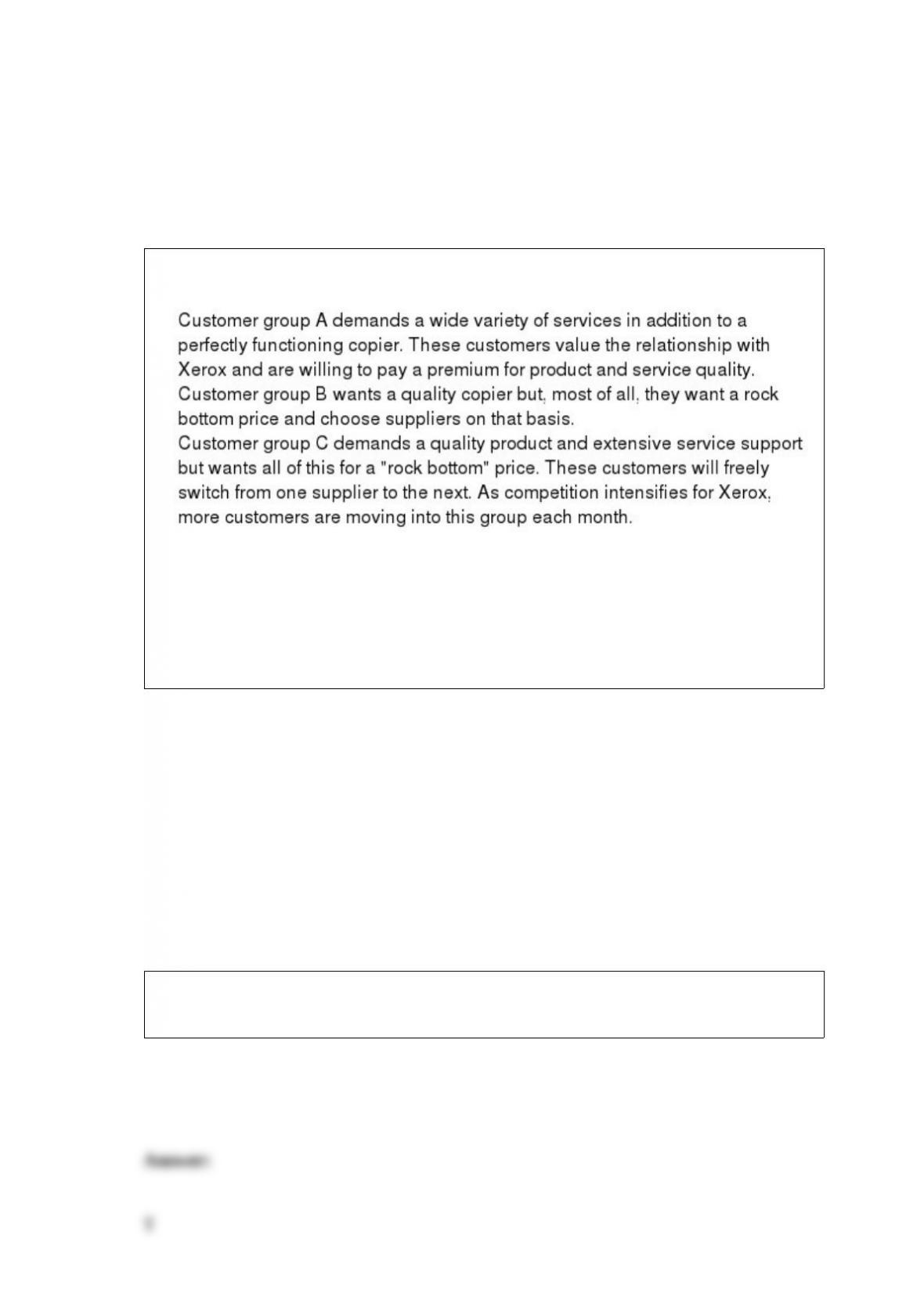
Xerox serves a diverse set of customers in the business market.
First, describe how Xerox might develop a portfolio of relationship strategies to meet
the needs of such diverse customer groups. Second, some customers in each group are
more costly to serve than others. How should such cost differences be reflected in the
particular relationship strategies that Xerox follows? Third, what strategies can Xerox
follow to increase the switching costs of customers in Group B or Group C?
Answer:
n/a
Recent evidence suggests that firms that stumble in the SCM area are punished by the
stock market.

Proprietary items are industrial products that are offered only in certain configurations
and produced in anticipation of orders.
The higher the level of perceived risk in a buying situation, the lower the probability
that the organizational buying decision will be made by a group.
If the costs of each logistical activity are minimized, total logistical costs for the
enterprise will be minimized.