
Consider the two statements below with regard to focus group planning.
I. When planning for the number of groups to be held, it is generally unwise to hold
only one group per city.
II. The number of locations selected for a set of focus groups reflects the extent
to which it is believed that geographic differences affect salient attitudes and behaviors.
Which, if any, of these statements is (are) true?
A) I only
B) II only
C) I and II are both true
D) Neither I nor II are true
John works in the NewWave Advertising Agency research department. John has been
asked to design a very sophisticated research study using a design and questioning
technique with which he is unfamiliar. John is most likely to turn to a ________ for
assistance.
A) media consulting company
B) research specialist
C) field service
D) trade organization
E) research advocate

Consider the question shown below.
How many computers do you own?
0
1
2
3 or more
This question is ….
A) exhaustive but not exclusive
B) not exhaustive but exclusive
C) not exhaustive, not exclusive
D) exhaustive and exclusive
________ threats to internal validity refer to any events or influences beyond those of
the researcher that occur during the experiment and have the potential to affect the
experimental outcome.
A) Testing
B) Researcher bias
C) Premeasurement
D) Historical

E) Mortality
Consider the methods shown below. How many of these methods can be used to collect
information via surveys?
– telephone
– mail or paper, self-completed
– personal, face-to-face
– online
A) 1
B) 2
C) 3
D) 4
Only ________ samples allow you to determine the sample size required for a specified
degree of confidence.
A) snowball
B) nonprobability

C) probability
D) judgment
E) quota
The quality of a quantitative data analysis is generally most influenced by ________.
A) the skills of the analyst conducting the research
B) the absolute research budget
C) the quantity of transcribed pages
D) the extent of client involvement
E) the professional fee of the qualitative analyst
________ in a qualitative report indicate the extent to which members of the sample
agreed or disagreed with regard to a particular point.
A) Statistical findings
B) Summaries of consensus
C) Individual respondent comments

The text notes that the closer a copy testing methodology is to “real world” exposure,
the more accurately the results will reflect “real world” advertising performance and
consumer response. Which copy testing company’s methodology is closest to the “real
world.”
A) Gallup & Robinson
B) Mapes and Ross
Think about presenting the results of a segmentation study. A ________ can be created
for each individual segment. This document typically names a segment, provides a
picture of that segment’s typical member and then lists the key characteristics, values,
behaviors, and beliefs of the segment.
A) summary sheet
B) persona
C) narrative
D) spec sheet

The two statements below refer to the effective use of tables and charts.
I. It is appropriate for one table or chart to communicate multiple ideas.
II. One important criteria for evaluating the “goodness” of a chart is that it looks pretty.
Which, if any, of these statements is (are) true?
A) I only
B) II only
C) I and II are both true
D) Neither I nor II are true
________ campaign evaluation is common for advertising placed in media where
continuous data collection is possible. Data gathered in concurrent evaluations is
typically behavioral and is collected throughout the campaign.
A) Systematic
B) Tracking
C) Concurrent
D) Sequential
E) Multi-modal

Consider the two questions shown below.
I. What is your highest level of education?
High school or less
Some college or beyond
II. What is your highest level of education?
Less than high school
High school graduate
Some college
College degree or higher
Which, if any, is the preferred method for collecting information related to the
respondent’s education?
A) I is preferred over II
B) II is preferred over I
C) The questions are interchangable and either one can be used; neither is preferred
When presented with the option of collecting respondents’ age on either the nominal or
ratio level of measurement, a researcher should collect the data on the ________ level.
A) nominal
B) ratio

Which form of random sampling works best when the target population is not
homogeneous with respect to what is being measured?
A) simple
B) systematic
C) stratified
D) snowball
E) judgment
________ threats to internal validity occur whenever, at the start of the experiment, the
test and control groups differ in terms of relevant demographics, attitudes, or behaviors.
A) Testing
B) Mortality
C) Researcher bias
D) Selection
E) Premeasurement
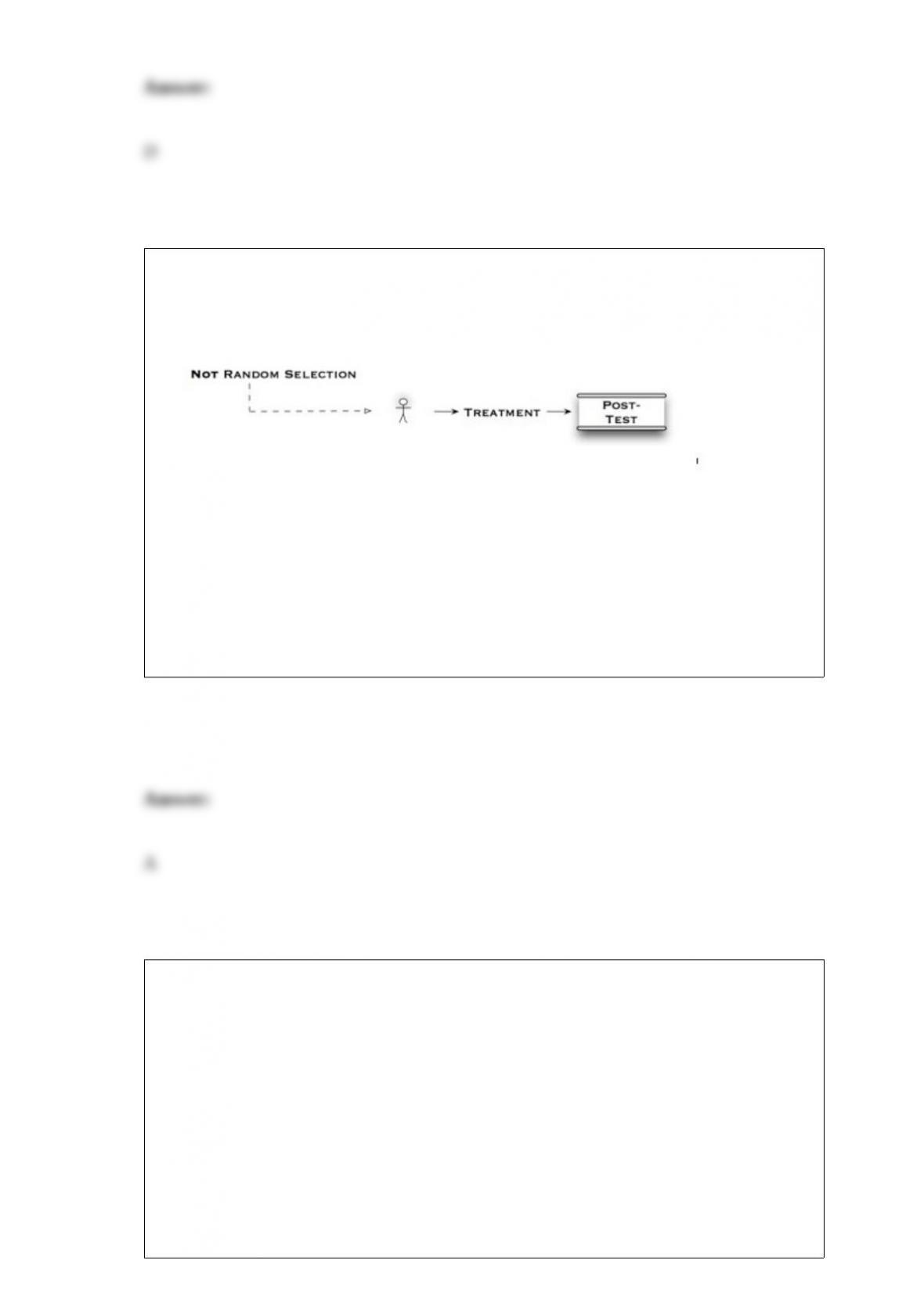
The diagram shown below illustrates what type of experimental design?
A) quasi-experimental: one group post-test only
B) quasi-experimental: one group pretest to post-test
C) experimental: one group post-test only
D) experimental: simulated pretest to post-test
With regard to target audience definitions, the text notes that populations of individuals
are typically defined in some combination of ________, geographic and behavioral
characteristics.
A) geoattitudinal
B) geopsychographic
C) demographic
D) physiological

E) democratic
You want to compare a sample average to a population average. There are 25 people in
the sample. You would use a ________ to determine statistical significance.
A) t-test
B) r-test
C) stat-test
D) Z-test
In which type of sample does each individual, household, or item in the target universe
have an equal chance of being selected for participation in the research?
A) Probability
B) Snowball
C) Quota
D) Nonprobability
E) Judgment

________ observation uses a researcher to observe other people’s behaviors. All of the
data is collected by a(n) ________ observer.
A) Regulated
B) Human
C) Automated
D) Biometric
Ford always asks consumers “Is Ford a quality vehicle?” after seeing a Ford
commercial. The proportion saying “yes” is then compared to the proportion saying
“yes” in the population of all Ford commercials. In order to determine statistical
significance, a ________ would be used.
A) g-test
B) stat-test
C) Z-test
D) r-test

Consider the question shown below.
What is your gender?
Male (1)
Female (2)
The data coding in this question reflects the researcher’s belief that men are superior to
women.
A) True
B) False
The text describes Peter’s pizza experiment. In this experiment the amount of water was
the ________ variable.
A) dependent
B) independent
C) causative
D) categorical

The two statements below refer to questionnaire organization.
I. When thinking about the main body of questions in a questionnaire, it is always best
to get the hardest questions out of the way first.
II. When thinking about the main body of questions in a questionnaire, all of
the questions on the same topic should be grouped together.
Which, if any, of these statements is (are) true?
A) I only
B) II only
C) I and II are both true
D) Neither I nor II are true
Which brain monitoring technique can pinpoint the specific areas being activated
during exposure to an ad or other stimulus?
A) EEG
B) fMRI

The two statements below refer to a questionnaire screener.
I. The primary function of a screener is to distinguish between those who should be
included in the research from those who should not be included.
II. The end result of the screener is an invitation to participate in the research for all
those who qualify.
Which, if any, of these statements is (are) true?
A) I only
B) II only
C) I and II are both true
D) Neither I nor II are true
The following two statements refer to online questionnaires.
I. When using an open-ended question on an online questionnaire, the length of a
respondent’s answer is generally unrelated to the size of the space provided for typing
the answer.
II. With regard to online questionnaires, there is a significant relationship between how
input boxes are labeled and the quality of data provided.
Which, if any, of these statements is (are) true?
A) I only
B) II only
C) I and II are both true
D) Neither I nor II are true

A concept or communication test begins with ________.
A) an explanation of the task and stimulus materials
B) payment of the incentive
C) identification of the research sponsor
D) the collection of information regarding respondents’ media habits
E) the collection of information regarding respondents’ attitudes toward advertising
What type of measure collects the data used to create a perceptual map?
A) multiple choice questions
B) dichotomous questions
C) rating scale
D) constant sum questions
E) semantic differential