
A need that moves an individual to action is a(n) __________.
a. drive
b. cue
c. attitude
d. response
e. reinforcement
Answer:
Intermediaries that work for several producers and carry noncompetitive,
complementary merchandise in an exclusive territory are referred to as__________.
a. selling agents
b. line brokers
c. distribution brokers
d. manufacturer’s agents
e. brokers
Answer:
A gray market refers to
a. the segment of products specifically designed for the need of older buyers.
b. a situation where products are sold through unauthorized channels of distribution.
c. a once active and powerful market that is rapidly becoming the bottom of the barrel.
d. a pricing structure that is based upon “haggling” that is considered acceptable in
some countries but not others.
e. the willingness of one party to accept “gifts” in exchange for better prices or price
allowances.
Answer:
Most of the 1.1 million retail establishments in the United States including hardware
stores, convenience stores, clothing stores, and computer and software stores are owned
by __________.
a. corporate chains
b. contractual systems
c. independent retailers
d. conglomerate
e. multinationals
Answer:
A direct channel is when
a. producers and end-users deal with each other on a one-on-one basis.
b. the producer and consumer and perform numerous channel functions.
c. a firm reaches different buyers by employing two or more different types of channels
for the same basic product.
d. an intermediary sells to other intermediaries, usually to retailers in consumer
markets.
e. an agent or broker brings ultimate consumers to manufacturers.
Answer:
Toro decided to augment its traditional hardware retail distribution channel by also
selling through mass merchandisers, such as Walmart and Target, and set prices for its
products substantially below those for its traditional hardware outlets. As a result, many
hardware stores abandoned Toro products in favor of other manufacturers. This is an
example of a firm failing to consider __________ effects when setting its final list or
quoted price.
a. company
b. social responsibility
c. regulatory
d. competitive
e. customer
Answer:
Formulating the sales plan involves three tasks: (1) setting objectives; (2) organizing the
salesforce; and (3) __________.
a. hiring sales reps
b. developing the marketing plan
c. establishing the budget
d. developing account management policies
e. identifying qualified leads
Answer:
Often companies must choose between a responsive supply chain and an efficient
supply chain. This decision is based on __________.
a. the specific needs of customer segments
b. monetary considerations
c. supplier alternatives
d. the business mission
e. a lack of an appropriate channel captain
Answer:
When Toysmart.com filed for bankruptcy in June 2000, it listed its customer database
as one of its assets even though it had assured its customers it would never disclose
their information to any third party. People who had purchased products from Toysmart
and were a part of its database were upset when they learned their private information
was being treated as property that was for sale. These customers believed that according
to the Consumer Bill of Rights, they should know how their private information would
be used. In other words, Toysmart’s former customers had a right to
a. choose.
b. be informed.
c. be heard.
d. safety.
e. happiness.
Answer:
As traditional media have become more expensive and cluttered, advertisers have been
attracted to a variety of nontraditional advertising optionsin airports, doctors’ offices,
health clubs, or theaters, which are referred to as __________.
a. remote media
b. electronic advertising
c. product placements
d. cooperative advertising
e. place-based media
Answer:
The first step a nonprofit organization should take to engage people with social media is
to __________.
a. set specific measurable goals
b. understand what motivates people to take up causes
c. create a simple and realistic operating budget
d. create a well-defined organizational hierarchy
e. develop a unique selling proposition
Answer:
There are seven commonly used organizational buying criteria. One of them is
__________.
a. adherence to governmental policies
b. flexibility and adaptability
c. past performance on previous contracts
d. consumer demand
e. senior management directives
Answer:
Facts and figures that are newly collected for a project at hand are referred to as
a. statistical data.
b. empirical data.
c. secondary data.
d. primary data.
e. inferential data.
Answer:
When purchasing a computer, factors the consumer considers prior to purchase are
called __________, which represent both the objective attributes of a brand and the
subjective ones used to compare different products and brands.
a. hot buttons
b. informational alternatives
c. buying-decision choices
d. evaluative criteria
e. consumer attributes
Answer:

A researcher asked Kelly, as a subscriber to Fitness magazine, which ads she
remembered seeing in the most recent issue. Then Kelly was asked questions about the
content and appearance of the ads she remembered. The researcher was using
__________ to test the effectiveness of ads in the magazine.
a. inquiry testing
b. concept testing
c. portfolio testing
d. aided recall
e. unaided recall
Answer:
The stage of the new-product process that defines the strategic role for a new product in
terms of the firm’s overall objectives is referred to as __________.
a. distinctive competency determination
b. new-product strategy development
c. strategic marketing process
d. strategic management process
e. product protocol definition
Answer:
The Phillies segment their fans primarily upon what basis?
a. location
b. interests
c. promotion
d. age
e. income
Answer:
A geographical sales organization would NOT be the best structure if _____.
a. a firm is trying to reduce duplication of selling effort
b. a firm is trying to minimize travel time
c. a firm’s products or customers require specialized knowledge
d. different buyers have similar needs
e. there is a need to increase the number of salespersons in the salesforce
Answer:
Press conferences and image management are tools used by a firm’s __________
department.
a. advertising
b. sales promotion
c. direct marketing
d. public relations
e. personal selling
Answer:
Norma Adler works for Tyco Healthcare. Her job is to visit hospitals and meet with
staff to explain the equipment that Tyco manufactures for use in operating rooms.
Although Adler is part of her company’s salesforce, she does not directly solicit orders.
Adler is what type of salesperson?
a. an inside order taker
b. an outside order getter
c. a missionary salesperson
d. a sales engineer
e. a sales team coordinator
Answer:
Marketing information or data consists of secondary and primary data. Define each of
these types of marketing information. Give examples for secondary and primary data.
Answer:
According to a 2011 Federal Communications Commission report, AT&T, Verizon,
Sprint-Nextel, and T-Mobile control the vast majority of the subscribers in the U.S.
wireless mobile phone market. Which form of competition characterizes this market?
a. pure competition
b. limited competition
c. a monopoly
d. an oligopoly
e. monopolistic competition
Answer:
Consumer behavior includes the actions a person takes in purchasing services and using
products and services, including
a. the mental and physical processes that come before and after these actions.
b. the financial and psychological processes that take place before and during these
actions.
c. the mental and social processes that come before and after these actions.
d. the financial and emotional processes that take place before and after these actions.
e. the cognitive and attitudinal processes that take place before, during, and after these
actions.
Answer:
Products that usually last over many uses, such as cars and appliances, are referred to as
a. endurable goods.
b. nondisposable goods.
c. imperishable goods.
d. reliable products.
e. durable goods.
Answer:
All of the following are names the BCG has given to describe the four quadrants in its
growth-share matrix EXCEPT:
a. dogs.
b. stars.
c. question marks.
d. cash cows.
e. hedgehogs.
Answer:
New Balance Athletic Shoes, Inc. claimed its shoes were “made in the USA” when
actually the shoe soles and most of the uppers were made in China. The shoes were
assembled in the United States. The Federal Trade Commission did not think that
assembling the shoes in the United States was enough to use the “made in the USA”
logo. New Balance actually used
a. direct exporting.
b. indirect exporting.
c. a joint venture.
d. contract manufacturing.
e. contract assembly.
Answer:
Physically moving a product to customers would be an example of a __________
function.
a. transactional
b. logistical
c. facilitating
d. selling
e. risk taking
Answer:
Kroger required that Birds Eye pay $15,000 to get its new Vegetable Quinoa Pilaf
placed in the frozen vegetable freezer section of its supermarkets. This payment is an
example of a
a. product placement fee.
b. bribe.
c. product support fee.
d. slotting fee.
e. shelf space allowance.
Answer:
Figure 1.
According to Figure 1. above, market share reaches its highest level during which stage
of the retail life cycle?
a. none
b. “A”
c. “B”
d. “C”
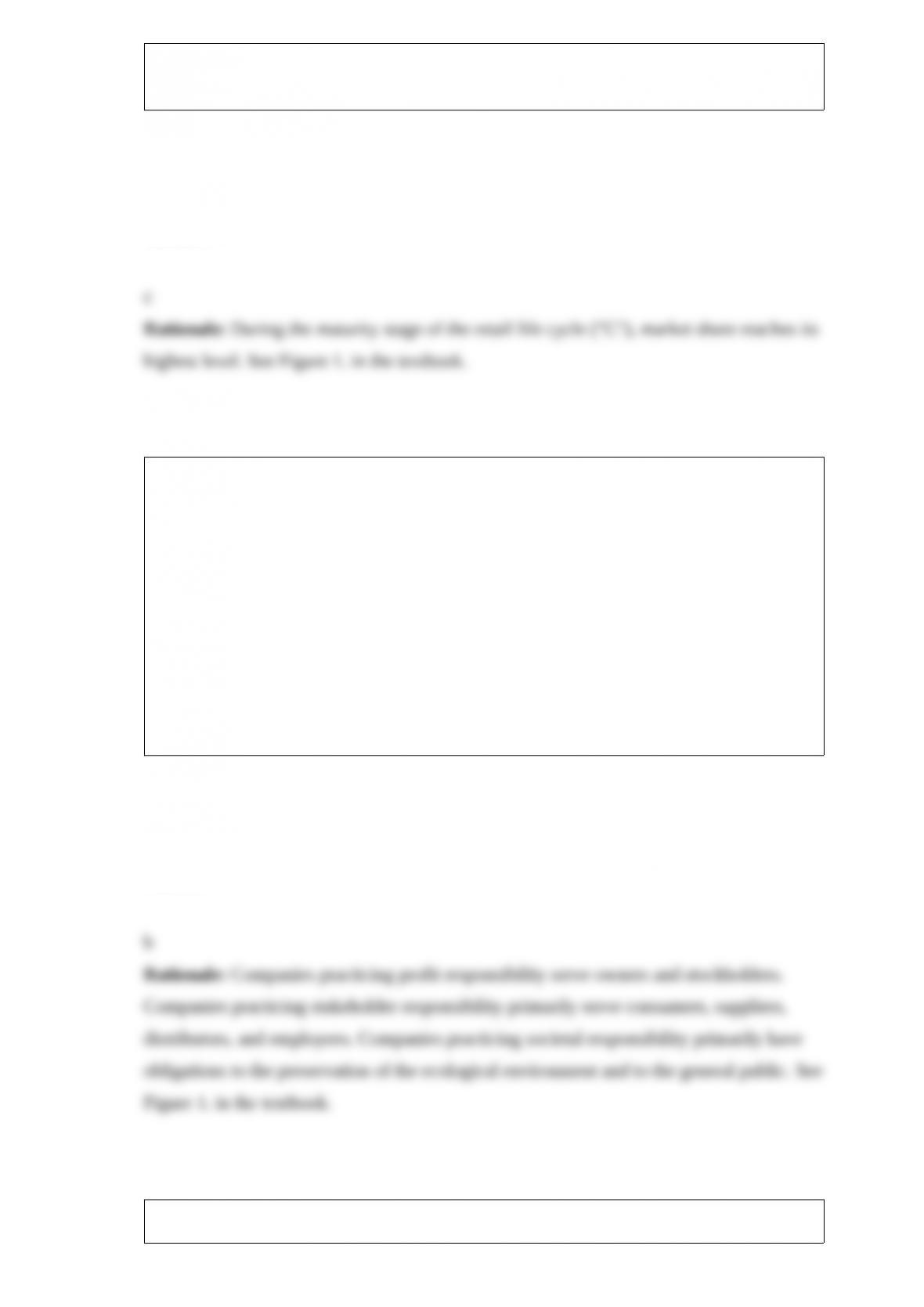
e. “D”
Answer:
The groups primarily served by a firm exhibiting stakeholder responsibility include
a. the general public, public interest groups, and the environment.
b. consumers, employees, and supplier/distributors.
c. owners and stockholders.
d. the general public, owners, and stockholders.
e. government, owners, and stockholders.
Answer:
Which type of store gives shoppers the greatest variety of merchandise?
a. a hypermarket
b. a specialty clothing store
c. a limited-line gift store
d. a clothing outlet
e. a discount store
Answer:
A negative aspect of selecting unit volume as a pricing objective is that
a. production often cannot keep up with demand.
b. there are increased carrying costs with extensive inventories.
c. if price reductions are used to achieve volume objectives, it can sometimes come at
the expense of profits.
d. it can create competition between divisions within the organization itself causing
conflicts over the allocation of resources.
e. it always positively correlates with a sales revenue objective.
Answer:
Which of the following quotes from a new product adopter would signal the need for a
firm to counteract a usage barrier?
a. “But it might make me fat.”
b. “What if I can”t make the monthly payments?”
c. “I don”t want to try this if it means I have to swallow it with milk.”
d. “Big deal, the only difference is the shape of the package.”
e. “Sure I”ll try it; why not!”
Answer:
Obtaining primary and secondary data would take place during which stage of the
five-step marketing research approach?
a. collect relevant information
b. develop the research plan
c. develop findings
d. take marketing actions
e. define the problem
Answer:
Explain what online companies are doing to address consumer worries about privacy
and security when shopping online.
Answer:
What are the three types of organizational buying situations or buy classes? Give an
example of each.
Answer:
What does lifestyle mean and why is it important to marketers?
Answer:
What role do people play in the managing of services? In answering the question,
discuss the concept of customer experience management (CEM).
Answer:
Describe the three components of competition.
Answer:
During the presentation stage, a salesperson may encounter objections. What are the six
basic techniques for handling objections?
Answer:
Discuss the ethics of salespeople asking their customers for information about such
things as the pricing and promotion strategies of the salespeople’s competitors.
Answer:
Psychologists point out that an individual’s needs may be hierarchical; that is, once one
set of needs is met, people seek to satisfy the next set of needs in the hierarchy. Name
each of the five levels in the hierarchy in order and give an example of each.
Answer:
Why are you, as a student, already somewhat of a marketing expert before taking this
course? Provide a specific example from your own personal experience and relate it to
something you just “formally” learned about marketing.
Answer:
What factors contributed to changes in attitudes of women during the past thirty years?
Answer:
Explain the role of missionary salespeople and sales engineers in the selling process.
Answer:
List the seven guidelines for developing effective plans and planning.
Answer:
List the six guidelines for improving implementation of marketing programs.
Answer:
Discuss the differences between traditional print media and social media with regard to
expense and access, permanence and credibility, and social authority.
Answer:
Explain the difference between consumer products and business products. Why are
some products difficult to categorize as one or the other? Give an example of a business
product, a consumer product, and a product that is difficult to categorize.
Answer:
List four of the eight demand-oriented approaches to selecting an approximate price
level and define what they are.
Answer:
What are the five most common deceptive pricing practices? Give an example of each
one.
Answer:
What are the four general bases that are used to segment consumer markets?
Answer:
What is the difference between a contest and a sweepstakes?
Answer:
List and briefly define the four forms of institutional advertising.
Answer: