
Which of the following is a category of secondary stakeholders?
a. Customers
b. Managers
c. Mass media
d. Suppliers
e. Regulating agencies
The cognitive process in which active concepts frame thoughts and therefore affect both
value and meaning is known as _____.
a. priming
b. signaling
c. prospecting
d. assimilating
e. positioning
_____ captures how much gratification a consumer receives from consumption.

a. Opportunity cost
b. Internal rate of return
c. Value
d. Emotional contagion
e. Sunk cost
The socialization process by which consumers’ behaviors slowly adapt to a culture
through a series of rewards and sanctions is known as _____.
a. modeling
b. renquing
c. diffusing
d. shaping
e. structuring
According to the psychoanalytic approach to personality, which of the following
focuses on pleasure-seeking and immediate gratification?
a. The id

b. The ego
c. The superego
d. The social self
e. The actual self
The first step in the perceptual process is called _____ and refers to the process of
bringing some stimulus within the proximity of a consumer so that it can be sensed by
one of the five human senses.
a. attention
b. exposure
c. comprehension
d. reaction
e. retention
Henry has a penchant for furniture. When he bought a new sofa, he focused on features
such as size, fabric, cushions, and padding, and ignored any information irrelevant to
the actual purchase. Which of the following factors contributed to Henry’s selection of
the sofa?

a. Social influences
b. Online resources
c. Product knowledge
d. Situational influences
e. Financial concerns
Which of the following elements in the attribution theory refers to judgments of who is
responsible for an event?
a. Locus
b. Control
c. Stability
d. Consistency
e. Reliability
The number of firms competing for business within a specific category is called
competitive _____.
a. density
b. intensity
c. inertia
d. concentration
e. share
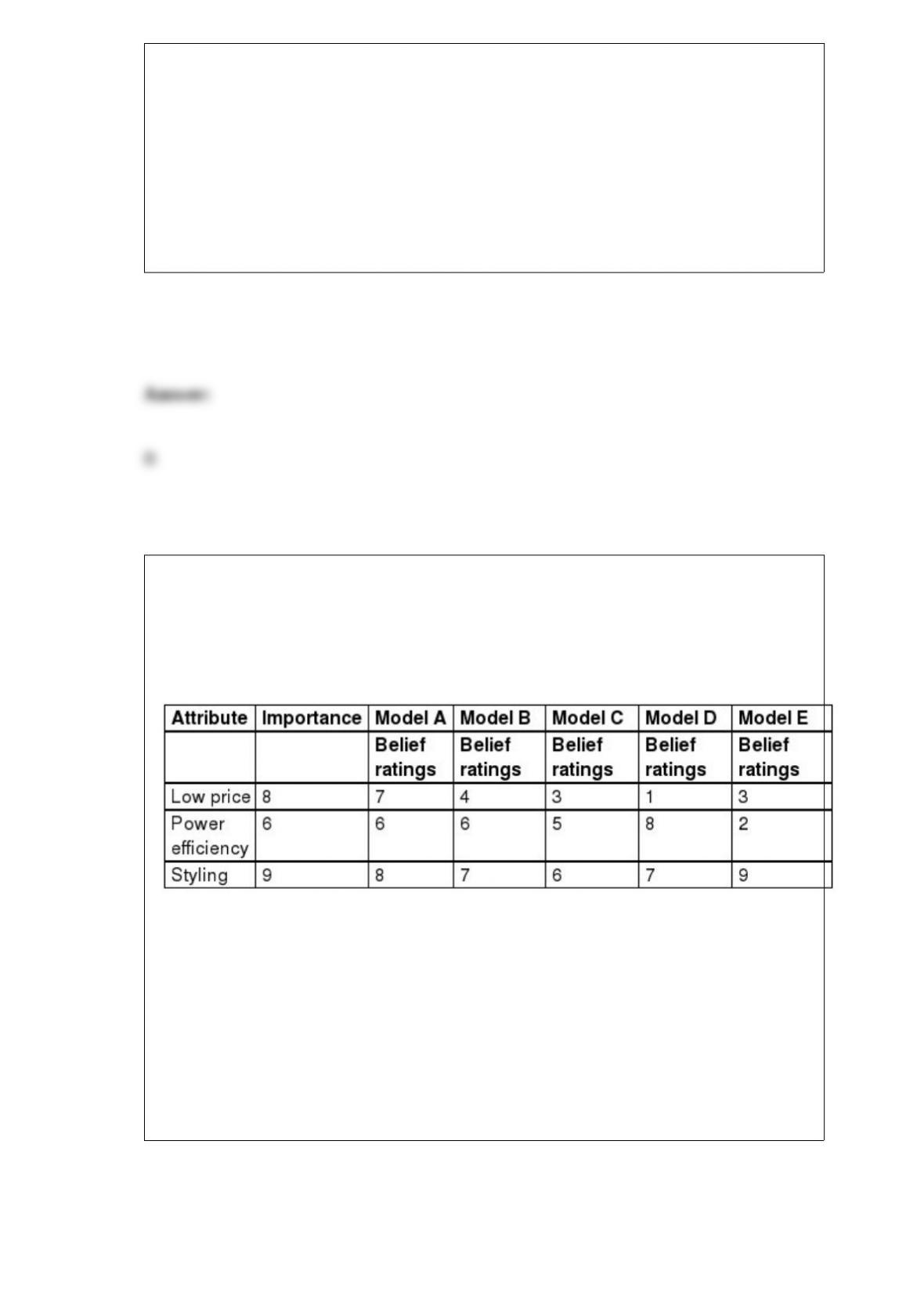
Melissa wants to buy a new hair dryer. She considers five models and assigns them
belief ratings from 1= very poor to 10= very good and importance ratings from 10=
most important to 1=least important. She sets a mental cutoff of 5 in order for the model
to be selected. According to the conjunctive rule, which of the following models would
she select?
a. Model A
b. Model B
c. Model C
d. Model D
e. Model E

Which orientation refers to a way of doing business in which the actions and decision
making of the institution prioritize consumer value and satisfaction above all other
concerns?
a. Product orientation
b. Production orientation
c. Consumer orientation
d. Sales orientation
e. Benefit orientation
The extent to which one continues processing a message even after he/she develops an
initial understanding in the comprehension stage is known as _____.
a. activation
b. elaboration
c. rumination
d. association
e. assimilation

Henry met an old friend, a fitness enthusiast, at his high school reunion. The friend
convinced him of the long-term health benefits of following a fitness regimen.
Following this interaction, he registered for a membership in the neighborhood fitness
center, a move Henry had deliberately avoided in the past. This change in Henry’s
behavior can be attributed to _____.
a. sensitization
b. cognition
c. habituation
d. learning
e. distortion
Which of the following is true about the consumer decision-making process?
a. Consumers always proceed through the activities in the decision-making process in a
sequential fashion.
b. Consumers always complete the decision-making process once it is initiated.
c. Consumers’ decision-making processes don”t always involve a tangible product.
d. Consumers’ decision-making processes operate independently of any value
perceptions.
e. Consumers’ decision making doesn”t always involve choices linked to value.

Consumers do not view all types of coffee as identical to one another. Some prefer iced
coffee, while others will only drink non-fat latte. Still others will only drink chai latte or
a cappuccino. This marketplace condition in which consumers do not view all
competing products as identical to one another is called _____.
a. product differentiation
b. product variation
c. market segmentation
d. perceptual differentiation
e. selective perception
_____ reflects the connectedness between a consumer and a retailer, a brand, or service
provider.
a. Hedonic value
b. Interconnectivity
c. Synergy
d. Consumption
e. Relationship quality

When Gemma attended her high school reunion after a gap of fourteen years, she
decided to wear an expensive designer dress even though a dress she bought at a sale
was much more flattering. Gemma wanted to make a fashion statement and also wanted
the dress to reflect her successful career as an editor for a well-known fashion
magazine. Which of the following criteria is most likely responsible for Gemma’s
choice of dress?
a. Relative criteria
b. Rational criteria
c. Hedonic criteria
d. Egalitarian criteria
e. Utilitarian criteria
_____ motivation involves a drive to experience something personally gratifying.
a. Utilitarian
b. Preventive
c. Homeostatic
d. Physiological
e. Hedonic

Before information can be stored in the long-term memory, all stimuli are converted to
meaning that can be expressed verbally. This process of converting stimuli is known as
_____.
a. semantic coding
b. meaningful encoding
c. dual coding
d. response generation
e. cognitive interference
Contrary to recommendations by consumer credit counselors, most consumers don”t
keep written track of their purchases, relying instead on their memories to keep track of
the expenditures. This is an example of _____ budgeting.
a. performance-based
b. formal
c. programmed
d. participatory
e. mental

Kenneth enrolled in a graduate school to study entrepreneurship because he wanted to
become a successful entrepreneur and start his own business venture in a few years’
time. Which of the following types of self-concepts played the greatest role in
Kenneth’s decision to enroll in graduate school?
a. Actual self
b. Social self
c. Ideal social self
d. Extended self
e. Possible self
The process by which continuous exposure to a stimulus affects the comprehension of
and response to the stimulus is known as _____.
a. lateralization
b. stimulation
c. expectation
d. sensitization
e. habituation

Cognitive psychology differs from social psychology in that cognitive psychology:
a. focuses on the thoughts, feelings, and behaviors that people have as they interact with
other people.
b. focuses exclusively on group interactions and group behavior.
c. applies psychological principles and research methods to the work place in the
interest of improving productivity and the quality of work life.
d. deals with the intricacies of mental reactions involved in information processing.
e. focuses on the psychological development of the human being that takes place
throughout life.
Postconsumption cognitions lead to an affective reaction most conventionally
represented by consumer _____.
a. confirmation or disconfirmation
b. association or disassociation
c. excitement or ignorance
d. satisfaction or dissatisfaction
e. agreement or disagreement

According to the famous psychologist _____, human behavior is influenced by an inner
struggle between various systems within the personality system. This approach is
commonly referred to as the psychoanalytic approach to personality.
a. B. F. Skinner
b. Ivan Pavlov
c. Abraham Maslow
d. Sigmund Freud
e. Karl Jung
Underlying attributes of a product are referred to as _____ qualities.
a. search
b. perceptual
c. consumption
d. pre-purchase
e. experience

Which of the following is true ofsensory memory?
a. It has limited capacity.
b. It has unlimited duration.
c. It is considered to be preattentive.
d. It uses semantic coding to store information.
e. It uses the same distinctive mechanism for different sensory information.
Brain dominance refers to the phenomenon of hemispheric _____.
a. infarction
b. lateralization
c. synchronization
d. specialization
e. adaptation

The extent to which consumers join groups to express their own closely held beliefs is
called _____ influence of groups.
a. utilitarian
b. normative social
c. hedonic
d. informational
e. value-expressive
Which of the following types of cognitive appraisals considers how something turned
out relative to one’s goals and can evoke emotions like joyfulness, satisfaction, sadness,
or pride?
a. Anticipation appraisal
b. Agency appraisal
c. Equity appraisal
d. Outcomes appraisal
e. Introspective appraisal

A group in which a consumer desires to become a member is called a(n) _____ group.
a. abstained
b. tangential
c. aspirational
d. dissociative
e. evading
Mary thinks of herself as a warm, caring person. She is happy and content with her life
and believes that others enjoy her company. These thoughts and feelings that Mary has
about herself comprise her _____.
a. body esteem
b. self-congruence
c. demographic features
d. need for cognition
e. self-concept

GOURMET RESTAURANT SCENARIO
Stella works for a publishing house in Midtown Manhattan. When her company
relocated her to a new city for six months, she had a tough time. She loves Italian food,
but couldn”t find herself a decent Italian gourmet restaurant in the city. When she
finally found one, Olive’s, she started eating there regularly. The food at Olive’s was not
satisfactory and nothing compared to the menu Stella was used to at fancy Italian
restaurants in Midtown Manhattan. However, Stella found the staff at Olive’s friendly
and believed that they could understand her preferences in food and wine. When her
colleagues heard her predicament, they suggested a place she might like but Stella
decided against it as it was a three-hour drive from where she stays. She wished the six
months will end soon and she would visit Italia, her favorite restaurant in Manhattan,
again. Stella vows that after the completion of six months, she is never going to come
back at Olive’s.
Refer to Gourmet Restaurant Scenario. When Stella’s colleagues heard her predicament,
they suggested a place she might like. However, Stella decided against it as it was a
three-hour drive from where she stays and continued eating at Olive’s. Which of the
following types of switching costs does this represent?
a. Transactional switching cost
b. Temporal switching cost
c. Financial switching cost
d. Procedural switching cost
e. Relational switching cost
The basic premise of _____ is that consumers are motivated to maintain perceived
consistency in the relations found in mental systems.
a. balance theory
b. changing schema-based affect
c. behavioral influence theory
d. social judgment theory
e. elaboration likelihood model
Explain how the behavioral intentions model differs from the attitude-toward-the-object
(ATO) model.
With elaboration, increased information is retrieved from long-term memory and
attached to the new information and understanding.
Rumination is the process by which continuous exposure to a stimulus affects the
comprehension of and response to some stimulus.
The term temporal factor refers to situational characteristics related to time.
Persuasion refers to specific attempts to change attitudes.
Consumers seem to be most receptive to an employee with a matching mood rather than
to an employee who always has a positive mood.
As the length of time between attitude measurement and overt behavior grows, the
predictive ability of attitudinal models strengthens.
Divergence refers to the phenomenon in which consumers choose membership in
microcultures in an effort to stand out or define themselves from the crowd.
According to the PAD approach, when consumers feel greater control, situational
influences play a greater role in shaping their behavior.
Analysis of typical consumer responses to a direct, global measure scale indicates that
the data are right skewed.
Positive word-of-mouth generally has a more widespread influence than negative
word-of-mouth.

When a consumer faces a situation involving conflicting expectations based on cultural
expectations, he or she is experiencing role conflict.
Media acts as an agent of enculturation.
A loyalty card/program is a device that keeps track of the amount of purchasing a
consumer has had with a given marketer and once some level is reached, a reward is
offered usually in terms of future purchase incentives.
While deciding between two alternatives, if information about some attributes is not
available, consumers tend to weigh the criteria that are common to both alternatives
quite heavily in the evaluation.
Describe the two basic approaches for studying consumer behavior. Give examples of
the different situations for which each type is better suited.